By Ilane Tall · Updated August 17, 2026 · Research-based.
Reader-supported: we may earn a commission when you buy through the links on this page, at no additional cost to you. It never changes which product we recommend. Prices quoted below were correct at the time of writing and move often.
The short version
Whatever number is printed on the box, plan on getting roughly 70–80% of it in practice — the rest is Bordeaux-bottle optimism. Buy for where your collection will be in a year, not where it is today; the most common regret in this category is a unit that was exactly right the week it arrived.
Size by habit, not ambition: a case-a-month household needs meaningfully more capacity than a weekly-glass household, and a real collection being laid down needs a different category of unit entirely — see size by household below.
And before you fall for a number, check the box the fridge has to fit in. A 15-inch or 24-inch cabinet opening is a harder constraint than any bottle count.
Why the number on the box is a Bordeaux number
Every wine fridge on the market is rated using the same convention: a standard 750ml Bordeaux bottle, roughly 3 inches in diameter with straight sides and square shoulders, packed nose-to-tail with no wasted space between rows. That bottle shape stacks with almost no dead air, which is exactly why manufacturers use it — it produces the highest number they can honestly print.
Almost nobody's cellar is entirely Bordeaux bottles. Burgundy and Pinot Noir come in a wider, more sloped bottle that eats extra width per row. Champagne and other sparkling wine uses thicker glass to survive internal pressure, plus a wider punt at the base, so a rack built for slim bottles often only takes a Champagne bottle every other slot. Rhone blends and a fair number of New World reds ship in heavier, higher-shouldered glass for the same reason producers do everything else in that region: it looks substantial on a shelf.
The effect compounds. A shelf designed to hold seven slim bottles side by side might hold six wider ones, or five if a couple have a pronounced shoulder that catches on the shelf above. Multiply that shortfall across every shelf and a fridge rated for 45 bottles can feel full at 34 or 35 the moment your case includes a run of Pinot and a bottle of Champagne someone gave you.
This isn't a flaw in any specific model — it's true of the entire category, regardless of price. The number on the box tells you the physical volume of the cabinet, expressed in the most flattering possible units. It does not tell you how many of your actual bottles will fit.
The 70–80% planning rule, and how to measure your own shelf
The practical fix is simple: treat the advertised capacity as a ceiling, not a target. Plan around 70–80% of the printed number for a mixed cellar — 70% if you buy a lot of Burgundy, Champagne, or heavy New World reds; closer to 80% if your collection leans Bordeaux-style Cabernet and Merlot, which is the shape the racks were designed around in the first place.
Concretely: a fridge rated for 25 bottles should be shopped as an 18-to-20-bottle fridge for a mixed case. A 45-bottle unit is a realistic 32-to-36-bottle unit. A 100-bottle unit — the size where manufacturers usually quote two figures, one with a display shelf installed and one without — should be planned around 70-to-80 bottles of your actual mix, not the round number in the listing headline.
To check this against your own bottles rather than a generic assumption, measure before you buy. Take three bottles you actually own — a straight-sided one, a wide-shouldered one, and a sparkling bottle if you keep any — and measure the diameter at the widest point, usually the shoulder rather than the base. Most listings publish external cabinet dimensions but rarely a per-shelf interior depth, so the practical approach is to count the rows visible in the listing's interior photos and compare that spacing against your own bottle widths rather than trust the headline count. None of the units in this guide publish a shelf-by-shelf depth figure — normal for the category, and worth asking the seller about directly if precise fit matters to you.
The quick gut-check: if more than a third of what you buy is Burgundy-shaped, Champagne, or heavy-glass New World red, round the advertised capacity down by a quarter before you compare units on a per-bottle basis. It will save you from buying a fridge that's already tight the week it arrives.
How fast a collection actually grows
The second reason buyers end up undersized has nothing to do with bottle shape — it's a straightforward failure to project forward. Most people buy their first wine fridge to solve a problem that exists today: a handful of bottles crowding the kitchen fridge, or a gift that needs somewhere cooler than the counter. They size the purchase to that problem, not to the collection that follows.
Collections grow faster than intended for a few predictable reasons. A wine club shipment lands six or twelve bottles at once, all in the same week. Holiday sales and case discounts encourage buying by the dozen rather than the bottle. Restaurant recommendations and gifts arrive unplanned and don't get drunk on schedule — they get stored "for later," and later keeps slipping. And once a household has a working wine fridge at all, the barrier to buying "just one more case" quietly disappears, because there's now visibly somewhere to put it.
The pattern that shows up again and again is a small unit — 12 to 18 bottles — bought to solve an immediate storage problem, full within two or three months, and replaced within the year by something two or three times the size. The second purchase is the one that gets the size decision right, because by then the household has real data: how many bottles come in per month, how many go out, and how lopsided the mix is toward reds, whites, or sparkling. The first purchase rarely has that information, which is exactly why it undersizes.
The practical takeaway isn't "always buy the biggest fridge you can afford" — it's to make an honest estimate of inflow before you buy, using the household categories below, and size for roughly a year of that inflow rather than what's sitting on the counter today.
Size by household: a case a month, a weekly drinker, a real collection
Six real products, matched to six different consumption patterns. Capacity figures below are the manufacturer's; treat them with the 70–80% rule above where a bottle count is given, and note that a couple of the smaller units here don't publish a bottle count at all — for those, size is stated the way the manufacturer states it, in liters or by inches, rather than guessed.
01One bottle at a time
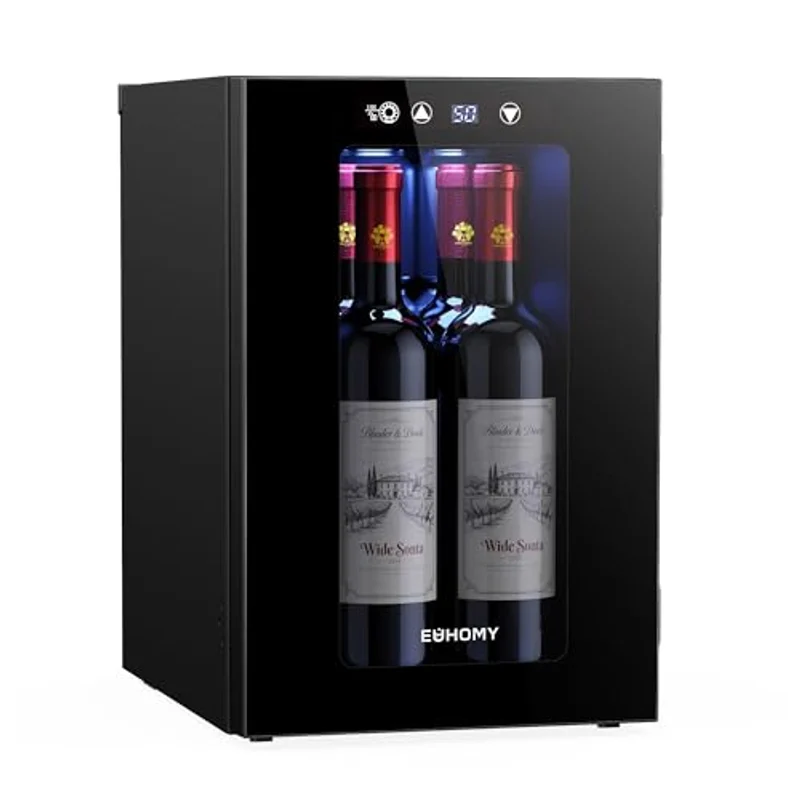
EUHOMY 18L Wine Fridge Mini Fridge
The occasional glass, not a collection
18 L·Flat shelf·Freestanding, countertop
Sized in liters rather than bottles, which is the honest way to describe a compact countertop cooler like this one — built to keep whatever you're currently working through cold and ready, not to store a growing case. Right for a desk, a small kitchen counter, or a studio apartment where a full-size unit doesn't make sense.
Buy this to solve tonight's bottle, not next year's case.
02A weekly bottle
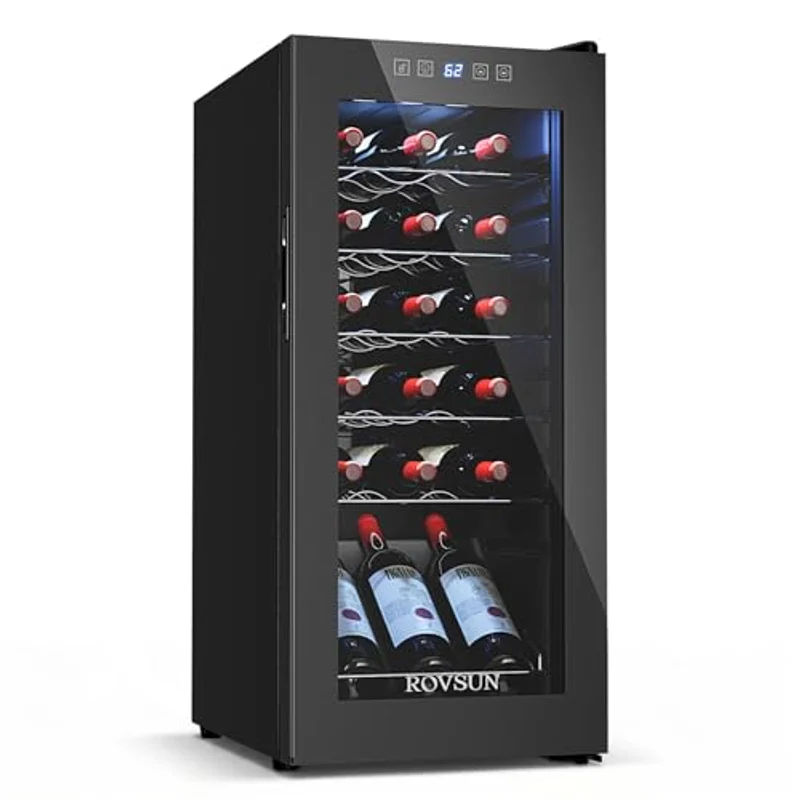
ROVSUN 18 Bottle Wine Fridge
Buys and drinks roughly in step
18 bottles·Digital temperature control·Freestanding
Eighteen bottles on the label is realistically 13 to 14 once you apply the 70–80% rule — enough for a household that opens roughly a bottle a week and replaces it not long after, without much of a standing reserve. Inflow and outflow are close enough that the fridge doesn't need headroom for a backlog.
Right-sized for steady drinking, not for stockpiling.
03A case a month
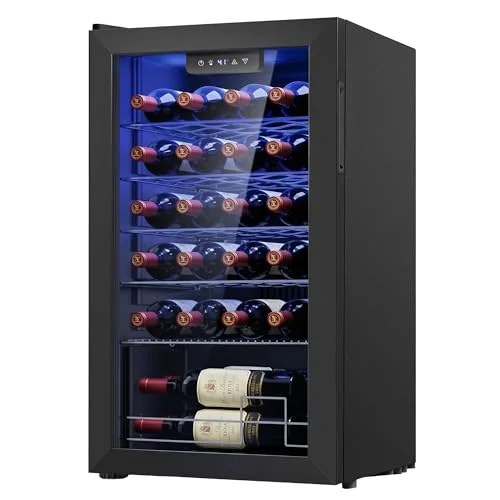
Icyglee 25 Bottle Wine Cooler Refrigerator
Building a small standing reserve
25 bottles·Freestanding
Twenty-five bottles nominal works out to roughly 18 to 20 in practice — the right range for a household buying a case a month and drinking through it more slowly than it arrives, with enough headroom for last month's case and this month's at once. This is also close to the size where the first-fridge undersizing pattern bites: comfortable today, tight within six months if buying keeps outpacing drinking.
The size where you should already be asking what comes next.
04Already outgrowing itself
Icyglee 45 Bottle Wine Cooler Refrigerator
A collection that's stopped being casual
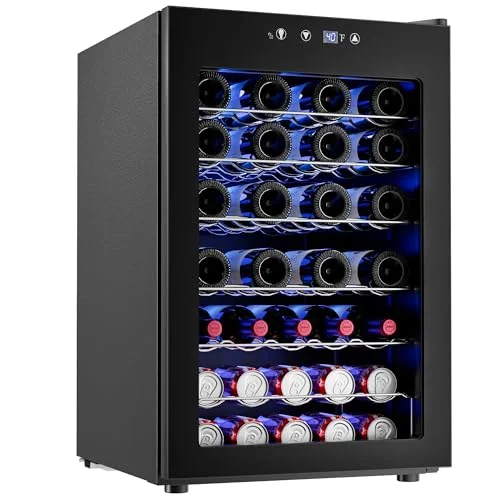
45 bottles·Freestanding
Forty-five nominal lands around 32 to 36 real bottles for a mixed case — roughly where a household graduates to once the smaller units above have run full a couple of months running, matching a year of case-a-month buying against a moderate drinking pace rather than the month or two a smaller unit covers.
Sized for the collection you'll have, not the one you have today.
05A real collection
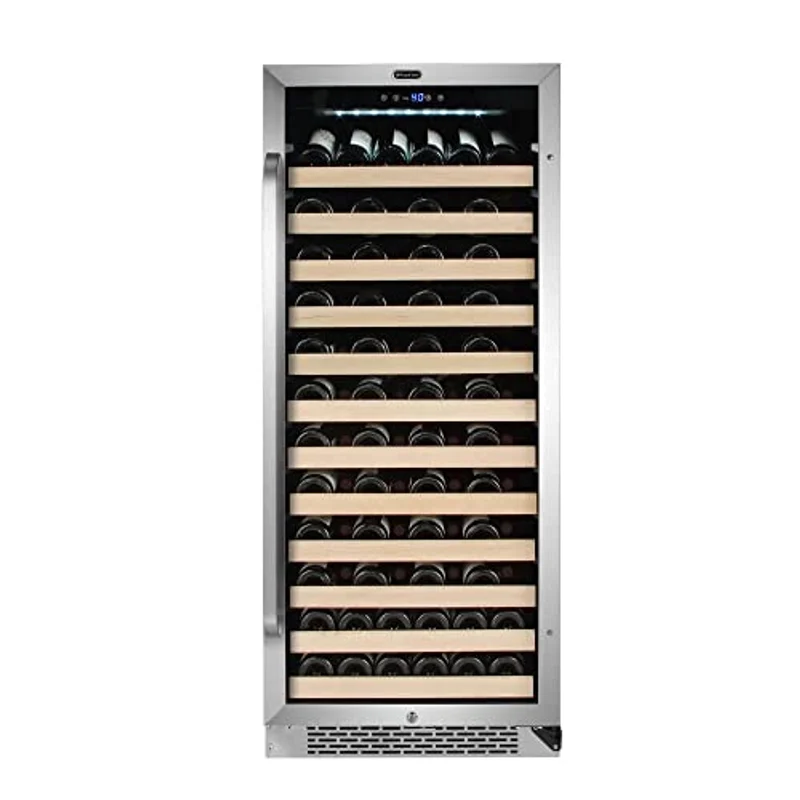
Whynter BWR-1002SD 100 Bottle
Laying bottles down, not just holding them
90 bottles·Built-in or freestanding
Whynter states 90 bottles with the display shelf fitted — the figure worth planning around, since the shelf is the practical way most owners configure it. Even before the 70–80% adjustment, that's several times the capacity of anything above, and it's the point where the purchase stops being about the next few months and starts being about years of storage: less restocking, more laying wine down and letting it be.
This is storage, not a rotating stock of what's for dinner this week.
06Committing to a cellar
BODEGA 24 Inch Wine Cooler
A real cellar in one cabinet
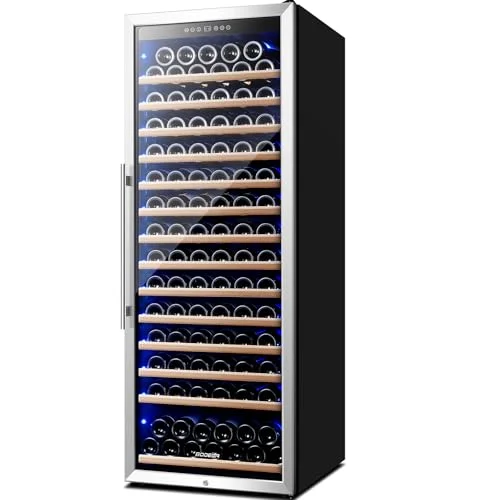
154 bottles·24 inch·Freestanding
At 154 bottles nominal, even a 70% adjustment leaves you well over 100 real bottles — a scale where the growth-rate math above stops mattering much, since the unit absorbs uneven inflow without running out of room. Here the stated 24-inch footprint becomes the binding constraint rather than bottle count: a cabinet this size needs a genuinely dedicated spot, not a corner of the kitchen.
The size you buy once you're certain, not while you're testing the habit.
Two of the growing-collection sizes above pair naturally with the dual-zone-versus-single-zone decision: once a collection is large and mixed enough to justify a second temperature zone, it's usually also large enough that the sizing questions on this page matter more than the zone count does. Get the capacity right first.
Bottle count is the number buyers fixate on, but it's rarely the number that actually stops a purchase from working. The physical footprint does that far more often, and it's worth checking before capacity.
Cabinet openings. If a wine fridge is going into existing cabinetry rather than standing freestanding in a room, the opening width is the hard constraint. Wine fridges built for cabinet installation are almost always sized to standard kitchen module widths — 15 inches for a single-appliance slot, 24 inches for a full module shared with other under-counter appliances. The BODEGA above is explicitly a 24-inch unit, which is the width to check your opening against for a built-in run. None of the smaller units in this guide are rated for enclosed installation — they're freestanding, which means airflow, not just width, decides whether they can go into a cabinet at all. That distinction is covered in full in built-in vs freestanding wine fridges; read it before you measure anything if the fridge is going under a counter.
Countertop height and clearance. A countertop unit like the EUHOMY needs headroom above it as well as footprint below — check the clearance under any overhead cabinet, since standard counter-to-cabinet gaps run tighter than people expect once an appliance is added to the counter. For a taller freestanding unit, check ceiling height and any sloped surfaces nearby, particularly under stairs or in converted closets — both popular spots and both prone to hidden height constraints.
Door swing clearance. Every freestanding unit needs room for its door to open fully in front of it, not just floor space for the cabinet. A narrow hallway or a spot wedged between an island and a wall can fit the fridge's footprint and still make it impossible to open the door or pull a shelf fully out. This matters more as capacity goes up — a 154-bottle unit has a taller, heavier door and shelves that need to slide out fully to load without bottles catching on the frame.
A wine fridge that's overheating because it's boxed in without ventilation shows the same early symptoms as one that's simply undersized — it runs constantly and never quite feels cold enough. Our wine fridge not cooling checklist works through airflow and placement issues before you assume a struggling unit has failed outright.
When a second small unit beats one big one — and when it doesn't
Once a household is weighing anything past the mid-size units above, the question shifts from "how big" to "one unit or two." Both are legitimate answers, and the right one depends on what's actually driving the purchase.
One large unit almost always wins on cost per bottle. Comparing the units above on stated capacity: the ROVSUN 18 Bottle at $179.99 works out to roughly $9 per bottle; the Icyglee 45 Bottle at $329.99 is about $6.20 per bottle; and the BODEGA 154 Bottle at $1,159.99 is about $6.50 per bottle — the largest unit here delivers capacity at close to the mid-size unit's per-bottle price, while a small starter unit costs noticeably more per bottle for far less total room. That's the ordinary economics of one compressor and cabinet serving more shelf space, rather than several appliances each paying for their own compressor and enclosure.
A second small unit earns its keep in three situations. First, mismatched locations: a countertop cooler in the kitchen for what's being served tonight, paired with a larger unit elsewhere for the standing collection, solves a convenience problem one central fridge doesn't. Second, redundancy: splitting a valuable collection across two units means a single compressor failure doesn't put the whole cellar at risk at once. Third, tight or awkward space: some rooms fit a countertop or 18-bottle unit but nowhere that fits a genuinely large cabinet, so two small footprints may be the only way to reach real capacity at all.
Outside those three cases, splitting the budget across two mid-size units instead of one larger one is usually the more expensive way to reach the same bottle count, and it doubles the compressors that can eventually need attention. If none of the three reasons apply to you, the arithmetic favors the single largest unit your space and budget support.
How we compared these — and what we can't tell you
We compared the manufacturers' own stated capacities, current listed prices, and stated dimensions where published, and applied the same 70–80% real-world adjustment across every unit rather than taking any listing's headline number at face value. Where a listing didn't include a size or capacity figure beyond what's in its title, we didn't estimate or invent one — that gap is noted in the product's entry above.
We do not run a testing lab. We do not own these units and we do not physically test them, so this guide won't tell you a bottle count we personally fit into any of them — only what the manufacturer states, and how far that number tends to drift from reality across the category. We also don't publish star ratings, review counts, or paraphrased owner sentiment here: that data isn't something we have for these products, and inventing it would be the same mistake as inventing a score.
Prices quoted here were correct at the time of writing and change frequently. Confirm the current price before buying.
Frequently asked questions
How many bottles will a wine fridge actually hold if it's rated for a certain number?
Plan on roughly 70–80% of the advertised figure for a mixed collection. The rating is calculated with slim, straight-sided Bordeaux bottles packed with no wasted space — Burgundy, Champagne, and heavy-shouldered bottles all take up more room per bottle, so a real cellar rarely reaches the printed number.
Should I buy a small wine fridge now or wait and buy a bigger one?
If you're already buying by the case or receiving regular shipments, buy for a year of that pace rather than for what's on the counter today. The most common regret in this category is a starter unit that's full within a few months, followed by a second, larger purchase that duplicates the first one's cost. Sizing up once, honestly, is usually cheaper than buying twice.
What's the standard width for a wine fridge that has to fit under a counter?
Built-in wine fridges are generally sized to standard kitchen module widths — 15 inches for a single-appliance slot, 24 inches for a full module. Always measure your actual cabinet opening before buying, and confirm the specific unit is rated for enclosed, built-in installation rather than freestanding use, since a freestanding unit boxed into cabinetry can overheat.
Is it better to buy one large wine fridge or two smaller ones?
One larger unit is almost always cheaper per bottle of capacity, since it spreads the cost of a single compressor and cabinet across more shelf space. Two smaller units make sense when you need appliances in two different locations, want redundancy so one compressor failure doesn't risk the whole collection, or the space you have doesn't fit one large cabinet anywhere.
Written by Ilane Tall. Research-based comparisons of published specifications, current prices and stated dimensions — we do not physically test these units and we do not publish invented scores.