Reader-supported: we may earn a commission when you buy through the links on this page, at no additional cost to you. Prices were correct at the time of writing and change often. This is general information about wine storage, not medical or safety advice.
Set it to 55°F for storage. Serve from 40°F to 65°F depending on the style.
If your wine fridge has one zone, 55°F (13°C) is the number to set. It is the long-standing convention for medium-term and long-term storage, and it is a defensible serving temperature for almost any red. If your fridge has two zones, run the lower zone at 45–50°F for whites and sparkling and the upper zone at 55–60°F for reds.
The more useful answer, and the one most guides skip: a cabinet that sits at a steady 58°F all year is kinder to wine than one that averages a perfect 55°F while swinging between 50°F and 62°F every day. Stability beats precision. If you only remember one thing from this page, remember that one.
Storage and serving are two different jobs
Almost every argument about wine fridge temperature comes from collapsing two separate questions into one. The first question is what temperature keeps a bottle in good condition for months or years. The second is what temperature the wine should be when it reaches the glass. Those numbers are not the same, and no single-zone cabinet can answer both perfectly at once.
Storage is about slowing chemistry down. Wine ages through a slow, oxygen-mediated set of reactions, and like most chemistry those reactions roughly double in rate for every 18°F you add. A bottle kept at 55°F evolves at a pace the winemaker more or less intended. The same bottle kept at 73°F in a kitchen cupboard is running through its life at something like double speed — not spoiled overnight, but arriving at its peak years earlier and falling off a cliff sooner.
Serving is about perception. Cold suppresses volatile aromatics and sharpens acid and tannin; warmth releases aroma and makes alcohol feel hot and blurry. That is why the same Chardonnay tastes lean and metallic at 40°F and broad and buttery at 58°F, and why a good Cabernet served at 72°F smells like alcohol before it smells like fruit.
So set your fridge for the job you are actually asking of it. A cabinet holding wine you will open over the next few years should sit at 55°F. A cabinet that is really a staging area for tonight’s bottles can be set colder. A dual-zone unit exists precisely so you can do both in one appliance.
Serving temperature by style
These are the widely used conventions in the wine trade, not laws of nature. Sommeliers disagree at the margins, producers sometimes recommend something different for their own wine, and your own preference is a perfectly good reason to move a few degrees either way. Treat the ranges as a starting point that will not embarrass you.
| Style | Serving range | What the temperature is doing | Practical route |
|---|---|---|---|
| Sparkling & Champagne | 40–50°F | Keeps the mousse fine and the bubbles persistent; cold also holds back the pressure so the bottle opens calmly. Vintage Champagne rewards the warmer end — near 50°F it stops tasting like a cold drink and starts tasting like wine. | Lower zone at 45°F, or 30 minutes in ice water |
| Light, crisp whites | 45–50°F | Sauvignon Blanc, Pinot Grigio, Albariño, dry Riesling. Cold keeps the acidity bright and the citrus defined. Below about 43°F you start losing the aromatics that made you buy the bottle. | Lower zone at 46–48°F |
| Full-bodied whites & rosé | 50–55°F | Oaked Chardonnay, white Rhône, white Burgundy, serious rosé. These have texture and oak to show, and both disappear when the wine is too cold. This is the range people most often get wrong by serving 10°F colder. | Straight from a 55°F zone, or 20 minutes out of a cold one |
| Light reds | 55–60°F | Pinot Noir, Beaujolais and Gamay, Loire Cabernet Franc, most Italian reds of modest weight. A light red served warm goes flabby and jammy; a slight chill restores its lift. This is the single most under-used trick in home wine service. | Straight from a 55°F cabinet, no waiting |
| Full-bodied reds | 60–65°F | Cabernet Sauvignon, Syrah, Bordeaux blends, Barolo, Châteauneuf. Enough warmth to open the aromatics and soften the tannin, not so much that alcohol dominates. Above about 68°F the wine reads hot and the fruit flattens. | Out of a 55°F cabinet 20–30 minutes before pouring |
The right-hand column is the part that turns a chart into a routine. A 55°F cabinet plus twenty minutes on the counter puts a Cabernet almost exactly where it should be; the same cabinet plus a short spell in the kitchen fridge does the same for a Sauvignon Blanc. Neither requires a second temperature zone. They require you to open the door twenty minutes earlier than you currently do.
The “room temperature” problem
The instruction to serve red wine at room temperature is not wrong so much as out of date. It comes from an era of stone-floored European dining rooms without central heating, where room temperature in the months when people drank red wine meant something in the low sixties Fahrenheit. A modern American living room in winter sits at 70–74°F, and in August with the air conditioning struggling it can be higher.
The result is that most red wine served in homes is served far too warm — often 8 to 12°F above where it shows best. The symptoms are easy to recognize: alcohol on the nose before fruit, a hot finish, and a wine that seems heavier and duller than it did in the shop. Nothing is wrong with the bottle. It is simply too warm.
The fix costs nothing. Put the bottle in the refrigerator for 15 minutes before dinner, or pull it from a 55°F wine cabinet and let it sit for 20. Wine warms in the glass anyway — a poured glass gains several degrees in the time it takes to drink it, so starting a touch cool means the wine passes through its best window rather than beginning past it.
Why 55°F became the default
Fifty-five degrees is not a magic number derived from a laboratory. It is the approximate year-round temperature of a deep European cellar — the underground rooms in Burgundy, Bordeaux and Champagne where wine has been kept successfully for centuries. When refrigeration arrived, manufacturers built cabinets that reproduced the conditions that were already known to work. The convention is empirical, not theoretical.
What that cellar actually provides is four things at once, and the temperature is only the most famous of them:
- A cool, slow environment. Around 55°F, the chemistry of aging proceeds at the pace the wine was built for.
- Remarkable stability. A cellar ten feet underground barely notices the seasons, let alone the day. This is the quality that is hardest to reproduce in an appliance, and the one that matters most.
- Moderate humidity. Damp stone keeps corks from drying out, which is why cellars smell of cellar.
- Darkness and stillness. No ultraviolet light, no vibration, no daily thermal cycling from someone opening a door.
Anywhere in roughly 50–59°F is a respectable storage temperature. Cooler slows aging further, which suits bottles you mean to keep a decade; warmer speeds it up, which is harmless for wine you will drink within a few years. What sits outside that band is a kitchen refrigerator at 37°F — cold enough to mute a wine, dry enough to shrink a cork — and a warm cupboard at 75°F, which is fast-forwarding your collection.
Why stability beats precision
Here is the insight that changes how you shop for a wine fridge and how you set it once you own one.
Wine, glass and cork all expand and contract with temperature, and they do it at different rates. When a bottle warms, the liquid expands more than the glass does, and the pressure it has nowhere else to go pushes a little wine up past the cork. When it cools, the contents contract and pull a small volume of air back in. Do that once and nothing happens. Do it every single day for three years and you have run a slow bellows on the seal: the cork loosens its grip, seepage stains the capsule, and the wine has been fed a steady trickle of fresh oxygen it was never supposed to get.
That mechanism is why the following comparison is not close:
- Cabinet A sits at 58°F, every hour of every day, all year. Three degrees warmer than the convention.
- Cabinet B averages a textbook 55°F, but swings from 50°F at night to 62°F in the afternoon because it is a thermoelectric unit in a sunny kitchen.
Cabinet A is the better home for wine, comfortably. Its bottles age slightly faster than a cellar would manage, and that is the entire cost. Cabinet B is cycling its corks twice a day, and after a few years the bottles at the top of it will show it. A manufacturer who states a tight variance figure is telling you something more valuable than one advertising the widest setpoint range.
Three practical consequences. Do not chase the dial: if your cabinet reads a steady 57°F, leave it alone, because nudging the setpoint weekly to hunt down 55°F creates exactly the cycling you are trying to avoid. Do not put a wine fridge in an unconditioned garage unless it is a compressor unit rated for that ambient range. And do not open the door thirty times an evening — the same problem with a human cause.
Humidity: when it matters, and when it really doesn’t
The conventional target is roughly 50–70% relative humidity, and the reason is entirely about the cork. A natural cork stays sealed because it is slightly compressed and slightly damp. In persistently dry air the exposed end dries, the cork shrinks a fraction, and the seal it makes against the glass loosens — letting oxygen in far faster than the wine can absorb gracefully. That is the mechanism behind the old advice to store bottles on their side: keeping the cork in contact with the wine keeps the inner face wet.
Above roughly 75% humidity the wine is fine but the labels are not. Mold on labels and rotted cardboard cases are the classic symptoms of an over-damp cellar, and while a stained label costs nothing in the glass, it costs real money if you ever sell or gift the bottle.
Two important qualifications keep this from becoming an obsession:
- A kitchen refrigerator is genuinely bad here. Frost-free refrigerators actively dehumidify to keep ice from forming, which is why lettuce wilts in them. Sitting near 37°F and very dry, a kitchen fridge is a poor long-term wine store on both counts — not because a week in it will hurt anything, but because a year in it may dry the cork of a bottle you were saving.
- For most people, humidity is close to irrelevant. If your wine turns over within a few months, the cork will not dry out in that time. If the bottle has a screwcap — and a great deal of very good wine now does — there is no cork to protect and humidity does not apply at all. Humidity is a concern for people cellaring cork-sealed bottles for years, and a specification-sheet talking point for everyone else.
Most wine fridges do not control humidity actively; they simply run a cooling cycle gentle enough that they do not strip moisture the way a frost-free fridge does, and many recirculate a little cabinet air to even things out. If you live somewhere very dry and you are storing bottles for the long term, a small dish of water on a bottom shelf is the low-technology answer people have used for decades.
The single-zone compromise, and why it works
If you own a single-zone cabinet, set it to 55°F and stop worrying. That number is not a compromise in storage terms — it is the correct storage temperature for everything. It is only a compromise in serving terms, and the compromise is small and easy to manage:
- Light reds: pour straight from the cabinet. 55°F is exactly where Pinot Noir and Beaujolais want to be.
- Full-bodied reds: take the bottle out 20 to 30 minutes before you pour. It will climb into the low sixties on the counter, and continue climbing in the glass.
- Full whites and rosé: pour straight from the cabinet. 55°F is at the top of their range and shows their texture well.
- Crisp whites and sparkling: move the bottle to the kitchen fridge for 30 to 45 minutes, or into ice water for 15. Then serve.
Notice that the direction of the compromise favors the cheaper appliance. Warming a bottle takes nothing but time on a counter; chilling one takes a bucket of ice water and fifteen minutes. Both are trivial. A second zone buys you the convenience of skipping that step, plus the ability to keep whites permanently at serving temperature — genuinely useful if you drink white wine most evenings, and largely wasted if you do not. We work through that decision properly in our guide to dual zone versus single zone wine fridges.
Measuring what your cabinet actually does
The number on the front panel is a claim. What you want is evidence. A ten-dollar digital thermometer with a probe, left in the cabinet for a few days, will tell you more about your appliance than the entire specification sheet.
Where to put the thermometer
Put it at bottle height, in the middle of the cabinet, ideally resting on a shelf between bottles rather than taped to the back wall. The back wall near the evaporator runs colder than the air the bottles are in, and the front glass runs warmer. If your thermometer has a probe, an even better trick is to sink the probe into a bottle of water and leave it there: that reads thermal mass rather than air, which is what the wine actually experiences.
Why the top and the bottom disagree
Cold air is denser and sinks. In a tall cabinet without forced circulation, that produces stratification — a genuine, measurable gradient between the bottom shelf and the top. A few degrees is normal; in a poorly circulated tall unit it can be considerably more, which means the bottles on your top shelf are being stored at a meaningfully different temperature from the ones at the bottom.
Stratification is not automatically a problem — some owners exploit it, keeping whites low and reds high in a single-zone cabinet for an accidental two-zone effect. It becomes a problem when the gradient is large enough to push the top shelf out of the safe band, and that risk scales with height. This is why fan-forced internal circulation is worth paying for once a cabinet gets tall: it stirs the air so all shelves converge on one number.
The other four things that move the reading
- Door openings. Every opening dumps the cold air out of the bottom of the cabinet and replaces it with room air. A cabinet opened repeatedly during a dinner party can take hours to settle. This is normal and harmless occasionally; it is corrosive if it is your daily pattern.
- Direct sunlight. A glass-doored cabinet in a sunbeam is a small greenhouse. Beyond the heat load, ultraviolet light causes light-strike, which is a real fault in its own right and hits sparkling and light whites in clear bottles hardest. Most wine fridge doors are UV-treated; none of them are a reason to put the cabinet in a window.
- Ambient temperature. This is the decisive one for thermoelectric units, which can only pull roughly 20°F below the room. In a 72°F kitchen such a unit reaches about 52°F and behaves. In an 88°F August kitchen, the same unit cannot get below the high sixties no matter what the display promises. Compressor units are far less sensitive, but even they have a rated ambient range.
- Ventilation. A freestanding unit pushed into a cabinet run cannot reject its heat, so it runs continuously and still misses its setpoint — a temperature symptom with an installation cause. Our guide to built-in versus freestanding wine fridges covers why front venting is the specification that decides this, and if your unit is already struggling, work through the wine fridge not cooling checklist before assuming it is broken.
Why the display number is not the bottle temperature
This one causes more confused owner reviews than any other single issue, so it is worth being precise about it.
The display on a wine fridge reports what its sensor sees. Depending on the model, that sensor is reading the air at a particular point in the cabinet, or in some designs a deliberately damped reading intended to approximate bottle temperature. Either way, it is reporting one location, and the cabinet is not a single location.
More importantly, glass and liquid lag air by hours. A 750ml bottle has considerable thermal mass. Load a case of room-temperature wine into a cabinet and the air will return to 55°F within an hour or two while the bottles themselves are still working their way down — realistically most of a day before the contents match the setpoint, longer in a full cabinet without circulation. That lag runs in both directions, and it is why a bottle left on a warm counter for twenty minutes only gains a few degrees rather than reaching room temperature.
Three practical consequences. Do not judge a new wine fridge on its first evening — give it 24 hours empty to stabilize, and another day after you load it. Do not change the setpoint and expect anything to happen quickly; wait a full day between adjustments, or you will chase your own tail. And do not panic when the display briefly reads high after you have stood with the door open — the air recovers long before the wine ever noticed.
The corollary is reassuring: thermal mass protects you. A full cabinet is far more stable than an empty one, because the bottles act as a flywheel. If your wine fridge fluctuates more than you would like, filling it — even partly with bottles of water — damps the swings.
What actually damages wine, and how fast
There is a lot of alarmism in this subject, and it does not help anyone make a good decision. Here is a proportionate account of what temperature does to wine, on what timescale.
Nothing much: a few hours warm
A bottle that spent an afternoon at 80°F in a car, or a weekend on a kitchen counter, is almost certainly fine. Wine is more robust than the internet suggests, and the delivery van that brought it to you was not climate-controlled either.
Accelerated aging: months at 70–75°F
This is the common real-world failure, and it is gradual rather than dramatic. Wine kept in a warm cupboard for a year or two matures faster than intended: fresh fruit gives way to dried fruit earlier, primary aromas fade, and a bottle you were saving for its tenth birthday peaks at year six. Nothing is undrinkable. You simply did not get the wine you were promised.
Real harm: sustained heat above about 80°F
At sustained high temperature the chemistry stops being aging and starts being cooking. The signs are a stewed, baked character on the nose, a flattened finish, and in bad cases a pushed-up cork or seepage down the neck where the expanding contents forced past the seal. That bottle has genuinely been damaged, and careful storage afterwards does not recover it.
The slow one: repeated cycling
The damage described in the stability section does not announce itself. There is no dramatic moment, only a cork worked loose over years and a wine that has taken on more oxygen than it should. It is why a mediocre but steady cabinet beats a precise but erratic one, and why a garage is a poor home for wine even when its average temperature looks fine on paper.
Freezing: rare, and mostly cosmetic
Wine freezes at roughly 15–20°F depending on alcohol content, so a wine fridge cannot do it — but a garage in a northern winter can. A frozen bottle expands and usually pushes its cork out. If the seal held, the wine is generally drinkable once thawed slowly, though it may have thrown harmless tartrate crystals. If the cork pushed out, treat the bottle as open.
The pattern across all five: sustained conditions matter, brief excursions do not, and consistency matters more than hitting an exact number. That is a far less anxious way to own wine than the usual advice implies.
If your fridge can’t hold these temperatures
Everything above assumes an appliance that can actually reach and keep its setpoint. Plenty cannot. If your current unit drifts with the room, cannot get below the low sixties in summer, or shows a large gap between its top and bottom shelves, no amount of dial-setting will fix it. These three are the models we would point at for the three versions of that problem — chosen on published specifications, current prices and the pattern in verified owner reviews.
An honest note on method: we do not run a testing lab and we do not physically test these units. There are no star ratings or review counts anywhere on this site, because we will not publish numbers we cannot stand behind. What we can do is read specifications carefully, track prices, and report what owners consistently describe.
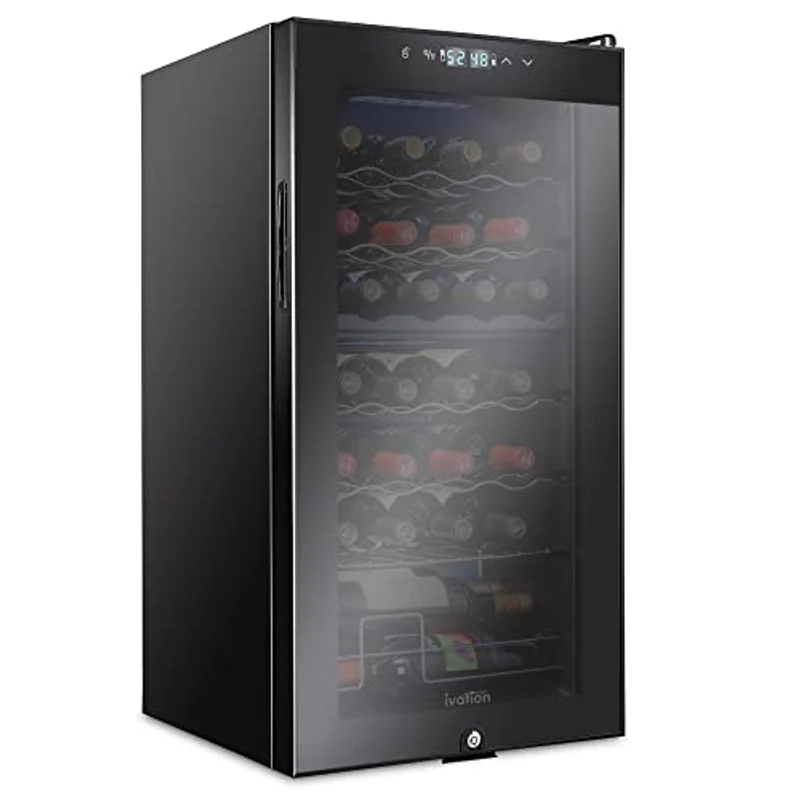
Ivation 28 Bottle Dual Zone Compressor
If you need reds and whites at serving temperature simultaneously
The 41–64°F range is what makes this relevant here: it is wide enough to run the lower zone as a genuine white-wine serving fridge in the mid forties while the upper zone holds true 55°F storage — unlike the dual-zone cabinets whose two zones can only differ by a few degrees. Compressor cooling holds those numbers whatever the kitchen is doing in August, which is the whole point. It is freestanding and it locks. Give it clear air at the back; enclosing it is the fastest way to make a good cabinet miss its setpoint.
The specification to check on any dual-zone unit is not that it has two zones, but how far apart they are allowed to be.
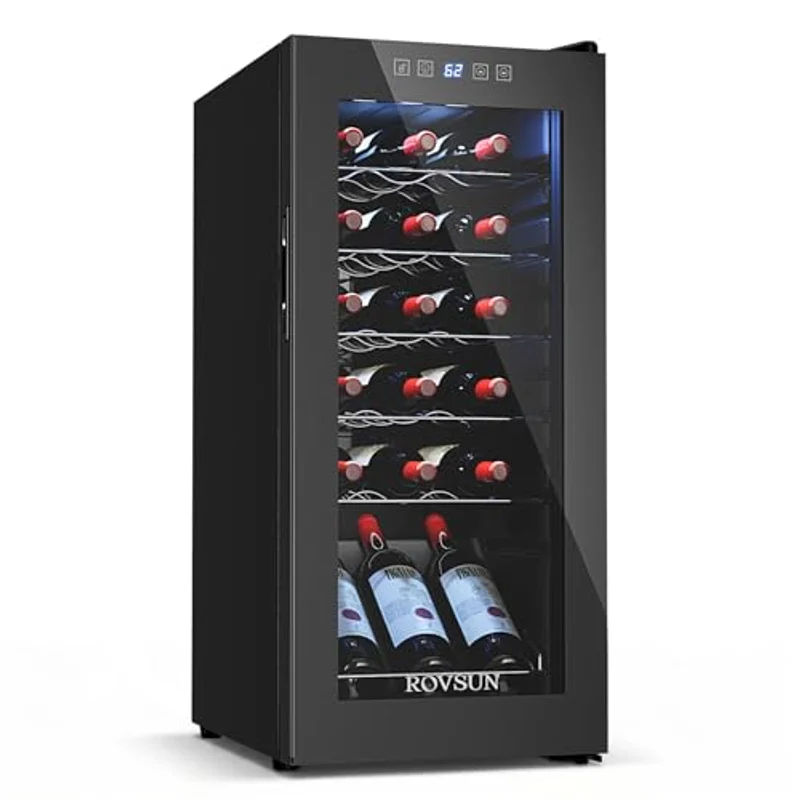
ROVSUN 18 Bottle Freestanding Compressor
If you just want one number that does not move
The cheapest sensible route to the advice at the top of this page: a single zone, set to 55°F, held by a compressor that does not care whether the room is 68°F or 84°F. Digital control means you set a number rather than a vague dial position between a snowflake and a sun. The economies are all in places that do not affect temperature — wire shelves rather than wood, a smaller cabinet, plainer trim. Against a similarly priced thermoelectric unit, this is the better wine fridge in any room that gets warm, and most rooms do.
Stability is a cooling-technology question, not a price question. The cheapest compressor beats the nicest thermoelectric unit in a hot kitchen.
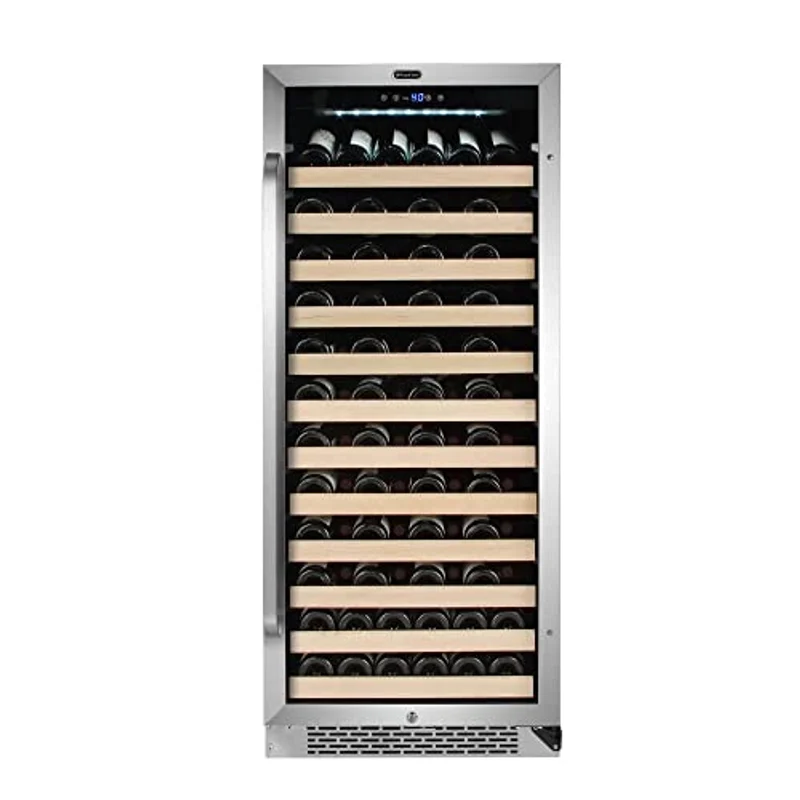
Whynter BWR-1002SD 100 Bottle
If the gap between your top and bottom shelf is the problem
Height is what causes stratification, so a 100-bottle cabinet is exactly where the countermeasure earns its keep. Fan-forced internal circulation stirs the air so the top and bottom shelves converge instead of drifting apart, which is the difference between storing a hundred bottles at one temperature and storing them across a gradient. The adjustable 40–65°F range covers everything from sparkling service to warm-side red storage, and the single zone is the right call at this size: at a hundred bottles you want one correct temperature rather than two compromised ones. It is a real appliance at a real price, and it is the point at which a wine fridge becomes storage rather than a staging area.
A tall cabinet without air circulation is not one storage temperature. It is several, stacked.
One deliberate omission: we have not recommended a thermoelectric unit here, and the reason is the subject of this page. A thermoelectric cooler such as the BLACK+DECKER BD60336 12-Bottle ($185.99) is silent and vibration-free, which makes it a fine choice for a bedroom or a study. But it cools by moving heat across a solid-state junction, and it can only pull roughly 20°F below whatever the room is doing. In a 72°F room that means about 52°F, which is fine. In a kitchen that reaches 88°F in August, the setpoint is unreachable and the cabinet simply follows the room up — the exact temperature instability this guide is about. If holding a number matters to you and the room ever gets warm, buy a compressor. If silence matters more and the room is climate-controlled, the trade is a reasonable one. If you are shopping at the lower end, our roundup of small wine fridges under $200 is where that decision gets made in practice.
Frequently asked questions
What temperature should a wine fridge be set to?
Set a single-zone wine fridge to 55°F (13°C). That is the long-standing convention for wine storage and a workable serving temperature for most reds. In a dual-zone unit, set the lower zone to 45–50°F for whites and sparkling and the upper zone to 55–60°F for reds. Anywhere in the 50–59°F band is a good storage temperature; consistency matters more than hitting 55°F exactly.
Is 55°F too cold for red wine?
For storage, no — 55°F is the correct storage temperature for red wine. For serving, it depends on the style. Light reds such as Pinot Noir and Beaujolais are excellent poured straight from a 55°F cabinet. Full-bodied reds such as Cabernet Sauvignon and Syrah show best at 60–65°F, so take the bottle out 20 to 30 minutes before pouring and let it warm on the counter. It will continue to warm in the glass.
Does a wine fridge need humidity control?
Only if you are storing cork-sealed bottles for years. The conventional target is 50–70% relative humidity, because dry air shrinks a natural cork and loosens its seal. If your wine turns over within a few months, or the bottles have screwcaps, humidity is effectively irrelevant. What matters more is avoiding a frost-free kitchen refrigerator for long-term storage: it is both very cold at about 37°F and deliberately dehumidified.
Why does my wine fridge display say 55°F when the bottles feel warmer?
Because the display reports air at the sensor, and glass and liquid lag air by hours. After loading room-temperature bottles it can take most of a day for the wine itself to reach the setpoint. Two other causes are common: stratification, where a tall cabinet without fan-forced circulation runs several degrees warmer at the top than at the bottom, and sensor placement, since the air near the cooling plate is colder than the air the bottles sit in. Put a separate thermometer at bottle height in the middle of the cabinet to see what is really happening.
Can I store wine in a normal kitchen refrigerator?
For a few weeks, yes — nothing bad happens to a bottle you are going to open soon. For long-term storage, no, on two counts: a kitchen fridge runs near 37°F, which is well below the storage convention and mutes a wine’s aromatics, and frost-free models actively dehumidify, which over a year or more can dry a natural cork and compromise its seal. Screwcap bottles you plan to drink within a few months are the exception.
Keep reading
Dual zone vs single zone
Whether a second temperature zone is worth the bottles and the money it costs you.
ComparisonThermoelectric vs compressor
The cooling technology that decides whether your cabinet can hold a setpoint at all.
TroubleshootingWine fridge not cooling?
Airflow, ambient temperature and door seals, in the order worth checking.
Start over at our wine fridge buyer’s guide, or browse all guides.