By Ilane Tall · Updated August 20, 2026 · Research-based.
Reader-supported: we may earn a commission when you buy through the links on this page, at no additional cost to you. It never changes which product we recommend. Prices quoted below were correct at the time of writing and move often.
The short version
If you buy a case a month and it's gone in a week, a wine fridge is solving a problem you don't have. Buy at the pace you drink and neither the kitchen fridge nor the counter has time to do any damage.
If you routinely hold bottles for more than about a month — for a dinner, a gift, a case you bought on sale, anything you're not opening this week — the kitchen fridge and the counter are both actively working against it, in different ways. That's the honest threshold.
And once you cross that threshold, the right question isn't "how much does a wine fridge cost." It's how much does it cost per bottle you're actually protecting — which is a much smaller number than the price tag suggests.
What a kitchen fridge actually does to a bottle of wine
The instinct to stash an extra bottle in the kitchen fridge feels safe. It's cold, it's dark, it's already there. It is also, for anything you plan to hold longer than a couple of weeks, a slow-motion mistake on three separate fronts.
The first is temperature. A kitchen fridge runs around 37°F to keep food safely below the danger zone for bacterial growth — a sensible target for milk and leftovers, and a genuinely poor one for wine. The long-standing consensus figure for wine storage is closer to 55°F. At 37°F you are not damaging the wine outright the way heat does, but you are storing it roughly eighteen degrees colder than its ideal, which mutes aromatics, dulls fruit character, and — held there for months — very gradually flattens what the bottle was supposed to taste like. Our temperature guide goes through the numbers by style; the short version is that cold suppresses a wine's character rather than harming it structurally, which is a real cost but a mild one next to what heat does.
The second is humidity, and this is the one people miss. A kitchen fridge is designed to pull moisture out of the air — that's what keeps produce drawers from turning your lettuce to soup, and it's also why an open box of baking soda in the back is a genuinely useful trick. Relative humidity inside a typical kitchen fridge sits somewhere around 15–20%. A wine cellar, by contrast, is usually kept near 60–70%. That gap matters because of what's holding the wine in: natural cork is a permeable, faintly springy plug that depends on ambient moisture to stay swollen against the neck of the bottle. Drop the humidity around it for weeks at a stretch and the cork starts to dry out and contract, exactly the way a sponge left on a counter shrinks and stiffens. A shrunk cork lets in more air than it should, and slow, uncontrolled oxidation is what eventually turns good wine flat, brown and sherry-like — not overnight, but over the months a lot of "I'll get to this bottle eventually" tends to take.
The third is vibration, which sounds like the least of the three and is more consequential than it seems for anything you're aging rather than just chilling. A kitchen fridge's compressor cycles on and off constantly, and the door gets opened and shut dozens of times a day by people reaching past the wine for the milk. None of that ruins a bottle you're drinking Friday. Held for a long stretch, though, constant low-level agitation is believed to disturb the slow settling of sediment and dissolved compounds that still, quiet aging depends on — part of why purpose-built storage is engineered to sit as still as a shelf, and a kitchen fridge, full of people's actual food, structurally cannot.
None of this means a kitchen fridge is a bad place for a bottle you'll open this weekend. It's a genuinely bad place for a bottle you're not planning to open for six months, and that's the distinction the rest of this piece turns on.
What the kitchen counter does — and why it's the worse offender
The instinct to leave a bottle on the counter "because red wine should be room temperature anyway" is even more common, and does more damage, faster, than the fridge does.
The first problem is heat cycling. "Room temperature" in most American kitchens is not a fixed number — it swings with the oven, the dishwasher's heat-dry cycle, direct afternoon sun through a window, and whatever the thermostat is doing that week. A kitchen counter can easily see a 15–20°F daily swing between a cool morning and an oven-warmed evening, repeated every single day a bottle sits there. Wine expands and contracts slightly with that swing, and if it gets warm enough, expanding wine pushes gently against the cork from the inside — sometimes hard enough to force a few drops of wine past it, which you'll occasionally see as a faint stain on the capsule or a bit of seepage around the cork on a bottle that's sat out too long. Once that's happened, air has a path in, and oxidation isn't a slow multi-month process anymore; it's already started.
The second is light, and it's the one people never think about at all. Ultraviolet and even ordinary visible light break down the compounds responsible for a wine's color and aroma — a phenomenon winemakers call "lightstrike," most infamous in clear-glass bottles like many rosés and some whites, where it can produce an unpleasant, almost skunky off-note in as little as a few hours of direct sun. That's precisely why serious bottles are shipped in tinted glass and serious cellars are kept dark: light damage is real, it's cumulative, and a sunny kitchen counter is one of the most efficient lightstrike machines you could design on purpose.
The reframe that actually matters: a wine held slightly too cold is a wine that tastes a little muted the day you open it — an inconvenience you can partly fix by pulling it out an hour early. A wine held through repeated heat cycles and direct light is a wine that has been chemically altered, sometimes irreversibly, before you ever pull the cork. Being a few degrees too cold is a reversible annoyance. Heat cycling and light are not.
Put the fridge and the counter side by side and the honest conclusion is that neither is a good long-term home for wine, but they fail in different ways and at different speeds. The fridge mutes a bottle slowly, over months, through cold and dryness. The counter can damage one meaningfully in a single hot week through heat expansion and, if it's in the sun, light — which is exactly why "just leave it out, it needs to breathe" is close to the worst advice a new wine drinker can follow for anything they're not opening tonight.
The honest threshold: how many bottles, and for how long
This is the part most buying guides skip, because "it depends" is an unsatisfying answer to sell against. It's also the correct one, and it depends on exactly two variables: how many bottles you're realistically holding onto, and how long you're holding them before the cork comes out.
Start with duration, because it matters more than volume. A bottle bought on Tuesday and opened Friday barely has time to notice which shelf it's on — two or three days of slightly-wrong humidity or an afternoon of ambient counter heat isn't enough exposure to meaningfully change anything in the glass. The damage described above is cumulative. It's the bottle that sits in the fridge door for four months because you keep forgetting about it, or the case you bought at a warehouse sale and are working through over the summer, where the clock actually starts to matter.
As a rough, honest planning line: if everything you buy is consumed within about two to three weeks of purchase, a dedicated wine fridge is solving a problem you don't actually have. Below that threshold, spend the money on better bottles instead. Above it — if you routinely have wine sitting around for a month or more, whether because you buy ahead, receive gifts, or just don't get through a case as fast as you meant to — the fridge starts paying for itself in exactly the failure modes described above, and the case for one gets stronger every additional month you'd otherwise be storing badly.
Volume matters second, mostly because it decides which size unit makes sense once you've crossed the duration threshold. Someone who holds four or five bottles at a time for a month or two doesn't need a large cabinet; something in the 12–18 bottle range covers that comfortably with room to spare. Someone building an actual rotation — buying by the case, holding some bottles for a special occasion, keeping a backlog they're slowly working through — is a different shopper entirely, and the math and the unit both scale up. Our bottle-count sizing guide works through that scaling in more detail if you already know you're past the threshold and are trying to size correctly rather than decide whether to buy at all.
One more honest wrinkle: the threshold isn't really about wine you're "aging" in the traditional collector's sense — very few casual buyers are laying bottles down for a decade. It's about wine you're simply holding, for anywhere from a few weeks to a year, before you drink it on an ordinary Tuesday or a planned occasion. That's the overwhelming majority of what a wine fridge in a normal household is actually for, and it's a lower bar to clear than "collector" implies.
The money question, framed correctly
Most people evaluate a wine fridge by asking "is a $130 appliance worth it." That's the wrong number to look at, because it compares the full price of the unit against nothing in particular. The number that actually answers the question is cost per bottle protected — what you're paying, per bottle, to stop the slow damage described above, spread across however many bottles the fridge will actually hold over the years you own it.
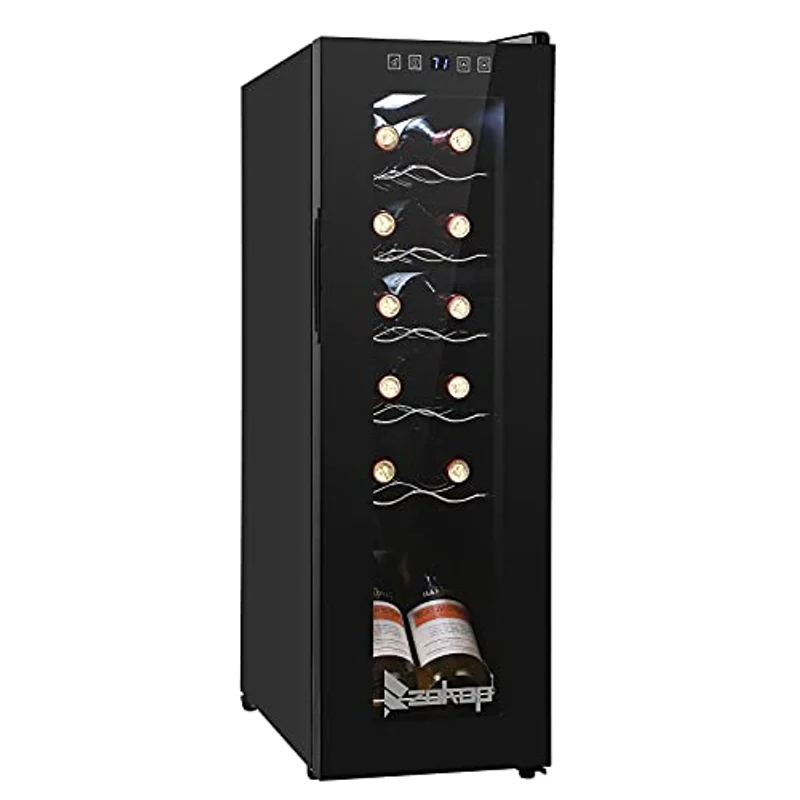
Here's how that plays out with real, currently listed prices. The Winado 12 Bottle Compressor Wine Cooler Refrigerator ($129.99) holds 12 bottles at a single zone. Divide the price by capacity and you get roughly $10.83 per bottle-slot — but that's not the honest figure, because you don't fill each slot exactly once. As a planning assumption (stated plainly, because we won't pretend to know your habits): if you keep the unit five years and turn over each slot on average three times a year, that's 180 bottle-stays over its life, or about $0.72 per bottle protected. Even a much more conservative assumption — two years of use, one turn per slot per year — still lands under $5.50 per bottle. Against a bottle that costs $15–$30, protecting it from a shrunk cork or four months of 37°F flattening for well under a dollar is not a difficult trade once you're actually crossing the threshold above.
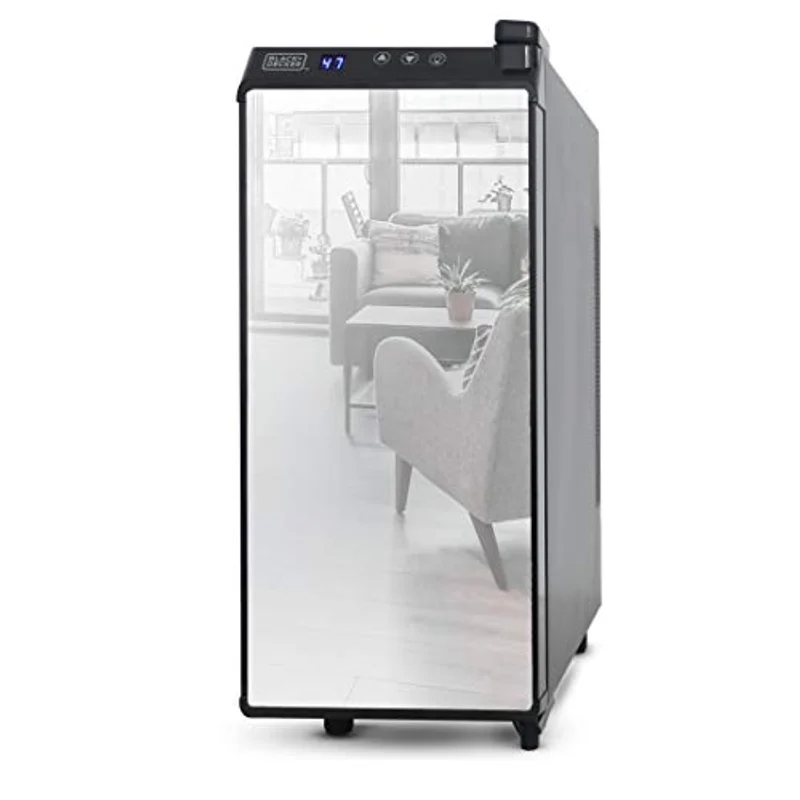
The same math holds up further along the range. The BLACK+DECKER 12-Bottle Thermoelectric Wine Chiller ($200.19) and the larger Wine Enthusiast 24-Bottle Compressor Wine Cooler ($399.00, rated for 41–64°F) both amortize down to a similarly small figure once you actually use the capacity — the Wine Enthusiast works out to roughly $16.63 per bottle-slot up front, which sounds larger, but it's also the unit that makes sense once you're holding two dozen bottles rather than a handful, at which point the per-bottle-year cost keeps falling the same way. The appliance's sticker price is the wrong denominator. The right one is bottles actually protected over the years you own it, and that number is almost always smaller than people expect.
This math only works, of course, if you're actually going to use the capacity. A 24-bottle unit that sits half empty because you never buy that much wine at once doesn't get cheaper per bottle — it gets more expensive, because you're paying for slots that never do any protecting at all. Size to your real habits, not your aspirational ones; the sizing guide is built around exactly that discipline.
What you are not buying: a cheap unit will not age wine like a cellar
It's worth being precise about what a $110–$400 wine fridge actually delivers, because the category gets oversold in both directions — dismissed as pointless by people who only need it for a week, and treated as a serious collector's cellar by marketing copy that implies more than the hardware supports.
What an entry-level unit reliably does: hold a stable temperature well below the swings of a kitchen counter, keep humidity meaningfully higher than a food fridge (though rarely as high as a purpose-built cellar), block direct light, and eliminate the door-slamming vibration of a shared kitchen appliance. That combination is exactly what solves the fridge-and-counter problem described above, and it's the entire reason these appliances are worth buying once you've crossed the threshold.
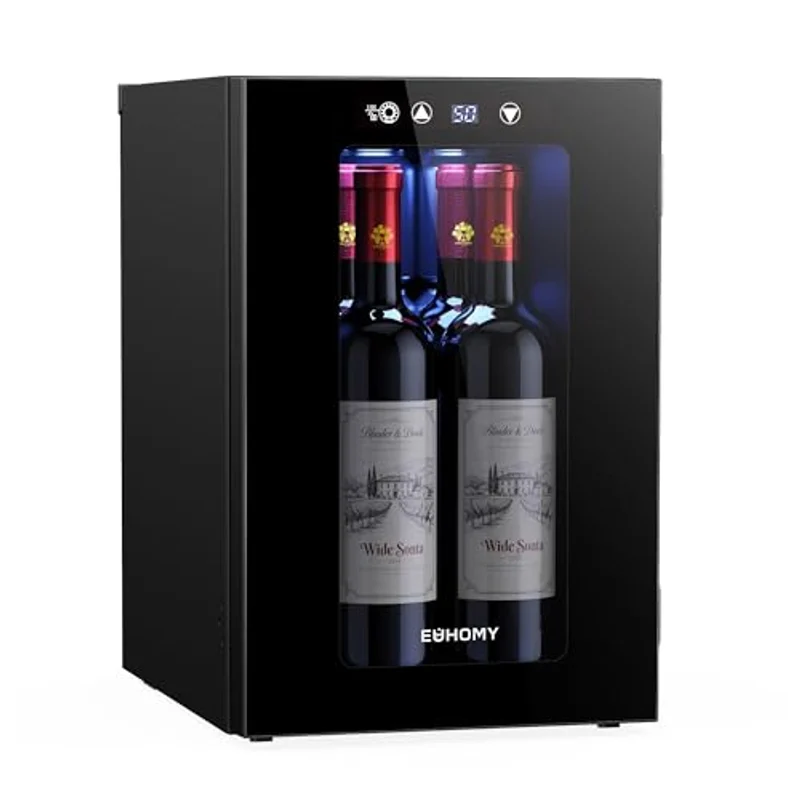
What it does not do is replicate a true cellar's precision. A compact compressor unit like the EUHOMY 18L Wine Fridge Mini Fridge ($111.99, 18 liters, freestanding countertop) is built to protect wine you're holding for weeks or months, not to hold a decade-long vertical of first-growth Bordeaux at museum tolerances. Cheaper units generally run wider temperature bands, offer less precise humidity control, and — on thermoelectric models specifically — lose their grip on the setpoint entirely in a warm room, since thermoelectric cooling can only pull roughly 20°F below ambient. Our thermoelectric vs compressor comparison covers that trade-off if a specific unit you're considering is thermoelectric rather than compressor-cooled — it's the single spec most likely to disappoint a buyer who assumed "wine fridge" meant "cellar."
If what you actually want is long-term collector-grade aging — a decade horizon, multiple cases, tight humidity tolerances — that's a genuinely different product category with a genuinely different price, and this article isn't arguing for that purchase. What's on offer at $110–$400 is protection from the two specific, well-documented failure modes above: the fridge's cold, dry air and the counter's heat and light. That's a smaller, more honest promise, and it happens to be the one almost every casual household actually needs.
Cheapest defensible entry points — and when to just drink the wine sooner
If you've read this far and landed on "yes, I'm past the threshold," here's where the money is well spent without overbuying.
01Cheapest defensible entry
EUHOMY 18L Wine Fridge Mini Fridge
For four to six bottles, held a few weeks to a couple of months
18 L·Freestanding countertop·Flat-shelf layout
The lowest price on this page and the right size for someone who occasionally holds a handful of bottles rather than running a rotation. It sits on a counter rather than the floor, which matters in a small kitchen, and it gets wine off the counter and out of the light and heat cycling described above — the two failure modes that do the most damage the fastest.
Buy this if the honest answer to "how many bottles" is a small handful.
02Best value once you cross the threshold
Winado 12 Bottle Compressor Wine Cooler
The unit the cost-per-bottle math above is built on
12 bottles·Single zone·Compressor
Real compressor cooling rather than thermoelectric, which means it holds its setpoint even if the kitchen gets warm — the single spec most likely to disappoint a buyer on a cheaper thermoelectric unit. Twelve bottles is enough for a genuine rotation without paying for capacity you won't use.
The number this whole argument's cost-per-bottle math is built on.
03Quietest option, for a bedroom or office
BLACK+DECKER 12-Bottle Thermoelectric Wine Chiller
Silence traded for a narrower temperature ceiling
12 bottles·Thermoelectric·Mirrored door
No compressor hum or vibration, which matters if it's going somewhere people sit near — but thermoelectric cooling only pulls about 20°F below the room, so it needs a genuinely cool location to hold a proper storage temperature. Read our thermoelectric vs compressor breakdown before choosing this over a compressor unit.
Right for a quiet room, wrong for a warm kitchen.
04Once you're holding two dozen bottles
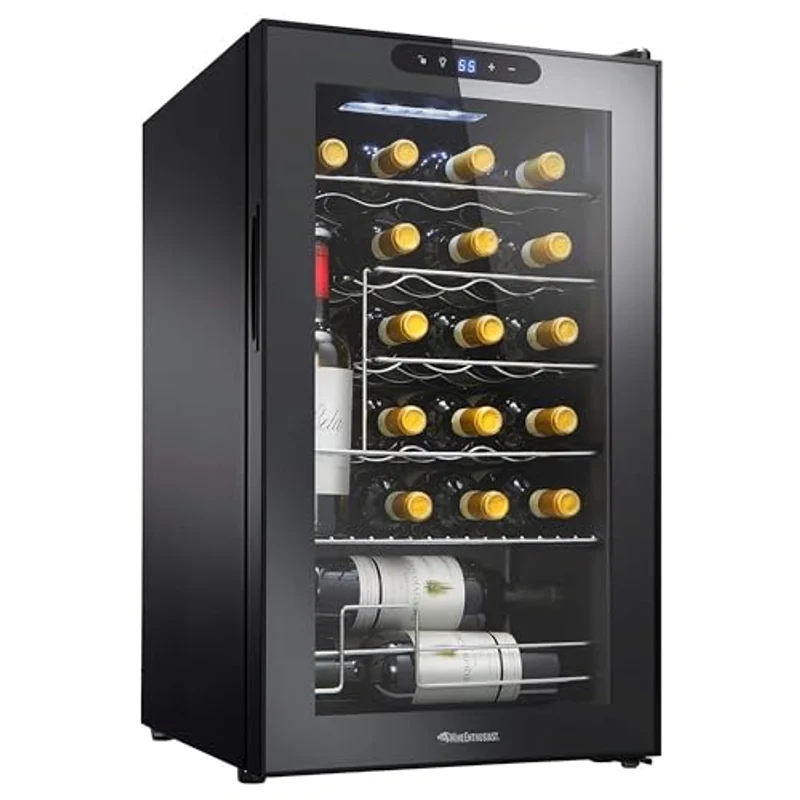
Wine Enthusiast 24-Bottle Compressor Wine Cooler
For an actual rotation, not just a handful held briefly
24 bottles·Compressor·41–64°F range
2.4 cubic feet with upright bottle storage and an LED digital control panel across a published 41–64°F range. This is the step-up size once four or five bottles held occasionally has turned into a genuine backlog — the point where the per-bottle math in the money section above starts to favor more capacity rather than less.
Buy this once you've outgrown a dozen slots, not before.
And the honest counter-case: if none of this describes you — if every bottle you buy is open within a week or two, if you're not the person who ends up with a forgotten case in the pantry — the correct answer is to just drink the wine sooner, not to buy an appliance to store it correctly. A wine fridge doesn't improve wine you're about to drink; it only slows the damage to wine you'd otherwise be holding badly. If nothing in your house is ever held long enough to be damaged, there's nothing here for the fridge to protect, and the money is better spent on the next bottle.
How we compared these — and what we cannot tell you
We compared published manufacturer specifications, current listed prices, and the general, well-documented facts about wine storage — kitchen refrigerator humidity, cork behavior, lightstrike and heat-driven cork failure — against what each appliance is actually built to control. Where a cost comparison required an assumption, such as how many years you'll own a unit or how often you'll turn over a bottle slot, we stated the assumption plainly rather than presenting a bare number as fact.
We do not run a testing lab. We do not own these units and have not physically compared them, so you will not find an invented score out of ten on this site, and you will not find a star rating or review count either — the retailer API does not return them for this category, and we do not publish figures we cannot source. What we can do honestly is read the specifications carefully, track the prices, and reason from established, general facts about how wine actually degrades.
Prices quoted here were correct at the time of writing and change frequently. Confirm the current price before buying.
Frequently asked questions
Is it really that bad to just keep wine in the kitchen fridge?
For a bottle you'll open within a couple of weeks, no — there isn't enough time for the low humidity or the cold to meaningfully change anything. Held for months, though, the very dry air common in kitchen fridges (roughly 15–20% relative humidity, versus 60–70% in a proper cellar) can dry out and shrink a natural cork, letting in air and starting slow oxidation. The 37°F running temperature also mutes aromatics well below the roughly 55°F long-standing consensus for storage. It's fine for the short term and a poor choice for the long term.
Is a wine fridge better than just leaving the bottle on the counter?
For anything held more than a couple of weeks, yes, and it isn't close. A counter exposes wine to daily heat cycling — sometimes a 15–20°F daily swing — which can expand the wine enough to push past the cork, and to light, which degrades color and aroma compounds and can cause noticeable off-flavors in clear-glass bottles in as little as a few hours of direct sun. A wine fridge holds a stable temperature and blocks light entirely, addressing both failure modes at once.
How many bottles do I need to justify buying one?
Volume matters less than duration. If you're holding even four or five bottles for a month or more at a time — gifts, a case bought ahead, wine you're saving for an occasion — a small 12–18 bottle unit already starts paying for itself in avoided damage. If everything you buy is gone within two or three weeks, the honest answer is that you don't need one yet; see our sizing guide once you do.
Will a $110–$130 wine fridge actually age wine like a real cellar?
No, and it isn't trying to. Entry-level units are built to solve the specific problems described in this article — cold, dry fridge air and hot, bright counter storage — not to replicate a purpose-built cellar's tight humidity and temperature tolerances over a decade-long aging horizon. For the large majority of households simply holding wine for weeks or months before drinking it, that's the right and sufficient job. Long-horizon collector storage is a different, more expensive category entirely.
Written by Ilane Tall. Research-based comparisons of published specifications, current prices and general, established facts about wine storage — we do not physically test these units and we do not publish invented scores.