By Ilane Tall · Updated October 29, 2026 · Research-based.
Reader-supported: we may earn a commission when you buy through the links on this page, at no additional cost to you. It never changes which product we recommend. Prices quoted below were correct at the time of writing and move often.
The short version
ETL and UL are not brands and not quality scores. They are electrical-safety certification marks from independent labs OSHA recognizes as Nationally Recognized Testing Laboratories (NRTLs). A landlord, HOA, campus housing office or homeowner's insurer generally doesn't care which of the two is on the nameplate — they want to see one, full stop.
Of the four wine and beverage refrigerators compared below, across four footprints, only the OYLUS 24" 46-Bottle states an ETL listing in its own specifications. The other three don't make the claim either way — and that silence is the lesson of this guide: see where the claim actually lives.
Already own a unit with no stated mark and need one for a lease, an HOA, or an insurance renewal? Jump to what actually works.
What ETL and UL certification actually tests — and what it has nothing to do with
UL (now branded UL Solutions) and ETL (Intertek's testing mark) are two of several labs OSHA recognizes under its Nationally Recognized Testing Laboratory program, alongside names like CSA and TÜV. Either mark means an independent lab tested a production sample against a published safety standard for refrigeration equipment, then kept auditing the factory line afterward — an ongoing manufacturing commitment, not a one-time bench report.
What the test covers is narrow: fire risk from the compressor and internal wiring, shock risk from a damaged cord or a fault inside the control board, heat buildup at the back panel, and the integrity of the power cord and plug. The lab is checking whether the unit can hurt someone or start a fire under foreseeable misuse — not whether it's a good wine fridge.
Here is what it says nothing about: whether the compressor survives three years of daily use, how loud it runs, whether a "dual zone" unit has a meaningful temperature differential between its halves (our 24-inch comparison covers that separately), or energy efficiency — Energy Star and the DOE standard OYLUS cites alongside its ETL mark are a different, voluntary program, sometimes bundled on the same listing but legally unrelated to safety certification. A unit can be safely wired and still be a mediocre wine fridge. Certification is a pass/fail floor, not a review score.
Why a landlord, HOA, campus housing office, or insurer asks for this specifically
None of these parties can open your wine fridge and inspect the compressor. What they can check in a few seconds is whether a recognized lab's mark is on the nameplate, in the manual, or named in the listing. That check exists because their own paperwork depends on it: homeowner and renter insurance, and the commercial liability coverage landlords and HOAs carry, are underwritten on the assumption that major electrical appliances carry NRTL certification. If a fire starts at an appliance with no recognized listing, that absence can complicate a claim regardless of what actually caused the fire — an uncertified major appliance reads as an unknown risk, and pricing out unknown risk is what underwriting does.
Campus housing offices apply the same logic for the same reason — their appliance policy is usually written by the university's own insurer, which is why dorm rules specify "UL or ETL listed" rather than naming acceptable brands. Our guide to wine fridges for a dorm room runs into this exact requirement. A lease clause, an HOA bylaw, or a housing policy that says "UL/ETL listed appliances only" isn't endorsing a brand — it's passing along a condition written one level up, in somebody else's insurance contract.
Where the claim actually lives on a listing — and why "UL-style" is a real yellow flag
When a manufacturer genuinely has the certification, it shows up in one of three places: a plain bullet in the listing's own feature copy, the specification table, or the printed manual and spec sheet. OYLUS states it directly — "Certified by DOE and ETL" appears in its own feature text, the clearest version of the claim you'll find on a retail page. Certification is also granted per model, not per brand, so a certified line from a company doesn't automatically cover every SKU it sells.
Watch for phrases that sound like certification but aren't: "UL-style," "meets UL standards," or "UL-approved" — a phrase that doesn't correspond to anything UL actually does. Language describing a standard a product was "designed toward" is marketing copy, not a guarantee a lab tested the unit on your counter. The only wording that counts is "UL Listed," "ETL Listed," or "ETL Certified," ideally paired with the mark's own logo in the listing images or the manual.
Among the four units in this guide, that distinction is visible in the data itself. The BODEGA 15" 30-Bottle, the EUHOMY 24" Wine and Beverage, and the ICEPURE 24" Wine and Beverage make no certification claim on their current listings — not "UL-style," just no mention at all. That absence doesn't prove those three lack a mark; some manufacturers print it only on the physical nameplate and never repeat it in marketing copy. But you can't take it on faith from the page, and if a landlord or insurer is actually going to ask, silence on the listing means you need better evidence first — the nameplate itself, or a direct answer from the manufacturer, covered below.
A certification does not mean a quiet or a reliable unit
The most common misreading of a UL or ETL mark is treating it as a stand-in for overall quality. It isn't. The test is a binary pass or fail against electrical and fire hazards — it says nothing about compressor noise, nothing about whether the unit survives five years of a kitchen's daily temperature swings, and nothing about whether a "dual zone" cabinet actually holds two different temperatures rather than one zone pretending to be two (a separate problem our 24-inch brand comparison works through).
A certified unit can still hum louder than you'd like and still have a dual-zone divider that barely creates a temperature gap. Certification answers one question only: will this appliance, wired and used as intended, avoid shocking or burning the person who owns it. Buying on the certification claim alone tells you nothing about the parts of ownership you'll actually notice day to day.
Built-in installations: why an inspector or insurer is far more likely to ask here
A freestanding wine fridge plugged into a wall outlet is, to a building inspector, no different from a toaster oven — a portable appliance on a cord nobody files paperwork about. A built-in unit is a different category. It's typically installed during a remodel that pulls a permit, wired closer to a dedicated circuit, and inspected as part of the finished buildout rather than treated as furniture you could unplug and carry out tomorrow. Local electrical code generally requires listed equipment for permanently installed appliances — a code reference a contractor or inspector has to satisfy to sign off the job, not a courtesy they're extending.
That's why certification matters more for a built-in than the freestanding version of the same model: the install itself triggers the paperwork. If a wine fridge is going under a counter in a space that shares humidity and heat with daily appliance use — our guides to laundry room and mudroom installs and quiet bedroom placements both cover built-in-rated units — confirm the certification before the cabinetry closes around it. Pulling a built-in unit back out is a much bigger job than returning a freestanding one.
The picks, across four sizes — and what each listing actually says
Four units spanning a real range of footprints: a narrow 15-inch cabinet, and three 24-inch units built around different combinations of wine and beverage storage. Only one states its certification outright.
01States its ETL listing
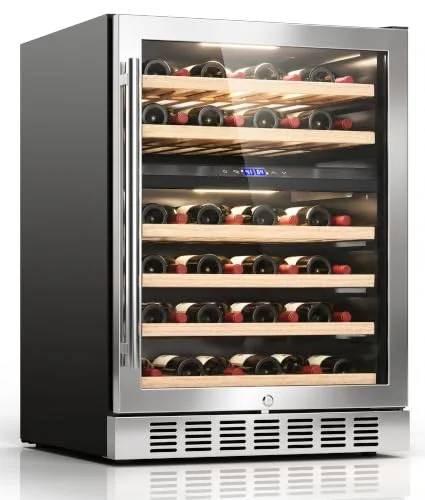
OYLUS 24" Wine Fridge, 46 Bottles Dual Zone
The one unit here with a stated ETL listing
46 bottles·Dual zone, 41–64°F·Compressor·Freestanding, 24"
OYLUS's own listing states it plainly: "Certified by DOE and ETL." That's the clearest version of the claim on any of the four products here — a named lab and the word "certified," not a vague gesture at a standard. It's also the largest-capacity unit here, with both zones independently adjustable across the full 41–64°F range. The DOE reference alongside it is a separate energy-efficiency claim, not part of the safety mark, even though the two get bundled in the same bullet.
If the certification itself is the deciding factor, this is the one with the paper trail already on the page.
02Smallest footprint
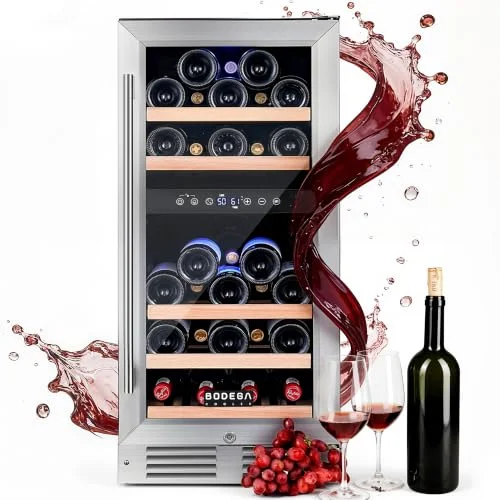
BODEGA 15" Wine Fridge, 30 Bottle Dual Zone
The narrow-cabinet size — verify before you count on it
30 bottles·Dual zone, 41–72°F·Compressor·Built-in or freestanding, 15"
At 15 inches wide with a 3.2 cu.ft capacity, this is the size that fits a narrow cabinet opening or a tight apartment corner — the footprint a dorm room or small rental tends to need. It's rated for either built-in or freestanding installation, which matters given the section above. Its current listing does not state a UL or ETL mark anywhere in its feature copy, which isn't proof it lacks one — but it means you check the nameplate or ask the manufacturer before a lease or HOA sign-off depends on it.
The right size for a lot of first apartments — confirm the mark yourself rather than assuming it from the listing.
03Wine and beverage combo
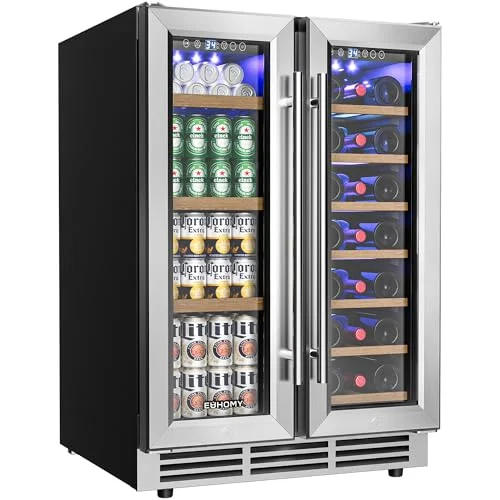
EUHOMY Wine and Beverage Refrigerator, 24 Inch Dual Zone
For households splitting the cabinet between bottles and cans
21 bottles + 80 cans·Dual zone·Compressor, 40dB rated·24", undercounter
A 24-inch cabinet split between a 41–64°F wine side and a 35–50°F beverage side — the right shape for a kitchen juggling wine and drinks in one footprint rather than two appliances. Like BODEGA and ICEPURE, its listing doesn't state an ETL or UL mark either way. If this is going into a rental or a space an insurer or HOA has opinions about, settle that first — not the bottle count.
A genuinely useful combo unit; the certification question is still an open one you have to close yourself.
04Lockable, shared housing
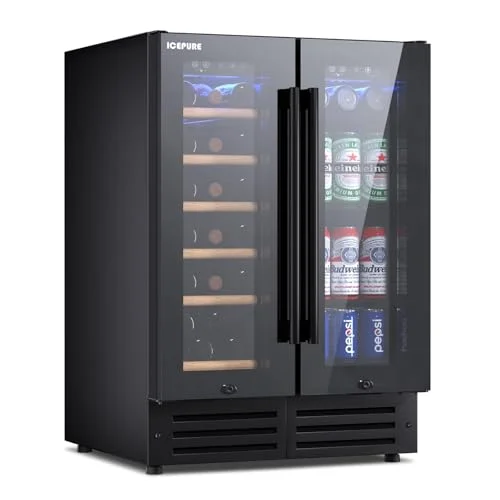
ICEPURE Wine and Beverage Refrigerator, 24 Inch
The lock is the feature that matters for shared spaces
19 bottles + 58 cans·Dual zone·Compressor, 41dB rated·Freestanding or built-in, 24"
Same 24-inch wine-and-beverage format as the EUHOMY, with a lockable door — a genuinely useful detail in a shared house, a dorm common room, or anywhere you don't want the cabinet raided. It's rated for either freestanding or built-in placement, so the built-in certification question above applies directly here. Its listing, like BODEGA's and EUHOMY's, does not currently state an ETL or UL mark.
The lock solves a real shared-housing problem; it does not answer the certification question for you.
Already bought an uncertified unit, and need one for a rental or a policy?
This happens more often than the marketing copy suggests, and it has a real sequence that actually resolves it — most of it before you spend money on a replacement.
- Check the physical nameplate first. Many units with no certification mentioned in their marketing copy still carry it on a small sticker near the compressor. This is the most common false alarm — the listing's silence isn't always the unit's silence.
- Email the manufacturer with the model number and ask directly. "Is this model UL or ETL listed, can you send documentation" gets a direct answer from most brands, even ones that never mention it in retail copy.
- If it genuinely isn't listed, you have three options. Replace it with a certified model before the deadline — the cleanest long-term fix. Ask for a documented exception, occasionally granted with proof of a dedicated GFCI outlet. Or, for a built-in, recognize the exception path mostly doesn't exist: that requirement is tied to electrical code, and a non-listed appliance on a permanent circuit won't pass a permitted inspection.
- Keep whatever answer you get in writing. The requirement usually surfaces once — at a move-in walkthrough, a claim, or the week before an inspection — and having the email or compliance letter on hand then beats remembering you checked once, a while ago.
How we compared these — and what we can't verify
We compared the published feature copy, specification tables and current prices of wine and beverage refrigerators available in the US, checking each listing's own text for an explicit certification claim rather than inferring one from price or brand reputation. Where a listing states "ETL" or "UL" by name, as OYLUS does, we reported that directly. Where a listing is silent, we reported the silence rather than assuming it confirms or rules out an unlisted physical mark — we have not inspected these units' nameplates ourselves.
We do not run a testing lab. We do not own these units and we do not physically test them, and you will not find an invented safety claim or a star rating here — the retailer data for this category doesn't include ratings or review counts, and we don't publish numbers we can't source. What we did do is read every specification sheet carefully and report exactly what each manufacturer does and doesn't claim, in their own words.
Frequently asked questions
Is ETL the same thing as UL?
For practical purposes, yes. Both are electrical-safety certification marks from labs OSHA recognizes as Nationally Recognized Testing Laboratories, and both carry equal legal and insurance weight — a landlord or insurer asking for "UL or ETL" treats them as interchangeable. The difference is simply which lab, UL Solutions or Intertek, tested that model.
Does a UL or ETL mark mean the wine fridge is quiet or well-built?
No. The certification is a pass/fail test against electrical and fire hazards — shock, fire, heat buildup, cord integrity. It says nothing about compressor noise, long-term reliability, or whether a dual-zone cabinet holds a real temperature differential. A certified unit can still be loud or mediocre; certification and quality are separate questions.
My wine fridge has no UL or ETL mark listed online — does that mean it isn't certified?
Not necessarily. Some manufacturers print the mark only on the physical nameplate and never mention it in marketing copy. But you can't take it on faith from a silent listing — check the nameplate, or email the manufacturer for documentation before a lease or insurance deadline depends on the answer.
Where exactly should I look for the certification claim before buying?
Three places: the manufacturer's manual or spec sheet, the listing's feature bullets or specification table, and the nameplate sticker on the unit itself, usually on the back panel near the compressor. Treat "UL-style" or "meets UL standards" as marketing language — the only wording that counts is "UL Listed," "ETL Listed," or "ETL Certified."
Written by Ilane Tall. Research-based comparisons of published specifications, current prices and manufacturer-stated certification claims — we do not physically test these units and we do not publish invented scores.