By Ilane Tall · Updated October 24, 2026 · Research-based.
Reader-supported: we may earn a commission when you buy through the links on this page, at no additional cost to you. It never changes which product we recommend. Prices quoted below were correct at the time of writing and move often.
Quick answer
For a bedroom or a nursery, buy a thermoelectric wine fridge, not a compressor one. Thermoelectric cooling has no compressor to cycle on and off, so there is no hum and no vibration transmitted through a shared wall or floor — the Antarctic Star 12 Bottle and the Schmécké 12 Bottle are both built this way and both sit quietly on a dresser or counter.
The tradeoff is real: thermoelectric cooling only pulls the inside of the cabinet down relative to the room, roughly 15–20°F below ambient, and it stops being useful once the room itself runs warm. If the space is going to see a Southern summer without reliable air conditioning, skip ahead to what actually works in a warm room before you buy.
Why a compressor's duty cycle is the wrong noise in this room
Every compressor wine fridge works the same way: a motor compresses refrigerant, pushes it through a condenser coil, and switches off once the cabinet reaches its setpoint — then switches back on once the temperature drifts back up. That on-off rhythm is called a duty cycle, and in a kitchen it is nothing. A refrigerator, a dishwasher, a running tap, a conversation — the compressor's hum and the click of it starting are buried under everything else happening in the room.
A bedroom has none of that masking noise. At 11 p.m. with the lights off, the ambient sound level in a quiet bedroom can sit as low as 25–30 decibels — close to the quietest a room gets. A compressor wine fridge that reads as "whisper quiet" against a kitchen's background noise is typically producing somewhere in the 38–45 decibel range at the cabinet itself, and that number does not travel far before it is the loudest thing in the room. Worse than the steady hum is the cycle itself: the motor kicking on from silence is a transient, attention-grabbing sound, and a duty cycle means it repeats every twenty to forty minutes, all night, every night. That is a specific and well-documented category of sleep disruption — not loud enough to wake a light sleeper outright, but exactly the kind of intermittent, unpredictable noise that prevents the deeper stages of sleep from consolidating. It is the same reason parents are told not to run a noisy HVAC vent near a crib even at a modest volume: steady background noise habituates, but switching, cycling noise mostly does not.
So the question for this room is not "how quiet is this fridge." It is "does this fridge have a duty cycle at all." A compressor unit, however well insulated, has one. That single architectural fact is the reason this guide leads with thermoelectric cooling rather than with decibel claims — which, as the next section covers, you mostly cannot get a straight answer on anyway.
Thermoelectric's real tradeoff: it only cools relative to the room
Thermoelectric cooling uses a Peltier module — a solid-state device with no moving parts beyond a small fan — to move heat from inside the cabinet to outside it. There is no compressor, no refrigerant loop, and no duty cycle to switch on and off. That is the entire reason it belongs in this room: there is structurally nothing to hum or click.
The tradeoff is that a Peltier module is weak compared to a compressor. It cannot pull a cabinet down to a fixed temperature regardless of conditions; it can only create a differential between the inside of the cabinet and the room it sits in, typically in the range of 15–20°F below ambient. Set a thermoelectric cooler to its lowest setting in a 68°F bedroom and the cabinet will settle somewhere near 48–53°F — a perfectly reasonable serving and short-term storage temperature. Put the same unit in a room that climbs to 82°F during a heat wave, and the cabinet may only reach 62–67°F, which is too warm for anything but the shortest-term storage.
This is why thermoelectric units are described honestly as room-relative, not absolute. The number on the dial is a target the Peltier module works toward, not a guarantee, and the gap between target and reality widens as the room warms. A bedroom or nursery that stays in a consistent, air-conditioned range through most of the year is exactly the environment this technology was built for. A sunroom, an uninsulated attic conversion, or a bedroom with the AC off most of the summer is not — and no amount of money spent on a better thermoelectric unit changes that physics. For that scenario, see when thermoelectric stops being realistic, below.
What "quiet operation" means on the spec sheet versus a decibel number nobody publishes
Search listings in this category and you will see "quiet operation" in nearly every title. What you will almost never see is an actual decibel figure, because none of the manufacturers in this guide publish one, and the retailer listing data we work from does not carry independent noise measurements either. That is worth being direct about rather than inventing a number to fill the gap.
What "quiet operation" reliably signals on a listing, even without a decibel figure, is the cooling architecture: it is marketing shorthand for "this is a thermoelectric unit," because that is the only mechanism that can make the claim honestly. A compressor unit is never marketed this way for a bedroom, because manufacturers know what a compressor sounds like at 2 a.m. The phrase is a proxy for Peltier cooling, not a measured, comparable spec — treat it as confirming the cooling type, not as a number you can compare between two different models.
The specification you can actually compare across listings is cooling type itself, usually stated plainly: thermoelectric, compressor, or occasionally a hybrid. That single line tells you more about bedroom suitability than any adjective in the title. If a listing does not state the cooling type at all, that is itself worth treating as a yellow flag — assume compressor unless thermoelectric is stated, since compressor is still the more common, cheaper-to-manufacture mechanism across the category as a whole.
Placement still matters, even at low noise
A Peltier module removes the compressor's hum, but it does not remove sound entirely — there is still a small fan moving air across the hot and cold sides of the module, and that fan runs continuously whenever the unit is on. It is a much softer, steadier sound than a compressor's cycle, closer to a desktop computer or a bedroom air purifier on its lowest setting. Steady fan noise is far easier for a sleeping brain to tune out than cycling compressor noise, but "easier to tune out" is not the same as "silent," and where you place the unit still changes the experience.
Two placement rules carry over from any appliance noise problem, and they apply even to a quiet thermoelectric unit:
- Keep it off a shared wall with a neighbor's bedroom, or off the wall backing a crib. Even low-level, continuous sound couples through drywall and studs more efficiently than it travels through open air. A unit on an interior wall away from where a head rests on a pillow transmits noticeably less than the same unit six inches from a headboard.
- Give the vents clearance. A thermoelectric unit still needs airflow across its heat sink to shed the heat it is pulling out of the cabinet. Push it flush into a corner or butt it against drapes and the fan has to work harder to move the same air — which can mean it runs louder and longer than it would with a few inches of clearance on the vented side.
Floor placement also matters more than people expect. A unit sitting directly on a hardwood or laminate floor can transmit a faint vibration into the floor itself, audible as a low resonance in an adjoining room below. A rubber furniture pad or a folded towel under the feet of the unit is a cheap, complete fix, and worth doing by default in a nursery, where the room below is often someone else's bedroom.
The nursery-specific point: a crib is typically against an exterior or shared wall by necessity of room layout, and a baby's sleep is disrupted by far smaller sound changes than an adult's. Err toward more distance between the unit and the crib than feels strictly necessary, and prefer the quietest shelf or dresser top in the room over the one nearest an outlet.
The picks
All four units below are genuinely compact — none holds more than twelve bottles, which is the right scale for a bedroom dresser or a nursery shelf rather than a kitchen counter. Three are thermoelectric; one is listed as thermoelectric-class compact cooling at a lower price point for comparison. None of these carry a published rating or review count in our data, so none is claimed here — judge them on the specification, not on invented stars.
01Quietest, smallest footprint
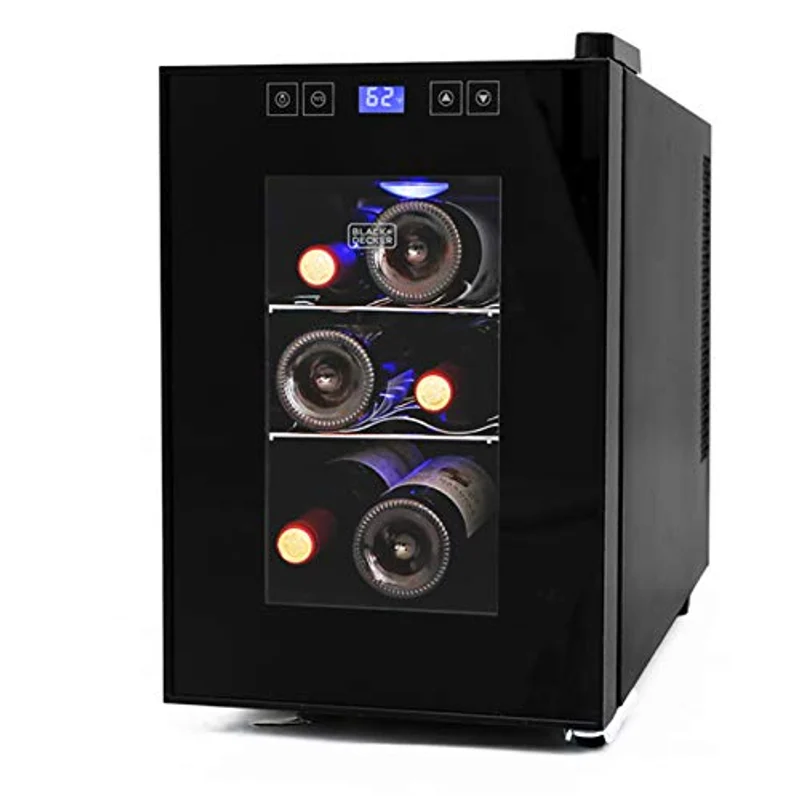
BLACK+DECKER 6-Bottle Thermoelectric Wine Cellar
Quietest, smallest footprint
6 bottles·Thermoelectric·Freestanding
At six bottles, the BD60016 is sized for a bedside table or a dresser top, not a counter. Thermoelectric cooling means no compressor cycle to listen for through the night, and the small footprint means it can sit far from the wall and still fit the room. Six bottles is a real limit — this is a nightcap fridge, not storage — but for a space where silence outranks capacity, that trade is the point, not a compromise.
The one to buy if the room is small and the priority is simply: no noise at all.
02Best value at 12 bottles
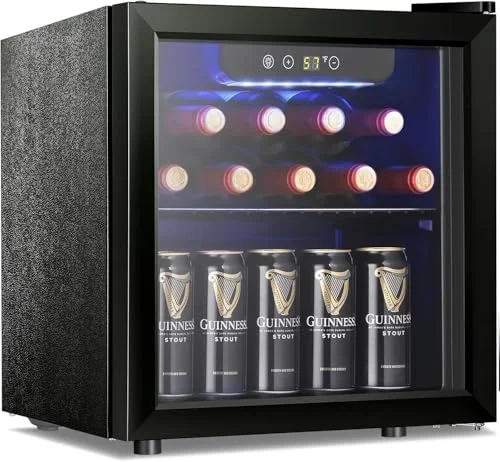
Antarctic Star 12 Bottle Wine Cooler
Best value at 12 bottles
12 bottles·1.3 cu.ft·Freestanding
Double the capacity of the BLACK+DECKER at roughly a $15 premium, with a clear glass door rather than solid — useful in a nursery where a parent wants to glance at the contents without opening the door and letting warm air in. The listing markets it explicitly on quiet counter-top operation, which on this category of unit is shorthand for Peltier cooling rather than a measured figure, but the cooling architecture is the part that matters for a bedroom.
The straightforward choice if twelve bottles covers what you actually keep on hand.
03Best for checking the setpoint at night
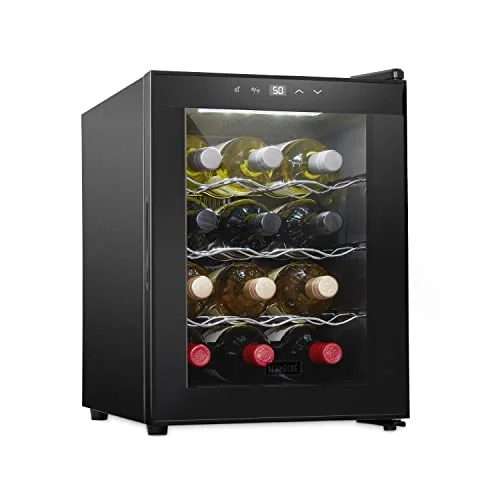
Schmécké 12 Bottle Thermoelectric Wine Cooler
Best for checking the setpoint at night
12 bottles·Thermoelectric·Digital display
Same twelve-bottle capacity and thermoelectric cooling as the Antarctic Star, with a digital temperature display and a smoked-glass door rather than clear. The smoked finish is the better call for a bedroom where you would rather not have a lit interior visible from the bed; the digital display lets you confirm the cabinet is actually within a few degrees of target without opening the door, which matters more with thermoelectric cooling than with compressor, since the achievable temperature shifts with the room.
Pick this over the clear-door Antarctic Star if you want to check the number, not the bottles, from across the room.
04Most finished look, same mechanism
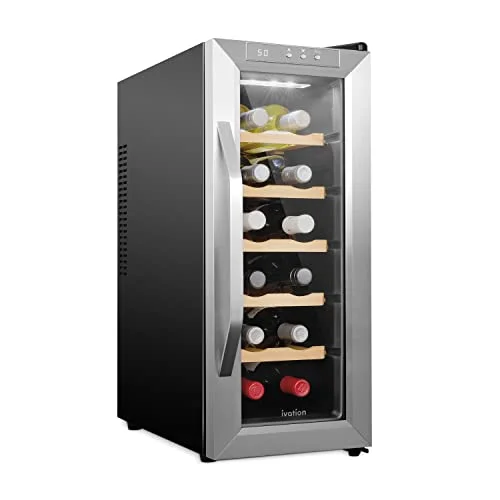
Ivation 12 Bottle Thermoelectric Wine Cooler
Most finished look, same mechanism
12 bottles·Stainless steel·Thermoelectric
The same twelve-bottle thermoelectric layout as the two above, built with a stainless-steel frame and smoked glass rather than an all-plastic shell. It costs roughly $60–115 more than the other twelve-bottle options here for the finish and build, not for a different cooling mechanism — the noise profile and the room-relative temperature limit are identical to the Antarctic Star and the Schmécké. Worth the premium if the fridge is visible furniture in the room rather than tucked into a closet.
Buy this one when the fridge itself is part of the room's décor, not just an appliance hidden in a corner.
When the room is too warm for thermoelectric to be realistic
Thermoelectric cooling's 15–20°F differential is a ceiling, not a suggestion, and it is worth being honest about where that ceiling stops working. If the bedroom or nursery regularly sits above roughly 78–80°F — a room without reliable air conditioning through a hot summer, a converted attic space, or a sunroom-adjacent bedroom that catches afternoon heat — a thermoelectric unit will settle somewhere in the low-to-mid 60s°F at best, which is too warm for anything beyond the shortest-term storage and well outside a proper serving temperature for most wine.
There is no thermoelectric model, at any price, that escapes this limit; it is a property of the Peltier mechanism itself, not a build-quality shortcoming any of the four units above could engineer around. In that scenario the honest tradeoff flips: a compressor unit will hold its temperature regardless of the room, but it brings back the duty-cycle noise this whole guide exists to avoid. The reasonable compromise is to treat the climate-control problem and the noise problem as two separate projects — fix the room's baseline temperature with a small portable AC unit or a better-sealed window first, so a thermoelectric cooler can do its job within its 15–20°F range, rather than reaching for a compressor unit and accepting the cycling noise as the cost of a warm room. If the room simply cannot be kept cool enough for that math to work, that is a case for a compressor unit placed as far from the bed as the room allows, with the placement guidance above applied as strictly as possible — not a case for forcing a thermoelectric unit to do something it physically cannot.
How we compared these — and what we cannot tell you
We compared the published cooling architecture, capacity, finish and current listed price for each unit, cross-checked against the manufacturer's own description where the retailer listing was ambiguous. Where "quiet operation" appeared as marketing language without a backing specification, we treated it as a proxy for thermoelectric cooling and said so, rather than repeating it as a measured claim.
We do not run a testing lab. We have not placed a decibel meter next to any of these units, and none of the manufacturers in this guide publish an independent noise rating, so you will not find a decibel number on this page that we cannot source. You will also not find a star rating or a review count: the retailer data we draw from does not return them for this category, and we do not publish numbers we cannot verify. What we can do honestly is explain the mechanism — compressor versus thermoelectric — and let that mechanism, which is a matter of public physics rather than opinion, do the explaining that a fabricated decibel figure would otherwise be asked to do.
Prices quoted here were correct at the time of writing and change frequently. Confirm the current price before buying.
Frequently asked questions
Will a thermoelectric wine fridge wake a light sleeper?
It is far less likely to than a compressor unit. There is no cycling motor and no on-off click — only a small, continuous fan, which most people habituate to the way they do a white-noise machine or an air purifier. Placement still helps: keep it off a shared wall and give it a few inches of clearance so the fan is not working harder than it needs to.
Can I run a thermoelectric cooler in a nursery that's kept around 70°F?
Yes — that is close to the ideal scenario for this technology. A thermoelectric unit pulling 15–20°F below a 70°F room settles in the low-to-mid 50s°F, which is a reasonable storage and near-serving temperature. The mechanism only struggles once the room itself climbs well above a typical conditioned indoor temperature.
Why don't these listings publish a decibel number?
None of the manufacturers for the units in this guide publish an independent, tested decibel figure, and the retailer data we use does not supply one either. "Quiet operation" on a listing is reliably a signal that the unit is thermoelectric rather than compressor-cooled — a real and useful signal — but it is marketing language, not a measured spec you can compare model to model.
Is a 6-bottle fridge really enough, or should I size up?
It depends entirely on how the fridge gets used. As a bedside unit for a nightly glass or two, six bottles is plenty and keeps the footprint small enough to sit well away from the bed. If it is doing any real storage duty, the 12-bottle options here roughly double the capacity for a modest price difference without changing the noise profile at all.
Written by Ilane Tall. Research-based comparisons of published specifications, current prices and general domain facts — we do not physically test these units and we do not publish invented scores or review sentiment.