By Ilane Tall · Updated October 23, 2026 · Research-based.
Reader-supported: we may earn a commission when you buy through the links on this page, at no additional cost to you. It never changes which product we recommend. Prices quoted below were correct at the time of writing and move often.
The short version
The bottle count on every wine fridge box assumes a slim 750ml Bordeaux bottle lying flat in a fixed-pitch rack. A magnum is roughly double the volume and noticeably taller, and a wide-shouldered Burgundy or a dumpy Port bottle is wider at the girth than the slot was built for — so neither fits the rack it was marketed against.
The feature that actually solves this is removable shelves, not bottle count. A cabinet that lets you pull a shelf out entirely gives you the headroom a magnum needs to stand upright; a cabinet with fixed wire racks doesn't, no matter how many bottles the box claims.
If oversized bottles are more than an occasional gift bottle, the honest fix is often a dedicated, uncooled magnum rack next to the fridge rather than one cabinet trying to do both jobs.
Why the bottle count on the box assumes a slim 750ml Bordeaux
A standard 750ml Bordeaux bottle is the quiet industry default: a cylindrical body roughly 3 inches across and about 12 inches tall, with straight sides and square shoulders that stack predictably against the next bottle. Manufacturers design the internal racks of a wine fridge around that one silhouette, because it is the shape that lets them quote the biggest possible number on the box. The slot width, the distance between shelves, and the cabinet depth are all set to that bottle, laid on its side, nose tucked against the bottle in front of it.
Every other common bottle shape loses space against that baseline. A Burgundy or Pinot Noir bottle has a wider, more sloped shoulder and a fatter body — often close to half an inch wider in diameter — so it either doesn't slide fully into a snug slot or it pushes the next bottle's neck out of alignment. A Port bottle is frequently shorter and wider, built to a different ratio entirely. Champagne bottles are thicker-walled to hold pressure and wider at the base, so they won't lie flush in a Bordeaux-sized slot either.
A magnum takes the problem furthest. At 1.5 liters it holds twice the wine of a standard bottle, and it isn't simply a scaled-up Bordeaux — it's taller and usually wider at the body, closer to 14–15 inches long. That needs more depth than most cabinets offer in the horizontal rack, and far more vertical clearance than the gap between two standard shelves. The capacity number on a wine fridge box is really a promise about slim 750ml Bordeaux bottles, and almost no listing spells out what happens the day one bottle doesn't match that shape.
Removable vs fixed shelves: making room for a magnum, or giving up
This is the specification that decides whether an oversized bottle is a five-minute rearrangement or a problem you give up on and leave standing on the kitchen counter.
A cabinet built with fixed wire racks welds its shelf pitch in place. The gap between one rack and the next is whatever the manufacturer chose for a 750ml bottle lying flat — typically a few inches — and there's no way to open it up. A magnum standing upright needs headroom close to its full height, 14 inches or more, and a fixed-rack cabinet rarely has a single gap that large anywhere inside it. The result isn't "it fits a little awkwardly." The bottle doesn't fit at all, and the fridge reads as "full" well before the shelves are actually loaded.
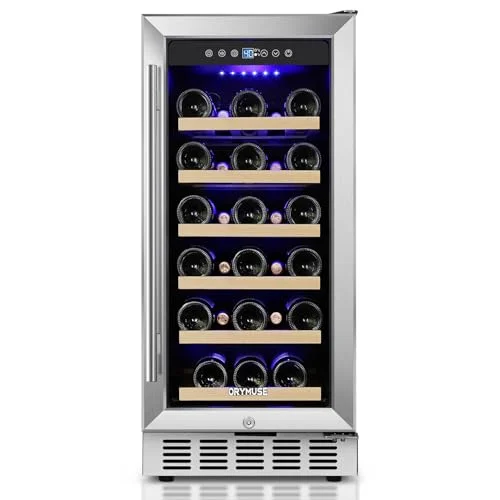
Removable shelves change the math. If a whole rack can be lifted out rather than just slid to a different pre-drilled notch, you can convert one section into open floor space tall enough to stand a magnum. The ORYMUSE 15 Inch Under Counter below states removable shelves directly, which is the specific feature that makes finding room for one oversized bottle a real option rather than a workaround.
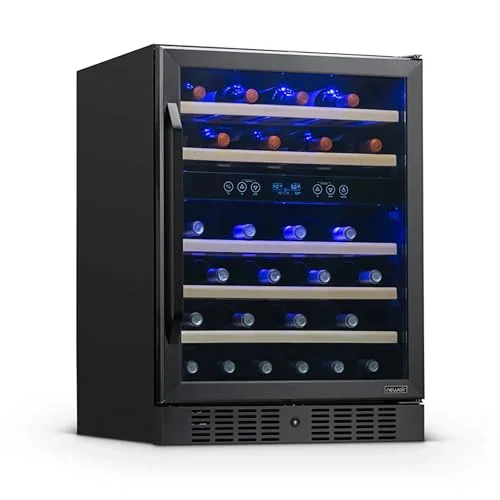
There's a middle category too: adjustable shelves, where a rack repositions along a rail rather than lifting out entirely. That's a real step up from a fixed rack, since you can space shelves unevenly to open a taller gap somewhere — the NewAir 24" Dual Zone below is built this way — but it isn't quite the same guarantee as a rack you can remove completely, since the available height is still set by wherever the rail's notches land.
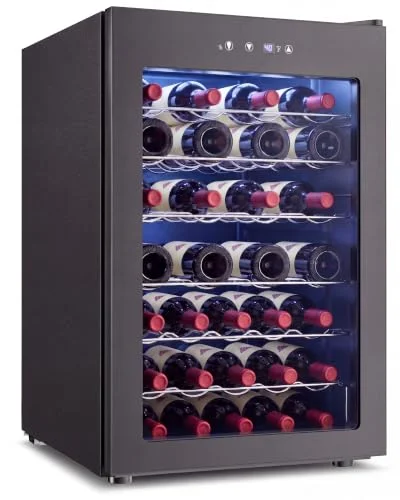
And when a listing says nothing about shelf type at all, as with the Feelfunn 45 Bottle below, the honest move is to treat it as fixed until you've confirmed otherwise on the product page, not to assume flexibility the spec sheet never promised.
Where a magnum actually has to go in a single-zone cabinet
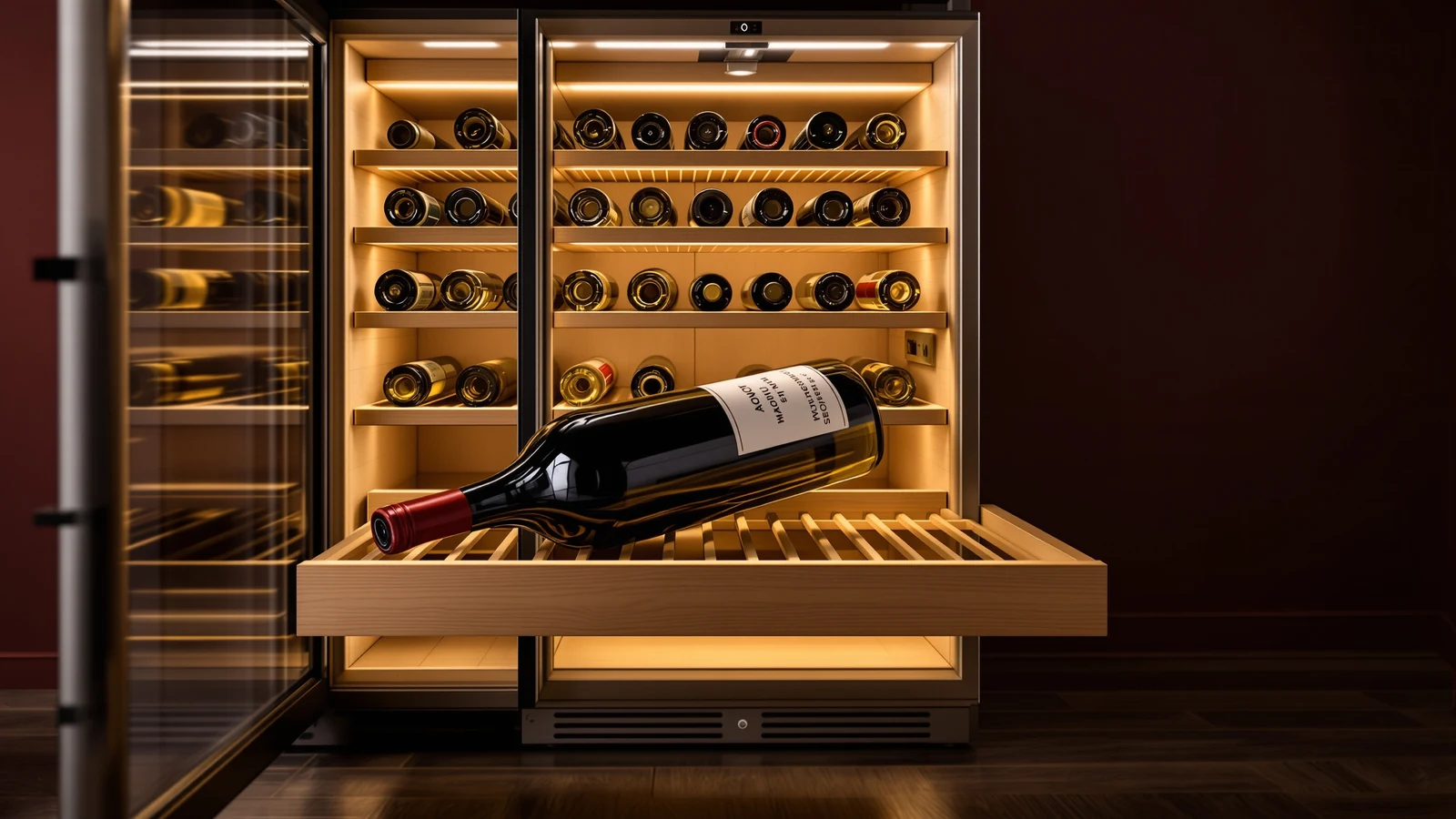
Most single-zone wine fridges are built around one storage posture: bottles lying on their side, neck resting in a slot, so the cork stays damp and the bottle doesn't roll. That posture is exactly what breaks down with a magnum.
Laid on its side, a magnum is simply too long for most racks — slot depth and cabinet depth are both sized to a 12-inch Bordeaux bottle, and one pushing past 14 inches either hits the glass door from the inside or leaves the neck hanging unsupported past the shelf's front edge. That's more than cosmetic: an unsupported bottle can tip, and a magnum pressed against the door glass is exactly the kind of interference that stops a door from sealing flush — the same mechanical problem covered in our guide to doors that won't stay closed.
So in practice, a magnum almost never lives in the rack. It stands upright, like a bottle on a cellar floor, which means it needs a flat deck rather than an angled wine rack, and the full vertical run of whatever space you've cleared above it — not the 4-to-5-inch gap a standard shelf pitch provides, but close to the bottle's full height plus clearance so the door can close without pressure on the glass. In a single-zone cabinet, that space is almost always at the very bottom: remove the lowest shelf or two, and the cabinet floor becomes the magnum's spot, since every other level is boxed in above by the next rack.
The shelf you give up, and what it costs you in standard bottles
Freeing that space isn't free. Pulling a shelf out to stand a magnum removes every slot that shelf used to hold, and the honest way to think about the trade is in standard bottles, not abstract inches.
Take a single-zone cabinet holding roughly 30 bottles spread evenly across its racks — a common layout at that capacity puts around five bottles on each shelf. Remove one shelf to open the vertical gap a magnum needs, and you've traded roughly five ordinary 750ml slots for one magnum-sized one. Not a bad trade for one or two oversized bottles, but it means the "30 bottle" cabinet is now closer to a 25-bottle cabinet the moment an oversized bottle moves in, and the listing never warns you about that.
The math gets friendlier in a larger cabinet, simply because there's more capacity to absorb the same single-shelf loss — one real argument for sizing up rather than squeezing a magnum into the smallest cabinet that otherwise fits. If you're already weighing a bigger cabinet, our guides to wine fridges between 50 and 80 bottles and holiday entertaining and big gatherings cover that step up, and both describe exactly the household where an oversized Champagne bottle tends to show up anyway.
Our picks
Three cabinets, three answers to the same question: what happens the day an oversized bottle needs a home.
01Best for actually making room for a magnum
ORYMUSE 15 Inch Wine Cooler Under Counter
The one cabinet here that states removable shelves outright
30 bottles · 3.1 cu.ft·Removable shelves·Built-in or freestanding·Digital control
This is the cabinet to buy if the goal is specifically what this guide is about: clearing real headroom for a magnum or a fat-shouldered bottle without buying a different appliance. The listing states removable shelves directly, the one feature here that lets you convert a section into open, flat floor space rather than hoping a bottle squeezes into a fixed gap. It's built to the standard 15-inch opening and rated for built-in or freestanding installation, with a stainless-steel glass door and digital temperature control. At 30 bottles with the shelves in their factory positions, remember the trade above: pulling a shelf for one oversized bottle costs roughly a shelf's worth of standard-bottle capacity.
Buy this one for the shelf, not just the bottle count.
02Best if you're mixing reds, whites and the occasional magnum
NewAir 24" Dual Zone Wine Fridge
Adjustable shelves and a wider cabinet to absorb the loss
46 bottles·Dual zone·Adjustable shelves·Built-in or freestanding
The listing describes adjustable shelves rather than fully removable ones — a real step up from a fixed wire rack, even if it isn't quite the same guarantee, since you reposition a rack along its rail rather than lifting it out. The bigger advantage here is scale: at 46 bottles across a 24-inch dual-zone cabinet, giving up one shelf level to fit an oversized bottle costs a smaller share of total capacity than it would in a smaller single-zone unit. Two independently managed zones also mean you can keep the magnum and its standard-bottle neighbors at different serving temperatures if that matters to you.
The pick if the magnum is one bottle among many, not the whole reason you're buying.
03Best if you just need overflow capacity, not magnum clearance
Feelfunn 45 Bottle Wine Cooler Refrigerator
The largest bottle count here, with no stated shelf flexibility
45 bottles·Freestanding·Black
At 45 bottles for under $270, this is the cheapest way to add real standard-bottle capacity here — but its listing doesn't mention removable or adjustable shelves, so don't assume you can open up magnum-height clearance inside it without checking the current product page first. It's a strong, affordable freestanding fridge for growing a collection of ordinary 750ml bottles, and the right companion to a separate magnum rack rather than the cabinet you lean on for the oversized bottles themselves.
A good fridge for everything else, paired with a rack for the one bottle that doesn't fit any fridge well.
When the honest answer is a dedicated magnum rack, not a wine fridge
If an oversized bottle is a once-a-year situation — a Champagne magnum for an anniversary, a bottle brought home as a gift — reorganizing a shelf for a few weeks is a reasonable answer, and the picks above cover that. But if oversized bottles are a regular part of what you buy, a wine fridge is the wrong tool to force into doing both jobs well.
The reason comes back to the same assumption this guide started with: a wine fridge's racks, shelf pitch, even its bottle-count marketing, are all optimized around the slim 750ml Bordeaux shape. Every inch of cooled, climate-controlled cabinet space dedicated to one irregular bottle is an inch not used for the shape the fridge was designed around — an inefficient use of the most expensive part of the appliance to solve a problem that doesn't need active cooling for most households.
A standalone magnum rack — typically open wood or metal, uncooled, sized for the longer, wider bottle — holds oversized bottles horizontally without eating into a single slot of your fridge's capacity. It lives in a closet, a sideboard, or alongside the fridge in a cool room, and it's a one-time purchase rather than a recurring tax on shelf space. That's the more sensible setup for anyone who already keeps a cooler storage room: our guide to wine fridges for a basement or cellar room covers pairing a smaller cabinet with exactly this kind of supplemental storage.
Worth saying plainly: oversized bottles show up disproportionately around gifts and celebrations. A Champagne or sparkling magnum is a common choice for a housewarming or wedding gift, so the "where does this magnum go" problem often arrives as a surprise rather than a planned purchase. Knowing in advance whether your fridge can make room for it — or whether a small rack by the door is the simpler fix — saves you from discovering the answer with a full bottle in your hands and nowhere to put it.
How we compared these — and what we can't tell you
What we did
Specs, prices and published shelf features
We compared manufacturer specifications and current listed prices, focusing on whether each listing states removable or adjustable shelves — the detail that actually determines whether an oversized bottle fits, not the bottle count on the box. The bottle-shape facts above (Bordeaux versus Burgundy versus magnum versus Port) are general, widely documented wine-industry facts, not claims about any specific product.
What we didn't
We don't run a testing lab
We do not physically test these units, own them, or measure a magnum against them by hand. Where a listing doesn't mention shelf flexibility, we say so rather than guessing — and we have no star ratings or review counts for these products, so you won't find invented sentiment like "owners report" attached to them.
Frequently asked questions
Will a magnum fit in any wine fridge?
Not reliably, and not lying flat in the rack. A magnum is taller and usually wider than the 750ml Bordeaux bottle most racks are sized for, so it has to stand upright. Whether it fits depends on whether you can clear a section of shelving tall enough for it to stand — which is why removable or adjustable shelves matter more than the bottle count on the box.
Do I need to remove a shelf every time I store a magnum?
If the cabinet has fixed wire racks, yes, since there's usually no other way to open enough vertical clearance. If the shelves are removable or adjustable, you can dedicate one section permanently to oversized bottles instead of rearranging the cabinet each time.
Is a dual-zone fridge better or worse for oversized bottles?
Neither, directly — zone count doesn't affect whether a magnum fits. What helps is that dual-zone cabinets built for real capacity, like the NewAir 24-inch above, tend to be larger overall, so sacrificing one shelf costs a smaller share of total capacity than in a smaller single-zone unit.
What's the easiest way to check before buying?
Read the listing for the words "removable shelves" or "adjustable shelves" rather than relying on bottle count. If neither is mentioned, assume the racks are fixed, and consider whether a small, uncooled magnum rack next to the fridge solves the problem more cleanly than any single cabinet will.
Written by Ilane Tall. Research-based comparisons of published specifications, current prices and general bottle-dimension facts — we do not physically test these units and we do not publish invented scores.