By Ilane Tall · Updated October 20, 2026 · Research-based.
Reader-supported: we may earn a commission when you buy through the links on this page, at no additional cost to you. It never changes which product we recommend. Prices quoted below were correct at the time of writing and move often.
The short version
A basement isn't a cooler version of a kitchen — it's a different problem. The heat-rejection specs that matter in a warm room barely matter here; what matters is whether the cabinet seals out ambient moisture, whether the compressor is happy running near the low end of its range, and whether you set it on something other than bare concrete.
Buy more capacity than your current collection. Basement and cellar setups tend to grow faster than a kitchen bar cart, mostly because there's finally room to let them.
If the room is already a stable 55–65°F with controlled humidity, you may not need an active compressor fridge at all — see when a passive setup beats a standalone unit before you buy one.
Why a basement is a different failure mode than a garage
Most of what gets written about wine fridge placement is really about garages, and garages and basements fail in opposite directions. A garage gets hot — summer afternoons that push 90°F or more, direct sun through a window, and a compressor that has to fight that heat continuously just to hold a 55°F setpoint. A basement does the opposite. It's the part of the house that heating and cooling barely reach, insulated by the earth around it, and most below-grade basements settle into a narrow band somewhere around 55–65°F for most of the year with comparatively little swing.
That sounds like an easy room for a wine fridge. In one sense it is — the compressor isn't working against anything close to what a kitchen or garage throws at it. But "cold" is only half of what a basement does to a appliance, and it's the half that gets all the attention. The other half is damp, and damp is the part a typical wine fridge spec sheet was never written to handle, because most of the category is designed and tested with a warm, dry kitchen in mind.
An unfinished basement near a concrete slab commonly runs with relative humidity above 60%, and well above that during summer humidity swings, even in houses where the rest of the floor plan feels perfectly dry. Finished basements with a dehumidifier running do better, but the room still tends to sit damper than upstairs, simply because it's closer to the ground and further from sun and airflow. A wine fridge bought for a basement needs to be evaluated on a different set of criteria than the same unit bought for a kitchen counter: not "can it fight heat" but "can it sit in persistent moisture for years without the damp getting into places it shouldn't."
What chronic humidity does to electronics and bare wood over years
The damage from basement humidity is slow, which is exactly why it's easy to underestimate. Nothing fails in the first month. What happens instead is a cabinet quietly degrading over several seasons in ways a hot, dry room never would.
Two places take the brunt of it. The first is the control board and display — the electronics that run the compressor, the thermostat sensor and the digital readout. These components are designed to tolerate the dry air of a normal living space, not a room where the ambient air carries noticeably more moisture for months at a stretch. Condensation inside a control panel, even in small amounts over a long time, is how a display starts flickering or a thermostat starts drifting years before it should. The second is any bare or lightly finished wood inside the cabinet — shelving, trim, or a wine-rack style interior. Wood that isn't sealed well absorbs ambient moisture, swells slightly, and over enough cycles of swelling and drying it warps, sticks, or in the worst cases starts to host mold where airflow is weakest, usually in back corners and under the bottom shelf.
A sealed cabinet with a proper gasket door is the main defense, because it limits how much of that ambient basement air actually gets inside to begin with — the interior largely breathes its own, drier, refrigerated air rather than exchanging freely with the room. Finish matters too: a stainless-steel exterior and interior liner shrugs off ambient moisture in a way that painted particleboard or unsealed wood trim does not, which is one reason the finish comparison between stainless, black and mirrored cabinets is worth reading before you buy for a basement specifically, rather than for looks. The full humidity guide goes deeper into interior RH targets if you're also trying to protect corks, not just the appliance.
The low end of a compressor's duty cycle
Here's the part that's counterintuitive: a basement being cold can be a problem for a compressor, not just an advantage. A compressor-cooled wine fridge is built around a refrigeration cycle that assumes a certain gap between the room and the setpoint. When the room is already close to the target temperature, the compressor has very little work to do, which sounds ideal — but it also means short, frequent cycles rather than the longer, steadier runs the system was tuned around, and on some cheaper units that short-cycling is exactly where a compressor is least efficient and a thermostat is most prone to overshoot.
This is where the stated temperature range on the spec sheet is worth reading literally rather than skimming. A unit with a quoted range that comfortably spans down into the high 30s, like the Antarctic Star at 39–64°F, has been engineered with margin on the cold end — its compressor and thermostat are designed to function properly well below a typical basement's ambient temperature, not just barely reach it. A unit whose range bottoms out close to where your basement already sits has less margin, and in practice tends to run almost continuously trying to hold a number it was never comfortably rated to hit.
Compressor behavior that sounds odd in a kitchen can be completely normal in a basement, and vice versa — a unit that runs almost silently in a 55°F basement might cycle noticeably more in a warm kitchen, and that difference alone isn't a defect. If a basement unit still seems to run constantly without ever settling into the normal hum-then-silence pattern, our guide to compressor cycling versus a real problem walks through how to tell the two apart.
Condensation risk on a cold concrete floor — and why the unit needs a pad
Concrete slabs in a basement run cooler than the air above them, especially in the part of the year when the ground outside is still cold and the air inside has started to warm. Where a noticeably cooler surface meets air carrying meaningful humidity, condensation forms — it's the same reason a cold glass sweats on a summer day. A wine fridge sitting directly on bare concrete puts its base, its feet, and often its rear ventilation intake right at that boundary.
Two things go wrong when that happens over time. Moisture that collects under and around the unit has nowhere to go, so it sits against the cabinet's underside and feet, which is a slow path to rust on any unprotected metal base and to mold on anything less than fully sealed flooring underneath. And a unit whose rear or bottom venting draws in air right at floor level is drawing in the dampest, coldest air in the room — exactly the air a compressor's condenser coil doesn't want pulling through it, since that moisture can contribute to frost or icing on the coil in a persistently cold, damp room.
The fix is simple and cheap relative to the appliance: a rigid foam or rubber pad, or even a few treated wood slats, raised slightly off the slab. That small air gap breaks the direct thermal bridge between the cold concrete and the unit's base, and it keeps the feet out of standing moisture if the slab ever sweats or a sump backs up briefly. It's a five-minute step people skip because the fridge seems to work fine without it — the cost shows up as surface rust and a slowly degrading gasket seal two or three years later, not on day one. Our placement and clearance guide covers the venting-gap side of this in more detail, and if a glass door is already fogging, the condensation and foggy door fix is the next thing to read.
Capacity planning for a basement collection that tends to grow faster than a kitchen one
A kitchen wine fridge has a ceiling that enforces itself: there's one counter, one nook, and when it's full, it's full. A basement rarely has that constraint. There's floor space, there's often an unused corner near a bar setup, and once a household has somewhere dedicated to keep wine, buying tends to outpace drinking — a case picked up at a wine club tasting, a few bottles brought back from a trip, gifts that accumulate around the holidays. The collection that started at twenty bottles in a basement corner is a common path to eighty within a couple of years, in a way that almost never happens on a kitchen counter.
- Under 40 bottles, and you're not sure it'll grow: a single mid-capacity unit like the 50-bottle Allavino below is plenty, and keeps the footprint small while you see whether the habit sticks.
- 40 to 60 bottles, or a household that buys by the case: this is where most of the dual-zone 24-inch units below land, and it's worth buying at the top of that range rather than the bottom — basement space is cheap, a second fridge later is not.
- Past 60 bottles and still climbing: at that point it's worth reading our guide to wine fridges between 50 and 80 bottles, and if the collection is heading toward triple digits, large wine fridges at 100 bottles and up is the more honest comparison than stretching a 24-inch unit past what it's built for.
The practical rule: buy for where the collection is going in two years, not where it is today. A basement is one of the few places in a house where that extra capacity doesn't cost you counter space you need for anything else.
The picks
All four of the following are compressor units, which is the only cooling type worth considering for an unattended basement — a thermoelectric unit's narrow cooling margin isn't the issue down here, but its minimal insulation and lighter-duty construction generally aren't built for a space that runs damp for months at a time the way a compressor cabinet with a proper gasket seal is.
01Best for a damp, unfinished basement
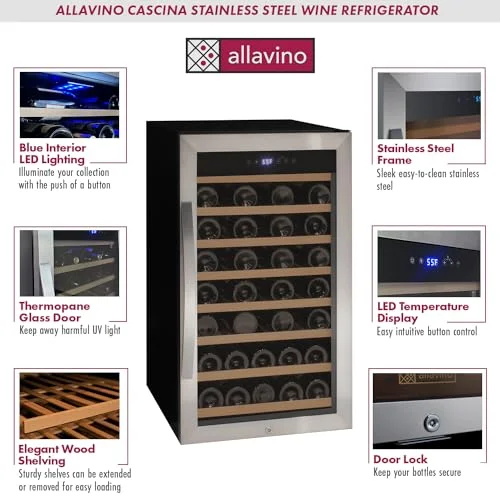
Allavino KWR50S-1SR Wine Refrigerator, 50 Bottle
Stainless construction over bare wood or painted trim
50 bottles·Stainless steel
Fifty bottles in a stainless-steel cabinet, inside and out, is the specification that matters most in an unfinished or chronically damp basement — a metal interior simply doesn't absorb ambient moisture the way wood shelving or painted particleboard trim does, which is exactly the slow failure mode discussed above. It's a straightforward single pick without extra features to worry about: no second zone, no display lighting, just capacity and a finish built to shrug off a damp room for years.
The pick for a basement where the room itself, not the weather, is the thing working against the fridge.
02Best if the basement already runs cool
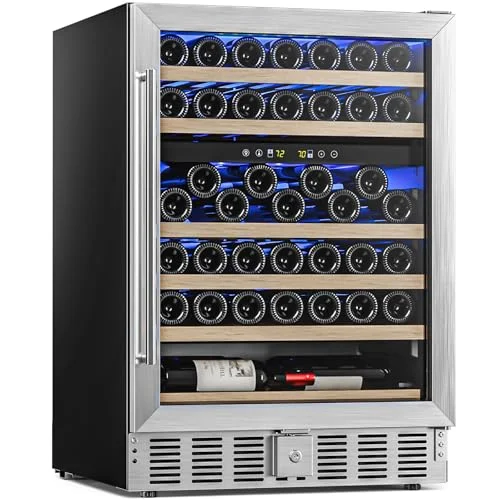
Antarctic Star 24 Inch, 52 Bottle Dual Zone
Built with margin on the cold end of its range
52 bottles·Dual zone·39–64°F·Built-in or freestanding
A quoted 39–64°F range reaches well below the temperature most basements already sit at, which is the margin that matters per the duty-cycle discussion above — this is a unit engineered to hold a low number comfortably, not one straining to get there. The glass door and dual zone mean reds and whites at different temperatures in one 24-inch footprint, and "built-in or freestanding" gives you the option to tuck it into a basement bar nook later without buying a second unit.
Pick this one specifically because its spec sheet doesn't stop at the edge of what your basement needs.
03Best for a finished basement bar
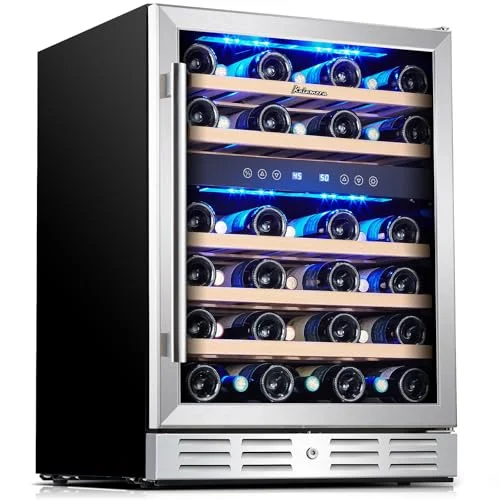
Kalamera 24 Inch Wine Cooler, Dual Zone
Built-in rated for a bar cabinet run
46 bottles (5.65 cu. ft.)·Dual zone·Built-in or freestanding
The variant worth buying here is the 24-inch dual-zone configuration rated at 46 bottles across 5.65 cubic feet. If the basement has a finished bar area with cabinetry already built out, the built-in rating is what lets this slot into a run rather than sitting as a standalone appliance — just confirm the cabinet opening has the clearance the listing specifies before you commit to enclosing it. Dual zone is the right call for a bar setting where someone is pouring different wines across an evening, rather than a pure storage room.
The pick if the basement is a room people actually gather in, not just a place bottles wait.
04Best for a collection that's going to keep growing
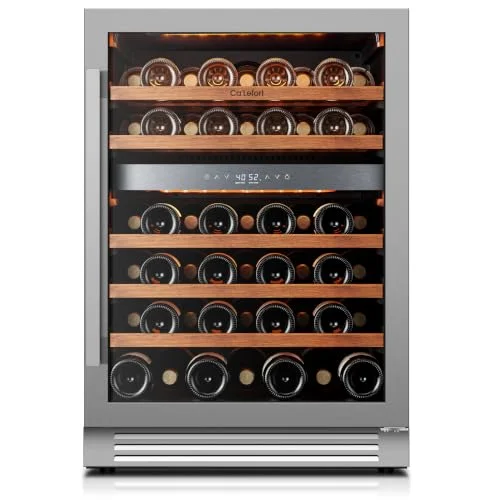
Ca'Lefort 24 Inch Wine Fridge, 52-Bottle Dual Zone
The most headroom of the four, for the room most likely to need it
52 bottles·Dual zone·24 inch
Fifty-two bottles across two zones is the largest capacity in this group, which matters most for exactly the scenario described in the capacity section above: a basement collection that starts modest and climbs. Buying toward the top of what a single 24-inch cabinet can hold now is cheaper than replacing a smaller unit in eighteen months once the "just a few bottles" shelf has quietly become a real collection.
Buy the headroom now; basements make it easy to fill it later.
When a passive cellar or a dedicated cooling unit makes more sense
A standalone compressor fridge isn't always the right tool for a basement, and it's worth saying so plainly before recommending four of them.
If the room is already a stable 55–65°F year-round with humidity under reasonable control — which some below-grade basements genuinely are, especially ones that are partially earth-sheltered or sit under a concrete slab with good drainage around the foundation — a passive cellar setup, essentially insulated racking in a naturally stable room with no active cooling at all, can store wine perfectly well without a compressor, a power draw, or a door seal to maintain. That only holds if the room's temperature doesn't swing meaningfully across the seasons; if summer heat or winter cold reaches the basement at all, you're back to needing active cooling of some kind.
The dividing line is room size and bottle count, not preference. A standalone wine fridge like the four above makes sense for a corner of a basement holding dozens to a couple hundred bottles. Once a basement room is being converted into an actual walk-in cellar — insulated walls, a sealed door, several hundred bottles or more — a dedicated split cellar cooling unit designed to condition an entire small room is the more appropriate category, not a larger version of a standalone fridge. That's a different purchase with different installation requirements, and outside the scope of what a 24-inch or 50-bottle unit is built to do.
For most households reading this, the honest answer is still a standalone unit: most basements have enough temperature and humidity variation across the year that an unconditioned passive setup leaves wine exposed during at least one season, and most collections are nowhere near the scale that justifies converting a whole room. The four picks above cover that middle ground — more deliberate than a kitchen counter unit, well short of a built-out cellar.
How we compared these — and what we cannot tell you
We compared published manufacturer specifications, current listed prices, and general, well-established facts about how compressor cooling, humidity and concrete floors interact — the kind of information that applies to this entire category of appliance, not to any one unit specifically. Where a specification wasn't published for a given product, such as a temperature range or installation rating, we said so rather than guessing or carrying over a number from a similar-looking listing.
We do not run a testing lab. We do not own these units, we do not install them in a basement for months to watch what happens, and you will not find an invented score out of ten or a fabricated star rating on this page — the retailer API does not return ratings or review counts for this category, and we do not publish numbers we cannot source. What we can do honestly is read the specification sheets carefully, track current prices, and apply sound, general reasoning about how refrigeration, moisture and concrete behave in a below-grade room.
Prices quoted here were correct at the time of writing and change frequently. Confirm the current price before buying.
Frequently asked questions
Do I really need an active wine fridge if my basement already stays cool?
Only if the room is also stable through every season and humidity stays in a reasonable range without help. Some below-grade basements genuinely qualify for a passive, unconditioned setup — see when a passive cellar makes more sense above. Most basements still see enough seasonal swing, or enough ambient humidity, that an active compressor unit with a sealed door is the safer choice.
Can I set a wine fridge directly on my basement's concrete floor?
You can, but it isn't the best idea long-term. A cold slab meeting humid basement air is a recipe for condensation right where the unit's feet and venting sit, which over years contributes to rust and seal wear. A simple raised pad or a few slats under the unit breaks that contact and is worth the five minutes it takes — see the condensation and placement section above.
Will the compressor run constantly because the basement is already cold?
It can run differently than it would in a kitchen — often in shorter, more frequent cycles rather than longer ones — because there's less of a gap between room temperature and setpoint for it to work against. That's generally normal rather than a fault, especially on a unit whose stated range comfortably covers temperatures below where your basement sits, like the Antarctic Star's 39–64°F. If it never settles into any quiet period at all, that's worth checking against our cycling-versus-problem guide.
How much bigger should I buy than what I own today?
More than feels necessary. Basement and cellar collections tend to grow faster than kitchen ones simply because there's room to let them, so buying near the top of a capacity tier — rather than exactly matching today's bottle count — tends to save a second purchase within a couple of years. See capacity planning above for rough tiers by bottle count.
Written by Ilane Tall. Research-based comparisons of published specifications, current prices and general product-category knowledge — we do not physically test these units and we do not publish invented scores.