By Ilane Tall · Updated October 19, 2026 · Research-based.
Reader-supported: we may earn a commission when you buy through the links on this page, at no additional cost to you. It never changes which product we recommend. Prices quoted below were correct at the time of writing and move often.
Quick answer
50 to 80 bottles is its own size class, not a bigger version of a 28-bottle fridge: more shelves, a compressor sized to cool a larger box evenly, and a footprint that usually jumps to 24 inches wide. Expect to spend $570 to $720 here, up from the $400–$500 tier a size down.
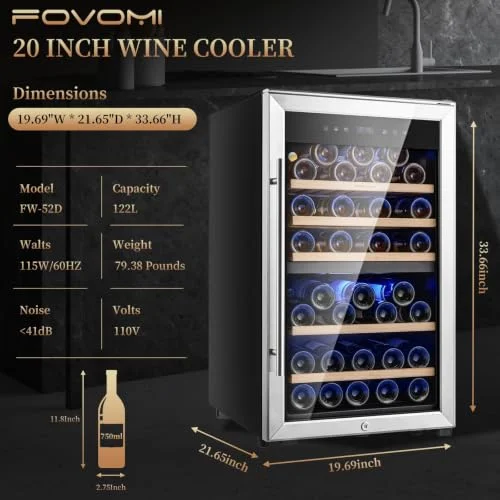
For most people still filling out a collection, the FOVOMI 52-Bottle Dual-Zone at $569.96 is the entry point — real dual-zone cooling and a shelf count built for the volume, at the low end of what this size costs.
Past fifty bottles and buying by the case, the GarveeHome 80 Bottle at $686.41 is the ceiling of this guide — see where 80 bottles stops being enough before you commit to it.
Why 50 to 80 bottles is its own size class
It is tempting to think of wine fridge capacity as one continuous line — 18 bottles, then 28, then 52, then 100 — where every step up is just the same cabinet stretched taller. It is not. Somewhere in the 50-bottle range, a wine fridge crosses from being a kitchen appliance that happens to hold wine into a piece of built-in or semi-built-in furniture that a room gets organized around, and the engineering underneath it changes to match.
Below 50 bottles, almost every cabinet on the market is a single compressor, a single insulated box, and a handful of wire or slatted shelves, sized to fit a standard counter or a narrow gap between cabinets. Above 50, the cabinet has to hold a meaningfully larger volume of air at one even temperature, support the physical weight of a fully loaded shelf without sagging, and do it across a wider footprint than the 15-inch class. None of that is optional once the bottle count gets this high — a 52-bottle fridge is not simply two 26-bottle fridges' worth of parts in a taller box.
The price reflects that: a bigger, evenly cooled box with more structural shelving genuinely costs more to build than a smaller one. The money goes into the parts that keep 50-plus bottles at one correct temperature, not into marketing.
What changes structurally at this size
Three things move together once a cabinet crosses into the 50-to-80-bottle range, and they are worth understanding individually before you compare any specific model.
01
Shelf count
A 28-bottle fridge typically runs 6 to 8 shelves. At 50 to 80 bottles, that climbs to 10 or more, often full-width racks rather than thin wire pull-outs, because the shelving has to carry real weight.
02
Compressor size
Cooling a larger insulated volume evenly takes a bigger compressor and more circulation. It is also why thermoelectric cooling essentially disappears at this size — it cannot reject enough heat at this volume.
03
Footprint
Below 50 bottles, 15 inches wide is the standard opening. At 50 to 80 bottles, 24 inches becomes common, or the unit goes freestanding and genuinely large instead.
04
Floor loading
A fully loaded 70-to-80-bottle cabinet is a genuinely heavy object. Where it sits and how the floor handles that weight over years is worth a moment's thought a countertop unit never requires.
The shelf count matters more than it sounds like it should. A wire shelf in a small fridge is fine because it only ever holds a handful of bottles across a narrow span. Spread that same thin wire across a 24-inch cabinet loaded with a full rack of bottles and it flexes, which is why the heavier-duty cabinets at this size — the finish and build quality of the cabinet itself included — tend to move to full-width, rigid shelving rather than wire pull-outs.
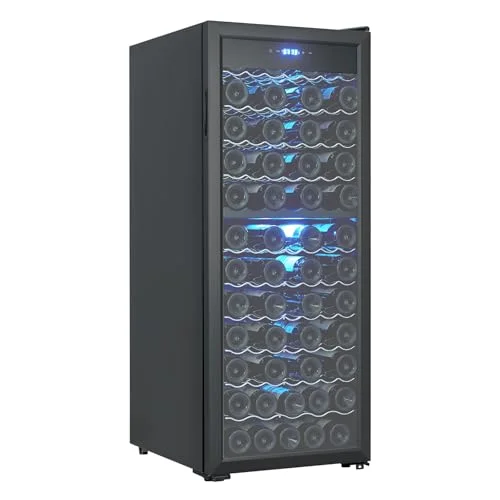
Compressor size is the part buyers notice least and should probably notice most. A compressor sized for 28 bottles asked to hold 70 evenly would either run constantly trying to catch up or fail to hold a stable temperature top to bottom. It is also why a genuinely large wine fridge almost never advertises thermoelectric cooling — the technology tops out well below this volume. The GarveeHome 80 Bottle states its cooling plainly as compressor, which at 80 bottles is not a premium feature so much as the only approach that works. If a compressor sounds louder than expected, that is normal cycling — our guide to compressor noise covers what is worth worrying about.
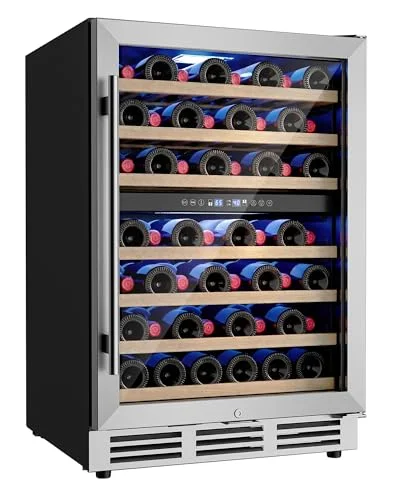
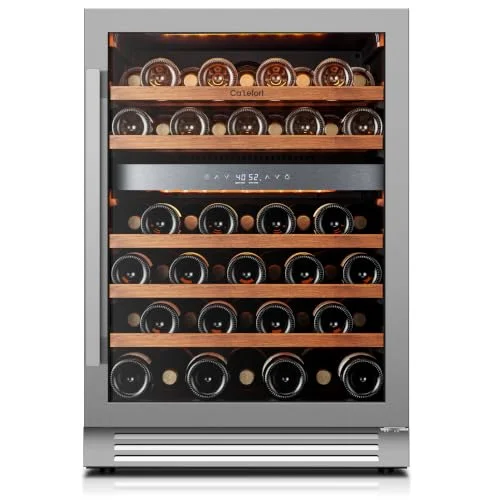
Footprint is the most visible change and the one that forces a decision before you buy. Two of the four cabinets here, the Icyglee and the Ca'Lefort, are built on a 24-inch frame — the width that has become standard once a cabinet needs to hold 50-plus bottles without stacking impractically tall. That opening is a real commitment in a kitchen remodel or a built-in run, which is why cabinets with a wider single footprint, like the FOVOMI and the GarveeHome, sometimes trade that width for a taller freestanding cabinet instead. Measure the space before the fridge, not after.
Single zone or dual zone, once you're past a casual collection
The single-zone-versus-dual-zone decision does not disappear at this size, but the stakes change. Below 30 bottles, a second zone is mostly about convenience — somewhere cold to park a white without a stop at the kitchen fridge. Past 50 bottles, it is closer to a planning problem: a serious collection usually includes both reds and whites in real rotation, which is exactly the household dual zone is built for, and three of the four cabinets in this guide answer that by shipping dual zone as standard.
The FOVOMI 52-Bottle, the Icyglee 54-Bottle, and the Ca'Lefort 24-Inch are all dual zone. That is not a coincidence of which four products we picked — dual zone is close to the default once a cabinet reaches this capacity, because a collection large enough to need 50-plus bottles is also, more often than not, large enough to include both colors at once. The one exception, the GarveeHome 80 Bottle, is not marketed with a second zone; its listing describes one digital temperature display across a 41–64°F range, the more traditional approach for a cabinet built to maximize raw capacity rather than split it.
A single, larger zone held at one correct cellar temperature — 55°F is the long-standing default — gives more usable shelf space per dollar, since none of the cabinet goes to a divider. A dual-zone cabinet at the same capacity trades some of that space for a serving-cold zone and a cellar-cold zone at once. Neither is objectively better; it depends on whether your household genuinely pours both colors weekly. A "dual zone" claim is only as good as the spread between its two compartments — where only one cabinet-wide range is published, treat the differential as unconfirmed rather than assuming it is wide.
The price jump from the $300–500 tier, and what it actually buys
A fridge in the 28-to-30-bottle class typically runs $400 to $500. The four cabinets in this guide run $569.96 to $683.98 — a jump of roughly $170 to $270. That is not a small gap, and it is worth being specific about where it goes rather than assuming it is simply a bigger number on the same kind of fridge.
Most of it goes into the structural changes covered above: more shelving material and a sturdier frame to support it, a larger-capacity compressor and circulation hardware to distribute cold air evenly, and for the 24-inch models, a wider and more expensive cabinet shell. None of that is discretionary this high — a 24-inch, 50-plus-bottle cabinet built with a 28-bottle fridge's compressor would fail to hold temperature evenly, particularly toward the top where warm air collects.
Price per bottle of stated capacity shows what each cabinet is actually charging for that structure. The FOVOMI 52-Bottle works out to about $10.96 per bottle; the Icyglee 54-Bottle is close behind at roughly $10.74. The GarveeHome 80 Bottle is the best per-bottle value of the four at about $8.58, tracking with its single-zone, capacity-first design — no divider eating into the math. The Ca'Lefort, built in to a 24-inch opening with a stated 52-bottle, 5.65-cubic-foot interior, comes out highest at roughly $13.84 per bottle, the premium a built-in-rated, dual-zone 24-inch cabinet commands over a freestanding one.
None of those numbers make one cabinet objectively better — they make explicit what you are trading. Built-in installation, dual zone, and a 24-inch footprint cost more per bottle than a large, single-zone, freestanding cabinet built to maximize capacity alone.
The picks across the range
Four cabinets, spanning the low end of this tier to its upper limit, chosen to cover the real decisions this size forces: zones, footprint, and whether built-in or freestanding fits your space.
When 80 bottles stops being enough
Eighty bottles sounds like a lot until a collection is actually built around it. Discount any of these stated capacities by the usual 70–80% once real bottle shapes enter the mix — Burgundy, Pinot and Champagne bottles are wider and heavier than the slim Bordeaux-style bottles manufacturers use to calculate the number — and the GarveeHome's 80 is realistically closer to 56 to 64 in practice. For a household filling out a first serious collection, that is plenty of room for years. For one buying by the case or joining a wine club, that ceiling arrives faster than the sticker number suggests.
The signal to watch for: if you are regularly topping out a cabinet within weeks of restocking it, that is the moment to stop shopping this tier and move to a genuinely large-capacity cabinet built for triple-digit bottle counts instead. At that scale the per-bottle economics continue to improve rather than simply charging more for the same architecture — the same pattern that makes the GarveeHome here the best per-bottle value within this guide's own range.
One category this tier does not really serve, despite the capacity, is a restaurant or small bar pouring by the glass night after night — that use case has duty-cycle and access requirements a household-grade cabinet isn't built around. Our guide to wine fridges for restaurants and small bars covers that scenario if commercial use is the actual job.
How we picked, and how we compared
We pulled every wine fridge in our product database stating a capacity between roughly 50 and 80 bottles, then filtered to listings with a clearly published zone configuration, cooling type or temperature range, and a current price — capacity, zones and price are what this tier actually turns on. We then compared the four finalists on those specifications plus footprint, installation type, and price per bottle of stated capacity. We do not have manufacturer-published star ratings or review counts for these listings, so none are shown or implied here — a limitation of the data available, not a judgment on the products. For how specific brands stack up more broadly, our brand comparison guide covers that separately.
We do not run a testing lab. We do not own these units and have not physically compared them, so you will not find an invented score out of ten here. What we can do honestly is read the specifications carefully, track the prices, and explain the structural trade-offs this price tier makes.
Prices quoted here were correct at the time of writing and change frequently. Confirm the current price before buying.
Frequently asked questions
What actually makes 50 to 80 bottles a different size class, rather than just a bigger version of a smaller fridge?
The structure, not just the number. At this capacity a cabinet needs sturdier shelving to carry the physical weight, a larger compressor and better internal air circulation to hold an even temperature across a bigger insulated box, and usually a wider footprint — 24 inches rather than the 15-inch standard a tier down. None of that scales linearly from a smaller cabinet; it is engineered differently from the start.
Do I need dual zone once I'm past 50 bottles, or is single zone the better call at this size?
It depends on whether your household genuinely keeps both reds and whites in regular rotation. Three of the four cabinets in this guide ship dual zone as standard, reflecting how common a mixed collection becomes at this capacity — but the GarveeHome 80 Bottle shows that a single larger zone, with no shelf space lost to a divider, is still the better math if raw capacity matters more than a serving-cold compartment.
Why do 50-to-80-bottle wine fridges cost so much more than a $400 fridge?
Mostly structural reasons: more shelving built to support real weight, a compressor and circulation system sized to cool a larger box evenly, and for 24-inch models, a wider cabinet shell. The cabinets here run $569.96 to $683.98, versus roughly $400 to $500 for a 28-to-30-bottle cabinet a tier down — a jump that tracks with those structural changes rather than branding.
At what point should I stop shopping this tier and move to a larger-capacity cabinet instead?
Once you are regularly topping out a cabinet within weeks of restocking it, buying wine by the case on a recurring basis, or already discounting an 80-bottle rating down to the real 56-to-64-bottle figure and still running out of room. At that point, a cabinet built for triple-digit capacity beats staying in this tier and simply buying a second fridge.
Written by Ilane Tall. Research-based comparisons of published specifications, current prices and public product data — we do not physically test these units and we do not publish invented scores.