By Ilane Tall · Updated October 12, 2026 · Research-based.
Reader-supported: we may earn a commission when you buy through the links on this page, at no additional cost to you. It never changes which product we recommend. Prices quoted below were correct at the time of writing and move often.
The short version
These four brands get compared constantly online, almost always on vibes: which one "feels" premium, which one has the nicer product photos. We compared what is actually published — price, capacity, zones, installation type and the rare case where a warranty term is stated outright.
Only Koolatron's listing tells you its cooling technology outright. The other three leave it unstated, which is itself useful information: a brand that doesn't publish a spec is a brand you have to verify yourself before you buy, not one you can take on faith.
If you only read one section, read how to read a warranty page — it is a more reliable signal than anything a star rating would have told you, and none of these four products carry one in our database.
Why brand comparisons on this topic read like marketing copy
Search "Ivation vs NewAir" or any permutation of these four names and most of what comes back is the same handful of manufacturer bullet points, reordered and reworded into a listicle. "Premium build," "whisper quiet," "sleek modern design" — phrases copied from the product title into the article and back out again, with nothing added and nothing checked. None of it tells you whether the fridge you're about to buy will still be cooling properly in year three.
What is actually checkable, for any of these brands, is narrower and more useful: the price on the day you look, the capacity and zone count the listing states, whether the unit is rated for built-in installation or freestanding only, the stated temperature range if one is given, and — far less often than it should be — the warranty terms. Star ratings and review counts get cited constantly in this kind of comparison, and we are deliberately leaving them out: our product database does not carry rating or review figures for any of the four models below, and we are not going to estimate them to make the page look more complete.
A concrete example of why the fine print matters more than the headline: the NewAir unit we priced for this comparison is titled as a 29-bottle model, but the specific variant tied to the price and image below is listed at 28. Trivial for most buyers, but it's the whole argument in miniature — the big number in a title describes a family of near-identical SKUs, and the variant detail is what actually ships. Before you buy from any of these brands, read the buying checklist against the specific listing, not the search-result headline.
01
Ivation
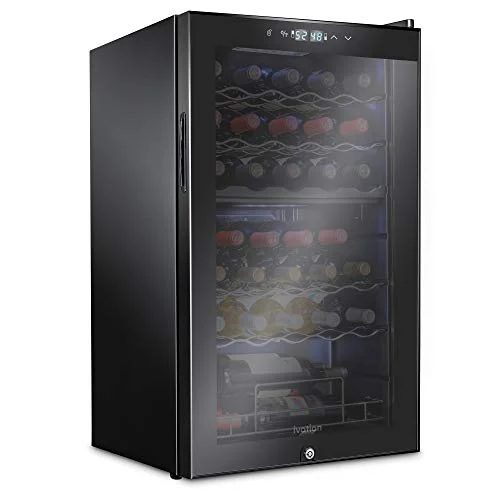
Broad catalog spanning both compressor and thermoelectric lines. This 33-bottle model doesn't state which, directly.
02
NewAir
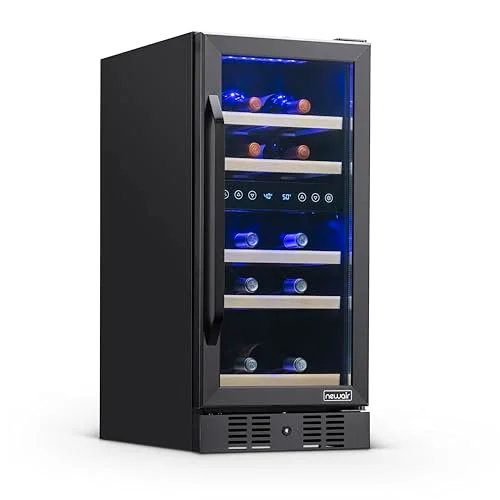
Built-in or freestanding, wood shelves, a glass door — build-quality signals, with pane count left unstated here.
03
Euhomy
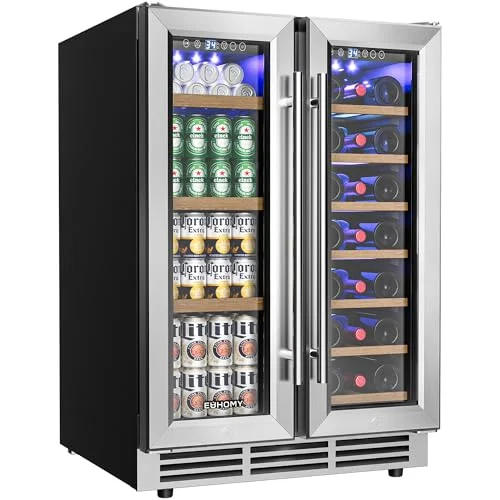
Known for inexpensive compressor units. The model we found in this comparison is not the inexpensive one.
04
Koolatron
States its cooling technology outright: thermoelectric, dual zone. The one spec here nobody has to guess at.
Ivation: catalog breadth, and where compressor meets thermoelectric
Ivation's catalog is wide enough that "an Ivation wine fridge" doesn't tell you much on its own — the brand sells units across both major cooling technologies, from small thermoelectric coolers through mid-size compressor cabinets. That breadth is why a brand-level comparison of Ivation is harder than it looks: two listings with the same name can behave completely differently once the room gets warm.
The specific model here is the 33-bottle dual-zone unit, priced at $419.99, with a lock, UV-resistant glass door and a quoted 41–64°F range. The listing doesn't state outright whether this one is compressor or thermoelectric cooled — a gap worth flagging rather than papering over. What we can say honestly: a 41°F floor on a dual-zone cabinet is a meaningful data point, since thermoelectric cooling generally only pulls about 20°F below whatever the room is doing. Reaching into the low 40s regardless of room temperature is a spread far more associated with compressor cooling — an inference from the published range, not a confirmed spec. Check the listing's own specification table if the cooling technology matters to your decision, because a brand that sells both lines is a brand where you cannot assume.
What is confirmed: the lock, which matters more than it sounds for anyone keeping this in a home bar or a space with guests passing through, and the freestanding-only installation — this is not a model to build into a cabinet run.
NewAir: build-quality signals, and the double-pane question
NewAir leans on build-quality language across its catalog more than most competitors in this price range — double-pane and triple-pane glass doors show up repeatedly in its listings, framed as insulation against both heat and UV exposure rather than just a design choice. That's worth caring about: more layers of glass means less thermal transfer through the one part of the cabinet that isn't insulated foam, part of why glass-door wine fridges generally run slightly less efficiently than solid-door units.
The 15-inch dual-zone model we priced at $530.11 states a glass door and wood shelving directly, and — unusually among the four brands here — is rated for both built-in and freestanding installation, which is the single biggest functional difference in this whole comparison. Most dual-zone cabinets at this size are freestanding only; a unit genuinely rated for enclosure is worth the premium if you plan to build it under a counter. What the listing doesn't itemize is the exact pane count behind "precision cooling" — treat that phrase as marketing until it's backed by a published temperature-hold tolerance, and check the specification tab directly if pane count matters to you.
Capacity for this unit is 28 bottles per the variant we priced, not the 29 the title advertises — the discrepancy we flagged above. Either number puts it in the same rough range as the Ivation, at a higher price, with built-in installation as the thing you'd actually be paying for.
Euhomy: the budget-compressor reputation — and this particular model
Euhomy's standing in this category rests on compressor coolers priced below what more established brands charge for similar capacity — that's the brand's core pitch, and a real one at the smaller end of its catalog. Worth being direct about where it does and doesn't apply here.
The Euhomy unit in this comparison is a 24-inch dual-zone wine and beverage refrigerator priced at $577.99 — the most expensive of the four brands in this piece, not the least. If "Euhomy" means "cheap" to you, this model is the exception: it's a larger dual-zone cabinet, and the price reflects that size rather than any premium positioning. The budget-compressor value case Euhomy is actually known for plays out further down its catalog, at smaller single-zone capacities we aren't comparing on this page.
That's not a knock on the unit — a 24-inch dual-zone cabinet at this price is reasonable if the size and zone count are what you need. It's a reminder that brand reputation and specific-model pricing are two different questions. If you're shopping by size rather than brand, our guide to choosing a wine fridge width covers what a 24-inch footprint typically buys across brands.
Koolatron: the thermoelectric specialist, and where the cooling ceiling shows up
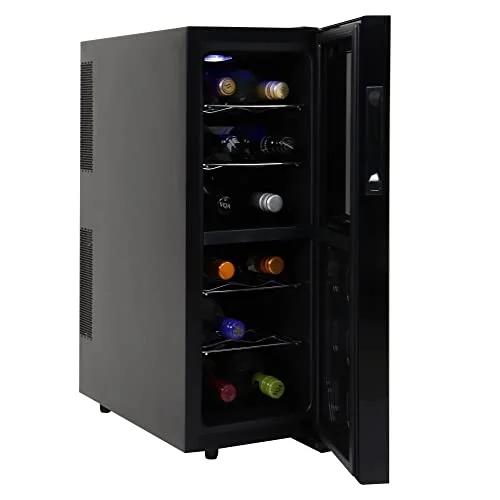
Koolatron is the one brand here that states its cooling technology directly in the listing: dual zone, thermoelectric. That single disclosed spec is the most useful thing on this page, because it lets us say something concrete rather than inferred. Thermoelectric cooling uses a solid-state element instead of a compressor and refrigerant loop — no hum, no vibration, which is why Koolatron markets this unit for kitchens, apartments and RVs, the small, quiet spaces where a compressor's noise and footprint are a real downside.
The ceiling is real, though, and it's a function of the technology rather than this brand's engineering: thermoelectric cooling pulls roughly 20°F below whatever temperature the room is holding, not down to a fixed low number the way a compressor can. In a 70°F room that's a workable cellar temperature; in a garage that hits 85°F in summer, the same unit plateaus well above where wine should be stored, regardless of the dial setting. That tradeoff applies to every thermoelectric wine fridge on the market — Koolatron is simply the brand here that tells you upfront which one you're buying.
At 12 bottles and $252.99, this is also the smallest and least expensive of the four. For a studio apartment, a bedroom bar cart upgrade, or genuinely for an RV kept in a temperate climate, that combination of silence, size and price is the honest case for buying it. For a warm garage, it is the wrong technology no matter which brand's name is on the door — see our breakdown of condensation issues if a glass door is already fogging on a unit like this one.
The picks, one per brand
Four different jobs, four different brands. None of these is a universal "winner" — the right one depends on which column in the table above actually matters for your space.
How to read a warranty page instead of a star rating
None of the four products in this comparison carry a star rating or review count in our database, and we aren't going to invent one just because a "versus" article feels incomplete without stars next to each name. What's actually available, if you go looking, is more useful anyway: the warranty terms each brand publishes. A warranty page tells you what the manufacturer itself is willing to be on the hook for, which is a more honest signal than a rating that can be influenced by review solicitation, return timing, or simple small-sample noise.
Here's what to actually check, on any of these four brands or any other wine-fridge listing:
- Overall coverage period versus compressor-specific coverage. Many appliance brands cover the cabinet and electronics for one term — often a year — and the sealed cooling system for longer, since that's the part most likely to fail and most expensive to fix. If a warranty page only states one number, ask which component it covers.
- Parts versus labor. Covering replacement parts but not the technician's time to install them is a materially smaller promise than covering both, even at the same headline length.
- Who processes the claim. Some brands handle warranty service directly; others route it through the marketplace or a third-party network. The difference shows up the day something breaks, not on the spec sheet.
- Conditions that void it. Built-in installation of a freestanding-only unit is the single most common way a wine-fridge warranty gets voided before the appliance ever fails on its own — why installation rating is one of the specs called out for each brand above.
- Registration requirements. A warranty requiring registration within 30 days is functionally different from one automatic from the ship date. Check this before you buy.
We don't have verified warranty-length figures for these four listings to compare side by side, and we won't publish a number we can't source. What we can tell you is where to look: the manufacturer's own site, the "Product guides and documents" section Amazon attaches to many appliance listings, and the listing's Q&A section, where past buyers sometimes report their actual warranty experience — closer to a real review than any star count, because it describes what happened rather than a number out of five.
The pattern worth remembering: a brand that publishes detailed, specific warranty terms is telling you it's comfortable being held to them. A brand whose warranty page is a single vague sentence is telling you something too.
How we compared these — and what we can't tell you
We compared the published prices, stated capacities, zone counts, installation ratings and any temperature range given directly in each brand's listing. Where a listing left a spec unstated — cooling technology for three of the four brands here, bottle count for the Euhomy unit — we said so explicitly rather than filling the gap with an industry-typical guess.
We do not run a testing lab, we have not physically compared these four units side by side in a room, and we do not publish invented scores out of ten. You will not find a star rating or a review count on this page because our product database does not carry one for any of these four listings. What we can do honestly is read each brand's own published claims carefully, note where they agree with general facts about the underlying cooling technology, and flag plainly where a brand's marketing language outruns what it actually states in writing.
Prices quoted here were correct at the time of writing and change frequently. Confirm the current price before buying.
Frequently asked questions
Which of these four brands has the best warranty?
We don't have verified warranty-length figures for these listings to compare honestly, so we won't rank them on a spec we can't source. Check the manufacturer's site and the "Product guides and documents" section on the Amazon listing, and read the warranty-reading guide above for what to look for once you find it.
Is thermoelectric or compressor cooling better across these brands?
Neither is universally better — it depends on the room. Koolatron's unit is thermoelectric, confirmed directly in its listing, and pulls roughly 20°F below ambient. The 41°F floor quoted on the Ivation model points toward compressor cooling, though its listing doesn't say so outright. If the room ever gets warm, compressor cooling is the safer bet regardless of brand.
Why doesn't this comparison show star ratings for these products?
Because we don't have them. Our product database carries no rating or review count for any of these four listings, and inventing one would be the same offense as inventing a spec. We anchor every claim in published prices, specs and listing language instead.
Do any of these four fit under a counter?
Only the NewAir 15" model is explicitly rated for built-in or freestanding installation. The Ivation and Koolatron units are stated as freestanding, and Euhomy's listing doesn't state an installation type at all — confirm directly before enclosing any of them, since building in a freestanding-only unit is a common and expensive mistake. Our guide to choosing a wine fridge width covers how installation type and footprint interact.
Written by Ilane Tall. Research-based comparisons of published specifications, current prices and brand-stated claims — we do not physically test these units and we do not publish invented scores or ratings.