By Ilane Tall · Updated October 9, 2026 · Research-based.
Reader-supported: we may earn a commission when you buy through the links on this page, at no additional cost to you. It never changes which product we recommend. Prices quoted below were correct at the time of writing and move often.
Quick answer
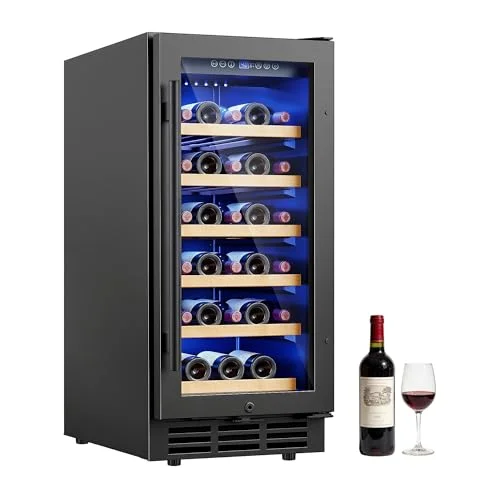
Past $300, the extra money buys three specific things: a compressor that holds its number instead of chasing the room, a dual zone with a differential wide enough to be worth the divider, and glass built to survive years of a door cycling in a warm kitchen. The ICEVIVAL 15 Inch 28 Bottle at $399.99 is the pick for most people whose collection is still mostly one colour — real compressor cooling, digital control, and a 15-inch width that fits a standard cabinet opening.
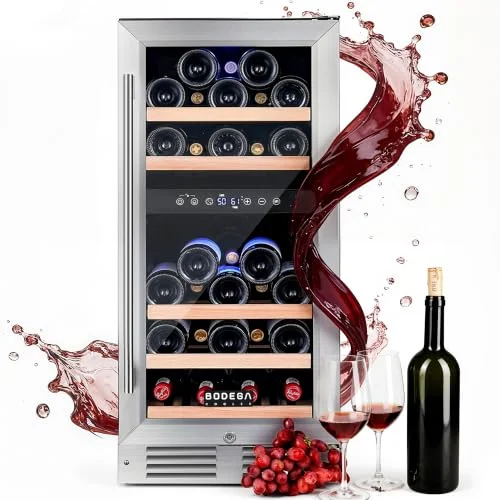
If reds and whites are genuinely both in rotation, the BODEGA 15 Inch 30 Bottle Dual Zone at $499.99 is where a real second zone — not just a second display — becomes affordable, with a published 41–72°F range split across two compressor-cooled compartments and a tempered glass door.
And if you are already past 40 bottles, or buying a case at a time, read where $500 stops being enough before you spend it — at that size, a larger-capacity cabinet is simply the better math.
What actually changes between $300 and $500
Spend $300 on a wine fridge and, with few exceptions, you are buying a single-zone compressor cabinet with double-layer glass and wire shelving — a perfectly good appliance, and the subject of our separate guide to what to check before you buy at any price. Spend another $100 to $200 and three things shift, in a fairly predictable order, and none of them are cosmetic.
The first is cooling consistency rather than cooling type. Thermoelectric units mostly disappear above $300 regardless of brand, so the real shift in this tier isn't compressor-versus-Peltier anymore — it's how hard that compressor has to work and how evenly it holds the number it's set to. A 15-inch cabinet sits closer to ambient heat sources than a wide one — a counter, a window, a warm interior wall — and a well-built compressor at this price is sized to fight that without cycling constantly or running loud. The ICEVIVAL below pairs compressor cooling with digital temperature control and UV-protected glass specifically because a narrow cabinet has less thermal mass to buffer it.
The second is zone precision, which is a different thing from zone count. A dual-zone fridge under $300 is often one compressor with a physical divider and two displays showing numbers that barely differ from each other. Somewhere around $400 to $500, the differential starts being wide enough to actually matter: the BODEGA below publishes a 41–72°F range across its two compartments, which is a real spread between a serving zone and a storage zone, not a cosmetic one. The next section covers exactly how to verify that spread on any listing before you buy, rather than taking "dual zone" at face value.
The third is glass and door hardware. Tempered glass starts showing up on listings in this range in place of standard double-pane glass, and it matters for reasons that have nothing to do with looks. Tempered glass tolerates the thermal cycling of a compressor door opening and closing in a warm kitchen better than standard glass, and it is the safer failure mode if a door seal ages and the glass ever takes an impact. The BODEGA's listing specifically states a tempered glass door; it's worth confirming on any model you're comparing in this range, since a listing that stays silent on glass type is a listing worth asking the seller about directly before you order.
Dual zone becomes realistic here — but check the spec, not the label
"Dual zone" is a label, not a guarantee. Because one compressor typically serves both compartments in a split cabinet, the achievable gap between the warm half and the cold half depends entirely on the engineering behind that one label — and the only way to know whether it's real is to find the number for each zone individually, not the number for the cabinet as a whole.
The BODEGA 15 Inch Dual Zone is a useful example of what to look for, because its listing does the thing most budget dual-zone units don't: it states a 41–72°F range for the cabinet, which is wide enough on its face to suggest the two compartments can sit well apart from each other — cellar-cold on one side, close to room temperature on the other. That published spread is exactly the detail that separates a dual-zone fridge worth paying for from one that's dual-zone in name only.
Red flag
The listing gives one temperature range for the whole cabinet and never breaks it out by zone. Treat that silence as a sign the differential is narrow, and ask the seller directly before ordering.
What to look for
A published range per zone, or a published range for the cabinet wide enough — like the BODEGA's 41–72°F — that a meaningful split between the two halves is actually plausible.
This is also where it pays to be honest about why you want two zones at all. A growing collection that's still mostly red doesn't need a serving zone for white — it needs more shelf space at one correct storage temperature, which is exactly what a single-zone cabinet like the ICEVIVAL gives you without spending part of the budget on a divider. Two zones earn their price when reds and whites are both genuinely in rotation and someone wants to pour a chilled white without a stop at the kitchen fridge first. If that's not your household yet, the single-zone pick in this guide is the better $400.
Compressor cooling as the default here — and why that matters for a growing collection
Both products in this guide use compressor cooling, and at this price that's not a coincidence — it's close to the whole category. Compressor cooling works the same way a kitchen refrigerator does: a motor compresses refrigerant, which then absorbs heat as it expands, and the system holds its setpoint regardless of what the room around it is doing. That's the opposite of thermoelectric cooling, which can only pull the interior down to roughly 20°F below ambient and gives up the moment a kitchen gets warm in the afternoon sun or in August.
For a static collection of a dozen bottles, that difference is a comfort. For a growing collection, it's closer to a requirement. A cabinet that's adding bottles every few months is also, almost by definition, a cabinet that's getting opened more often — and every door opening lets warm room air in that the compressor then has to pull back down. A compressor does that reliably across months and years of exactly this cycle; a thermoelectric module does it until the room has a warm week, and then it doesn't. Stability matters more than any single setpoint here: wine stored at a steady 57°F fares better over time than wine in a cabinet that swings between 50°F and 64°F while averaging a number that looks fine on paper.
The practical upshot for a collection that's still being built is simple: compressor cooling is the one spec in this price range not worth compromising on, and above $400 you mostly don't have to. Both the ICEVIVAL and the BODEGA below are compressor units for exactly that reason.
Capacity headroom: buy for next year's case count, not this year's
The most common mistake in this price range isn't a bad cooling choice — it's buying exactly enough fridge for the collection you have today. A growing collection, by definition, won't fit the same cabinet in twelve months that it fits now, and a wine fridge is not a purchase most people repeat every year.
Start with the math manufacturers use, and then discount it. Every bottle count on every box in this category — the ICEVIVAL's 28, the BODEGA's 30 — is calculated using slim, standard 750ml Bordeaux-style bottles stacked as tightly as geometry allows. Burgundy and Pinot Noir bottles are noticeably wider through the shoulder; Champagne and other sparkling bottles are wider still, and heavier, because they're built to hold pressure. A reasonable planning number, once a collection includes anything other than uniform slim reds, is 70–80% of the stated capacity. A 28-bottle cabinet is realistically a 20-to-22-bottle cabinet for most people's actual buying habits.
Now add the case math. Wine is commonly bought and shipped by the case — twelve bottles at a time, from a club, a direct shipment, or a case discount at a retailer. If a 28-bottle fridge is really holding 20 to 22 bottles of what you own, one case purchase can fill most of what's left in a single order. That's the headroom problem: it isn't that the fridge is undersized today, it's that "today" is a moving target for anyone whose collection is actually growing, and the gap between the advertised number and the real number closes faster than people expect.
Width matters here too, and it's worth deciding on deliberately rather than by accident. Both products in this guide are sized differently for a reason: the ICEVIVAL and BODEGA are both 15 inches, the standard undercounter cabinet opening, while a 24-inch cabinet holds meaningfully more in the same general price range once you're willing to give up that narrower footprint. Our guide to choosing wine fridge width walks through that trade-off in detail before you commit to a cabinet size you can't change later without a new hole in the counter.
The picks
Two products, because at this price the right choice usually comes down to one question: is this collection still mostly one colour, or is it genuinely a mix of reds and whites in regular rotation?
The point where $500 stops being enough
Five hundred dollars buys a real, compressor-cooled, often dual-zone cabinet for 28 to 30 bottles. It does not buy that same specification at double the capacity, and a collection that's genuinely growing will eventually run into that ceiling — usually faster than people expect, for the case-math reasons covered above.
The next step up in both capacity and width looks like the OYLUS 24" Wine Fridge, 46 Bottles Dual Zone, at $631.69. It's a useful marker for exactly where the $500 tier ends: a 24-inch cabinet, nearly 50% more rated capacity than the BODEGA, with a published 41–64°F range across its zones per the listing — at a price that sits meaningfully above this guide's budget. That jump in price for that jump in capacity and width is the honest trade once 30 bottles, discounted for real bottle shapes, stops being enough shelf space.
If that's already you — past roughly 40 bottles, buying by the case, or simply done discounting a 28-bottle rating down to 20 real bottles every few months — the better move isn't to keep shopping the $400–$600 bracket. It's to size up deliberately. Our guide to large wine fridges, 100 bottles and up, covers the cabinets built for that scale, where the per-bottle economics actually improve rather than simply charging more for the same architecture.
For reference: OYLUS 24" Wine Fridge, 46 Bottles Dual Zone — $631.69, 24-inch width, dual zone.
None of this is a reason to overbuy now. A collection that's genuinely at 15 to 20 bottles and growing slowly is well served by either pick in this guide for years, not months. The ceiling matters for planning, not for panic — know roughly where it is, and size your next purchase to the collection you're actually building rather than to the biggest number you can afford today.
How we picked
We started from every wine fridge listed for sale in the US priced between roughly $350 and $500, pulled from our own product database rather than a general search, and filtered for units with a clearly published cooling type, capacity, and current price. We excluded anything where the listing didn't state whether cooling was compressor or thermoelectric, since that single specification affects the buying decision more than any other in this guide.
How we compared
We compared the products above on published manufacturer specifications and current Amazon prices: cooling type, zone count and published temperature range, cabinet width, installation type, and price per bottle of stated capacity. We do not have manufacturer-published star ratings or review counts for these listings, so none are shown or implied anywhere on this page — that is a limitation of the data we have, not a judgment on the products, and we do not estimate or paraphrase sentiment we cannot source.
We do not run a testing lab. We do not own these units and we have not physically compared them, so you will not find an invented score out of ten here. What we can do honestly is read the specifications carefully, track the prices, and explain which trade-offs the price point makes — because, as above, those trade-offs repeat across the category regardless of brand.
Prices quoted here were correct at the time of writing and change frequently. Confirm the current price before buying.
Frequently asked questions
Is $500 enough for a dual-zone wine fridge that actually works?
Yes, provided the listing publishes a real temperature differential rather than a single cabinet-wide number with no breakdown by zone. The BODEGA 15 Inch Dual Zone at $499.99 publishes a 41–72°F range, which is the kind of spread that makes a second zone worth its price. Treat a listing that stays silent on per-zone ranges as a reason to ask before buying, not a reason to assume the worst.
Do I need compressor cooling at this price, or is thermoelectric still an option?
Compressor cooling is effectively the default above roughly $350 to $400, and for good reason: it holds its setpoint regardless of room temperature, where thermoelectric cooling can only pull about 20°F below ambient and loses control once a room gets warm. Both products in this guide use compressor cooling, which is the right call for a cabinet that will be opened often as a collection grows.
How many bottles will a 28-to-30-bottle wine fridge really hold?
Realistically 70–80% of the advertised number once your collection includes anything other than uniform, slim red-wine bottles. Burgundy, Pinot and Champagne bottles are wider and heavier, and waste more rack space. Plan on roughly 20 to 24 bottles from a cabinet rated for 28 to 30, and buy ahead of that number rather than to it.
At what point should I skip the $400–$500 tier and buy a larger cabinet instead?
Once you're regularly buying wine by the case, already own more than about 40 bottles, or find yourself discounting a 28-to-30-bottle rating down to 20 real bottles every few months. At that point a cabinet built for higher capacity, like the ones in our large wine fridges guide, is a better use of the budget than another 28-bottle cabinet in a year or two.
Written by Ilane Tall. Research-based comparisons of published specifications, current prices and public product data — we do not physically test these units and we do not publish invented scores.