By Ilane Tall · Updated October 8, 2026 · Research-based.
Reader-supported: we may earn a commission when you buy through the links on this page, at no additional cost to you. It never changes which product we recommend. Prices quoted below were correct at the time of writing and move often.
The short version
A wine fridge's width is not a specification you adjust for — it's a constraint set by your cabinetry, your countertop, or the end of your counter, and it exists before you ever look at bottle counts. 12-inch units fill a narrow gap or a slim end-of-counter spot. 15-inch is the standard built-in cabinet opening, which is why most under-counter wine fridges on the market are built to that width. 24-inch uses a full cabinet-run slot, the same footprint as a dishwasher, and is where capacity and dual zones stop being a squeeze.
Measure your actual opening before you shop by style or capacity — see measuring your own space below. A fridge that's one inch too wide doesn't fit a little; it doesn't fit at all.
Why width, not bottle count, is the first filter
Most wine fridge shopping starts with a number: "I want something that holds 30 bottles" or "I need room for my whole collection." That's a reasonable second question. It's the wrong first one, because bottle count is flexible — you can buy a bigger or smaller unit at nearly any width — while the space you have for it is not. A wine fridge is a rigid box. It does not compress to fit a gap, and a cabinet opening does not stretch to fit a fridge.
That's the practical reason the category has settled into three recognizable width classes rather than a continuous range of sizes. Manufacturers build to the openings people actually have: a narrow leftover gap, a standard under-counter cabinet slot, or a full-width appliance bay. Shopping by capacity first and width second is how people end up with a wine fridge sitting in a box in the garage because it doesn't fit where they measured — after the fact.
The width also tells you something about the appliance itself beyond the measuring tape. A narrower cabinet has less room for a divider, less room for airflow, and less room for a second compressor zone. A wider one can afford to give some of that width to a zone wall, to beverage shelving, or to extra depth for taller bottles. Width and capability move together — which is why the right question is "what width fits my space, and what does that width class actually deliver," not "which fridge has the highest number on the box."
12-inch class
Narrow-gap and end-of-counter format. Fits where nothing wider will. Single zone, modest bottle count, almost always freestanding.
15-inch class
The standard built-in cabinet opening. Dominates the under-counter market because most kitchen cabinetry is built around this width already.
24-inch class
A full cabinet-run slot — dishwasher width. Room for real capacity, a true second zone, or a wine-and-beverage split.
12-inch: the narrow-gap and end-of-counter format
A 12-inch-class wine fridge is built for the spot nothing else fits: the sliver of counter at the end of a run, the gap beside a refrigerator, a corner of a home office or bedroom where a full cabinet-width appliance was never going to go. These units are almost always freestanding — sold to stand on a countertop or floor with clearance on all sides, not to be sealed into a cabinet.
The EUHOMY 12 Bottle Wine Cooler Refrigerator, Wine Fridge with Lock is representative of what this class actually measures and delivers. EUHOMY lists it at 10.7 inches wide, 19.2 inches deep and 30.9 inches tall — narrow enough to leave real clearance in a 12-inch cabinet opening or a tight end-of-counter spot, while still standing tall enough to hold a dozen bottles upright on five removable chrome-plated shelves. It's single zone, cooled by a compressor rather than a thermoelectric module, with a stated 41–64°F range and a touchscreen that adjusts the setpoint without opening the door. EUHOMY also fits a lockable door and a hidden handle, both common at this width because the format is marketed as much for a bedroom, home office or small bar as for a kitchen.
What you give up at this width is exactly what you'd expect: one zone instead of two, a dozen bottles rather than dozens, and no realistic path to building it into finished cabinetry — the clearance and venting that built-in installation requires simply isn't engineered in at this size. What you gain is placement flexibility nothing wider offers. If your actual problem is a narrow leftover gap rather than a shortage of bottle storage, a 15-inch unit that won't physically fit is not a better fridge for you — it's an unusable one. This is the width class that matters most for apartments and rentals, where a cabinet cutout isn't an option and the fridge needs to stand freely and move with you when the lease ends.
15-inch: the standard cabinet opening, and why it dominates built-in
Fifteen inches is the width most kitchen cabinetry was already built around before wine fridges were a category — it's the standard single-cabinet-door opening in a huge share of American kitchens. That's the real reason 15-inch dominates the built-in wine fridge market: manufacturers aren't choosing this width arbitrarily, they're building to the slot that already exists in the most kitchens.
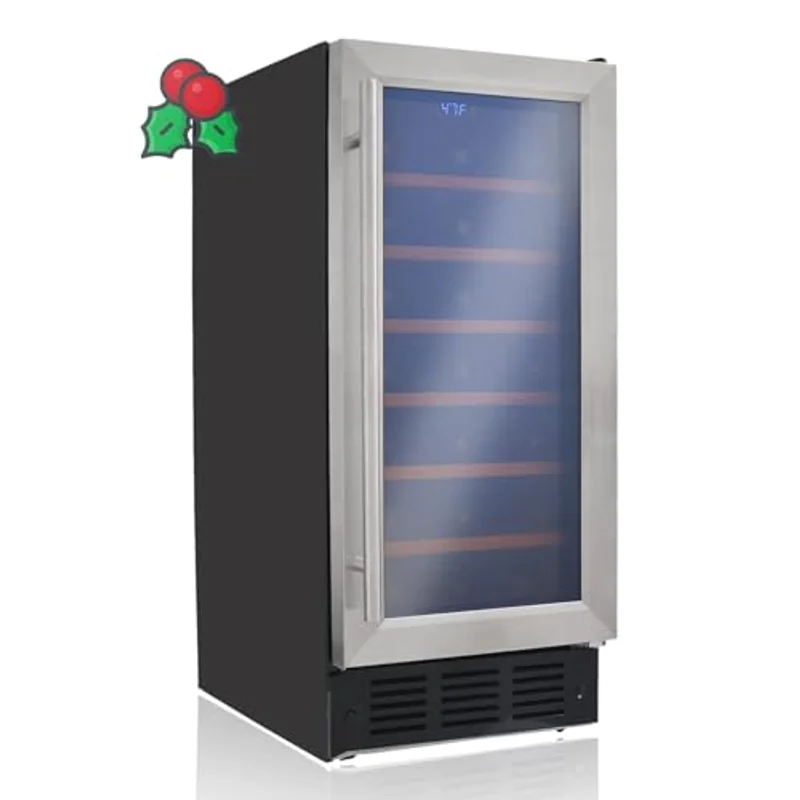
The Techomey 15 Inch Wine Fridge Under Counter, Upgraded 31 Bottles shows what that width buys once a manufacturer commits engineering to the built-in use case rather than just the measurement. It's a single-zone unit holding 31 standard 750ml bottles on six beech wood sliding racks, with touchpad controls maintaining a 39–64°F range. The double UV-resistant glass door is the detail that matters most for a unit that will likely sit exposed under a counter in daylight — UV is one of the few things that degrades wine faster than heat. Techomey builds it for under-counter installation and for freestanding use, which is the flexibility this width is known for: the same cabinet that slots into a 15-inch opening today can stand on its own in a different room tomorrow.
Thirty-one bottles in a 15-inch footprint is a genuinely efficient use of that opening, and it's why this width wins the built-in category by volume rather than by being the biggest. Fifteen inches is also, not coincidentally, too narrow to split sensibly into two temperature zones — divide a cabinet this size in half and each compartment is too small to be useful, which is the real reason dual-zone units at this exact width are rare and tend to disappoint when they do exist. Single zone here isn't a cost-cutting compromise; it's the correct engineering choice for the opening. Before committing a 15-inch cabinet slot to any fridge, it's worth reading our buying checklist — venting direction and clearance are the two specs that decide whether a built-in installation survives its first summer.
24-inch: full cabinet-run width, and when the extra capacity is worth it
Twenty-four inches is the width of a standard dishwasher bay — a full appliance slot in a cabinet run, not a leftover gap. At this width, a manufacturer finally has enough room to do something a narrower cabinet physically cannot: fit a genuine second cooling zone with its own shelving, rather than a token divider.
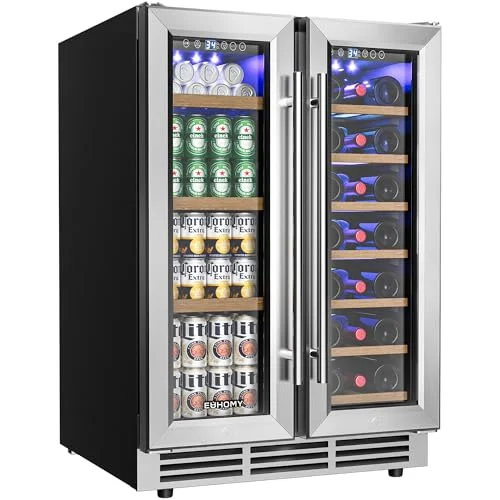
The EUHOMY Wine and Beverage Refrigerator, 24 Inch Dual Zone Wine Cooler is the clearest example of what that extra width is spent on. It splits into two independently controlled compartments — a beverage zone running 35–50°F on one side for beer, juice or cola, and a wine zone running 41–64°F on the other for reds, whites and sparkling — across seven wooden shelves and three removable wire shelves, with capacity for 21 bottles of wine plus roughly 80 standard 330ml cans. A compressor rated at 40dB drives a 360° circulation fan for even cooling on both sides, the door is low-e glass for thermal insulation, and the listing's own description refers to it as an undercounter design with a concealed lock and sensor-controlled interior lighting. It also remembers its last setpoint after a power failure, which matters more than it sounds — a cabinet that forgets its target temperature every time the power blips is a slow way to damage wine you forgot to check on.
The trade this width makes is an honest one: 21 bottles of actual wine storage is noticeably fewer than a 24-inch all-wine cabinet would hold, because half the width goes to the beverage side. That's worth it only if the can side genuinely earns its half of the cabinet — if what you actually have is wine competing with beer and soda for kitchen space, this solves that cleanly in one footprint. If what you want is maximum wine capacity in a 24-inch run with no beverage compartment, that's a different unit and a different conversation. Either way, this is the width class for a home bar that gets opened constantly during a gathering rather than once a week — the capacity and the zone split both earn their keep under that kind of use.
The three widths, side by side
One pick per width class. Prices were correct at the time of writing and move often; confirm the current price before buying.
| Model | Width class | Capacity | Zones | Price | Get it |
|---|
 EUHOMY 12 Bottle with Lock EUHOMY 12 Bottle with Lock |
12-inch (10.7" actual) |
12 bottles |
Single |
$188.99 |
Get it |
 Techomey 15 Inch, 31 Bottle Techomey 15 Inch, 31 Bottle |
15-inch |
31 bottles |
Single |
$259.99 |
Get it |
 EUHOMY 24 Inch Dual Zone EUHOMY 24 Inch Dual Zone |
24-inch |
21 bottles + 80 cans |
Dual |
$638.26 |
Get it |
The picks, one per width
Measuring your own space before you choose a width
The width printed on a listing is the fridge's own measurement, not the opening it needs. Before you shop by style, capacity or price, take five measurements of the actual space — they take ten minutes and they prevent the single most common and most expensive mistake in this category.
- The opening width, at its narrowest point. Cabinet openings are rarely perfectly square; measure at the top, middle and bottom and use the smallest number. If there's trim, a face frame, or a cabinet door hinge that intrudes into the opening, measure past it, not to the raw framing.
- Depth, front to back, including the door swing. A fridge that fits the width can still be unusable if its door, once open, hits a cabinet handle, an island edge, or a walkway. Measure the door's full open arc, not just the closed cabinet depth — our guide to door hinges and reversible doors covers what to do when the swing lands on the wrong side.
- Clearance behind and beside it, if it's freestanding. A freestanding unit — which covers most 12-inch units and many 15-inch ones — rejects heat out of the back and sides. Enclose one tightly and the compressor runs constantly while the interior never quite reaches its setpoint. Only a model explicitly rated for built-in installation, which vents through the front, may be sealed into a cabinet run on all sides.
- Height to the underside of the counter or the top of the opening. Overall height varies more between models at the same width than you'd expect — a tall single-zone unit and a shorter dual-zone one can share a width class and still differ by several inches top to bottom.
- Where the outlet is, once the fridge is in place. A built-in installation often buries the original outlet behind the cabinetry. Confirm there's a reachable outlet before you commit to a width, not after the fridge is already sitting in the opening.
One more thing worth checking before you measure anything: whether the spot you're planning for is a cabinet cutout at all, or just open floor or counter space. If it's the latter, you have more width options than the built-in market suggests, because a freestanding unit at any of these three widths will work there. The constraint only tightens once you're trying to slot something into existing cabinetry.
Which width to buy, without the hedging
Buy 12-inch if: your actual space is a narrow leftover gap, an end-of-counter sliver, or a spot outside the kitchen entirely — a bedroom, office or small bar — where a wider unit was never going to fit. Expect one zone and a modest bottle count, and plan on it standing freestanding with clearance, not sealed into cabinetry.
Buy 15-inch if: you have a standard single-cabinet opening, which is the most common built-in slot in American kitchens, and you want a dedicated wine fridge rather than a wine-and-beverage hybrid. This is the width where single zone is the right engineering choice, not a compromise — don't let a dual-zone 15-inch listing talk you out of that.
Buy 24-inch if: you have a full cabinet-run slot — dishwasher width — and either want genuine dual-zone capability with real shelving on both sides, or want to solve a wine-plus-beverage space conflict in one footprint. At this width, check whether the extra space is going toward more wine capacity or toward a second category of drink entirely; those are different purchases that happen to share a width.
Across all three widths, the rule that outranks every other spec is the same: measure first, shop second. A fridge that's exactly the capacity you want is worthless if it doesn't fit the opening you have, and a fridge that's slightly undersized for your bottle count but fits perfectly will get used every day. If your collection is outgrowing whichever width you land on, our main wine fridge buying guide and the guide for a wine club or subscription box both cover scaling capacity once the width problem is solved.
How we compared these — and what we cannot tell you
We compared the published manufacturer specifications and current listed prices for each unit above — dimensions, zone counts, temperature ranges, shelving and capacity — and checked that the width class each fridge is marketed under matches its actual stated measurements rather than just its name. Where a listing used language like "undercounter design" to describe an installation type, we reported that as the listing's own description rather than independently confirming the venting direction, because that detail wasn't published for every unit here.
We do not run a testing lab. We don't own these units and we don't physically test them, so there's no physical verdict and no invented score out of ten on this page. There's also no star rating or review count here, by design: the retailer data for these three listings doesn't currently return a rating or review count, and we don't publish sentiment we can't source — not "owners report," not "buyers say," nothing paraphrased from reviews we can't point to. What you're reading is built entirely from published specifications, current pricing and general facts about how wine fridges are engineered at each width.
Prices quoted here were correct at the time of writing and change frequently. Confirm the current price before buying.
Frequently asked questions
Is a 12-inch wine fridge too small for a kitchen?
Not inherently — it's too small for a large or mixed collection, but that's a capacity question, not a kitchen question. A 12-inch unit works well in a kitchen when the available space is genuinely narrow: the end of a counter, a gap beside a full-size refrigerator, or a slim corner. If your kitchen has a full 15-inch or 24-inch cabinet opening available, a wider unit will almost always hold more for a similar or only slightly higher price — the 12-inch class earns its place by fitting where nothing wider can, not by being the better fridge in open competition.
Can I install a 24-inch wine fridge anywhere, or does it need to be built in?
It depends entirely on what the manufacturer rates it for, not its width. A 24-inch footprint can belong to either a freestanding unit that needs clearance on the sides and back, or a built-in unit designed to vent through the front and sit flush in a cabinet run. Check the installation rating for your specific model before enclosing it — sealing a freestanding unit into cabinetry regardless of its width traps heat the compressor can't get rid of, and that applies at 12 inches, 15 inches and 24 inches alike.
Why don't 15-inch wine fridges usually come in dual zone?
Space. A dual-zone cabinet needs a physical divider plus a second sensor and airflow path, and a 15-inch width doesn't leave much room on either side of that divider once it's in place. The compartments that result are often too small to be genuinely useful, which is why single zone is the width's default rather than a budget trade-off — the engineering case for one zone at this width is as strong as the case for two zones at 24 inches.
Do I need extra clearance beyond the fridge's listed width?
Yes, for anything freestanding. The listed width is the unit itself, not the clearance it needs to breathe or for its door to swing open without hitting something. Add a few inches of side and rear clearance for a freestanding model, and separately measure the door's full open arc regardless of installation type — a fridge that fits the opening can still be unusable if the door can't open past a neighboring cabinet or handle.
Written by Ilane Tall. Research-based comparisons of published specifications, current prices and public manufacturer data — we do not physically test these units and we do not publish invented scores or ratings.