By Ilane Tall · Updated October 3, 2026 · Research-based.
Reader-supported: we may earn a commission when you buy through the links on this page, at no additional cost to you. It never changes which product we recommend. Prices quoted below were correct at the time of writing and move often.
The short version
In a rental, "built-in" is the wrong category even when it's cheaper per bottle — it assumes a cabinet cutout, a front vent, and often an installer, none of which you're allowed to create. What you actually want is a freestanding, rear-venting compressor unit that plugs into a standard outlet, sits with a few inches of air behind it, and can be unplugged and carried out the door on your last day.
All four of the picks below are freestanding compressor units built for exactly that: counters, closet corners, and studio kitchens, not cabinet runs. The ROVSUN 18 Bottle is the cheapest way in; the Yeego 34 Bottle is the one to buy if you want real capacity in a footprint still small enough to carry up a stairwell.
Before any of that: check your lease's appliance and electrical clauses. A wine fridge is a plug-in appliance almost everywhere, but a few leases restrict additional refrigeration or cap how much you can draw on a single circuit, and it costs nothing to read that clause before the fridge arrives.
Why "built-in" is the wrong category here, even when the price looks better
Scroll any wine fridge comparison and the built-in models often look like the smarter buy: similar capacity, sometimes a similar price, and a cleaner look tucked under a counter. For a homeowner remodeling a kitchen, that's a fair trade. For a renter, it's the wrong category from the start, independent of price.
A true built-in wine fridge is designed to be enclosed on three or four sides inside a cabinet opening, which only works because it vents through the front, usually through a grille below the door. That front-venting hardware is what lets the unit shed its heat without airflow at the back or sides. Getting that right in a rental means one of two things: a cabinet was already built for it, which is rare outside of new-construction kitchens, or you cut, modify, or have an installer configure cabinetry you don't own. Neither is something a lease will let you do, and even where it's technically allowed, you're paying to improve a property you'll hand back.
The cheaper-per-bottle built-in listings you'll see elsewhere are real, but they're solving a problem renters don't have — fitting a cooling appliance invisibly into a kitchen you're going to live in for a decade. None of the four products in this guide are marketed as built-in. All four are freestanding, which is the category built for a different problem: a cooling appliance that has to work in whatever space exists today and move with you when it doesn't.
Freestanding and rear-venting: what it needs is clearance, not a cabinet
A freestanding compressor wine fridge rejects the heat it pulls out of the cabinet through the back and sides, the same way a standalone refrigerator does. That means the one thing it actually requires from a rental kitchen isn't a cutout or a finish — it's air. Push one flush against a wall or wedge it into a closet with the back touching a shelf, and the compressor has nowhere to send its heat. It runs longer, the interior struggles to hold its setpoint, and a compressor rated to last years can fail in months.
This is also the one spec a listing rarely states in plain terms, which is why it's worth treating as a universal rule rather than hunting for an exact number per model. A few inches of open air behind and beside a freestanding unit, and a gap above it if anything sits on top, is the baseline every compressor wine fridge in this guide needs to perform the way its temperature range promises. Our clearance guide walks through the inch-by-inch rules if you're placing one in a tight galley kitchen or a closet corner.
The rule that matters most: never enclose a freestanding unit on more than one side. A countertop with open air on three sides is fine. A gap between a fridge and a cabinet with doors that close in front of it is not — closing those doors traps the exhaust heat exactly like a built-in cabinet would, on a unit that was never designed to vent that way.
All four picks below are freestanding compressor units, not thermoelectric. That matters here for a reason beyond cooling power: a compressor wine fridge holds its setpoint regardless of how warm the kitchen gets, which is relevant in a rental because you often don't control the building's insulation, window seals, or whether the unit sits near a stove or a sun-facing window. A thermoelectric cooler only pulls around 20°F below room temperature, so in a kitchen that runs warm, it quietly stops being a wine fridge. The compressor units here don't have that failure mode.
Standard outlets only — no dedicated circuit, no installer
This is the other advantage of staying in the freestanding category, and it's the one renters feel immediately: every unit in this guide is designed to plug into an ordinary household outlet, the same one a lamp or a microwave uses. There's no dedicated circuit to run, no outlet to add, and no electrician to schedule a visit around your landlord's approval. You plug it in, let it run empty for the stand-up period the manufacturer specifies, and start loading bottles.
The Yeego 34 Bottle is explicit about this in its own listing: it's built to fit freestanding or tucked under a counter, but the manufacturer is specific that it is not a built-in unit — meaning it still needs the clearance a freestanding compressor requires even when it looks like it belongs in a cabinet gap. It's a useful reminder that "fits under the counter" and "built-in" are not the same claim, and only the second one changes how an appliance vents.
One practical habit worth adopting in an older building: plug the fridge into its own outlet rather than a power strip already carrying a microwave, a toaster, or a space heater. Compressor startup draws more current for a moment than its running load, and older apartment wiring sometimes trips a breaker on a circuit that's already near its limit. That's a wiring quirk of the building, not a defect in the fridge, and it's solved by spreading the load rather than by anything you'd buy.
Rental kitchens are the one place where the inches matter more than the bottle count. A countertop with eighteen inches of clear depth, a gap beside a fridge, or a closet corner in a studio apartment are the three places these units most often end up, and the difference between an 18-bottle and a 34-bottle cabinet is usually only a few inches in each direction.
| Model | Capacity | Footprint (W × D) | Height | Price | Per bottle |
|---|
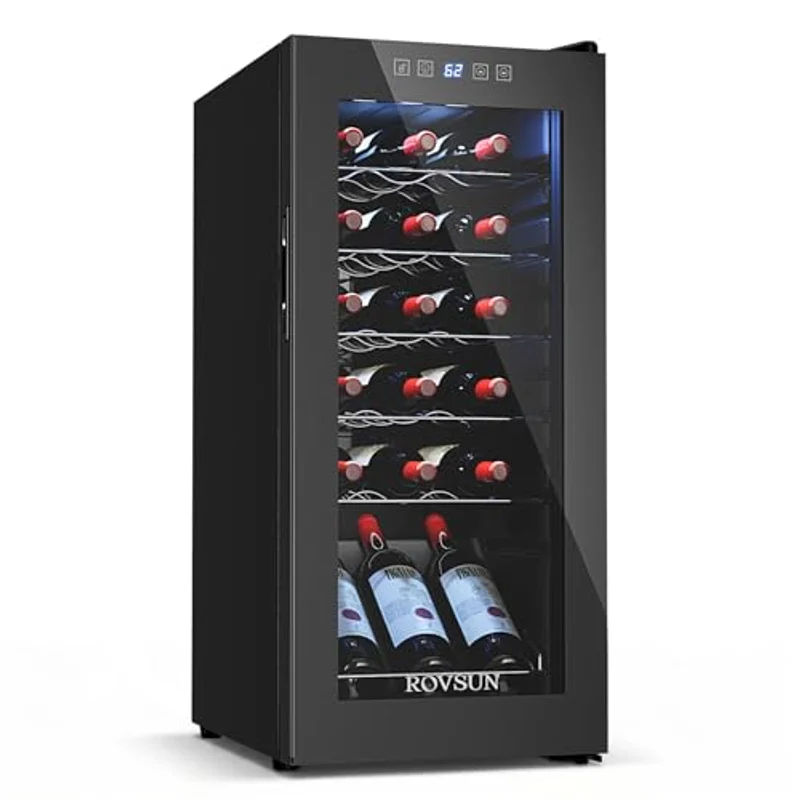 ROVSUN 18 Bottle ROVSUN 18 Bottle |
18 bottles |
Not published by the manufacturer |
— |
$179.99 |
$10.00 |
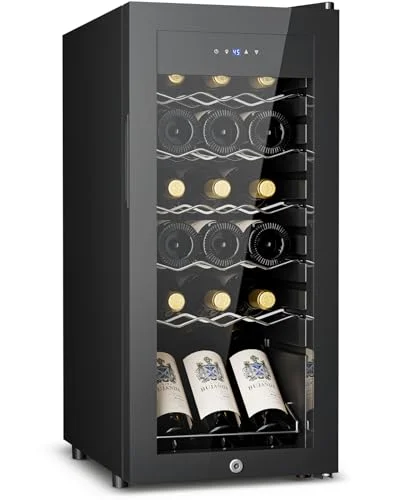 Feelfunn 18 Bottle Feelfunn 18 Bottle |
18 bottles |
13.6"W × 19.3"D |
30.9" |
$199.99 |
$11.11 |
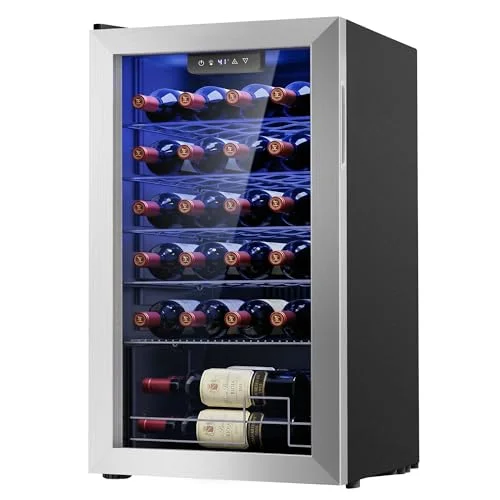 Icyglee 25 Bottle Icyglee 25 Bottle |
25 bottles |
17.5"W × 18.9"D |
31.3" |
$229.99 |
$9.20 |
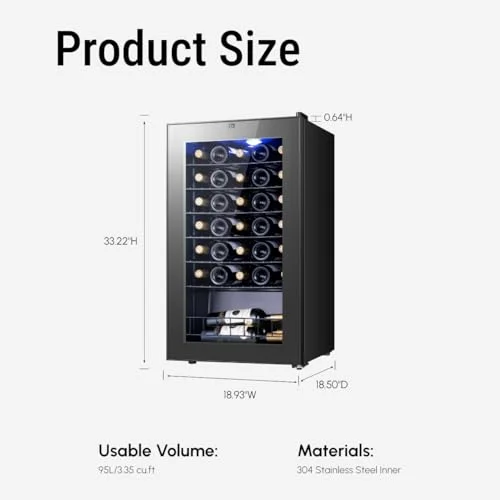 Yeego 34 Bottle Yeego 34 Bottle |
34 bottles |
18.93"W × 18.5"D |
33.22" |
$389.99 |
$11.47 |
Two things stand out. First, going from 18 bottles to 34 bottles costs you roughly five more inches of width and depth and about two and a half inches of height — a meaningfully bigger cabinet in bottle count, but not a dramatically bigger footprint on the floor. If the spot you have is a 20-inch gap, all three dimensioned units here fit it; the capacity difference is a real choice, not a constraint. Second, ROVSUN doesn't publish a footprint in its listing at all. If you're measuring a tight gap rather than an open counter, check the current listing's dimensions directly before ordering rather than assuming it matches the similarly sized Feelfunn.
None of these four listings publish a shipping or product weight either, which matters if the apartment is a walk-up with no elevator. An 18-bottle compressor unit is light enough for one person to carry up a flight of stairs; a 34-bottle unit with a full compressor and double-paned glass door is not something you want to discover is awkward at the bottom of three flights. If stairs are part of your move-in, confirm the weight on the current Amazon listing before you buy — it's exactly the kind of detail that changes week to week as listings are updated, which is why we're not printing a number we can't verify here.
For the tightest rental kitchens — a single countertop corner, no spare closet — our guide to wine fridges under 20 bottles goes deeper on the smallest footprints the category offers.
The picks
All four are freestanding, compressor-cooled, and designed to plug into a standard outlet. The differences that matter in a rental are footprint, published dimensions, and how far your money stretches per bottle.
01Best budget
ROVSUN 18 Bottle
The cheapest way into real compressor cooling
18 bottles·Compressor·41–64°F·Freestanding
At $179.99 this is the least expensive unit here, and the part that matters most in a rental isn't discounted to get there: it's a genuine compressor, not a thermoelectric cooler, so it holds its setpoint whatever the kitchen is doing. Chrome-plated shelves and a double-layer glass door keep the cost down without touching the cooling system. The manufacturer doesn't publish exterior dimensions in the listing, so measure against the current listing photos and specs rather than assuming it matches a similarly priced competitor.
The right choice if the budget, not the footprint, is the constraint.
02Narrowest footprint
Feelfunn 18 Bottle
The one to pick when the gap is narrow, not deep
18 bottles·Compressor·41–64°F·13.6"W × 19.3"D × 30.9"H
At 13.6 inches wide, this is the narrowest unit in the comparison — useful in a rental kitchen where the only free spot is a sliver beside a refrigerator or at the end of a counter run. Five removable shelves let you rearrange the interior as your collection changes shape, and a safety lock is a genuinely useful feature in a shared apartment. The published 41–64°F range and compressor cooling match the ROVSUN; the $20 premium here buys you a confirmed footprint and a lock, not better cooling.
Pick this over the ROVSUN specifically because you need to know the exact inches before it arrives.
03Best capacity per dollar
Icyglee 25 Bottle
The most bottles for the least money per bottle
25 bottles·Compressor·40–64°F·17.5"W × 18.9"D × 31.3"H
At $9.20 per bottle of stated capacity, this is the best value in the lineup, and it does it without asking for a bigger footprint than the Yeego — a 17.5-inch width still clears most counter corners and closet gaps. Adjustable shelves and a double-paned, UV-shielding glass door are the two specs worth checking against your own space: the glass keeps light off the bottles, and the shelving lets you fit odd-sized bottles without wasting the extra seven slots over the 18-bottle units.
If the question is "how many bottles can I fit for the money," this is the answer.
04Most capacity, still portable
Yeego 34 Bottle
The one to buy if you want real capacity without outgrowing a rental
34 bottles·Compressor·38–65°F·18.93"W × 18.5"D × 33.22"H
Thirty-four bottles in a footprint barely larger than the 25-bottle Icyglee, with six removable shelves and 1°F control increments. The manufacturer states plainly that it fits freestanding or under a counter but is not a built-in model — worth repeating here because it's the exact distinction this whole guide is built around. It also includes power-failure memory, which matters more in an older building prone to breaker trips or brief outages than it does in new construction: the unit resumes its setpoint automatically instead of defaulting to a random temperature every time the power blinks.
The capacity of a much bigger cabinet, in a footprint that still moves with you.
What to check in the lease before you plug one in
Nothing here requires a lawyer, but five minutes with the lease before the fridge arrives avoids every version of this problem that actually happens to renters.
- Additional appliance clauses. Most residential leases say nothing about small plug-in appliances, but some — particularly in older buildings or ones with shared or limited electrical capacity — restrict adding refrigeration-class appliances without notifying the landlord. It's rare, but it's a one-line clause to confirm, not a risk worth skipping.
- Security deposit and wall damage. A freestanding unit needs no wall anchors, no outlet installation, and no cabinet modification — which is the entire point of staying in this category. If you're tempted to secure it to a wall for stability or child safety, use a method that leaves no holes, and check your lease's damage clause for exactly what counts as modification.
- Circuit load, especially in older buildings. You don't need a dedicated circuit for any unit in this guide, but if your kitchen already runs a microwave, a toaster oven, and a window AC unit off the same handful of outlets, confirm with your landlord or a look at the breaker panel that adding a compressor appliance won't be the thing that finally trips it.
- What happens at move-out. A freestanding fridge is yours to take with you — there's no cabinet to patch, no vent to seal, no cutout to leave behind. The only move-out step that matters is defrosting and drying the interior before it goes into a moving truck, the same as any refrigerator.
- Noise and quiet-hours clauses. Compressor units cycle on and off and make an intermittent hum, which is normal and rarely audible outside the kitchen. In a studio or a shared wall apartment with strict quiet hours, it's worth knowing that upfront rather than being surprised by it the first night.
If you're furnishing a first apartment and a first wine fridge at the same time, our guide to wine fridges for a first collection covers the broader buying questions — temperature range, shelf count, lock — that apply whether you own or rent.
How we compared these — and what we can't tell you
We compared the manufacturers' own published specifications — capacity, temperature range, cooling type, and exterior dimensions where the listing provides them — against the current Amazon price for each unit. Where a dimension or weight wasn't published in the listing, we said so rather than estimating it; the ROVSUN's footprint and all four units' shipping weights fall into that category, and the honest answer is to check the live listing before you buy, not to guess on your behalf.
We do not run a testing lab. We don't own these four units and we haven't installed them in a rental kitchen ourselves, so this is not a lab verdict, and you won't find a star rating or a review count either — none of these listings carry one from the retailer, and we don't publish a number we can't source. What you're reading is a comparison of what each manufacturer states on the record, read against the practical constraints — clearance, outlets, footprint, a lease — that apply specifically to a rented kitchen.
Frequently asked questions
Can I put a freestanding wine fridge under a rental kitchen counter?
Only if there's open air on at least three sides, including the back. A freestanding compressor unit vents its heat out the back and sides, and enclosing it the way a true built-in model is designed to be enclosed traps that heat, makes the compressor run constantly, and can shorten its life dramatically. If the space you have is a closed cabinet opening rather than an open counter end, treat it the same as any built-in installation question and read our clearance guide first.
Do I need an electrician or a dedicated circuit to run one of these?
No. All four units in this guide are freestanding compressor appliances designed to plug into a standard household outlet, the same as a microwave or a window AC unit. The only wiring consideration in an older building is avoiding sharing an outlet or power strip already carrying other high-draw appliances, which is a precaution against tripping an aging breaker, not a requirement of the fridge itself.
How much clearance does a freestanding wine fridge actually need against a wall?
Every compressor unit needs some open air behind and beside it to shed the heat it pulls out of the cabinet — pushing one flush against a wall or closing cabinet doors in front of it defeats that. None of the four listings here states an exact clearance figure, so treat a few inches on the back and sides as the safe minimum, and check the current listing or our dedicated placement and clearance guide if you're working with a genuinely tight gap.
What should I check in my lease before buying a wine fridge?
Confirm there's no clause restricting additional refrigeration appliances, check that your kitchen's existing circuit isn't already near its load with other high-draw appliances, and note that a freestanding unit requires no wall anchors or cabinet modification — so there's nothing to patch when you move out beyond defrosting and drying the interior before transport.
Written by Ilane Tall. Research-based comparisons of published specifications, current prices and general appliance-class facts — we do not physically test these units and we do not publish invented scores.