By Ilane Tall · Updated September 28, 2026 · Research-based.
Reader-supported: we may earn a commission when you buy through the links on this page, at no additional cost to you. It never changes which product we recommend. Prices quoted below were correct at the time of writing and move often.
The mistake almost every first-time buyer makes
Nearly everyone buying their first wine fridge does the same arithmetic: count the bottles on the counter right now, buy a cabinet that holds a few more than that, and call it solved. It feels like the responsible choice — why pay for capacity you don't need yet? — and it is the single most common regret in this category.
The problem isn't the bottles you own today. It's the ones that show up the month after the fridge arrives. A gift bottle from a dinner party. A case discount you couldn't pass up. A wine club shipment that lands six bottles at once. None of that is exotic behavior — it's what having somewhere cold and dark to put wine actually does to a household's buying habits. The moment there's a dedicated place for it, the pace of acquisition quietly picks up, and a cabinet sized for today's eight bottles is uncomfortably full within a season.
That's the case for buying a step above what looks necessary. It is not a case for buying the biggest unit you can afford — a first-time buyer also doesn't yet know whether they'll drink mostly red, split evenly with white, or develop a taste for sparkling, and an oversized cabinet built around the wrong assumption is its own kind of expensive mistake. The better rule is to buy the smallest unit that still leaves obvious room to grow, rather than the smallest one that fits what you own right now.
If twelve bottles genuinely is your ceiling — a small apartment, a casual habit, no intention of building a cellar — a compact unit is the right and honest choice, and our guide to wine fridges under 20 bottles covers that end of the market properly. But if there's any real chance the collection grows, buying at the small end of what's available and hoping it's enough is the mistake this whole guide is trying to head off.
Why a wide temperature range matters more than a precise one
Manufacturers like to advertise precision — a display reading to the tenth of a degree, a claim of tight thermal stability. For a first cabinet, none of that matters as much as the width of the range the unit can actually reach, because you don't yet know which end of it you'll need.
Red wine storage sits around 55°F. White wine served straight from the fridge wants something closer to 45–50°F. Sparkling wine wants colder still. A first-time buyer usually hasn't settled into one of these patterns yet — you might start out thinking you're a red-only household and discover six months in that you're reaching for a chilled white three nights a week. A cabinet that only covers a narrow band around cellar temperature locks you into today's guess. One that publishes a genuinely wide range gives you room to be wrong about your own habits without buying a second appliance.
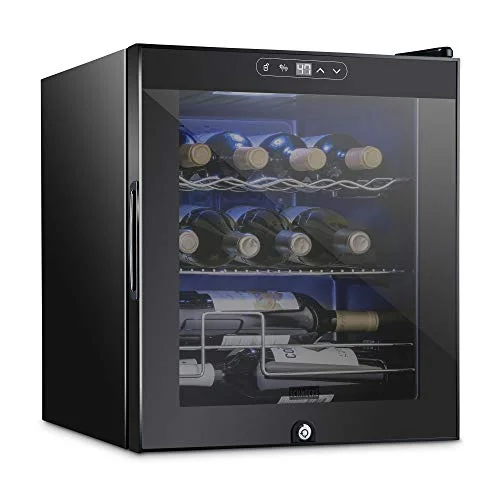
The Schmecke 12-Bottle Compressor Wine Cooler is the clearest example among the units here: it's rated for a published 41–64°F range in a single 12-bottle zone. That's wide enough to hold classic cellar temperature, run cooler for whites, or sit warmer for a lighter red — all without a second compartment or a second thermostat. You're not committing to a serving strategy on day one; you're buying the flexibility to figure it out.
This is also where it's worth being honest about what a published range promises and what it doesn't. A wide range tells you the compressor and insulation can reach those numbers under normal conditions — it doesn't guarantee the unit will hold a precise setpoint down to the degree, and no manufacturer's spec sheet for a fridge in this price range claims that kind of precision. For a first cabinet, that trade is the right one: a wide, honest range you can adjust as you learn your own habits beats a narrow one advertised as more exact.
Compressor over thermoelectric — even at twelve bottles
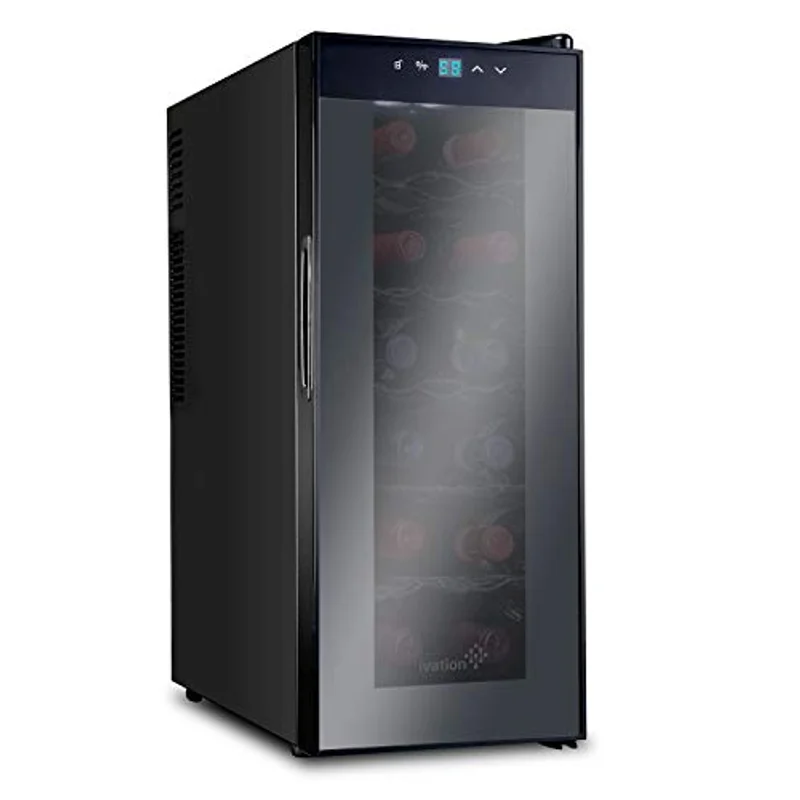
This is the decision that matters most, and it's easiest to see side by side. The Ivation 12-Bottle Thermoelectric Wine Cooler lists at $214.99. The Schmecke 12-Bottle Compressor Wine Cooler, holding the same twelve bottles, lists at $259.99. Forty-five dollars separates a fundamentally different cooling technology from a superficially similar one, and for a first purchase, that gap is worth paying.
Thermoelectric cooling works by moving heat across a solid-state plate rather than compressing refrigerant, which is exactly why it's quiet — there's no compressor cycling on and off, no vibration transmitted to the bottles. The Ivation's listing leans on that: digital temperature display, smoked glass door, quiet operation. Those are real, honest advantages, and in the right room they matter. The limitation is thermal, not a matter of build quality: thermoelectric units can generally only pull the interior down to something in the neighborhood of 20°F below whatever temperature the room already is. Keep it in a steady 68–72°F room and it can reach a reasonable cellar temperature. Put it somewhere that runs warm — a kitchen near the oven, an uninsulated garage, a room that gets direct summer sun — and it simply cannot get cold enough, no matter how the dial is set.
A compressor unit like the Schmecke doesn't have that ceiling. It cools the same way a kitchen refrigerator does, actively removing heat rather than passively pulling it across a plate, so it holds its setpoint regardless of what the room around it is doing. The trade is a compressor's intermittent hum and a small amount of vibration — real, but modest at 12-bottle scale, and rarely a dealbreaker outside a bedroom or a very quiet office.
Here's why this decision matters more for a first fridge than a fifth one: by the time you're buying a replacement or a second unit, you know exactly where it's going and what that spot does in August. A first-time buyer usually doesn't have that data yet — the fridge might end up in the kitchen, the garage, a sunroom, wherever there's an outlet and floor space when it arrives. Compressor cooling removes that unknown entirely. It works wherever you eventually put it. For $45 more on a 12-bottle unit, that's a small price for not having to guess right about a room you haven't decided on yet. Our guide to compressor-only wine fridges goes deeper on this if cooling type is the only decision left on your list.
Simple controls beat smart features — what to actually ignore on the spec sheet
Spec sheets for entry-level wine fridges have gotten more crowded with features in the last few years, and almost none of what's new belongs on a first purchase. The instinct to want the model with more listed features is understandable — more usually seems safer — but for a first cabinet, more controls mean more things that can confuse whoever else in the household opens the door, and more things that can fail.
What's actually worth having: a digital temperature display you can read at a glance, and — as on the Schmecke — a physical lock, which is a genuinely simple, useful control if the fridge will live somewhere kids or guests have easy access to. That's it. That's the whole list of controls a first wine fridge needs.
What's worth ignoring, at least for now: touch-panel interfaces that require multiple presses to change a setpoint, app connectivity, and Wi-Fi monitoring. None of it changes whether your wine stays at temperature, and all of it is a feature you're paying for on a unit you're likely to outgrow before you've used it twice. One feature that is genuinely worth having eventually — a control board that remembers its setpoint after a power outage, so the fridge doesn't default to some random temperature every time the power blinks — is real and useful, just not a first-purchase priority. Our guide to digital touch control and power-outage memory is where to look once you're buying your second fridge, or a larger one where a brief outage means more bottles at risk.
The same logic applies to zones. A dual-zone cabinet means two thermostats, two displays, and two things to set correctly instead of one. None of the three products in this guide is a dual-zone unit, and that's deliberate: for a first collection that hasn't settled into a red-white split yet, a single zone with one number to remember is the simpler, more honest starting point. If you want the fuller case for that, we work through it in our guide to single-zone wine fridges.
UV-resistant glass is a similar story — a real feature, worth caring about if the fridge is going to sit in direct sunlight for years, and covered in our guide to UV-protected glass doors. It's not something to chase on a first purchase unless that's genuinely where the cabinet is going to live; for most first units, in a kitchen corner or a closet away from direct sun, it's a line on the spec sheet you can safely skip.
Should you just start with the kitchen fridge?
This is the question almost everyone asks before they buy anything, and it deserves a straight answer rather than a sales pitch. A standard kitchen refrigerator runs close to 37°F and keeps the air inside deliberately dry, because that combination is what keeps produce and dairy safe. It is close to the worst environment you could pick for wine on purpose: cold enough to mute a red's flavor for as long as it sits there, and dry enough that, over months, it can dry out a cork through the foil and let air creep in.
For a bottle you're going to open this week, none of that matters. Chilling a white or a bottle of sparkling in the kitchen fridge for a few hours before dinner does no damage at all — that's a perfectly normal use of the appliance you already own, and buying a dedicated fridge to solve that problem alone would be overkill. The issue only shows up with time: a bottle sitting in a kitchen fridge for months, not days, is genuinely at risk in a way the same bottle sitting in a proper wine fridge at 55°F is not.
So the honest answer is a threshold, not a yes or no: if you're keeping bottles around for more than a few weeks at a time, or you can see yourself accumulating more than what fits in a fridge door rack, the kitchen fridge stops being a reasonable substitute and starts being where good wine quietly goes to be damaged. We work through the full comparison — including where a countertop cooler or a proper wine cellar fits into that decision — in wine fridge vs. kitchen fridge vs. wine cellar.
The picks: from genuinely entry-level to room to grow
Three real options at three different points on the first-fridge spectrum — the one to consider only in a specific situation, the one most first-time buyers should actually start with, and the one to reach for if you already suspect twelve bottles won't be enough for long.
01Quietest, if your room stays cool
Ivation 12 Bottle Thermoelectric
A deliberate trade, not a starter default
12 bottles·Thermoelectric·Freestanding countertop
Smoked glass, a digital display, and genuinely quiet operation, at the lowest price of the three. The trade is the one covered above: thermoelectric cooling can only pull the interior a fixed amount below whatever the room already is, so this belongs in a room that stays reliably cool year-round — a climate-controlled office, a cool interior closet, a bedroom that never gets warm in summer. If you can promise that room, and the near-silent operation matters more to you than an all-purpose guarantee, it's a legitimate, honestly-specified first purchase. If you can't promise the room yet, the extra $45 for the Schmecke below removes the guesswork entirely.
Buy this only if you already know exactly which cool room it's going in.
02Genuinely entry-level
Schmecke 12 Bottle Compressor Wine Cooler
Where most first-time buyers should actually start
12 bottles·Compressor·41–64°F range·Lock
This is the shape a genuinely entry-level pick should take: real compressor cooling that works wherever it ends up living, a published 41–64°F range wide enough to cover cellar temperature and serving temperature for red or white, and a physical lock — simple controls, nothing to figure out. At $259.99 it costs only $45 more than the thermoelectric option above and removes the one real limitation that comes with it. For a household that hasn't yet settled into a fixed red-or-white habit and doesn't want to think hard about where the fridge sits in the house, this is the safer default.
The one to buy when you don't yet know your own habits — because it doesn't require you to.
03Room to grow
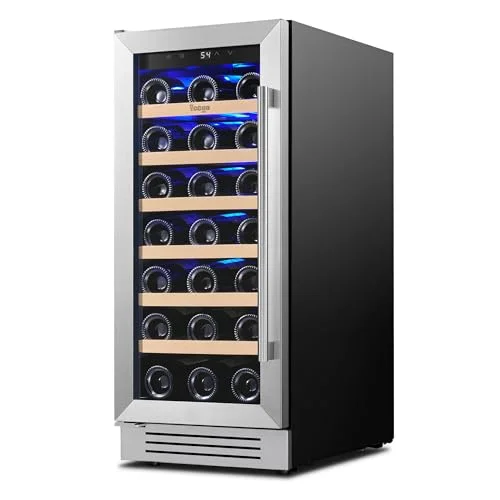
Yeego 15" Wine Cooler Refrigerator
For the buyer who already suspects twelve won't be enough
33 bottles·15" width·Glass door
If the mistake covered earlier already sounds familiar — you can picture a case landing unannounced within a few months — this is where to start instead. Thirty-three bottles is real headroom over a 12-bottle unit without jumping to a full-size cellar, and the 15-inch width is the standard cabinet opening if there's ever a chance you'll want it built in later. One honest gap: the listing doesn't specify the cooling technology the way the two smaller units above do, so before you buy, confirm on the current listing whether it's compressor or thermoelectric — at 33 bottles and this price point, compressor is worth insisting on for the same reasons covered above, and it's worth reading the full spec sheet rather than assuming.
Buy the size that assumes the case of wine you haven't bought yet.
How we compared these — and what we can't tell you
We compared the manufacturer-published specifications and current Amazon prices for each of these three units — capacity, cooling type where it's stated, temperature range, and the physical features called out on the listing itself. Where a specification wasn't published, as with the Yeego's cooling technology, we said so directly rather than guessing or assuming the more expensive-sounding option.
We don't run a testing lab. We haven't bought these three units and run them side by side in a climate-controlled room for a season — nobody genuinely comparing a dozen wine fridges at this price point has done that either, whatever a review claims. What we can do honestly is read the specifications carefully, track what they actually cost, and explain what the differences mean in practice. You won't find a star rating or a review count on this page: none of these listings currently publish one, and we don't estimate numbers we can't source.
Frequently asked questions
Do I need a dual-zone wine fridge for my first purchase?
No. A dual-zone cabinet means two thermostats and two displays to manage, and it only pays off once you already know you keep a real mix of reds and whites you want at different temperatures. A first-time buyer usually hasn't settled into that pattern yet. A single zone with one number to remember is the simpler, more forgiving place to start.
What temperature should I set a first wine fridge to?
55°F is the standard long-term storage temperature and works for red, white, and sparkling alike — it's the number to set and mostly leave alone. Serving temperature differs by style, but that's a small, later adjustment, not a reason to second-guess the initial setpoint.
Is a thermoelectric cooler ever the right choice for a first-time buyer?
Only if you already know exactly where it's going and that room stays reliably cool year-round. Thermoelectric units can only cool a fixed amount below the surrounding room temperature, so they lose control in a kitchen, garage, or sunroom that runs warm. If you can't promise the room yet, compressor cooling is the safer default for a first unit.
Should I just use my kitchen fridge instead of buying anything yet?
Fine for a bottle you're chilling to drink within days — that's a normal use of the fridge you already own. Not fine as ongoing storage: a kitchen fridge runs colder and drier than wine needs, and over weeks or months that combination can start to dry out a cork and dull the wine. The full breakdown, including where a countertop cooler fits between the two, is in wine fridge vs. kitchen fridge vs. wine cellar.
Written by Ilane Tall. Research-based comparisons of published specifications, current prices and verified owner reviews — we do not physically test these units and we do not publish invented scores.