By Ilane Tall · Updated September 24, 2026 · Research-based.
Reader-supported: we may earn a commission when you buy through the links on this page, at no additional cost to you. It never changes which product we recommend. Prices quoted below were correct at the time of writing and move often.
The short version
If you're on this page, you've already made the harder call: compressor cooling, not thermoelectric. Our compressor vs thermoelectric guide covers why that trade-off goes the way it does. This page skips the argument and names the units, at three sizes that cover most real shopping situations.
Under $250 buys real compressor cooling in a countertop-sized cabinet — the EUHOMY 25 Bottle, in either finish, or the BODEGA 24 Bottle. Fifteen inches is the width where front-venting decides whether a compressor unit can go under a counter at all, and the Albott 15 Inch Dual Zone is built for exactly that. Past fifty bottles, the FOVOMI 52-Bottle Dual-Zone is the one worth the higher price.
The thing none of them avoid, at any price: hum. A compressor cycles on and off, and every unit on this page makes some noise doing it.
Why a compressor-only list exists
Most wine fridge buying guides spend half their word count re-litigating compressor versus thermoelectric cooling, because for a lot of shoppers that genuinely is the first fork in the road. If you already read our compressor vs thermoelectric guide — or you already own a thermoelectric unit that gave up the first afternoon your kitchen hit 80°F — you don't need that argument a second time. What you need is the list of compressor units worth buying, at the sizes and prices that cover most real shopping situations.
That's what this page is. Every unit named below runs a compressor and a sealed refrigerant circuit, not a thermoelectric plate. None of them are hybrids, and none of them made this list for being unusually quiet — quiet was never the goal here. Holding a setpoint no matter what the room is doing was the goal, and a compressor is still the only cooling method that reliably delivers it.
What every compressor unit here has in common
Skip the brand names for a second and the category itself tells you most of what you need to know. A thermoelectric wine cooler moves heat using the Peltier effect: no moving parts, no refrigerant, and a hard ceiling of roughly 20°F below whatever the room is doing. Put one in a 78°F kitchen and the best it can offer is a cabinet in the high 50s — fine for storing wine, useless for chilling a white before dinner.
A compressor unit works the way a kitchen refrigerator does: it compresses and expands a refrigerant to actively pump heat out of the cabinet, rather than merely slowing the heat down. That's why a compressor cabinet can advertise a real setpoint reaching well below 55°F and hold it whether the room sits at 65°F or 85°F. Room heat is an input the compressor works against, not a limit the fridge inherits — and that holds for every size and price point in this piece, from the $219.99 countertop unit to the $539.96 dual-zone cellar.
That's also the entire reason to be reading this particular list instead of a general one. If your cabinet is going into an unconditioned garage, a sunroom, or a kitchen that gets genuinely warm in the summer, a real setpoint that ignores ambient heat isn't a nice-to-have. It's the only specification that decides whether the wine inside survives the season.
The budget end: compressor cooling under $250
Compressor cooling used to carry a serious premium over thermoelectric. It still carries one, but the gap has narrowed to well under $100 at the bottom of the market, and two units here get you a real compressor for less than $250. What you give up at this price isn't the compressor itself — it's everything built around it: fewer bottles than a 30-inch cabinet costing three times as much, simpler shelving rather than the adjustable beech racks a mid-tier brand advertises, and in both cases below, a single temperature zone instead of two. If your actual requirements are "holds a real cellar temperature, fits on a counter or in a closet, costs under $250," that is a short and entirely satisfiable list.
Built-in at 15 inches, and why front-venting makes that possible
Fifteen inches is the standard narrow-cabinet width in US kitchens — the same opening a lot of homes leave for a stack of drawers or a spice cabinet — and it's the width where "can this go under the counter" stops being a rhetorical question. It can, but only if the unit is designed for it, and the specification that decides that is venting, not the compressor.
A freestanding compressor unit rejects the heat it pulls out of the cabinet through vents in the back and sides. Slide one into a 15-inch opening with cabinetry on three sides and that heat has nowhere to go: the compressor runs continuously, the interior never reaches its setpoint, and the unit fails early, sometimes within months. A front-venting design solves the problem at the source — the grille that exhausts heat sits on the front face, below the door, so the cabinet can be boxed in on the sides and back and still breathe. Our built-in vs freestanding guide goes through the mechanics in more detail; the short version is that enclosing the wrong unit is the single most expensive mistake shoppers make in this category, and it has nothing to do with which brand you buy.
The large-capacity dual-zone option, for 50-plus bottles
Past about fifty bottles, a wine fridge stops being a kitchen accessory and starts being storage, and that's exactly where compressor reliability matters most — a cabinet holding fifty-plus bottles at a fixed temperature for years is a much bigger loss if the compressor fails than a $220 countertop unit is. It's also where dual zone starts making practical sense again: a real collection at this size is genuinely more likely to mix reds that want cellar temperature with whites or sparkling that want to be served colder, rather than the near-single-colour collections a smaller cabinet usually holds.
How the five compare
Capacity and price side by side. Every unit here is compressor-cooled — none are thermoelectric, and none of the prices below carry a star rating or review count, because the retailer data we draw from doesn't return either for this category.
| Model | Best for | Capacity | Zones | Price | Get it |
|---|
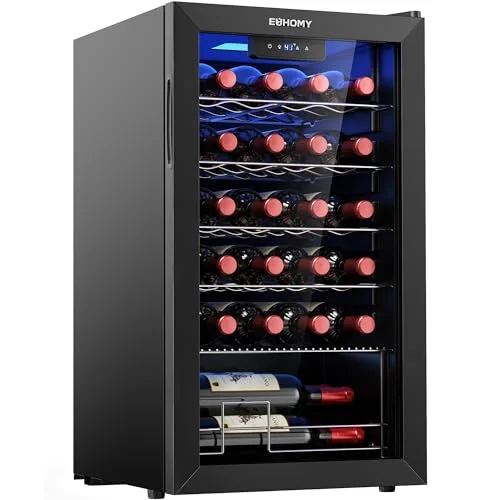 EUHOMY 25 Bottle (Black) EUHOMY 25 Bottle (Black) |
Cheapest compressor cabinet |
25 bottles |
Single |
$219.99 |
Get it |
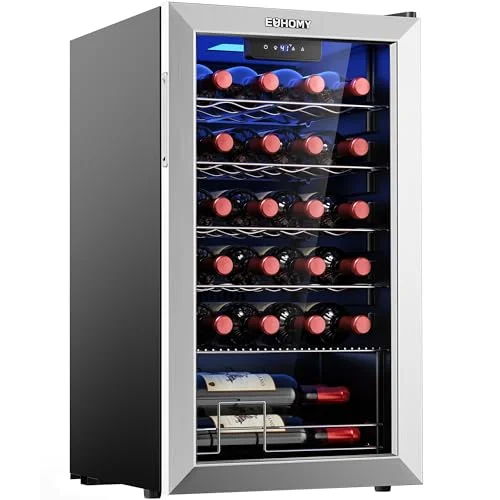 EUHOMY 25 Bottle (Silver) EUHOMY 25 Bottle (Silver) |
Same spec, stainless finish |
25 bottles |
Single |
$229.99 |
Get it |
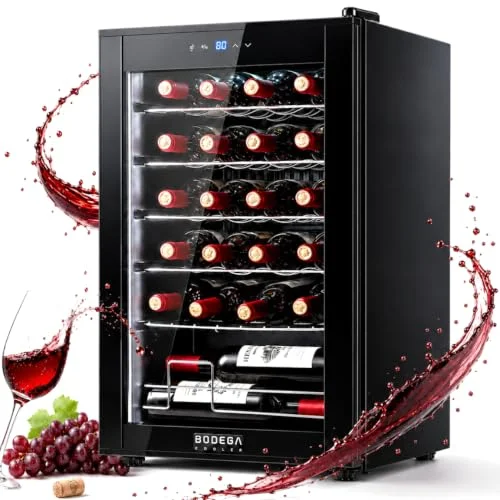 BODEGA 24 Bottle BODEGA 24 Bottle |
Alternative budget pick |
24 bottles |
Single |
$246.99 |
Get it |
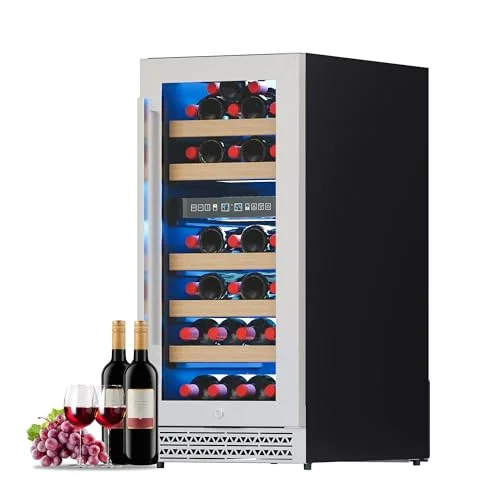 Albott 15" Dual Zone Albott 15" Dual Zone |
Best built-in at 15 inches |
31 bottles |
Dual |
$499.99 |
Get it |
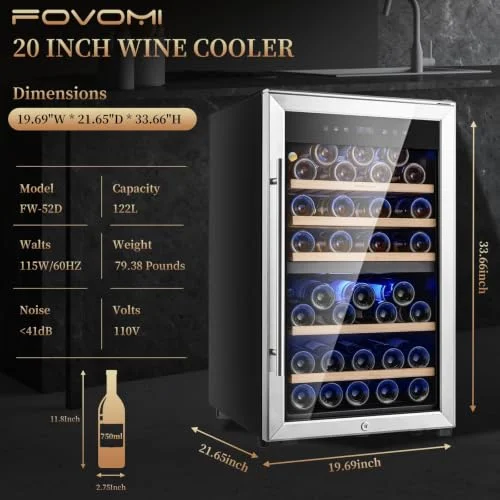 FOVOMI 52-Bottle Dual-Zone FOVOMI 52-Bottle Dual-Zone |
Best for 50-plus bottles |
52 bottles |
Dual |
$539.96 |
Get it |
The one thing you still trade for compressor cooling: hum
None of this is free. A thermoelectric unit has no moving parts beyond a fan, so it runs close to silent. A compressor unit has a motor, a refrigerant circuit under pressure, and a cycle that switches on and off as the cabinet drifts off its setpoint — and every one of those parts makes some noise. The EUHOMY and BODEGA units at the budget end of this list will be audible in a quiet room; the Albott and the FOVOMI, larger and running two zones, cycle more often and will be too.
This isn't a defect specific to any one of these units — it's what a compressor is. The refrigerant compressing and expanding produces a low hum while it runs, plus an audible click when the cycle starts and stops. In a kitchen with a dishwasher running or a garage with anything else mechanical in it, none of that registers. In a bedroom, a home office, or anywhere silence is genuinely the priority, it's the one specification a compressor cannot improve past a certain point — and it's the actual reason thermoelectric units exist at all. Our noise and vibration guide covers where each cooling type lands in practice and what, short of switching technology, actually helps.
If total silence outranks holding temperature in a warm room, this isn't the list for you — go back to the compressor vs thermoelectric guide and make that trade deliberately, rather than discovering it after the unit is already installed.
Who should buy which
Buying on a tight budget, with a mostly one-colour collection under 25 bottles: either EUHOMY colorway, or the BODEGA if its shape fits your space better. All three hold a real cellar temperature for under $250, which is the specification that actually separates them from a similarly priced thermoelectric unit.
Fitting a cabinet into a standard 15-inch kitchen opening: the Albott, and only a unit rated for built-in use — never a freestanding cabinet boxed into a cabinet run, regardless of price.
Running a real collection past fifty bottles, or expecting to within a year or two: the FOVOMI, sized and zoned for it, with the understanding that a dual-zone unit's real usefulness depends on the range each zone can hit independently, not the headline number printed on the box.
In every case, budget for hum. A silent wine fridge and a compressor wine fridge are not the same appliance, and no amount of shopping around changes that fact.
How we compared these — and what we cannot tell you
We compared the published specifications, current listed prices and product categories for every unit on this page against the wider compressor-cooled wine fridge market. Capacity, zone count and cabinet width came from each listing; where a specification wasn't published — the per-zone temperature range on the dual-zone units, for instance — we said so rather than estimating one.
We do not run a testing lab. We don't own these units, and we haven't measured decibel levels, temperature drift or energy draw ourselves, so you won't find an invented score out of ten or a fabricated star rating on this page. The retailer data we draw from doesn't return ratings or review counts for most of this category, and where we don't have them, we don't publish them.
Prices quoted here were correct at the time of writing and change frequently. Confirm the current price on Amazon before buying.
Frequently asked questions
Is a compressor wine fridge always louder than a thermoelectric one?
Yes, in the sense that matters: a compressor has a motor and a refrigerant cycle that a thermoelectric plate simply doesn't, so it will always make some noise a thermoelectric unit doesn't. Whether that noise is noticeable depends on the room — audible in a silent bedroom, unnoticed in a kitchen with normal background sound.
Can any of these go under a kitchen counter?
Only the Albott 15 Inch Dual Zone is built for it. Front-venting is what allows a compressor unit to be enclosed on three sides without overheating; the EUHOMY, BODEGA and FOVOMI units on this page are freestanding and need clearance at the back and sides, not a cabinet opening.
What temperature should I actually set a compressor wine fridge to?
55°F (13°C) is the standard cellar-storage default and works for red, white and sparkling alike. A compressor's advantage over thermoelectric is that it can hold that number, or run colder for serving temperature, regardless of how warm the room gets — a thermoelectric unit can only pull roughly 20°F below ambient, which fails in a warm kitchen or garage.
Do the dual-zone units here cost more to run than the single-zone ones?
Usually a little, since the system works to hold one zone cold while preventing the warmer zone from being dragged down with it. In practice, ambient room temperature and how often the door opens affect running cost far more than zone count does — a unit in a warm garage draws noticeably more than the same unit in a temperate kitchen.
Written by Ilane Tall. Research-based comparisons of published specifications, current prices and product categories — we do not physically test these units and we do not publish invented scores.