By Ilane Tall · Updated September 23, 2026 · Research-based.
Reader-supported: we may earn a commission when you buy through the links on this page, at no additional cost to you. It never changes which product we recommend. Prices quoted below were correct at the time of writing and move often.
The short version
A dozen to sixteen bottles is the practical ceiling for a genuine small space — a dorm room, a studio kitchen counter, the narrow gap next to a refrigerator. At this size almost every unit sold is a single zone, so the real decision is not zones, it's thermoelectric versus compressor and whether the actual footprint, not the bottle count on the box, fits the spot you have.
If bottle count is the priority, the Antarctic Star Wine Cooler reaches sixteen bottles for $166.66. If quiet matters more than capacity, the Schmécké and Qgnaewnoyj coolers are both thermoelectric and built for a bedroom or office.
Already past fifteen or eighteen bottles, or buying regularly enough that you will be there within the year? Skip this category and go straight to a 30-plus-bottle unit instead — see our guide to 30-inch wine fridges for where that money goes further.
Every listing in this category leads with a number — 12 bottles, 16 bottles — because that's the spec shoppers search for. It's also the least useful number for deciding whether a unit will actually fit where you want to put it. Bottle count tells you almost nothing about the three measurements that determine whether a fridge belongs on your counter: width, depth and height.
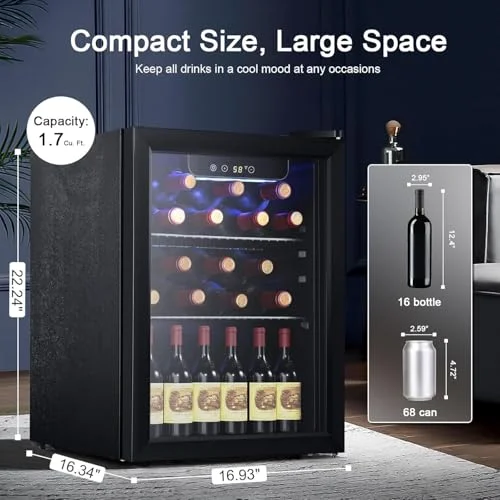
A 16-bottle unit can be narrower than a 12-bottle unit if it's built taller instead of wider, or it can be wider and shallower if the shelving is arranged differently. The Antarctic Star Wine Cooler holds 16 bottles in 1.7 cubic feet — a genuinely tight enclosure for that count, which is exactly the kind of ratio worth comparing before you compare bottle numbers. Two fridges advertised for the same 12 bottles can occupy meaningfully different amounts of counter and wall space, and the product title is the only place that difference shows up.
So "small space" in this guide means a specific claim: a unit that fits a narrow counter gap, a dorm-room desk, or a spot next to an existing kitchen fridge — not simply "fewer bottles than a full-size cellar." A 12-to-16-bottle countertop unit is the right search only if your constraint is genuinely square inches of surface, not just your wine budget. If your constraint is money rather than space, a larger single-zone unit is usually the better dollar-per-bottle buy, which is the point we come back to at the end of this guide.
What 12 to 16 bottles actually looks like on a counter, in inches
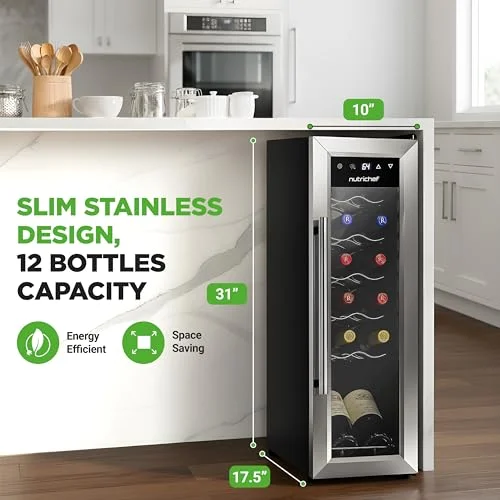
Two of the units in this guide publish real dimensions, and they're worth using as anchors. The Nutrichef 12 Bottle Stainless Steel Slim Wine Fridge is listed at 31 x 10 x 17 inches. The NewAir 10" Wine Fridge for 12 Bottles is named for its width directly: 10 inches. Manufacturers aren't consistent about the order they list width, depth and height in a title string, so treat "31 x 10 x 17" as a set of three numbers to verify against the listing's own diagram rather than a confirmed width-depth-height sequence — but the 10-inch figure lines up with NewAir's own width claim for the same 12-bottle capacity, which is a useful cross-check.
Ten inches wide is narrow enough to slide into the gap next to a coffee maker, a microwave stand, or the side of a kitchen refrigerator — narrower than almost any other small appliance you own. That's the good news for a genuinely tight counter. The number that catches people out is height. Nutrichef's unit runs 31 inches tall, which is taller than most countertop appliances and will not clear the underside of a standard upper kitchen cabinet, typically mounted around 18 inches above the counter. A unit this size is meant to stand freely against a wall or in an open corner, not to slide under cabinetry.
Depth matters for a different reason: it decides how far the unit protrudes past your counter's front edge, which is what actually determines whether it blocks a walkway or a drawer. Before buying anything in this category, measure your spot in three numbers — width, depth, and the clearance above it — and check all three against the listing, not just the width. If you're setting one up in a dorm room you'll be vacating at the end of the term, our guide to moving and restarting a wine fridge covers the one step that keeps a compressor unit from failing the first time you plug it back in after a move.
Thermoelectric vs compressor at this size: which one you can actually hear from the next room
At full-size scale, this is a simple trade: thermoelectric is near-silent but only pulls about 20°F below room temperature, while a compressor holds its setpoint anywhere but hums and vibrates intermittently. At the 12-to-16-bottle countertop size, the same trade holds, and it matters more, because these units are bought specifically to sit within a few feet of where you sleep, study or work — a dorm desk, a bedroom dresser, a home-office credenza.
Two of the units here state their cooling technology directly. The Qgnaewnoyj 12 Bottle Wine Cooler and the Schmécké 12 Bottle Wine Cooler are both listed as thermoelectric. Neither has a compressor to cycle on and off, so there's no hum and no vibration transmitted through a desk or shelf — the trade being that both are limited to cooling roughly 20°F below whatever the room is doing. In an air-conditioned bedroom or office held around 70–72°F, that's a comfortable cellar temperature. In a dorm room with no air conditioning that hits 85°F in September, it isn't.
The Antarctic Star, Nutrichef and NewAir listings don't state which cooling technology they use. That's not unusual at this size — some compact units are compressor-based despite the small footprint, others are thermoelectric — but it means you should not assume one or the other from price or brand alone. If quiet operation or a warm room is your deciding factor, check the listing's specification sheet for the word "thermoelectric" or "compressor" specifically before you buy, rather than inferring it from the bottle count or the price tier. Nutrichef and NewAir both describe their units as offering quiet operation on the listing, which is a manufacturer claim worth weighing, though it doesn't tell you which cooling method produces that quiet.
If the fridge is going somewhere that gets genuinely hot — an uninsulated garage, an enclosed porch, a room with no air conditioning through summer — a countertop unit at this size is usually the wrong tool regardless of cooling type; see our guide to wine fridges for a garage or outdoor bar for units built to handle that ambient swing.
Why single zone is basically automatic below 20 bottles
None of the five units in this guide is sold as dual zone, and that's not an accident of which products happen to fit the size — it's close to a law of the category. A dual-zone divider takes a fixed slice of usable shelf space to create two independently controlled compartments. Split a 28-bottle cabinet in half and you still have roughly a dozen bottles' worth of room on each side, which is workable. Split a 12-bottle cabinet in half and each zone holds five or six bottles — not enough to be useful for a serving-temperature white and a storage-temperature red at once, and not enough to justify the extra thermostat, control board and cost that a second zone adds.
So at this size, single zone isn't a compromise you're settling for. It's the specification that makes sense of the whole category: one thermostat set near 55°F stores red, white, rosé or sparkling correctly, and a white pulled from a 55°F cabinet needs only twenty to thirty minutes in the freezer to reach a proper serving temperature. Our full guide to single-zone wine fridges covers the reasoning in more depth if you're deciding between this size and a larger single-zone unit.
The picks
All five hold between 12 and 16 bottles and are built to stand on a counter, desk or open shelf rather than to be enclosed in cabinetry — none of these is rated for a built-in installation, so give each one clear air on at least the back and sides.
| Model | Best for | Capacity | Price | Get it |
|---|
 Antarctic Star Wine Cooler Antarctic Star Wine Cooler |
Most bottles for the money |
16 bottles |
$166.66 |
Get it |
 Qgnaewnoyj 12 Bottle Thermoelectric Qgnaewnoyj 12 Bottle Thermoelectric |
Cheapest quiet option |
12 bottles |
$169.00 |
Get it |
 Schmécké 12 Bottle Thermoelectric Schmécké 12 Bottle Thermoelectric |
Bedroom or office |
12 bottles |
$199.99 |
Get it |
 Nutrichef Slim Wine Fridge Nutrichef Slim Wine Fridge |
Narrowest footprint |
12 bottles |
$219.99 |
Get it |
 NewAir 10" Wine Fridge NewAir 10" Wine Fridge |
Glass door, built by a wine-fridge specialist |
12 bottles |
$279.99 |
Get it |
01Most bottles for the money
Antarctic Star Wine Cooler Beverage Refrigerator Mini Fridge
Most bottles for the money
16 bottles·1.7 cu.ft·Freestanding
Sixteen bottles for $166.66 is the best capacity-per-dollar figure in this guide, and 1.7 cubic feet is a compact enclosure to fit that many bottles into — the ratio that actually matters more than the headline number. The listing doesn't specify whether the cooling is thermoelectric or compressor, so if a silent unit for a bedroom is the priority, confirm that spec directly on the product page before ordering rather than assuming it from the price. For a kitchen counter, a den shelf, or anywhere the room stays at a normal indoor temperature, this is the most bottles you'll fit into this size category for the least money.
The pick if capacity, not silence, is the deciding factor.
02Cheapest quiet option
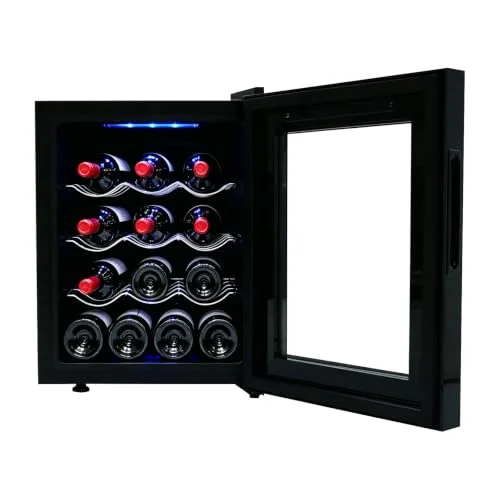
Qgnaewnoyj 12 Bottle Thermoelectric Wine Cooler
The least you can spend and still get thermoelectric quiet
12 bottles·Thermoelectric·Freestanding, stainless steel
At $169.00 this is the cheaper of the two thermoelectric units here, and thermoelectric is the entire reason to consider it: no compressor means no cycling hum and no vibration transmitted into a desk or shelf. The listing describes LED interior lighting and a freestanding stainless-steel cabinet built for red and white storage together at one setpoint. The trade that comes with any thermoelectric unit applies here too — it cools roughly 20°F below room temperature and no further, so it belongs in a climate-controlled room, not an uninsulated space that runs hot in summer.
Buy this over a compressor unit only if silence matters more than a warm-room guarantee.
03Bedroom or office
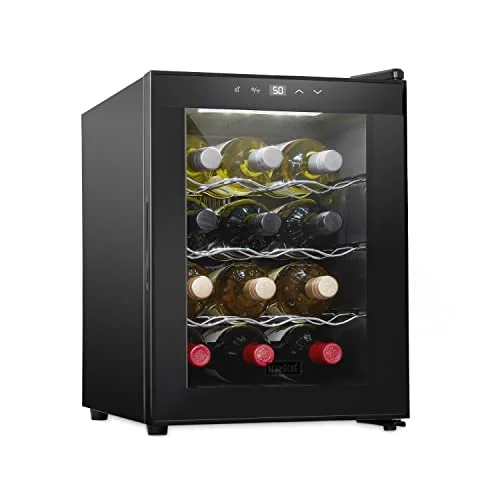
Schmécké 12 Bottle Thermoelectric Wine Cooler
The pick if it's going somewhere you sleep or work
12 bottles·Thermoelectric·Digital display, smoked glass door
At $199.99, this adds a digital temperature display and a smoked-glass door over the cheaper Qgnaewnoyj — the smoked glass cuts light exposure to the bottles as well as looking less like an appliance on an office credenza. It's thermoelectric, so the same room-temperature ceiling applies: comfortable in an air-conditioned bedroom or office, less reliable if the room regularly runs warm. The listing describes it as built for quiet operation, consistent with the lack of a compressor. If the light exposure a fully clear glass door lets in is a concern, our guide to UV-protected glass doors covers what that spec does and doesn't solve.
The digital display and smoked glass are the upgrade over the cheaper thermoelectric option here.
04Narrowest footprint
Nutrichef 12 Bottle Stainless Steel Slim Wine Fridge
The pick for a genuinely narrow gap
12 bottles·31 x 10 x 17 in·Adjustable temperature control
Nutrichef states 31 x 10 x 17 inches for this unit, and if the 10-inch figure is the width — which lines up with NewAir's separately stated 10-inch width for the same 12-bottle capacity — this is about as narrow as this category gets, at the cost of standing 31 inches tall. That height rules out tucking it under a cabinet, but makes it a good fit for a slim gap between a refrigerator and a wall, or a narrow stretch of counter with open space above. The listing lists adjustable temperature control and describes ultra-quiet, energy-efficient operation, though it does not state whether the cooling is thermoelectric or compressor — confirm that on the listing if it matters for your room.
Ten inches wide is the number worth building your kitchen plan around, not the twelve bottles.
05Built by a wine-fridge specialist
NewAir 10" Wine Fridge for 12 Bottles
The pick from a brand that only makes this category
12 bottles·10 in wide·Freestanding, glass door
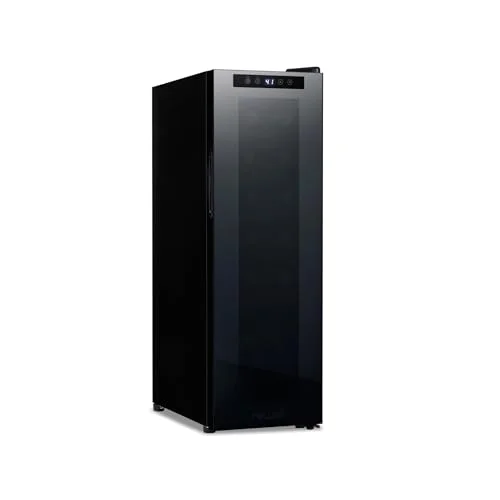
NewAir is a brand that specializes in wine and beverage refrigeration specifically, and at $279.99 this is the most expensive unit in this guide — the premium buys a stated 10-inch width, a glass door, and listing claims of precision cooling and quiet operation. Like the Nutrichef, the listing doesn't specify thermoelectric or compressor cooling directly, so weigh the "precision cooling" language against your own room's temperature swings rather than assuming either technology. At 10 inches wide, it's built explicitly for the narrow-counter use case this guide is about, and the glass door means you can see what's inside without opening it.
The pick if you'd rather pay more once for a brand that only builds this category.
When to skip this size entirely and go straight to a 30-plus-bottle unit
This size category earns its place only when the constraint is genuinely square inches of counter or desk space. If the real constraint is money and you have even a modest amount of floor or counter room to spare, a 12-to-16-bottle unit is usually the worse dollar-per-bottle buy — you're paying for a compact compressor or thermoelectric assembly and a small cabinet, and the fixed costs of that assembly don't shrink proportionally with the bottle count. A mid-size single-zone unit in the 25-to-35-bottle range frequently costs less per bottle stored than anything in this guide.
The other signal to watch is how fast you're filling what you already have. If you're buying wine often enough that a 12-bottle unit is regularly full, you will outgrow it within a year, and buying a second small unit later costs more in total than buying one larger unit now. The same logic applies if you eventually want a real dual-zone setup: as covered above, a 12-to-16-bottle cabinet doesn't have enough shelf space to split into two useful zones, so if serving-temperature whites alongside cellar-temperature reds is a goal, you need a cabinet with at least roughly 24 to 28 bottles of total capacity before a divider makes sense.
Finally, none of the units in this guide is rated for built-in installation — they're all freestanding countertop units that need clear air around them. If you eventually want the fridge built into cabinetry, that's a different product category entirely, and our guide to 30-inch wine fridges covers the width where built-in installation becomes standard.
How we compared these — and what we cannot tell you
We compared published manufacturer specifications, current listed prices, and the exact language used in each listing — capacity, dimensions where stated, cooling technology where stated, and quiet-operation or energy-efficiency claims where the manufacturer makes them. Where a listing didn't specify a spec, such as cooling technology for three of the five units here, we said so directly rather than guessing or inferring it from price or brand reputation.
We do not run a testing lab. We do not own these units and we do not physically test them, so there's no invented score out of ten on this page. You also won't find a star rating or a review count: the retailer API does not return them for this category, and we do not publish figures we cannot source. What we can do honestly is read the specifications carefully, track the prices, and be explicit about the difference between what a manufacturer states and what we're inferring from general knowledge of how thermoelectric and compressor cooling behave.
Prices quoted here were correct at the time of writing and change frequently. Confirm the current price before buying.
Frequently asked questions
Is 12 to 16 bottles actually enough for a small space?
For a genuinely constrained space — a dorm room, a studio kitchen, a narrow counter gap — yes, and it's often the only realistic option. But "small space" should mean a real measurement constraint, not just a modest wine budget. If you have even a little floor or counter room to spare, a larger single-zone unit is usually a better value per bottle stored.
Thermoelectric or compressor for a countertop wine fridge this size?
Thermoelectric is silent and vibration-free but only cools about 20°F below room temperature, which is fine in an air-conditioned bedroom or office and unreliable in a room that runs warm. Compressor units hold their setpoint regardless of room temperature but produce an intermittent hum. Two of the five units in this guide state thermoelectric cooling directly; the other three don't specify, so check the listing if this matters to you.
Do I need dual zone if I'm buying a fridge this small?
No. A 12-to-16-bottle cabinet doesn't have enough shelf space to split into two zones that hold a useful number of bottles each — five or six bottles per side isn't enough to justify the added cost and complexity. Every unit in this guide is single zone, which at this size is the sensible default rather than a compromise.
When should I size up instead of buying a compact unit?
If your actual constraint is money rather than counter space, if you're filling a 12-bottle unit regularly enough to outgrow it within a year, or if you eventually want a real dual-zone setup for reds and whites at once. In any of those cases, a 30-plus-bottle unit is very likely the better long-term buy.
Written by Ilane Tall. Research-based comparisons of published specifications, current prices and public listing data — we do not physically test these units and we do not publish invented scores.