By Ilane Tall · Updated September 19, 2026 · Research-based.
Reader-supported: we may earn a commission when you buy through the links on this page, at no additional cost to you. It never changes which product we recommend. Prices quoted below were correct at the time of writing and move often.
The short version
30 inches is a real cabinet-design width, not a marketing number — it is a step up from the common 24-inch opening, and it exists because a growing number of kitchens want a wider bar zone or a wider wine-and-beverage station. It is not, on its own, a bottle-storage upgrade over 24 inches.
The one 30-inch unit in this guide, the ORYMUSE Wine and Beverage Refrigerator 30 Inch, spends most of that extra width on cans, not bottles. If bottle count is genuinely your priority, a 24-inch dual-zone cabinet can hold more wine in less footprint.
Before anything else: measure the cabinet cut-out and confirm the unit is rated for the installation you have in mind. That single check decides whether the compressor survives its first summer.
Where 30 inches fits, and where it does not
Wine and beverage refrigerators are sold in a handful of standard widths because kitchen and bar cabinetry is built around a handful of standard openings. Fifteen inches is the narrow slot next to a sink or a prep station. Twenty-four inches is the width shared with a standard dishwasher bay, and it is by far the most common size for a dedicated wine fridge. Thirty inches sits a step above that — closer to the width of a small under-counter refrigerator drawer or a compact beverage center, and it shows up in a specific kind of build: a home bar, a media room wet bar, a butler's pantry, or a kitchen island where the designer allocated a full bay to drinks rather than splitting it with cabinetry.
That context matters more than the number itself. A 30-inch opening is usually a decision made at the blueprint stage, not a retrofit. If you are shopping for a replacement unit in an existing 24-inch cabinet cut-out, a 30-inch cabinet will not fit, full stop — there is no trimming a compressor cabinet down six inches. If you are building new cabinetry and deciding the width from scratch, the real question is not "24 or 30" as an abstract preference. It is what you are actually going to put in the cabinet: reds and whites, or wine and canned drinks together, and how many of each.
Where 30 inches earns its keep is the wine-and-beverage format. A single-purpose 30-inch, all-wine cabinet is a comparatively unusual product — most brands that build at this width build it as a split cabinet, because a household with the counter space for a 30-inch bay is usually also the household that wants somewhere to put beer, soda and mixers without opening a second appliance. The ORYMUSE 30 Inch we cover below is built exactly this way: 30 bottles and 110 cans in one 6.5 cubic foot cabinet. If your mental image was 30 inches of pure wine racking, read the spec sheet before you buy — you are more likely to find a wine-and-beverage split at this width than a dedicated cellar.
Where 30 inches does not fit: anywhere the cabinetry is already built to 24 inches, anywhere a narrower footprint matters more than the extra volume, and anywhere the household is genuinely wine-only and would rather have every one of those 6.5 cubic feet racked for bottles instead of half of it shelved for cans. In those cases, a 24-inch, all-wine cabinet — like either Ca'Lefort 24 Inch unit below — is very often the better appliance for less counter space and less money.
Cabinet cut-outs and the clearance to leave
Every wine and beverage refrigerator is designed around one of two airflow strategies, and getting this wrong is the single most common way a new cabinet fails early. A freestanding unit rejects the heat its compressor generates out of the back and sides. It needs open air around it — typically a few inches on each side and behind, per the manufacturer's installation sheet — to breathe. A built-in unit is designed to be sealed into a cabinet run on three sides, because it is engineered to vent all of that heat out through a grille on the front, usually at the bottom, drawing air in and pushing it back out at the toe-kick.
The mistake that ruins a compressor fastest is enclosing a freestanding unit as if it were built-in. Boxed in on all sides with nowhere for hot air to go, the compressor runs close to continuously trying to reach its setpoint, internal temperatures still run high, and the compressor itself fails months or years earlier than it should. None of the four products in this guide are described in the data available to us as rated for a fully enclosed built-in installation — treat that as the default assumption unless the product listing states otherwise, and always check the manufacturer's own installation instructions before you commit to a finished cabinet opening. This is a specification you confirm from the listing and the installation manual, not one we can assert from a size number alone.
Before you cut a cabinet opening or order custom millwork around any of these units, work through the following, in order:
- Confirm freestanding versus built-in from the listing. Do not infer it from the width. A 30-inch cabinet is no more likely to be built-in-rated than a 24-inch one — installation type and width are two separate specifications, and the size/variant text on the listing is the only place to check either.
- Measure the opening at its narrowest point. Cabinet openings are rarely perfectly square once trim, shims and old caulk are accounted for. Measure width, depth and height at three points each and use the smallest of the three.
- Leave clearance on every side the unit needs it, not just the ones that are convenient. A freestanding cabinet that vents from the back needs that space at the back specifically — a gap at the sides does not substitute for it.
- Check the depth against your counter overhang, not just the cabinet box. A unit that is a comfortable fit for a 24-inch-deep cabinet can still catch on a counter overhang or a baseboard if nobody measured that dimension.
- Plan the door swing and the power outlet before the cabinetry is finished. A dedicated outlet inside or immediately behind the cabinet, on its own circuit if the unit's load calls for it, is far easier to add before the walls are closed than after.
The rule that matters more than any single measurement: if the listing does not explicitly say the unit is rated for built-in or enclosed installation, plan the cabinetry as if it is freestanding. Guessing wrong in the generous direction (leaving clearance you did not strictly need) costs you a little airspace. Guessing wrong in the other direction costs you the compressor.
Dual zone at this width: worth it or not
A wider cabinet has more room for a divider, which is one reason dual-zone configurations show up more often as width increases — there is simply more volume to split into two workable compartments. But more room for a divider is not the same question as whether a second zone is worth having, and the honest answer at 30 inches is the same one that applies at any width: it depends on what you actually store, not on how much cabinet you bought.
The case for two zones has not changed just because the cabinet got wider. If you genuinely keep reds and whites at the same time and want to pour a white straight from the door without an ice bucket, a second, colder zone earns its keep. If your household drinks mostly one colour, or if the "second compartment" in your cabinet is actually a beverage section running at can-serving temperature rather than a second wine zone, the case is weaker — and a 30-inch cabinet split that way is not delivering two wine zones at all.
This distinction matters directly for the products in this guide. The ORYMUSE 30 Inch and the Ca'Lefort 24 Inch Dual Zone are both described in the size/variant data as dual zone. Neither listing gives us the individual temperature range for each zone — only the overall envelope for the unit — so we cannot tell you here how wide a spread each zone can actually hold, or whether one side is a true cellar zone and the other a serving zone versus one side being a can compartment. That is the specification to pull up on the listing itself before you buy if a genuine reds-and-whites split is the reason you are considering dual zone in the first place. Where a spec is not published, the honest move is to say so, not to assume the number that would make the sale easiest.
Buy dual zone at 30 inches if
You keep a genuine mix of reds and whites, or wine and cold drinks, and the listing's per-zone temperature ranges (not just the overall envelope) support the split you need.
Skip it if
Your collection leans heavily toward one style, or you cannot confirm the per-zone ranges — in which case a single-zone 24-inch cabinet set near 55°F is very often the simpler, cheaper, more capacity-efficient answer.
There is also a practical trade that a wider dual-zone cabinet does not escape: a fixed divider still occupies volume that would otherwise hold bottles or cans, and a wider cabinet does not make that division free — it just makes both halves a little larger than they would be in a narrower dual-zone unit. The full dual-zone-versus-single-zone breakdown covers the mechanics of how that divider works and what it costs you in either direction, and the logic applies at 30 inches exactly as it does at 24.
Capacity against a 24-inch, honestly
Here is the comparison most 30-inch shoppers actually want answered, using only the published numbers for the four products we can name in this guide.
| Model | Width | Capacity | Zones | Price | Get it |
|---|
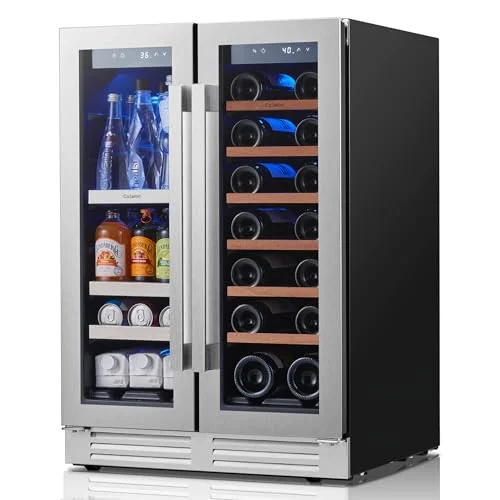 Ca'Lefort 24 Inch, 60 Can & 20 Bottle Ca'Lefort 24 Inch, 60 Can & 20 Bottle |
24 inch |
60 cans + 20 bottles |
Single |
$695.88 |
Get it |
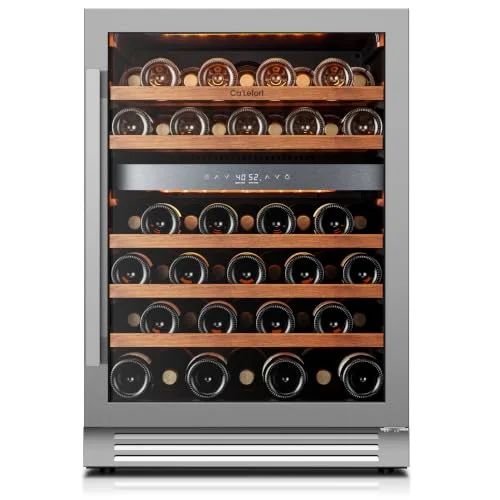 Ca'Lefort 24 Inch Dual Zone, 51-Bottle Ca'Lefort 24 Inch Dual Zone, 51-Bottle |
24 inch |
52 bottles (5.65 cu.ft) |
Dual |
$719.98 |
Get it |
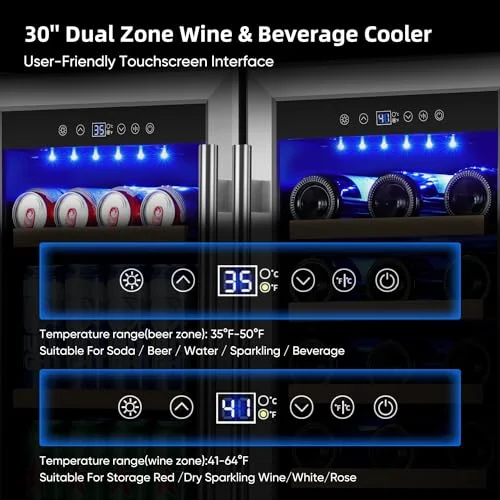 ORYMUSE 30 Inch, 110 Can & 30 Bottle ORYMUSE 30 Inch, 110 Can & 30 Bottle |
30 inch |
110 cans + 30 bottles (6.5 cu.ft) |
Dual |
$799.99 |
Get it |
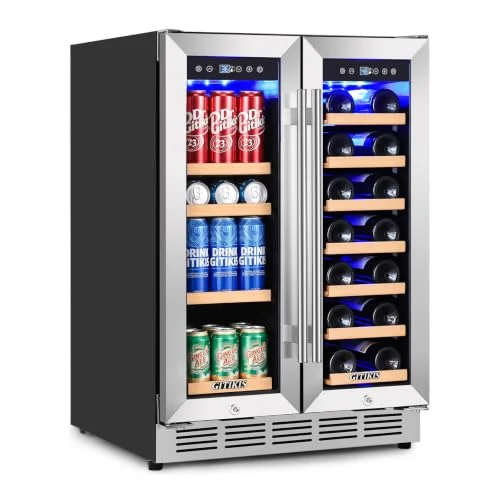 24 Inch Dual Zone, 88 Can & 20 Bottle 24 Inch Dual Zone, 88 Can & 20 Bottle |
24 inch |
88 cans + 20 bottles (4.7 cu.ft) |
Dual |
$799.99 |
Get it |
Capacity figures are the manufacturers' own, based on the size/variant data available for each listing. Prices were correct at the time of writing and move often.
Look at the pure-bottle side of that table first: the Ca'Lefort 24 Inch Dual Zone holds 52 bottles in 5.65 cubic feet, at $719.98 — narrower, and by bottle count alone, ahead of the 30-inch ORYMUSE's 30 bottles at $799.99. If wine bottles are the only thing you are counting, the extra six inches of the ORYMUSE is not buying you more wine storage. It is buying 110 cans' worth of beverage capacity instead, in a larger 6.5 cubic foot cabinet.
That is the honest trade at this width: the 30-inch cabinet in this lineup wins decisively on combined capacity — 140 total items (110 cans plus 30 bottles) against 72 for the Ca'Lefort dual-zone unit — but it does so by giving most of its extra volume to cans, not bottles. If your household genuinely wants both, or wants a dedicated bar-style bay that can serve cold drinks alongside a real wine selection, the 30-inch format is doing something a 24-inch all-wine cabinet cannot. If your household wants maximum wine storage and nothing else, a 24-inch dual-zone or single-zone all-wine unit is the more efficient use of the same or less cabinet footprint.
One caution that applies to every number in that table equally: advertised bottle and can counts assume favorable, uniform bottle and can shapes packed with no wasted space. A cabinet rated for 30 bottles using slim profiles will hold fewer if your collection includes wider Burgundy or Champagne bottles. None of the listings we have specify which bottle profile their counts assume, so treat every capacity figure here as a ceiling, not a guarantee, and check the listing photos for shelf spacing before you buy if your bottles run wide.
The picks
Four products, two widths, two very different jobs. We are not naming these as a ranked "best overall" list — at 30 inches specifically, the honest framing is which of these fits the cabinet and the mix of wine and drinks you actually have.
01The 30-inch pick
ORYMUSE Wine and Beverage Refrigerator 30 Inch
The 30-inch cabinet in this guide
30 bottles + 110 cans·Dual zone·Upgraded cooling·Built-in or freestanding
The one genuinely 30-inch product we can name, and it is built as a wine-and-beverage split rather than an all-wine cellar: 30 bottles alongside 110 cans in a 6.5 cubic foot cabinet, described by the manufacturer as suitable for either built-in or freestanding installation. That combined capacity is the largest in this lineup by a wide margin, which makes sense of the width — this is the product to reach for if the goal is one cabinet that covers wine and cold drinks for a household or a gathering space, not the product to reach for if the goal is maximum bottle storage alone. It is listed as dual zone; the individual per-zone temperature ranges are not published in the data available to us, so confirm those on the listing before assuming a specific reds-and-whites split.
Built for the wine-and-drinks bar, not for a dedicated cellar.
02Most bottles per dollar
Ca'Lefort 24 Inch Wine Fridge, 51-Bottle Built-In Wine Cooler
The case for staying at 24 inches
52 bottles·Dual zone·5.65 cu.ft·24 inch
Six inches narrower than the ORYMUSE and holding more than fifteen times the wine — 52 bottles against 30 — in 5.65 cubic feet. This is the product to compare against before you commit to the wider cabinet: if the household drinks wine and does not need a dedicated can section, this 24-inch dual-zone cabinet delivers meaningfully more bottle storage for a similar price and a smaller footprint. As with the ORYMUSE, the listing describes it as dual zone without publishing the individual zone ranges, so confirm the specific split you need before buying.
If bottle count is the whole point, this beats the wider cabinet on the number that matters.
03Wine and cans, narrower footprint
Ca'Lefort 24 Inch Wine & Beverage Refrigerator, 60 Can & 20 Bottle
A smaller-footprint alternative to the 30-inch split
60 cans + 20 bottles·24 inch
If the appeal of the ORYMUSE is the wine-plus-beverage format rather than the width itself, this is the same idea in a narrower cabinet: 20 bottles and 60 cans in a 24-inch unit. It gives up roughly half the can capacity and a third of the bottle capacity against the 30-inch ORYMUSE, which is the direct cost of the six inches saved. Worth considering wherever the cabinet opening is fixed at 24 inches and a wine-and-drinks combination is still the goal.
The 30-inch idea, sized for a 24-inch opening.
04Most cans in a 24-inch cabinet
24 Inch Dual Zone Wine and Beverage Refrigerator Cooler Under Counter
Maximum can capacity without moving up to 30 inches
88 cans + 20 bottles·Dual zone·4.7 cu.ft·24 inch
At the same $799.99 as the ORYMUSE, this 24-inch dual-zone unit trades cabinet width for a smaller overall volume — 4.7 cubic feet against the ORYMUSE's 6.5 — while still fitting 88 cans and 20 bottles into that narrower footprint. It is the closest match in this lineup to the ORYMUSE's wine-and-beverage concept for anyone who needs to stay at a 24-inch opening. As with the other dual-zone units here, confirm the individual zone temperature ranges on the listing before assuming a specific split between the wine and beverage sides.
Nearly the ORYMUSE's combined-item idea, built to fit where 30 inches will not.
What to check before you cut anything
If the plan involves finished cabinetry — a custom cut-out, built-in millwork, or a permanent bar installation — treat this as the pre-flight checklist. Every item here is something the listing, the installation manual, or a tape measure can answer definitively; none of it should be guessed.
- Freestanding or built-in, confirmed from the manufacturer's own installation instructions — not inferred from the width or the price. This is the single specification most likely to be assumed rather than checked, and getting it wrong is the most expensive mistake in the category.
- The exact cut-out dimensions, measured at the narrowest point on width, depth and height, with the door open and closed both accounted for if the cabinetry has adjacent doors or drawers.
- Clearance on every side the manufacturer specifies, particularly at the back and any vented face, even if that side is less convenient to leave open.
- A dedicated electrical outlet placed before the cabinetry is closed up, sized and positioned according to the unit's power requirements.
- The actual per-zone temperature ranges, if the unit is dual zone and a specific reds-and-whites or wine-and-drinks split matters to you — pull this from the listing directly rather than assuming it from the overall range.
- The real capacity for your bottle and can shapes, checked against listing photos, not just the headline count.
- The current price, since every figure quoted in this guide reflects a single point in time and wine and beverage refrigerator pricing moves often.
None of this is exotic — it is the same due diligence any built-in appliance deserves. The reason it matters more at 30 inches specifically is that a 30-inch opening is more often a custom or semi-custom cabinetry decision than a 24-inch one, which means there is more to unwind if the measurements or the installation type turn out to be wrong after the millwork is finished.
How we compared — and what we cannot tell you
We compared the published specifications and current listed prices for the wine and beverage refrigerators available to us, focusing on capacity, zone configuration, cabinet dimensions and price. Where a listing's size/variant text was the only stated authority on a product's configuration, we treated it as such and did not infer additional specifications — installation type, per-zone temperature ranges, or bottle-shape assumptions — that were not explicitly given.
We do not run a testing lab. We do not own these units and we do not physically test them, so you will not find an invented score out of ten on this page, and you will not find a star rating or a review count either — the retailer data available to us does not include verified ratings for this category, and we do not publish figures we cannot source. What we can do is read the specifications carefully, compare them honestly against each other, and tell you plainly where a spec sheet leaves a real question unanswered, as it does here for per-zone temperature ranges and built-in clearance on every unit in this guide.
Prices quoted here were correct at the time of writing and change frequently. Confirm the current price before buying.
Frequently asked questions
Will a 30-inch wine fridge fit a 24-inch cabinet opening?
No. A 30-inch unit needs a 30-inch (or slightly larger, per the manufacturer's clearance specification) opening — there is no trimming a finished compressor cabinet down by six inches. If your cabinetry is already built to 24 inches, shop 24-inch units; if you have not built the cabinetry yet, decide the width based on what you are actually storing, not the other way around.
Does a 30-inch wine fridge hold more wine than a 24-inch one?
Not necessarily. In this lineup, a 24-inch dual-zone cabinet holds more bottles — 52 — than the 30-inch model, which holds 30 bottles alongside 110 cans. Many 30-inch units are built as wine-and-beverage splits rather than dedicated wine cellars, so the extra width often buys combined capacity for drinks generally, not more racked bottle storage specifically. Check the bottle count directly rather than assuming a wider cabinet means more wine.
Can I build a 30-inch wine and beverage refrigerator into a cabinet run?
Only if the manufacturer's installation instructions rate it for enclosed or built-in installation — confirm this from the listing and manual rather than assuming it from the size. Enclosing a freestanding unit on all sides traps the heat its compressor needs to expel, which shortens the compressor's life. If the documentation available to you does not explicitly confirm built-in clearance, plan the cabinetry as freestanding to be safe.
Is dual zone worth it in a wine-and-beverage cabinet at this width?
It depends on what each zone actually does. In a wine-and-beverage split, one side is often a beverage compartment running at can-serving temperature rather than a second wine-storage zone — that solves a different problem than a genuine reds-and-whites dual zone does. Check the listing for the individual temperature range of each zone before assuming which split you are getting; the products in this guide publish an overall range but not always a documented per-zone breakdown.
Written by Ilane Tall. Research-based comparisons of published specifications, current prices and manufacturer data — we do not physically test these units and we do not publish invented scores.