By Ilane Tall · Updated September 18, 2026 · Research-based.
Reader-supported: we may earn a commission when you buy through the links on this page, at no additional cost to you. It never changes which product we recommend. Prices quoted below were correct at the time of writing and move often.
Quick answer
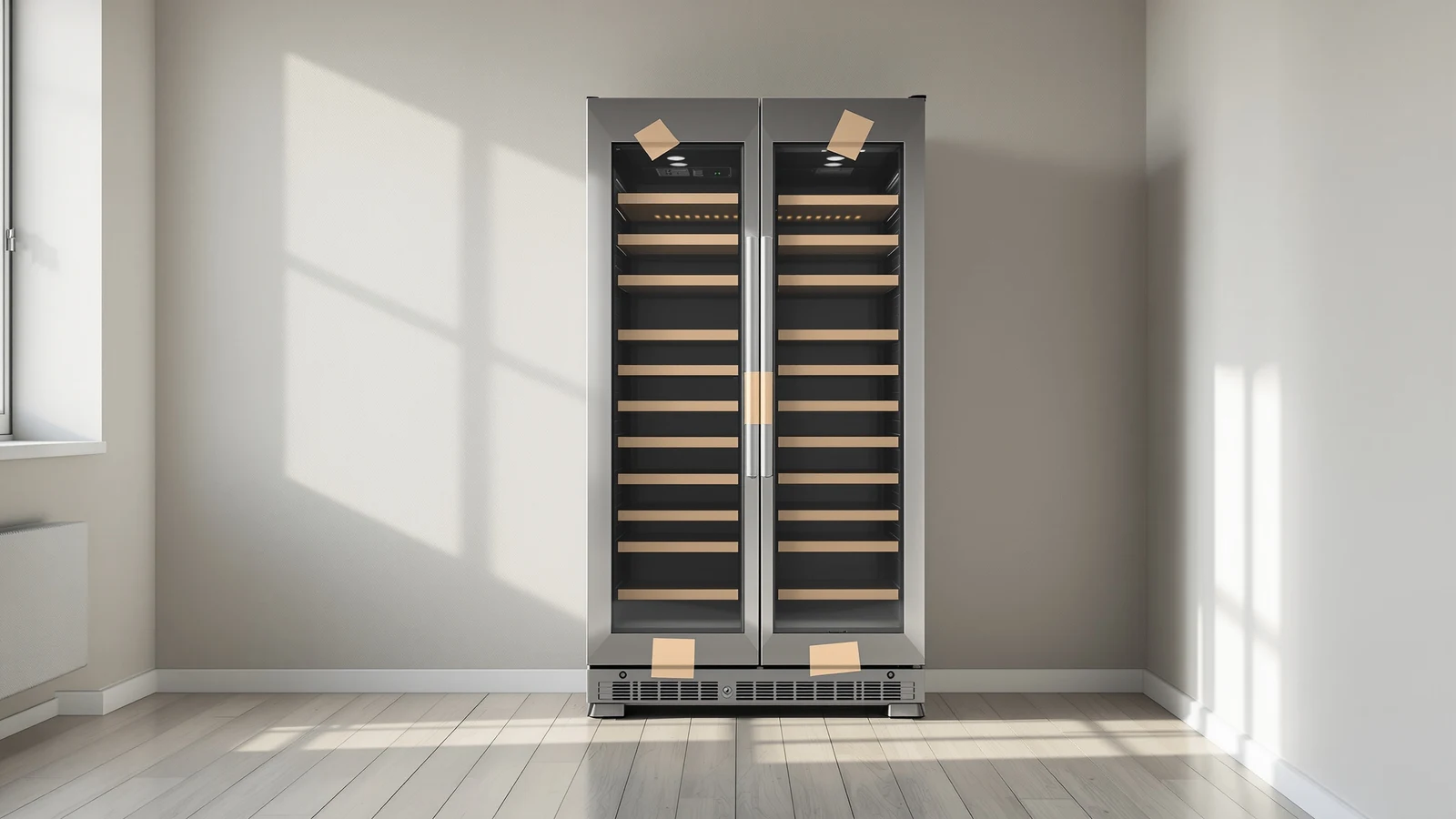
Keep the cabinet upright the entire time — loading, riding, unloading. If it ever has to go on its side, note roughly how long it was down, then let it stand upright at least as long again (24 hours is the safe rule) before plugging it in. Empty it, tape or strap the shelves and door shut, and don't skip the wait: switching a compressor fridge on right after a move is the single most common way people ruin one on moving day.
The cabinets on this page happen to travel unusually well because of what's inside them — the picks below explain why.
Why the compressor decides everything about moving day
Almost every wine fridge worth buying uses a compressor, the same technology that runs a kitchen refrigerator or an air conditioner. A compressor is a sealed pump that circulates refrigerant through a loop of tubing, and inside it — critical to everything that follows — there is a reservoir of lubricating oil that keeps its moving parts from grinding against each other. That oil sits at the bottom of the compressor housing when the unit is upright, exactly where it needs to be to coat the internal components as they move.
Tip the cabinet on its side, even briefly, and the oil migrates out of the reservoir and into the refrigerant lines. It doesn't drain back on its own the moment the fridge is upright again — it has to work its way back down, and that takes time. Plug the unit in before it has, and the compressor starts turning with dry or partially lubricated internals. It may run for a few minutes, or a few days, before it seizes or fails outright. There's no warning light for this. The first sign is usually that the fridge stops cooling for good.
This is also why the wait-before-power-on rule and the keep-it-upright rule are really the same rule, viewed from two directions. Keep the cabinet vertical throughout the move and the oil never leaves the reservoir, so there's nothing to wait for beyond letting the refrigerant settle. Lay it flat for the ride — which happens constantly, because a fridge on its back fits through doorways and into truck beds that an upright one won't — and you've bought yourself a mandatory wait before that unit can safely run again.
Thermoelectric units don't have this problem, because they have no compressor and no refrigerant oil to migrate — a Peltier module and a fan will run the moment they're plugged in, tilted or not. But thermoelectric cooling only pulls the interior about 20°F below room temperature, which is a different set of trade-offs covered in our thermoelectric vs compressor guide. If the fridge you're moving holds any kind of temperature in a normal room, assume it's a compressor unit and follow the rules below.
Emptying, securing the shelves, and taping the door
Do the prep the day before the move, not the morning of, so nothing is rushed.
- Take every bottle out. A full wine fridge is heavy enough to strain whoever's carrying it, and loose bottles inside a moving cabinet become projectiles that can crack shelving or shatter the glass door. Pack the bottles separately, upright in a wine-specific box if you have one, cushioned if you don't.
- Remove or secure every shelf. Wire and wood shelves are designed to hold bottles under gravity, not to survive being flipped or jolted. If the shelves lift out, take them out and pack them flat, wrapped so they don't scratch the cabinet's interior finish. If they're fixed, use painter's tape (never anything more aggressive on a finished interior) to hold them against their rails so they can't shift or drop during transport.
- Tape the door shut. A door that swings open mid-move is how glass gets broken and how movers get hurt. A strip of painter's tape from the door edge to the cabinet frame, front and back if there's a handle to anchor it to, keeps it closed without leaving residue on paint or trim.
- Unplug it well before you lift it. Give the compressor time to settle — ideally unplug it a few hours ahead, not seconds before the movers arrive. A compressor that was actively running when it's unplugged has pressure still equalizing in the refrigerant lines; a short rest before it moves at all is one more thing in its favor.
- Coil and tape the power cord against the back of the unit so nobody trips on it and it doesn't snag on a doorframe.
None of this is specific to wine fridges — it's the same prep you'd do for any refrigerator or freezer. The difference is that a wine fridge is usually lighter and more tempting to tip on its side to squeeze through a tight stairwell, which is exactly the move that causes the trouble in the next section.
Upright, always — and what happens if it tips
The rule that matters most is also the simplest: a compressor wine fridge should be moved standing on its feet, the same orientation it runs in, for the entire trip — up the stairs, into the truck, and back out again.
In practice this means using an appliance hand truck with a strap, tilting the unit back only far enough to roll it (a brief few-degree tilt to get it onto the truck's lip is normal and not the problem), and never laying it flat in a truck bed or a trunk because it's easier to stack that way. If the cabinet won't fit through a doorway or stairwell standing up, that's a sign to remove the door rather than lay the fridge down — most wine fridge doors are designed to come off their hinges, and a narrower door-less cabinet clears openings that would otherwise force it onto its side.
If it does end up on its side — a mover loses their grip, it has to go flat in a moving truck, anything like that — the fridge is not ruined. But it does need to be treated differently once it arrives. Note roughly how long it was tilted or lying down, stand it upright the moment you can, and then wait before plugging it in for at least as long as it was down, with 24 hours as the safe floor regardless of how briefly it was tipped. That gives the compressor oil time to drain back into its reservoir by gravity, which is the only way it gets there — there's no way to speed this up by shaking the unit, running it briefly, or warming it up.
The temptation to skip this is strongest with a short move — carrying a small countertop unit across a room, say — where it feels absurd that laying it on its side for thirty seconds could matter. It genuinely might not, in that one case. But there's no reliable way to know how much oil moved in thirty seconds versus three minutes, so the honest answer is that the wait doesn't scale down for a short tip the way people hope it does. Owners who've skipped the wait after "it was only tilted for a minute" are the ones most likely to describe a fridge that ran fine for a few days and then went silent.
The wait before switching it on, and why
Once the fridge is in its final spot, upright, and has cleared whatever waiting period applies — zero extra wait if it never left vertical, at least 24 hours if it was tilted or laid flat at any point — there's a second, shorter step before power-on: let it sit in place, unplugged, for a couple of hours regardless. This lets it reach room temperature and lets any pressure in the refrigerant lines from the move settle, and it costs nothing but patience.
When you do plug it in, don't load it with bottles right away. Let it run empty for a few hours and confirm the interior is actually reaching a cold temperature — most units display the internal temperature, so this is a matter of checking the readout rather than guessing. Only once it's holding a stable, cold number should the bottles go back in. Loading a fridge that hasn't proven it can cool yet just means warm bottles sitting in a warm box while you wait to find out if the move damaged something.
Also give it clearance once it's plugged in. Every freestanding compressor unit needs air space at the back and sides to reject the heat the compressor generates — usually a few inches, check the manual for the exact figure — and it's easy to shove a fridge flush against a wall in the chaos of unpacking and forget to pull it back out. A unit that can't vent runs hot, works harder than it should, and shortens its own life even if the move itself went perfectly. Our running-cost guide has more on what makes a compressor work harder than it needs to.
The picks that travel best
Every compressor wine fridge is subject to the same physics above, but some cabinets make the move meaningfully less stressful. The three below share the traits that matter on moving day: manageable size and weight for stairs and doorways, standard freestanding installation that doesn't involve disconnecting anything hardwired, and enough published detail on dimensions to plan the move properly before the truck shows up.
01Best for a fresh start
BODEGA 24 Inch Wine Cooler, 154 Bottle
A tall freestanding unit sized for a real move-in
154 bottles·Compressor·Freestanding
At 24 inches wide and built for a large 154-bottle capacity, this is the cabinet people buy when they're setting up a new kitchen or bar rather than relocating an existing collection — which makes it a useful case study for the reverse situation, moving it in for the first time. It ships and delivers upright for exactly the reason covered above: a tall compressor cabinet laid on its side during delivery is the scenario the 24-hour rule exists for. Confirm the delivery truck can keep it vertical, and if it can't, budget the wait before you plug it in on day one.
Freestanding and floor-standing — plan the doorway width before delivery day, not during it.
02Best if you're relocating a serious collection
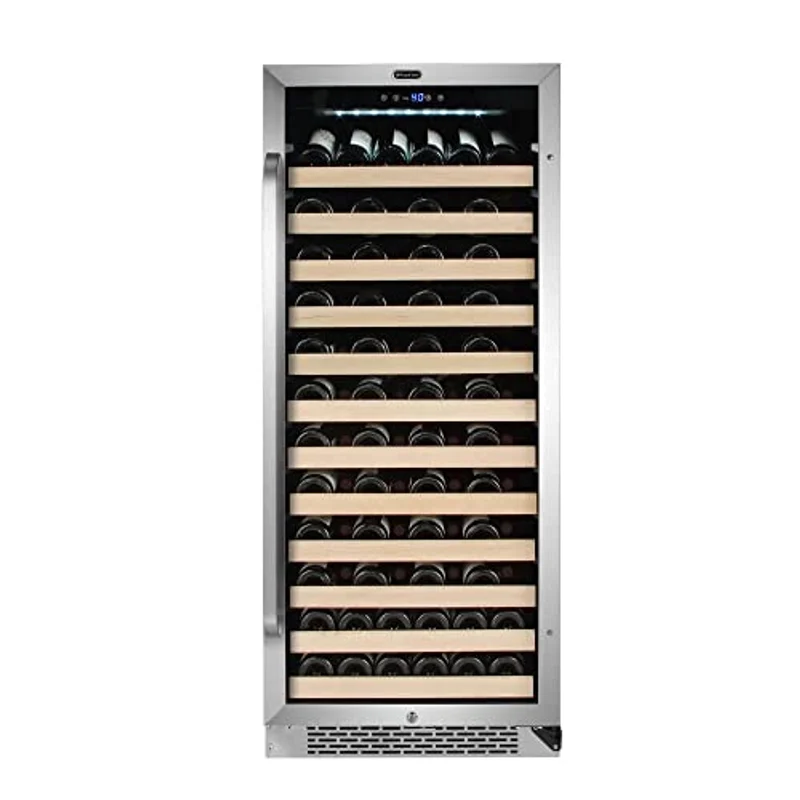
Whynter BWR-1002SD 100 Bottle Built-In
Rated for built-in or freestanding placement, either way
90 bottle·Compressor·Built-in or freestanding
Whynter rates this cabinet for either built-in or freestanding installation, which matters on moving day in a specific way: if it's currently built into a cabinet run, it likely isn't hardwired or plumbed, but it may be trimmed in or fastened to adjacent cabinetry, so check for mounting screws or a trim kit before anyone starts pulling it toward the door. Once it's free of the cabinetry, treat it exactly like any other compressor fridge — upright, emptied, shelves secured. Its size makes it a two-person lift, which is also the safest way to guarantee it never gets tipped to make it easier to carry alone.
A collection this size is exactly the one you don't want to gamble the compressor on.
03Best lighter option for stairs
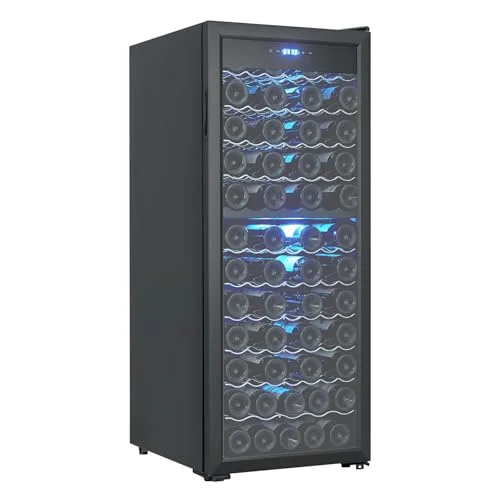
GarveeHome 80 Bottle Compressor Wine Cooler
A mid-size freestanding cabinet that two people can manage comfortably
80 bottles·Compressor·Freestanding
Eighty bottles is a meaningful middle ground: enough capacity to be worth moving carefully, small enough that it doesn't require professional movers or an appliance dolly built for a full-size refrigerator. Its digital temperature display (rated 41–64°F) is worth using on the other end of the move, too — it's the readout that tells you the unit is actually cooling again before you reload it with bottles, rather than a guess based on how cold the door feels.
A size that makes "just keep it upright" genuinely easy to enforce with two people carrying it.
What a damaged compressor sounds and looks like
If the wait got skipped, or the move was rougher than planned, here's what to watch and listen for once the fridge is back in service. None of this is a substitute for a technician's diagnosis, but it tells you whether to worry.
- A loud, continuous hum or buzz that wasn't there before. A healthy compressor cycles on and off and makes a moderate hum while running. A compressor short on lubrication tends to run louder and more continuously as it works harder to do the same job, or to make a harsher, more mechanical buzz than its normal operating sound.
- Clicking or clunking, especially every few minutes. Repeated clicking without the compressor actually starting up is a classic sign of a compressor trying and failing to start — often the overload protector cutting power because the motor is struggling, which is consistent with oil that hasn't fully returned to where it needs to be.
- It runs constantly and never gets cold. A compressor working hard but moving no heat — the fridge stays at room temperature no matter how long it runs — points to a lost refrigerant charge or a seized element inside the sealed system, both plausible outcomes of a rough move.
- It gets cold, then stops. A unit that cools initially and then shuts down and won't restart, sometimes after a warm buzzing sound, suggests the compressor started but then failed or tripped its protector under load — again, consistent with insufficient lubrication rather than a simple thermostat issue.
- Vibration you can feel through the cabinet or floor. Some hum is normal; a rattle or a shake that wasn't present before the move can indicate something inside came loose or shifted, which is more likely if the unit was on its side or dropped during transport.
Any of these within the first day or two of restarting a moved fridge is worth taking seriously — it's more likely to be moving-related than coincidental. If the noise or performance is new and the unit is still under warranty, that's the point to contact the manufacturer rather than keep running it and hoping it settles down; a compressor that's struggling and left running can go from recoverable to fully seized.
How we compared these — and what we cannot tell you
We compared published manufacturer specifications, current listed prices, and general compressor-refrigeration engineering that applies to appliances of this kind — the same physics that governs why any compressor fridge, freezer, or air conditioner needs to rest upright after being tilted. We do not run a testing lab. We do not own these units and did not physically move them ourselves to write this guide, so you won't find a claim here about how any specific unit performed during an actual relocation. What we can do is read the specifications carefully, track prices, and lay out the mechanics of what a compressor needs to survive a move undamaged.
We publish no star ratings or review counts on this page, and we don't paraphrase review sentiment we don't have data for — the retailer API doesn't return that information for the products above, so we're not going to invent it. Every claim about a specific product here is anchored to its published specification sheet, its price, or the class of appliance it belongs to.
Prices quoted here were correct at the time of writing and change frequently. Confirm the current price before buying.
Frequently asked questions
How long can a wine fridge be on its side before it's a problem?
There's no precise cutoff, which is why the safe answer is to treat any period on its side the same way: stand it upright as soon as possible and then wait at least 24 hours before plugging it in, regardless of whether it was tipped for two minutes or two hours. Compressor oil migration isn't something you can eyeball from the outside, so guessing that a brief tilt doesn't count is exactly the guess that leads to a dead compressor a few days later.
If it stayed upright the whole time, generally nothing — that's the case where there's no oil migration to wait out. If it was tilted or laid flat and you plug it in right away anyway, the compressor may run fine, run briefly and then fail, or fail to start at all; there's no way to predict which from the outside, and the failure isn't always immediate. It's the single most common way a wine fridge gets damaged during a move, precisely because it often doesn't fail on the spot.
Do I have to empty every bottle before moving it a short distance?
Yes, even across a room. A full cabinet is significantly heavier and harder to control, and loose bottles shift and strike the shelving or the door glass on even a short, careful carry. The prep in this guide is the same regardless of distance — it's the orientation and the wait afterward that scale with how rough the move actually was.
My wine fridge is louder than before I moved it — is that normal?
A slightly different sound for the first day or two, as it settles back into its spot and the refrigerant redistributes, isn't unusual. A loud continuous hum, clicking, or a rattle that doesn't fade after the first day is worth investigating rather than waiting out — see what a damaged compressor sounds like above, and if the unit is under warranty, that's the point to call the manufacturer rather than keep running it.
Written by Ilane Tall. Research-based comparisons of published specifications, current prices, and general appliance-engineering fact — we do not physically test these units and we do not publish invented scores.