By Ilane Tall · Updated September 2, 2026 · Research-based.
Reader-supported: we may earn a commission when you buy through the links on this page, at no additional cost to you. It never changes which product we recommend. Prices quoted below were correct at the time of writing and move often.
The short version
A wine fridge never switches off: 8,760 hours a year, which is why a modest wattage figure adds up to a real number on the electric bill.
At the U.S. average residential rate of roughly 17¢ per kWh, a plausible planning range is $35–65 a year for a small single-zone compressor cooler in a normal room, $70–110 for a 33-bottle built-in unit, and $60–150 for a large freestanding cabinet, more if it lives somewhere hot.
Three things move that number far more than bottle count does: cooling type, room temperature, and how often the door opens. Get those three wrong and a $30-a-year fridge on paper becomes a $100-a-year fridge in practice.
Some wine fridge listings publish an energy figure and most do not. When one does show up, it is usually kilowatt-hours per day, buried in a bullet next to the compressor type. The BODEGA 24 Inch 154 Bottle we cover below is a rare example that states it plainly: an R600a compressor rated at 0.413 kWh per day.
Run that forward: 0.413 × 365 is roughly 151 kWh a year, about $25.60 at 17¢ per kWh, to run a cabinet that holds 154 bottles. Why that can be so low is the subject of this article.
A published daily-draw figure is measured under a fixed test protocol: a set ambient temperature, usually the high 60s or 70s Fahrenheit, a closed door, nobody reaching in for a bottle — a fair way to compare two fridges against each other, the way an EPA fuel-economy sticker compares two cars, but not a promise about your kitchen, garage or basement, none of which hold a constant lab temperature or a door that stays shut all evening.
Two of our three picks below — the EUHOMY 12 Inch 18 Bottle and the Whynter 15" 33 Bottle — do not publish a daily kWh figure at all, which is common at the smaller end of the category. That is not a reason to assume they run for free; the honest answer for those two is a category estimate rather than a number lifted off the box, built later in this guide.
The figure also does not scale the way you would expect with size. A cabinet built to hold 154 bottles is not automatically drawing more power than one built to hold 18, because the daily-draw figure reflects the compressor's duty cycle under test conditions, not the volume of air being cooled. A larger, well-insulated cabinet can post a lower figure than a small one with thin insulation and a leaky door seal. Capacity tells you how many bottles fit; it tells you very little about the electric bill.
Thermoelectric versus compressor: the running-cost inversion
The single biggest lever on running cost is which of the two cooling technologies sits inside the cabinet, and the intuitive answer is backwards more often than not.
A thermoelectric wine cooler uses a peltier module: a solid-state plate that moves heat from one side to the other when current runs through it, with a fan pushing air across each face. It has no compressor and almost no moving parts, which is why thermoelectric units are close to silent. The catch is a hard ceiling on how far it can push the temperature below whatever the room is doing — roughly 20°F below ambient, and no further, however long it runs. To hold that gap, the module runs close to continuously: low wattage, but close to full-time duty.
A compressor wine cooler works the way a kitchen refrigerator does: a motor compresses refrigerant, sheds heat through a condenser, and lets it expand and absorb heat again inside the cabinet. It draws more power while running than a peltier module does, but it does not run all the time. Once the cabinet reaches its setpoint, the compressor shuts off and coasts until the temperature drifts back up, which in a stable room can mean it is idle more than it is running. That is the inversion: the technology with the higher instantaneous draw often costs less over a full day, because it is not paying that draw around the clock.
The inversion has a limit. Push a compressor into a hot room and its duty cycle climbs toward continuous too, so its higher per-hour draw stops being offset by idle time. That is also why compressor cooling tends to win on cost in anything but a cool, stable room: it keeps working as the room warms, rather than drifting off its setpoint while still drawing power.
One compressor-specific detail matters for the built-in or undercounter category, which includes two of our picks below. A cabinet rated for built-in installation has to vent its heat out through a front grille rather than the back, since the sides and rear are sealed into cabinetry. A peltier module dumps heat continuously and in volume; sealing one into a cabinet with only front airflow will shorten its life or stop it holding temperature at all. That constraint is why front-venting, built-in-rated wine fridges are compressor units almost without exception, and why they are the ones you will hear cycling on and off; our guide to wine fridge noise and vibration covers what that hum should and should not sound like.
Room temperature: the variable that doubles the bill
Every refrigeration appliance works harder as the gap between its setpoint and the surrounding air widens, and a wine fridge feels this more than a kitchen refrigerator does, because it is thinner-walled, smaller, and often placed somewhere the kitchen fridge would never go — a garage, a sunny dining room corner, an uninsulated basement near a furnace.
The physics is roughly linear and unforgiving. A compressor cooling a 55°F cabinet in a 68°F room is bridging a 13-degree gap. Move the same cabinet to a room that sits at 82°F in summer and the gap more than doubles to 27 degrees, and the duty cycle rises sharply to match, because heat transfer through the cabinet walls accelerates with the temperature difference. A unit that idles most of the day at 68°F can end up running close to continuously at 82°F.
That single variable is why the same fridge can plausibly cost $40 a year in one house and $90 in another, with nothing about the appliance itself different. Any "at US rates" running-cost estimate carries a quiet assumption underneath it: at what room temperature. A number calculated for a 70°F den tells you little about a 78°F sunroom, and almost nothing about a garage.
The practical takeaway is not to obsess over a specific degree, since most people cannot control their room's temperature precisely anyway. It is to notice which of two categories your fridge's location falls into. A climate-controlled interior room — a den, most kitchens — stays close enough to a listing's test conditions that the published number, where one exists, is a reasonable estimate. Anywhere that swings with the seasons — a garage, an enclosed porch, an attic room — should be planned around a meaningfully higher figure.
Door openings, ambient heat and a garage in August
The two variables above compound in one common scenario: a wine fridge in a garage in summer, opened at the same rate as one in a climate-controlled kitchen.
Every time the door opens, the cabinet loses its cold air and pulls in warm, usually humid, air to replace it, and the compressor has to remove that load on top of whatever is leaking in through the walls. A fridge opened twice a day for thirty seconds loses relatively little; the same fridge opened repeatedly during a dinner party, or left ajar while someone digs for a bottle, can spend the next hour recovering. A wine fridge's smaller interior volume means a given door-opening event is a larger fraction of its total air, so the recovery is proportionally more noticeable than in a kitchen refrigerator.
Ambient heat and door openings do not add together; they multiply. A garage that reaches 90°F in August already asks the compressor to bridge a wider gap than a lab test assumes. Add the door-opening pattern of a household treating the garage fridge as the beer-and-mixer stop for a barbecue, and the unit can run continuously for most of an August afternoon.
Installation matters here too. A freestanding unit needs clearance at the back and sides to reject its compressor's heat; block that against a garage wall or a tight nook, and it fights its own exhaust as well as the room. A built-in-rated unit vents through the front instead, but only if the model is actually rated for it. Our guide to installing an undercounter wine fridge covers the clearance numbers, and getting them right costs nothing beyond reading the manual first.
Put together, the honest range for a garage placement in a hot climate is not the label figure with a modest markup. It can be two to three times the same fridge's cost in a climate-controlled room, which is the single biggest reason the "realistic" figures below sit well above the label-only math.
The picks
Three sizes, three price points, three different running-cost pictures.
01Smallest running cost
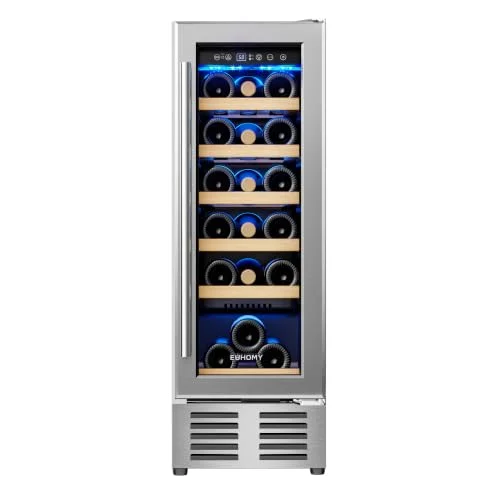
EUHOMY 12 Inch Wine Cooler, 18 Bottles
The cheapest fridge to run, mostly because it is the smallest
18 bottles·Single zone·41–72°F range·Built-in or freestanding
At 11.6 inches wide and 22.4 inches deep, this is the smallest of the three, with the least volume to condition and the least surface area for heat to leak through. It quotes a 41–72°F range with a temperature-memory function that restores the setpoint after a power outage. The listing publishes no daily kWh figure, typical at this price; its built-in-or-freestanding rating puts it in the compressor class discussed above. Double-layer tempered glass blocks UV and slows heat exchange through the door, the largest uninsulated surface on any wine fridge.
The smallest cabinet in this guide, and the cheapest one to run, for exactly that reason.
02Best under a counter
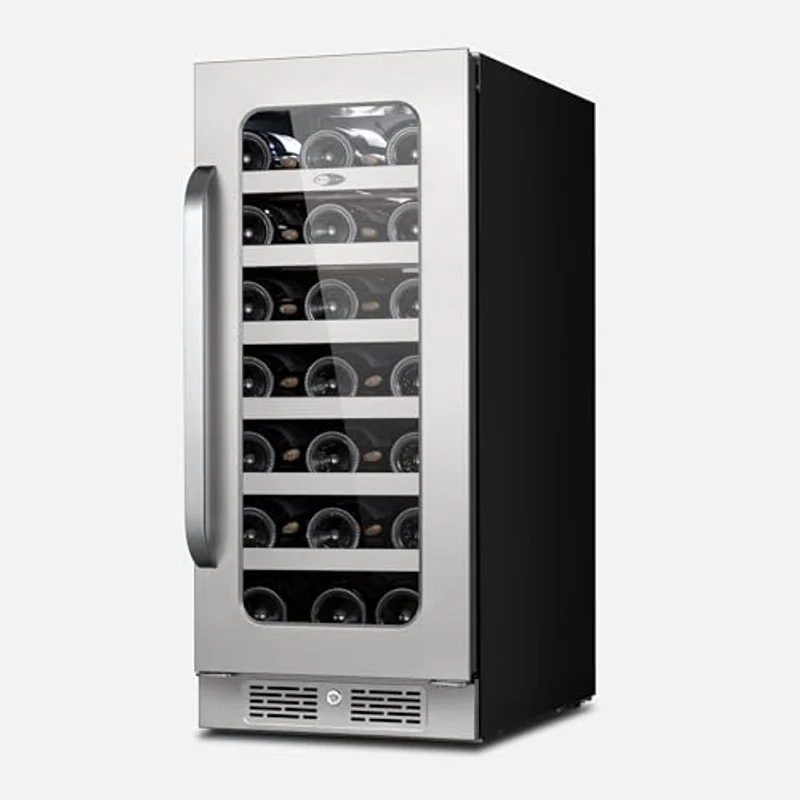
Whynter 15" Built-in Undercounter Wine Refrigerator, 33 Bottle
Front-venting by design — the correct engineering for an enclosed space
33 bottles·Single zone·3.0 cu. ft.·Built-in or freestanding
This is a genuinely built-in-rated unit, designed to vent out the front rather than the back, which matters directly for running cost: a freestanding fridge shoved into a cabinet run with no clearance fights its own exhaust and its duty cycle climbs, whatever the label says. Properly installed, this size class typically posts a moderate figure — larger than the 12-inch EUHOMY above, smaller than the 24-inch cabinet below, roughly in proportion to its 3.0 cubic feet. Whynter does not publish a daily kWh number either, so treat any figure here as the category estimate below, not a manufacturer claim.
Where the fridge is going under a counter, venting design decides the running cost before wattage does.
03Most bottles, lowest cost-per-bottle
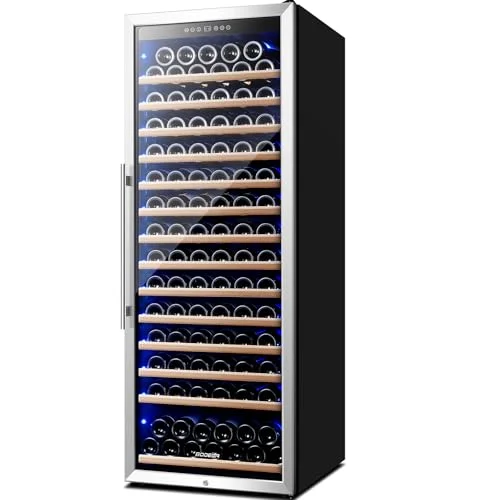
BODEGA 24 Inch Wine Cooler, 154 Bottle
The one with a published number, and the case study for this whole guide
154 bottles·R600a compressor·40–65°F range·Freestanding
BODEGA's listing states an R600a compressor rated at 0.413 kWh per day — about 151 kWh a year, roughly $25.60 at 17¢ per kWh, the one figure here we can attribute directly to a manufacturer spec rather than a category estimate. It quotes a 40–65°F range with a stated differential of no more than 2°C (about 3.6°F) once settled, and 14 removable wooden shelves. At this size, the label figure deserves the most caution: a freestanding 24-inch cabinet is also the one most likely to end up somewhere warmer and opened more often than a lab test assumes.
The published number and the real-world number are furthest apart on the largest fridge, not the smallest — because it is the one most often installed somewhere hot.
A realistic annual cost, size by size
The table below states its assumptions. The "label estimate" column uses BODEGA's published 0.413 kWh/day figure for the 154-bottle cabinet, and a category-typical range for the two sizes whose listings do not publish a daily-draw number — an estimate, not a manufacturer claim. Every dollar figure assumes the U.S. average residential rate of roughly 17¢ per kWh; rescale by your own rate. The "realistic range" column adds a normal room that is not lab-cool year-round and a door opened like a household actually opens one, without assuming a worst-case garage.
| Size class | Example | Price | Assumed daily draw | Label estimate (annual) | Realistic range (annual) |
|---|
| 12", 18 bottle |
EUHOMY 18 Bottle |
$329.99 |
~0.4–0.6 kWh (category estimate) |
~$25–37 |
$35–65 |
| 15", 33 bottle, built-in |
Whynter BSR-033SW |
$499.99 |
~0.7–1.0 kWh (category estimate) |
~$43–62 |
$70–110 |
| 24", 154 bottle, freestanding |
BODEGA 154 Bottle |
$999.99 |
0.413 kWh (manufacturer published) |
~$25.60 |
$60–150 |
Two things are worth noticing beyond the headline dollar figures. First, the label estimate does not climb in a straight line with bottle count — the 154-bottle BODEGA's published figure sits close to the small EUHOMY's estimated range, the "capacity does not predict running cost" point from earlier, made concrete. Second, the gap between the label estimate and the realistic range widens as the cabinet gets larger and more likely to end up somewhere warm. That gap, not the label number, is the one to plan a budget around.
How we compared
What we did
Published specs, one real energy figure, and general refrigeration physics
We read the manufacturer listings for capacity, temperature range and the one published daily kWh figure among our three picks, and combined it with well-established facts about how compressor and thermoelectric cooling behave as ambient temperature and door use change. Where a listing did not publish a figure, we said so and estimated from the category rather than inventing one.
What we didn't
We don't run a testing lab
We do not own these units or meter them in a garage over a summer, and we do not publish invented ratings or review counts — the retailer does not supply them here. The dollar ranges above are planning estimates built from a stated rate and stated assumptions, not measurements.
Frequently asked questions
Does the number on a wine fridge's listing reflect what I'll actually pay?
Only as a starting point. A published kWh-per-day figure is measured under a fixed lab protocol — moderate ambient temperature, door shut — that most real rooms do not match. Treat it as a way to compare two fridges against each other, not a forecast of your own electric bill.
Is a thermoelectric wine fridge cheaper to run than a compressor model?
Not reliably. A thermoelectric unit draws less power at any moment but runs close to continuously, since its peltier module has no off-cycle. A compressor draws more per hour but often runs a smaller share of the day. In a hot room the comparison can flip again, since a compressor keeps working as heat rises while a thermoelectric unit struggles to hold temperature.
Does room temperature really change the running cost that much?
Yes, more than almost any other single factor. The wider the gap between the room and the fridge's setpoint, the harder and more often the compressor runs, and that relationship accelerates rather than staying flat as the gap widens. The same fridge can plausibly cost twice as much to run in a warm room as a cool one.
How much more does a wine fridge cost to run in a hot garage?
Ambient heat and frequent door openings compound rather than add, so a garage that reaches the high 80s or 90s Fahrenheit in summer can push a fridge toward two to three times its label-estimate cost, more if it is installed without proper clearance for its exhaust.
Written by Ilane Tall. Research-based comparisons of published specifications, current prices and general refrigeration physics — we do not physically test these units and we do not publish invented scores.