By Ilane Tall · Updated August 23, 2026 · Research-based.
Reader-supported: we may earn a commission when you buy through the links on this page, at no additional cost to you. It never changes which product we recommend. Prices quoted below were correct at the time of writing and move often.
The short version
At 100+ bottles, bottle count stops being the interesting number. A cabinet this tall needs a fan actively moving cold air from bottom to top, or the top shelf quietly runs several degrees warmer than the bottom — a fault a thermostat can't detect because its sensor sits in one spot. Of the five fridges we compared, only the Whynter BWR-1002SD states internal fan-forced circulation, which is why it's the pick we'd buy first even though it holds fewer bottles than the others here.
If maximum capacity is the goal instead, the Velieta 179 Bottle and BODEGA 154 Bottle hold meaningfully more wine for a similar price — you're trading the circulation spec for shelf space, and should go in knowing that's the trade.
Check the Whynter BWR-1002SD's price on Amazon →
Stratification: why a tall cabinet without forced air runs warmer at the top
Every wine fridge cools the same basic way: a compressor pulls heat out of the cabinet and the interior settles toward the thermostat's setpoint. In a small 18- or 28-bottle unit, the interior air volume is small enough that it stays reasonably even without help. Stretch that principle to a 33-to-45-inch-tall cabinet holding 150 or 179 bottles and the physics stops cooperating on its own.
Cold air is denser than warm air, so it sinks. In a tall cabinet cooled passively — cold air released near the bottom or back, with no fan pushing it around — the coldest air pools low and the warmest air collects at the top, near the door seal and furthest from the cooling coil. That's stratification, and it's what happens to any tall, unforced cabinet, not a defect exclusive to cheap units. The gap can run several degrees, which sounds small until you remember that wine stored at 62°F for a year ages measurably faster than the same bottle held at 55°F.
A thermostat only knows the temperature where its sensor sits. If that sensor sits mid-cabinet and reads a perfect 55°F, the display can say exactly what you want to see while the top rack quietly cooks ten degrees warmer. The only real fix is mechanical, not electronic — a fan that continuously moves air through the whole interior so every shelf sees the same air. Of the five cabinets in this guide, only the Whynter BWR-1002SD's listing explicitly states "internal fan-forced circulation for even temperature distribution throughout the cabinet." None of the other four listings make that claim, so we're not assuming it for them — ask the seller or check the current specification sheet before buying any of the others. Our wine fridge not cooling checklist covers the symptoms of a stratified or failing cabinet if you already own one.
Why single zone is usually the right answer at this size
Dual zone makes obvious sense in a 20-to-30-bottle countertop unit: split the cabinet, park whites cold on one side, hold reds warmer on the other, and the loss in capacity is a few bottles you can live with. At 150 or 179 bottles, the arithmetic flips: a divider that costs a small fridge four or five bottles costs a tall one considerably more shelf space, and a serious collection at this scale is being built for storage, not for pouring a chilled glass on demand.
There's a mechanical reason too, compounding the stratification problem above. A dual-zone cabinet is still almost always one compressor serving two compartments through a divider, a damper or a secondary fan. Splitting an already-tall cabinet into two shorter zones means each zone gets less air to work with for its own circulation — precisely the wrong direction if your risk is a warm top shelf. A single, tall, well-circulated zone holding one number is mechanically simpler, and simpler is what you want when the cabinet holds thousands of dollars of wine rather than a case.
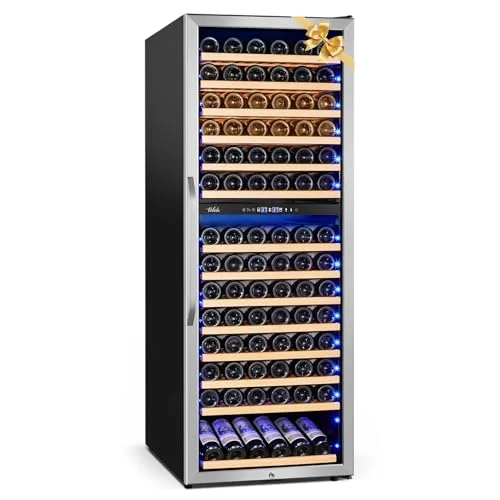
Of the five fridges here, only the Velieta KMHJ408D is dual zone — its listing states an upper zone of 40–55°F and a lower zone of 55–65°F, both bottle-racked, a genuine per-zone spread rather than one narrow overall range with two displays. If you keep a real mix of serving-temperature whites and cellar-temperature reds at volume, it's defensible. For most buyers at this scale, the advice matches our dual-zone wine fridge guide: one correct temperature beats two compromised ones, and the flexibility of not permanently dividing the cabinet is worth more here than in a 28-bottle fridge.
Shelving: full-extension wooden racks vs wire, and what access looks like at 100+ bottles
Shelf material and design matter more here than in a small cabinet: at 18 bottles you can lift a whole shelf out to reach the back row. At 150 bottles, you can't — the shelves above and below are fully loaded, and if the shelving doesn't slide, the bottle you want is buried three deep against the back wall.
The BODEGA 154 Bottle is explicit about its shelving: 14 removable wooden shelves, individually adjustable, which the listing frames as enabling "multiple storage modes" — reconfiguring spacing as bottle shapes change, pulling shelves for cleaning without disturbing the rest of the cabinet. Wood is also gentler on labels than bare wire. The dual-zone Velieta KMHJ408D states iron shelving, framed as "less likely to scratch your wine labels" than cheaper wire racks — a narrower claim than BODEGA's wood, but a real one. The other three listings — the single-zone Velieta 179 Bottle, the Whynter BWR-1002SD and the GarveeHome 80 Bottle — describe adjustable shelves without stating material, so check the current listing's photos if label protection matters to you. Full-extension, slide-out racking is the feature to look for regardless of material, since it's what keeps every bottle reachable once the cabinet is genuinely full; none of the five listings explicitly confirm it, so treat that as an open question to verify before buying.
Locks, alarms and door-ajar warnings — worth it once the contents cost more than the cabinet
A $700 wine fridge holding $700 worth of wine is a mild loss if something goes wrong. The same cabinet holding $3,000 worth of wine after several years of filling racks is a different risk profile entirely — exactly the situation a large-format buyer is in more often than a small-format one.
Two of the five units here state a physical lock. The Whynter BWR-1002SD ships with a cylinder lock and two keys — a real lock rather than a child-safety latch, which matters if the cabinet sits somewhere accessible to guests, renters or kids. The dual-zone Velieta KMHJ408D also states a safety lock. The single-zone Velieta 179 Bottle, the BODEGA 154 Bottle and the GarveeHome 80 Bottle don't mention a lock, so confirm directly with the seller before buying those three if it's a requirement rather than a nice-to-have.
None of the five listings advertise a door-ajar or high-temperature alarm, so we're not claiming that feature for any of them. It matters anyway: a cabinet left slightly ajar can lose cold air steadily for hours before anyone notices, and the top of a 150-bottle cabinet spends that time in the warmest air in the box — cheap insurance worth adding to your checklist alongside the lock question above.
Floor loading, placement and the noise of a large compressor in a living space
A full 150-to-179-bottle cabinet is heavy in a way that's easy to underestimate. A standard 750ml bottle weighs roughly 2.6 to 3 pounds full, so a loaded 150-bottle cabinet carries somewhere around 400 to 450 pounds of wine and glass, on top of a cabinet weight that typically runs well over 100 pounds empty. That's a genuine point load: a concrete slab or a well-supported subfloor over joists handles it without a second thought, while an older or lighter-framed floor is worth a quick check first. Leveling matters too — a compressor sitting even slightly off level can run its refrigerant unevenly and let its door seal gap on one side, reopening the stratification problem from a different angle. Confirm the cabinet sits dead level once it's in its final spot, and re-check after the floor settles under the weight.
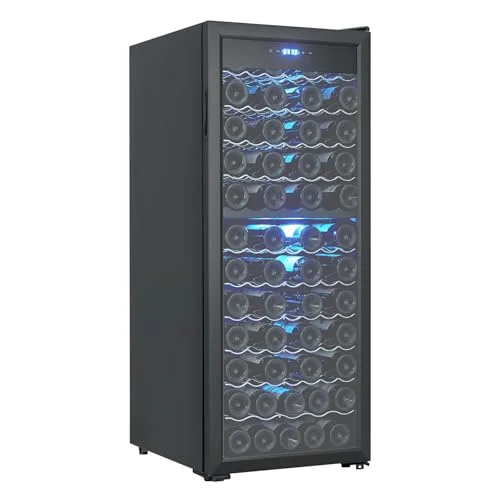
On noise: several listings describe themselves in general terms as quiet or low-vibration — the BODEGA cites an R600a compressor rated at 0.413 kWh/day, the single-zone Velieta 179 Bottle an "ultra silent" compressor, the GarveeHome a low-noise compressor and well-sealed door. None publish a decibel figure, so treat "quiet" as characterization, not measurement. Compressor cooling in general is not silent the way a small thermoelectric cooler is — it cycles on and off with an audible hum, and a larger compressor moving more air through a taller cabinet won't be quieter than the small unit it's replacing. Plan for that if the cabinet is going in a bedroom or home office.
How the five compare
Capacity and spec figures are each manufacturer's own. Prices were correct at the time of writing and move often — confirm the current price before buying.
| Model | Best for | Capacity | Zones | Shelving | Price | Get it |
|---|
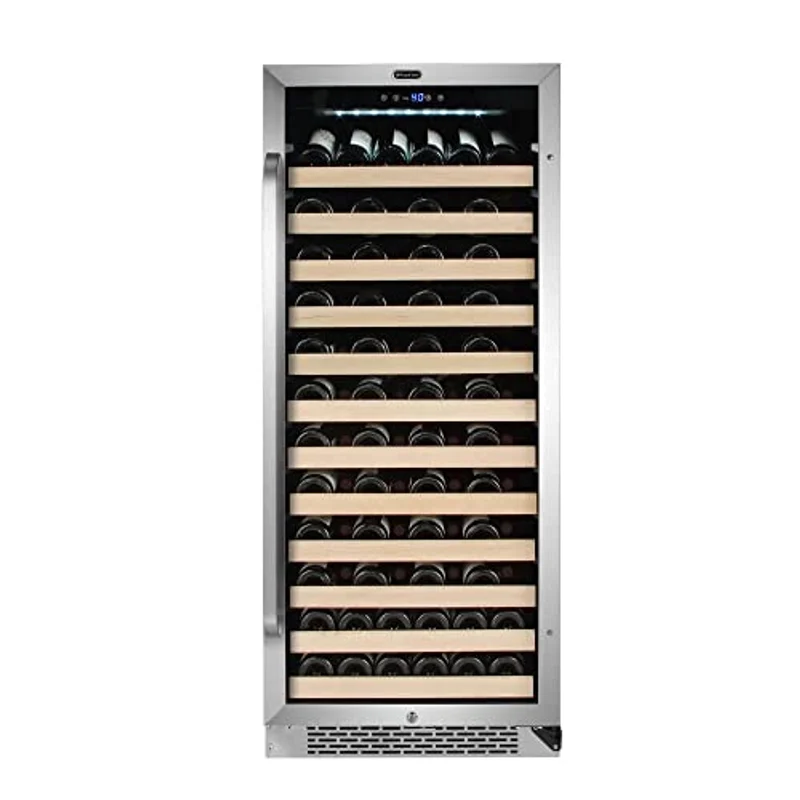 Whynter BWR-1002SD Whynter BWR-1002SD |
Best overall — stated circulation |
100 bottles (90 with display shelf) |
Single |
Adjustable, not specified |
$1,078.67 |
Get it |
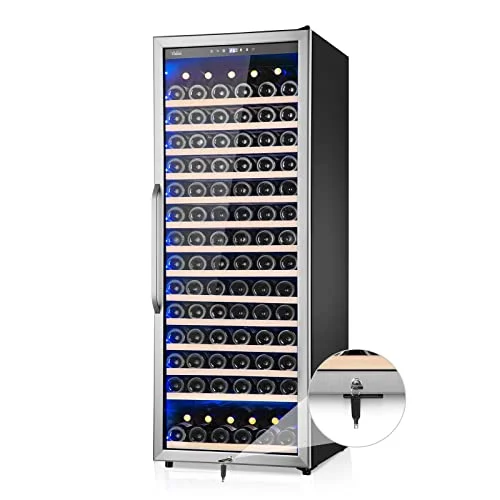 Velieta 179 Bottle Velieta 179 Bottle |
Most capacity, single zone |
179 bottles |
Single |
Not specified |
$1,199.99 |
Get it |
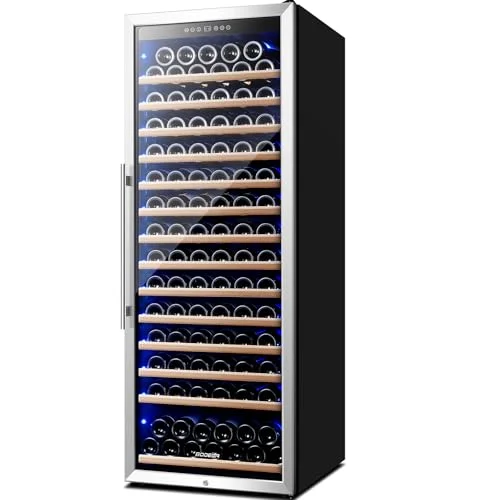 BODEGA 154 Bottle BODEGA 154 Bottle |
Best shelving |
154 bottles |
Single |
14 removable wooden shelves |
$1,049.99 |
Get it |
 Velieta KMHJ408D Velieta KMHJ408D |
Best dual zone at this size |
179 bottles |
Dual (40–55°F / 55–65°F) |
Iron |
$1,169.99 |
Get it |
 GarveeHome 80 Bottle GarveeHome 80 Bottle |
Best if you're not at 100 yet |
80 bottles |
Single |
Adjustable, not specified |
$686.41 |
Get it |
Our picks, and who each one is for
Five cabinets, five trade-offs between raw capacity and the engineering that keeps a tall cabinet at one even temperature. Read the "best for" line before the price — the wrong trade-off costs more at this size than in a small fridge.
The honest case for a wine cellar cooling unit instead
There's a size and a mindset where none of the five cabinets above, or any freestanding wine fridge, is really the right tool anymore — worth naming plainly rather than pretending a bigger box is always the answer. A freestanding compressor wine fridge, even a well-built 150-to-179-bottle one, is fundamentally a large domestic appliance: it sits in a room, exhausts heat into that room, and is designed to be replaced every several years the way any refrigerator is. A wine cellar cooling unit is different equipment entirely — a self-contained or split refrigeration system built to be installed into a purpose-built room, closet or under-stair space converted into an actual wine cellar, insulated and vapor-barriered like a small walk-in cooler. Where a wine fridge cools an insulated box, a cellar cooling unit cools a small insulated room, venting heat elsewhere and running a wider, steadier humidity range than any compressor fridge is built to manage.
The honest dividing line is what you're actually building, not bottle count. If you own or will build out a dedicated space — a closet, a basement corner, under a staircase — and expect the collection to keep growing past what a single cabinet can hold, a cellar cooling unit paired with an insulated room scales in a way stacking multiple wine fridges never does. It's also a different investment: construction, professional installation and ongoing maintenance, not a plug-and-play delivery. If your ceiling is "a large, well-organized collection that still lives in one appliance," one of the five cabinets above is almost certainly the more practical and cheaper answer. We don't review specific cellar cooling systems here, since our product data covers wine refrigerators rather than HVAC equipment — but the category is worth knowing about before assuming the next step up from a 179-bottle fridge is simply a bigger fridge. Our bottle-count sizing guide is the right next read if you're deciding which side of that line you're on.
How we compared these — and what we can't tell you
We compared the published manufacturer specifications and current Amazon prices for large-capacity wine fridges listed in the US, focused on the details that change at this scale: stated circulation method, zone configuration and per-zone ranges, shelving, security features, and price. Where a listing stated a fact — the Whynter's forced circulation, BODEGA's wooden shelves, Velieta's per-zone ranges — we used it; where it didn't, we said so rather than filling the gap with a plausible guess.
We do not run a testing lab, do not own these five cabinets, and have not measured their internal temperature spread shelf by shelf, so you won't find an invented score out of ten here, or a star rating or review count — the retailer data available to us doesn't return them for this category. What we can do honestly is read the specifications carefully, explain the physics governing whether a tall cabinet holds one temperature or several, and tell you plainly which claims each listing does and doesn't make. Prices quoted here were correct at the time of writing and change frequently; confirm the current price on Amazon before buying.
Frequently asked questions
Do I really need fan-forced circulation at 100+ bottles?
If you want every shelf to sit at close to the same temperature, yes. A passively cooled tall cabinet relies on cold air sinking and settling on its own, which leaves the top shelf reliably warmer than the bottom, sometimes by several degrees. A fan that actively moves air through the whole interior is the mechanical fix; of the five cabinets in this guide, only the Whynter BWR-1002SD's listing states it explicitly.
Is dual zone worth it once you're past 100 bottles?
Usually not: a serious collection at this scale is built for storage more than for pouring a chilled glass on demand, and dividing the cabinet costs shelf space while making circulation harder to solve in each half. If you do keep a genuine mix that needs two real serving temperatures, look for a listing that publishes each zone's range separately — the Velieta KMHJ408D in this guide does.
How much does a full 150-bottle wine fridge weigh, and does the floor matter?
A standard 750ml bottle weighs roughly 2.6 to 3 pounds full, so a fully loaded 150-bottle cabinet carries somewhere around 400 to 450 pounds of wine and glass on top of the cabinet's own weight, which commonly exceeds 100 pounds empty in this size class. A concrete slab or a floor well-supported over joists handles it without issue; an older or lighter-framed floor is worth checking first.
What temperature should a large wine fridge hold?
55°F is the standard long-term storage target for red, white and sparkling wine alike, and it's the number every single-zone cabinet in this guide is built to hold. Stability matters more than hitting that exact figure — a cabinet holding steady at 57°F is kinder to wine than one swinging between 50°F and 60°F while averaging 55°F. Our full temperature guide covers the numbers by style in more depth.
Written by Ilane Tall. Research-based comparisons of published specifications, current prices and manufacturer listings — we do not physically test these units and we do not publish invented scores.