By Ilane Tall · Updated August 31, 2026 · Research-based.
Reader-supported: we may earn a commission when you buy through the links on this page, at no additional cost to you. It never changes which product we recommend. Prices quoted below were correct at the time of writing and move often.
The short version
Almost everything you hear from a wine fridge is the appliance doing its job. A compressor unit hums and clicks on and off in cycles; a thermoelectric unit runs a small fan more or less continuously. Neither is a defect.
Vibration from a domestic compressor is real but mild, and there's no solid evidence it meaningfully damages wine over the timescales most people actually store it — weeks to a few years. The things proven to damage wine are heat, light and temperature swings, not the gentle shake of a compressor mount.
What is worth acting on: noise that changes — gets louder, more frequent, or turns into a new rattle or grind. That's a maintenance signal, covered in the section on noises that mean something's wrong.
Where the noise actually comes from
A wine fridge makes noise for the same reason any refrigeration appliance does: moving heat out of a cold space takes mechanical work, and mechanical work is never silent. Where that work happens, and how loud it sounds in your kitchen, depends entirely on which of the two cooling technologies is inside the cabinet.
A compressor unit works the same way a kitchen fridge or a beverage cooler does — the comparison is worth making explicit in our wine fridge vs kitchen fridge vs wine cellar guide. A motor-driven compressor squeezes refrigerant gas, a condenser fan pushes heat out the back, and an evaporator fan circulates cold air inside the cabinet. The compressor doesn't run continuously; it cycles on when the interior drifts above the setpoint and off once it's cooled back down. That cycling is exactly what you hear: a low hum or whir while it's running, a soft click or thunk at the start and end of each cycle, and near-silence in between. A well-built, well-placed compressor unit is not silent, but it is quiet enough to sit in most kitchens without becoming background irritation.
A thermoelectric unit has no compressor and no refrigerant loop at all. It uses a Peltier module — a solid-state plate that moves heat from one side to the other when current runs through it — paired with a heat sink and one or more small fans to carry that heat away. There's no gas to compress and nothing to click on and off in the same way, so thermoelectric units are meaningfully quieter at rest. What you do still hear is the fan, and on most units that fan runs nearly all the time rather than cycling, which trades the compressor's intermittent hum for a steadier, lower-level whoosh.
One more source gets overlooked: the cabinet itself. Any wine fridge is a rigid box, and a rigid box sitting on or against another rigid surface can act as a sounding board, turning a mechanical vibration that would otherwise be inaudible into an audible hum. This is why the same unit can sound completely different in two kitchens — the compressor or fan hasn't changed, but what it's resting against has. We come back to this in placement changes that halve the perceived noise, because it's the single biggest noise variable you actually control.
Thermoelectric versus compressor, in a quiet room
If noise is the deciding factor in your purchase, the cooling technology matters far more than the brand, and the honest comparison has a real trade-off buried in it — not just "thermoelectric is quieter."
Thermoelectric units are the quiet choice for a bedroom, a home office, a nursery, or any small room where a compressor's cycling hum would be noticeable at night. Because there's no compressor and no refrigerant, there's also no vibration transmitted into a shelf or a cabinet — the only moving part is a small fan. The budget end of the category, where most thermoelectric units live, is dominated by this technology for exactly this reason.
The trade-off is capability, not sound quality: thermoelectric cooling can only pull the interior down to roughly 20°F below whatever the room already is. In a 70°F room, that's a usable mid-50s setpoint. In an 85°F garage or an un-air-conditioned summer kitchen, the same unit may never reach cellar temperature at all — it will simply run its fan continuously, trying. That's not a fault; it's the physics of the technology, and it's worth knowing before you buy one for a warm room, not after.
Compressor units close that gap. Because they move heat the same way a refrigerator does, they can hold a setpoint regardless of how warm the room gets, within the limits of their stated range. The trade is the one this whole guide is about: a compressor cycles on and off, and while it's running, it is audibly louder than a thermoelectric fan. If the fridge is going in a quiet bedroom and the room stays cool year-round, that's a real cost for no benefit. If it's going in a kitchen, a garage, or anywhere temperature swings with the seasons, it's the only technology that reliably holds its number.
The practical rule: match the technology to the room before you match the brand. A silent room wants thermoelectric. A room that gets warm wants a compressor and accepts the hum that comes with it.
Does vibration really hurt wine, and over what timescale
This is the question that generates the most confident-sounding, least-sourced claims in the category, so it's worth being precise about what's established and what isn't.
The mechanism people worry about is real in principle: sustained, forceful vibration can disturb sediment in a bottle, and in theory could accelerate some of the slow chemical reactions — ester formation, tannin polymerization — that shape how wine develops. The vibration levels where this is documented, however, come almost entirely from transport: trucking, shipping, and repeated handling over long distances, which subjects bottles to far more frequent and far more forceful shaking than a compressor mount ever produces sitting still in a kitchen. A domestic compressor's vibration is orders of magnitude gentler and, critically, it's a low-amplitude cycling vibration rather than the road-and-rail jostling the transport research actually measured.
For the timescale most people actually care about — a fridge holding wine for a few weeks up to a few years before it's opened — there is no solid evidence that ordinary domestic compressor vibration meaningfully changes how the wine tastes. The claim gets repeated constantly online with a confidence the underlying evidence doesn't support for this specific case. That doesn't mean vibration is irrelevant to wine in general; it means the domestic-refrigerator version of the concern is much smaller than the marketing copy around thermoelectric units implies.
What the evidence does support, consistently and without much controversy, is that heat, light and temperature instability degrade wine — a bottle held at a swinging 48–62°F ages worse than one held steadily at 57°F, regardless of which cooling technology produced either number. If you're deciding how much to worry about vibration, spend that attention budget on temperature stability instead; it's the variable actually proven to matter. Our humidity guide covers the other storage-condition question people ask alongside this one, with the same standard: state what's established, and say plainly when it isn't.
Where vibration is worth a genuine precaution: a serious long-term collection, held for a decade or more, where sediment-heavy bottles are lying undisturbed for years at a time. In that specific case, minimizing vibration is a reasonable "why not" — it costs nothing to choose a stable surface — even without proof that skipping it would cause measurable harm. For the collection most buyers actually own, this is a minor consideration next to getting the temperature right, covered in our broader honest look at whether a wine fridge is worth buying in the first place.
Placement changes that halve the perceived noise
Before assuming a unit is defective or shopping for a different model, it's worth ruling out placement — because the same fridge can sound dramatically different depending on where and how it sits, and most of the fixes cost nothing.
Put it on a rigid, level surface. An unlevel cabinet forces the compressor and fans to work slightly against gravity in one direction, which increases both running time and vibration. A few minutes with a level, adjusting the feet until the unit sits flat, is the single highest-value fix available and it's free.
Give it the clearance the manual specifies. Freestanding units reject heat out of the back and sides; blocking that airflow makes the compressor work harder and run longer per cycle, which directly increases the noise you hear over the course of a day. This is the same clearance rule that governs whether a freestanding unit can survive being built into a cabinet — worth reading in full in our guide to installing an undercounter wine fridge if that's where yours is headed.
Don't set it directly against a hollow surface. A wine fridge pushed flush against a hollow-core cabinet panel or a drywall partition can turn that panel into a sounding board, amplifying a vibration that would otherwise be inaudible. A thin rubber or felt pad under the feet, or an inch of clearance from the wall behind it, breaks that resonance path.
Account for room temperature. A compressor unit in a room that regularly hits 80°F+ will cycle on more often and run longer each time than the same unit in a 68°F room, simply because it has more heat to remove. If noise is the priority, keeping the fridge out of direct sun and away from ovens or radiators reduces both its workload and how often you hear it working.
Think about what's on the other side of the wall. A compressor's hum travels through a shared wall more easily than through open air. If the fridge backs onto a bedroom, moving it a few feet, or orienting it so the compressor side faces a hallway instead, does more for perceived noise at night than any spec sheet number.
The quietest picks
Published sound-level ratings are inconsistent across this category — many listings simply don't provide a decibel figure — so the reliable signal is cooling technology, not a number on a spec sheet. All three of the following are thermoelectric, which means no compressor cycling and no refrigerant vibration; the fourth is a compressor unit included for households that need the colder range or larger capacity a compressor allows and can accept the trade-off.
01Smallest footprint
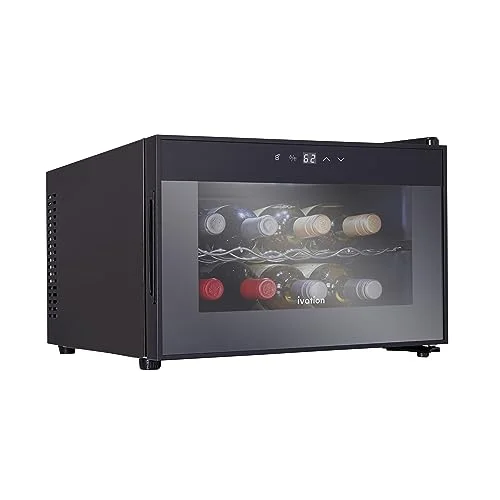
Ivation Premium 8 Bottle Horizontal Thermoelectric
Quiet operation for a countertop or a bedside shelf
8 bottles·Thermoelectric·Digital temperature control·Freestanding
A horizontal countertop unit sized for a small collection rather than a room-sized cabinet. Thermoelectric cooling means the only moving part making noise is a small fan — there is no compressor to click on and off nearby. Digital temperature control lets you set and hold a number without guessing at a dial. Like every thermoelectric unit, it cools relative to room temperature rather than to an absolute floor, so it belongs somewhere the room itself doesn't get hot.
The one to buy if the fridge needs to disappear into a quiet room, not dominate a kitchen.
02Quiet, with more capacity
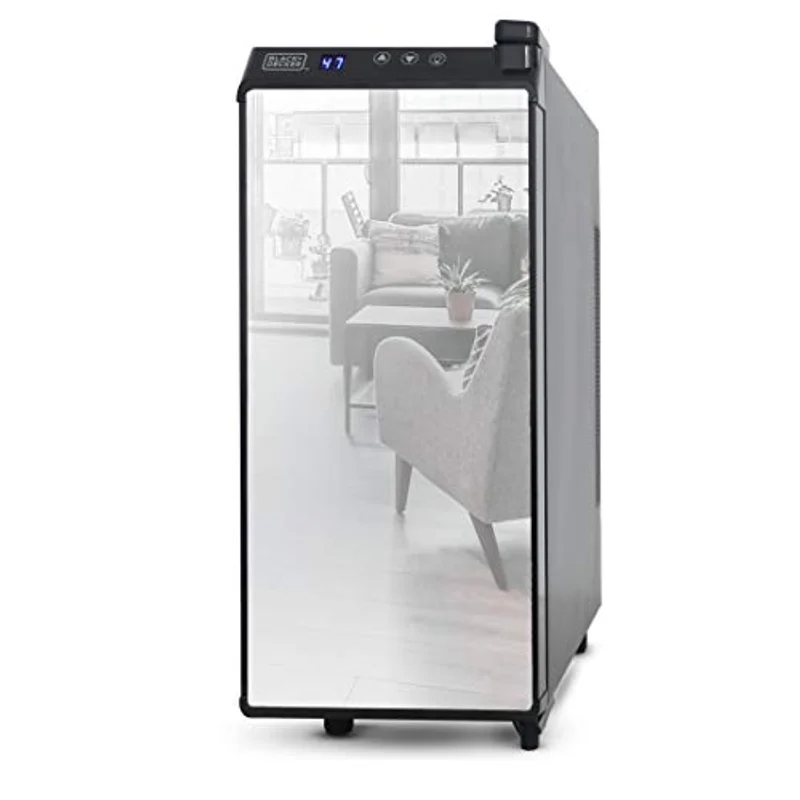
BLACK+DECKER 12-Bottle Thermoelectric, BD60336
A step up in bottles without adding a compressor
12 bottles·Thermoelectric·Mirrored door·Freestanding
Twelve bottles in a still-compact freestanding cabinet, cooled the same low-noise way as the 8-bottle option above. The mirrored door is a cosmetic choice, not a cooling one — it doesn't change the noise profile, only the look on a counter or sideboard. As with any thermoelectric unit, plan on it holding roughly 20°F below whatever the room is doing, which is the reason it belongs in living spaces rather than a warm garage.
The reasonable middle size if eight bottles is too few but a compressor's hum is unwelcome.
03Quiet, dressier finish
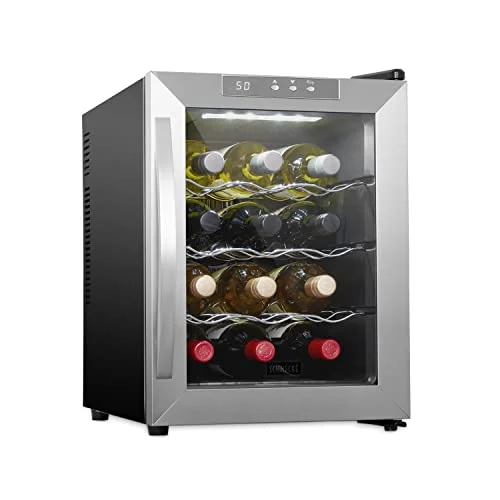
Schmécké 12 Bottle Thermoelectric
Stainless steel and smoked glass, still thermoelectric
12 bottles·Thermoelectric·Digital temperature control·Freestanding
Same underlying cooling technology and the same noise trade-off as the two units above — no compressor, a small fan, quiet at rest — in a stainless steel cabinet with a smoked glass door. Digital temperature control is standard here too. Choose between this and the BLACK+DECKER largely on finish and where it needs to sit visually; the acoustic case for both is identical because the cooling mechanism is identical.
Same quiet mechanism, dressed for a spot where it will actually be seen.
04If you need compressor cooling anyway
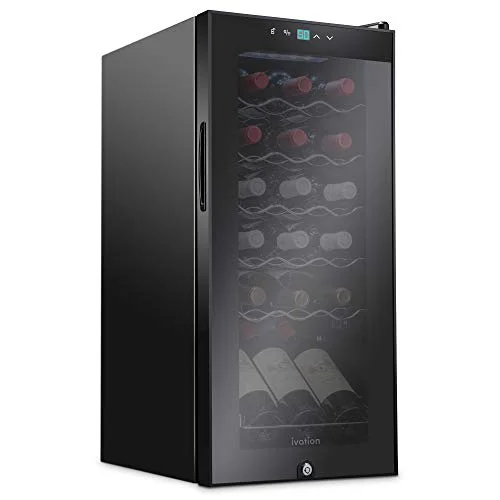
Ivation 18 Bottle Compressor Wine Cooler
Louder, but holds its number regardless of the room
18 bottles·Compressor·41–64°F range·Freestanding, lock
Include this one on the list not because it's quiet, but because the honest answer for a warm room or a larger collection is a compressor, and pretending otherwise just sends someone home with a thermoelectric unit that can't hold temperature where they're putting it. Eighteen bottles, a 41–64°F range wide enough to actually reach cellar temperature in a warm kitchen, a lock, and a glass door. It will cycle on and off audibly, the trade-off covered above — but it will hold that range in August, which none of the thermoelectric units on this page can promise.
The honest pick for anyone whose room, not their patience for noise, is the real constraint.
The noises that mean something is wrong
Everything above describes normal operation. A short list of sounds don't fit that description, and each one points to a specific, usually fixable, cause.
It never stops running. A compressor that cycles off periodically is normal; one that runs continuously, hour after hour, without ever going quiet is not. The most common causes are a room that's simply too warm for the unit's range, blocked rear or side vents forcing it to work nonstop, or a door gasket that's no longer sealing — check that the door closes flush and the gasket isn't cracked or dirty before assuming a bigger fault.
A new rattle that wasn't there before. Usually mechanical and usually simple: a bottle has shifted and is touching a shelf, wall, or the interior fan; an internal panel or shelf bracket has worked loose; or, on a thermoelectric unit, ice has built up on the cooling fins and a fan blade is now clipping it on each rotation. Repositioning bottles or clearing frost typically resolves it.
Repeated clicking without the compressor actually starting. A single click at the start and end of a cycle is normal. Clicking that repeats every few seconds without the compressor engaging suggests the start relay is struggling — the compressor is trying to start and failing, then retrying. This is a genuine early-warning sign and worth addressing before it becomes a full failure, since a compressor that can't start at all means the unit stops cooling entirely.
A buzz or hum that's noticeably louder than when the unit was new. This points toward the compressor mounts loosening over time, or in less common cases a refrigerant issue changing how the compressor runs. Either way, it's a change from baseline, which is the useful signal — you're not listening for "is this fridge quiet," you're listening for "is this fridge quieter or louder than it used to be."
A grinding or squealing sound, especially from the fan. This is a bearing wearing out in a fan motor, on either cooling type. It tends to get worse, not better, and doesn't resolve itself the way a stray rattle sometimes does.
The common thread across all five: normal wine fridge noise is steady and repeats in a predictable pattern. Anything that's new, escalating, or arrhythmic is worth a look before it's worth living with.
How we compared these — and what we cannot tell you
We compared the published specifications and current prices for the units named on this page — cooling technology, stated temperature range, capacity and installation type — against the general, well-established physics of how compressor and thermoelectric cooling actually work. Where the underlying science on vibration and wine ageing is thinner than the confident claims that circulate about it, we said so rather than repeating the claim.
We do not run a testing lab. We have not measured decibel levels on these units ourselves, we do not own them, and this page does not contain star ratings, review counts, or paraphrased owner sentiment for any of the four products named — the retailer data we work from doesn't include verified reviews for these listings, and we won't invent what we don't have. Every claim above is anchored in published specs, price, product class, or general domain facts about refrigeration and wine storage, not in fabricated testing or invented sentiment.
Prices quoted here were correct at the time of writing and change frequently. Confirm the current price before buying.
Frequently asked questions
Is a truly silent wine fridge possible?
Not entirely, no. Thermoelectric units get close — there's no compressor and no refrigerant vibration, only a small fan — but that fan still runs, usually near-continuously. "Near-silent" is accurate; "silent" isn't, for either cooling technology.
Does compressor vibration actually damage wine?
There's no solid evidence it does over the timescales most people store wine, from a few weeks to a few years. The vibration research that does exist mostly measures transport and shipping, which is far more forceful and frequent than a compressor cycling in a kitchen. The proven risks to stored wine are heat, light and temperature swings, not gentle mechanical vibration.
Why has my wine fridge gotten louder recently?
A change from its normal baseline is the signal to pay attention to. Continuous running with no cycling off usually means a warm room, blocked vents, or a failing door seal. A new rattle is often a shifted bottle or loose panel. Repeated clicking without the compressor starting can mean a struggling start relay. See the noises that mean something's wrong for the full list.
Does where I place a wine fridge really change how loud it sounds?
Yes, often dramatically. An unlevel cabinet, blocked airflow clearance, or direct contact with a hollow wall or cabinet panel can all turn a mild, ordinary vibration into an audible hum through resonance. Leveling the unit and giving it the manual's specified clearance is usually the single biggest, and cheapest, noise fix available.
Written by Ilane Tall. Research-based comparisons of published specifications, current prices and general domain facts about refrigeration and wine storage — we do not physically test these units and we do not publish invented scores or review sentiment.