By Ilane Tall · Updated August 25, 2026 · Research-based.
Reader-supported: we may earn a commission when you buy through the links on this page, at no additional cost to you. It never changes which product we recommend. Prices quoted below were correct at the time of writing and move often.
The short version
A kitchen fridge holds wine at roughly 37°F in single-digit humidity — fine for a bottle you're finishing this week, measurably drying a cork out by the six-month mark.
A counter or a cupboard is the riskiest of the three, not because it's warm but because it swings: daily heat cycling and direct light do more damage in a season than steady storage does in years.
A wine fridge fixes both problems with one number that doesn't move and a door that blocks light — the real limit, covered in our humidity guide, is that most of them do nothing for humidity either way. A cellar is the only setup built to hold a bottle correctly for a decade, and it costs accordingly.
The kitchen fridge: cold enough, dry enough, and built for neither job
A standard kitchen refrigerator runs around 37°F, set that low for one reason: food safety, not wine. That temperature is well below the 55°F long considered correct for wine storage, and cold enough to mute aroma and flavor if you pour straight from it — which is why a red pulled from the kitchen fridge tastes flat until it's had twenty or thirty minutes on the counter to warm up.
Temperature is the smaller issue. The bigger one is humidity. A food refrigerator's compressor is designed to pull moisture out of the air — that's what keeps produce from turning the inside of the box into a science experiment — and typical relative humidity inside runs well under 15%, against the roughly 50–70% a cork wants over the long term. A cork is porous. In a dry environment it slowly loses moisture, shrinks, and stops sealing as tightly, which lets in more air over time and speeds up oxidation. That process is real, but it's also slow — measured in months, not days.
Which is exactly why the kitchen fridge is not the villain it's sometimes made out to be. For a bottle you'll open this weekend, or a bottle you've already opened and re-corked to finish over two or three evenings, the fridge is close to ideal: it's cold, it's dark, and nothing meaningfully changes in a bottle over a few days regardless of the exact number on the dial. The problem only shows up on a longer clock — a case you're planning to work through over the next year, sitting in the door rack, quietly drying out one degree of cork elasticity at a time. There's also a smaller, stranger risk worth a mention: corks are porous both ways, and a fridge that also holds onion, garlic, or strong cheese can transmit a faint version of those smells into a bottle stored there for weeks.
The counter or the cupboard: the fastest way to cook a bottle
Leaving a bottle on the counter feels like doing nothing to it, which is the trap. A closed cupboard or a counter away from the stove has no refrigeration and no insulation, so it simply tracks the temperature of the room — and most kitchens aren't a stable room. They swing across the day with cooking heat, sun through a window, and whatever the thermostat is doing, sometimes by 15–20°F between a cool morning and a warm evening with the oven running.
That swing matters more than the average temperature does. Wine expands slightly as it warms and contracts as it cools, and each cycle pushes a small amount of air past the cork and back — a slow pumping action that accelerates oxidation far more than sitting at a slightly-too-warm but steady temperature would. A widely repeated rule of thumb in the wine trade is that aging speeds up roughly twofold for every 18°F increase in storage temperature; a kitchen that regularly tops 80°F in summer is putting a bottle through the equivalent of a much older wine's worth of change in a fraction of the time, and doing it inconsistently, which is worse than doing it steadily.
Light is the other failure mode, and it's underrated. Ultraviolet and even visible light break down the compounds that give wine its color and aroma — the effect is commonly called "lightstrike," and it's most visible in white and sparkling wine bottled in clear or pale glass, which is why serious retailers keep those out of direct light entirely. A counter near a window is the single worst spot in most kitchens: heat and light working on the bottle at the same time.
None of this matters for a bottle you're opening tonight or this week — heat cycling and lightstrike are both cumulative effects that need real time to show up, and a few days on the counter changes nothing you'd notice in the glass. It matters for the bottle that gets pushed to the back of the cupboard and forgotten through a summer. That bottle has quietly had a much harder few months than the one sitting in the kitchen fridge the whole time.
The wine fridge: one steady number, and the compromise it actually is
A wine fridge is built to solve the two problems above at once. Compressor cooling holds a single setpoint — typically adjustable somewhere in the low 40s to mid-60s°F, depending on the unit — regardless of what the kitchen around it is doing, and the cabinet itself blocks direct light the way an open counter can't. That combination removes both the heat-cycling problem and the light problem in one purchase, which is the entire case for owning one; our separate look at whether wine fridges are worth it goes through when that trade actually pays off.
The compromise is the one thing a wine fridge borrows from the kitchen fridge: most consumer units, including compact and mid-size compressor models, don't actively add humidity. The honest way to put it is that they don't dry the air the way a food fridge does, but they also don't correct for a dry house the way a purpose-built cellar cooling unit can. In a humid climate that's rarely an issue. In a dry one, a cork can still slowly lose moisture inside a wine fridge over a year or two — just far more slowly than it would in a food fridge, because the swings and the light are already gone. We cover exactly where that line falls in our humidity guide, including which situations genuinely call for an add-on humidifier and which don't.
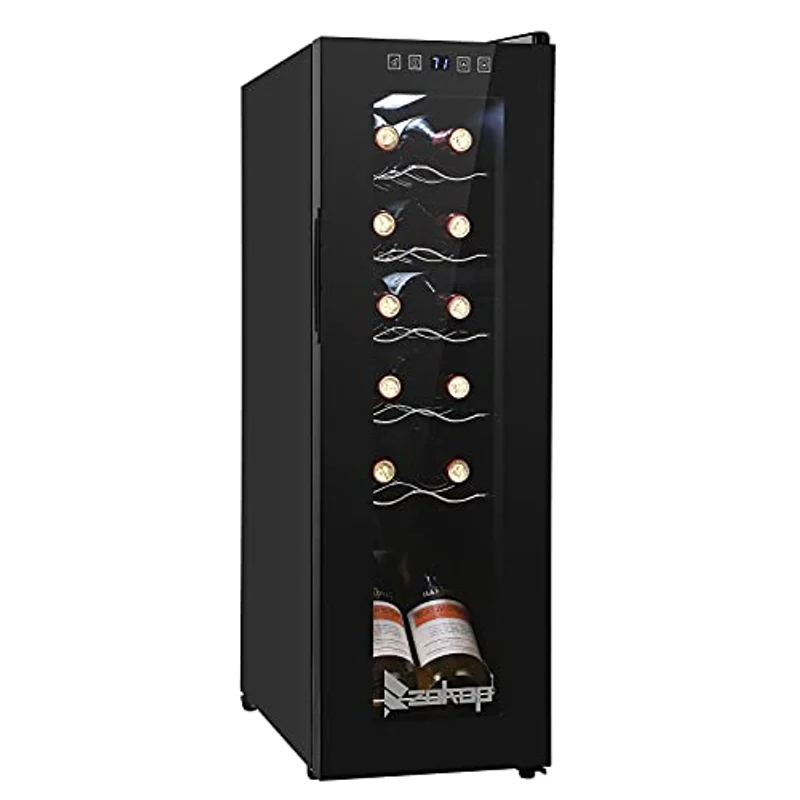
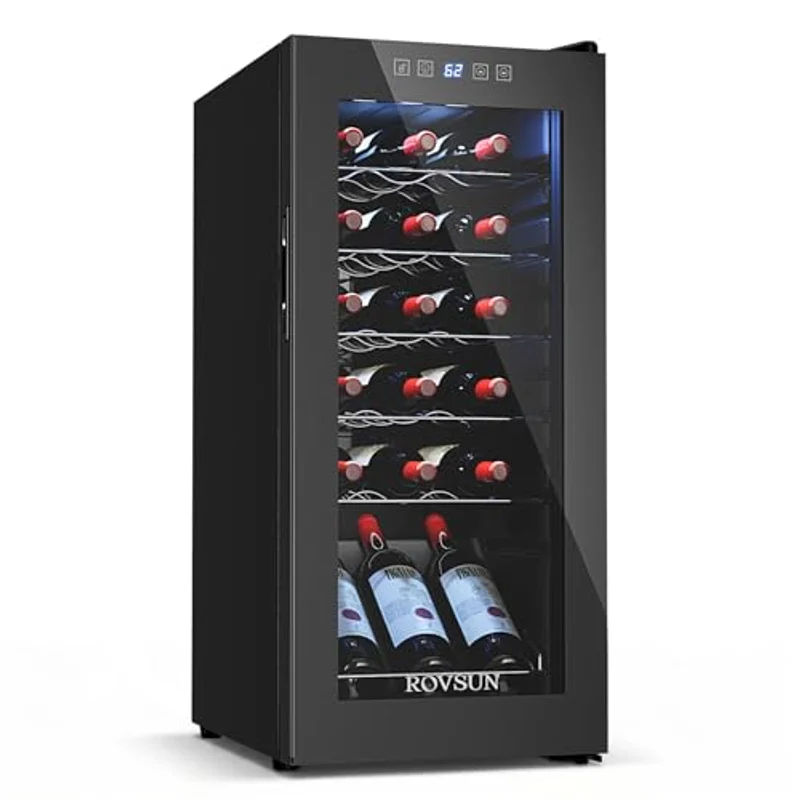
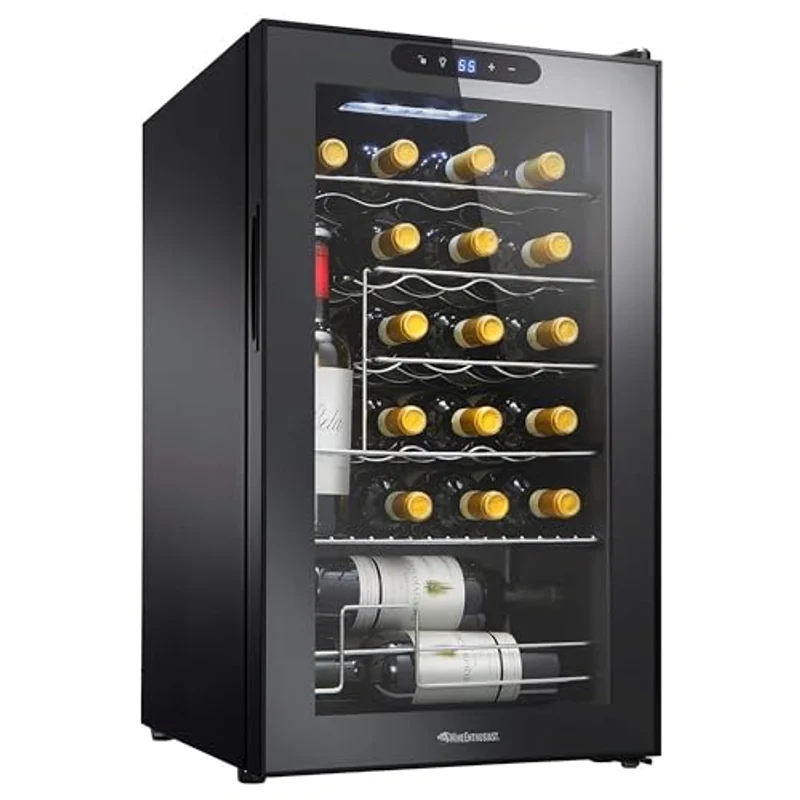
Sizing is the other real decision, and it scales with how much wine you're actually holding at once rather than how much you might someday own. For a dozen bottles in steady rotation, a compact unit like the Winado 12 Bottle Compressor Wine Cooler Refrigerator (ASIN B0BBR6XMCW, $129.99) covers the job at the lowest entry price in the category — genuine compressor cooling rather than the thermoelectric cooling that gives up in a warm room, in a footprint that fits a counter or a small stand. Step up to a working case and a half and the ROVSUN 18 Bottle Wine Fridge (ASIN B08K93NJP8, $169.99) adds capacity and a digital temperature readout behind a double-layer glass door, still at a price close to the Winado. For a collection that's outgrowing both — heading toward two dozen bottles held at once — the Wine Enthusiast 24-Bottle Compressor Wine Cooler (ASIN B08FJG4SYY, $399.00) is a freestanding 2.4 cubic foot unit with an LED digital control panel and a stated 41–64°F cooling range, wide enough to run cooler for whites or warmer for reds depending on what's inside.
One installation note applies to all three, and to compressor wine fridges generally: they're freestanding units that reject heat out the back, so they need clear air behind the cabinet to work properly. If the plan is to build one into a cabinet run instead of setting it on a counter or floor, read the clearances first — our undercounter installation guide walks through what a built-in installation actually requires before you commit a cabinet opening to it.
01Smallest, lowest price
Winado 12 Bottle Compressor Wine Cooler Refrigerator
A dozen bottles in steady rotation
12 bottles·Single zone·Compressor·Freestanding
The cheapest way into real compressor cooling rather than a thermoelectric unit that stops working once the room warms up. Twelve bottles is enough to replace both the kitchen fridge and the counter for the wine you're actually working through this month, without paying for capacity you don't need yet.
The bridge appliance: enough steady, dark storage for what you're drinking soon.
02A step up in capacity
ROVSUN 18 Bottle Wine Fridge
A case and a half, with a digital readout
18 bottles·Single zone·Compressor·Freestanding
Freestanding compressor cooling with digital temperature control and a double-layer glass door, at a price close to the smallest unit in this piece. The right size for a household that's settled into buying by the case rather than the bottle, and wants that case held at one steady number instead of cycling on a counter.
Six more bottles of headroom for close to the same money.
03For a growing collection
Wine Enthusiast 24-Bottle Compressor Wine Cooler
Two dozen bottles, before you'd consider a cellar
24 bottles·Single zone·Compressor·41–64°F range
A 2.4 cubic foot freestanding cabinet with an LED digital control panel and a stated 41–64°F cooling range — wide enough to run it cooler for a mostly-white collection or higher for reds. This is the size where a wine fridge stops being a stopgap and starts being genuine storage for a collection that's still growing.
The point where a wine fridge covers what most households would otherwise want a cellar for.
The cellar: passive space or an active cooling unit
A wine cellar comes in two forms, and they're worth telling apart because only one of them requires spending anything.
A passive cellar is simply a naturally cool, naturally stable space — a below-grade basement, an unheated crawl space, or a dug-out room — that stays in a workable range year-round without any equipment. Where a house genuinely has one, it's the best possible answer to storage, because ground temperature is remarkably steady and humidity underground tends to run high, which is good for corks over decades. The catch is that very few homes actually have a space that qualifies: most basements in a climate with real seasons still swing more than a true cellar should, and a room that's too humid brings its own problem — mold on labels and corks, rather than the dryness a kitchen fridge causes.
A cellar cooling unit is the answer when the house doesn't have a naturally suitable space: a self-contained refrigeration system built into an insulated room, engineered to hold both a low-50s°F temperature and a controlled humidity level simultaneously, which a wine fridge's compressor is not designed to do. It's the only setup in this comparison actually engineered for years-to-decades storage rather than months, and the cost reflects that — insulating and sealing a room, running the electrical and drainage a cooling unit needs, and the unit itself, land well beyond what any wine fridge costs, before counting the fact that the space becomes permanent and stops being useful for anything else.
For most collections, that cost isn't necessary. If the real number is somewhere under a couple hundred bottles, a large wine fridge does the temperature and light job a cellar does at a fraction of the price and none of the construction; our guide to large wine fridges for 100 bottles and up covers the point where a single cabinet starts to make more sense than several smaller ones. A cellar earns its cost only once the collection is genuinely large, genuinely long-term, or both.
The question that actually decides it: are you storing, or just holding?
Strip away the appliances and there's one distinction underneath all of this: holding a bottle means keeping it intact until you open it soon — days, maybe a couple of weeks. Storing a bottle means preserving and, for some wines, letting it improve over months or years. Almost every mistake in this comparison comes from treating a storing problem like a holding problem, or the reverse.
For holding, none of this matters much. A bottle sitting in the kitchen fridge for a week, or on the counter for a few days before dinner, isn't measurably different from the same bottle in a wine fridge over that span. Heat cycling needs repeated swings to do damage, lightstrike needs sustained exposure, and a cork drying out is a slow process — a few days anywhere reasonable changes nothing you'd taste.
For storing, the clock is the whole story. A wine fridge held at one number for a year is a categorically different environment than a kitchen counter that swings through a summer, even though both technically "stored" the bottle. The damage from heat cycling, light, and slow cork drying doesn't happen on a fixed schedule that starts the moment you set a bottle down — it accumulates, which is why the same location can be completely fine for one bottle and quietly damaging for another, depending only on how long each one actually sits there.
So the honest first question when deciding where wine belongs isn't "which storage option sounds most serious." It's "how long until this bottle is actually open" — and the answer to that question, more than any spec sheet, tells you whether the kitchen fridge, the wine fridge, or something more is the right call.
Where wine should live, by collection size and how long it stays
A concrete version of the same logic, matched against your actual situation rather than an abstract rule:
| Collection & timescale | Where it belongs | Why |
|---|
| A few bottles, open within a week |
Kitchen fridge or counter |
Neither heat cycling nor cork drying has time to matter. |
| A case, working through it over a couple of months |
Small wine fridge |
Steady temperature and no light beat convenience once you're past a few weeks. |
| 12–24 bottles, held for several months to two years |
Wine fridge sized to the count |
One steady setpoint prevents the slow damage a counter or food fridge causes over that span. See our bottle-count sizing guide. |
| A growing collection, 30–150 bottles over years |
Large wine fridge |
Capacity and stability without the cost of building a room. See our large wine fridge guide. |
| A serious collection, meant to sit five-plus years |
Passive cellar or a cellar cooling unit |
Only setup engineered to control temperature and humidity together over decades. |
How we compared these — and what we can't tell you
We compared published manufacturer specifications, current listed prices, and general, well-established facts about wine storage — how corks respond to humidity, how heat cycling and light affect a sealed bottle, how a compressor refrigerator's target humidity differs from what a cork wants. None of that requires physically testing an appliance to know; it's the same set of facts a sommelier or a cellar builder would cite.
We do not run a testing lab, we do not own these units, and we have not physically compared them, so you won't find an invented score out of ten here. This site also does not publish star ratings, review counts, or paraphrased review sentiment for any product — we have no verified review data for the products named in this piece, and inventing that sentiment would be exactly the same offense as inventing a number. Every claim about these three products above is anchored in their published specification, their price, and their product class, not in sentiment we can't source. Prices quoted here were correct at the time of writing and change frequently — confirm the current price before buying.
Frequently asked questions
Is it really bad to keep wine in the kitchen fridge?
Not for a bottle you're opening within a week or two — the cold and the low humidity haven't had time to do anything measurable. It becomes a real issue only for wine held there for months, where the fridge's low humidity can slowly dry out a cork and let in more air than intended.
How long can a bottle sit on the counter before it's a problem?
A few days is fine. The damage from heat cycling and light exposure is cumulative and needs sustained time — a week or two in a stable kitchen away from direct sun is unlikely to matter, while the same spot through a hot summer is a genuinely different story.
Do I need a cellar, or does a wine fridge cover me?
For most collections, a wine fridge covers it. A cellar — passive or actively cooled — only earns its cost once you're storing a genuinely large collection for genuinely long periods, typically several years or more. Under that, a well-sized wine fridge delivers the same steady temperature and light protection for a fraction of the price.
What's the one factor that actually decides where wine should live?
How long the bottle is going to sit before you open it. Short holds tolerate almost any reasonable spot; long-term storage is where temperature stability, darkness, and eventually humidity start to compound, and where the difference between a kitchen fridge, a wine fridge, and a cellar actually shows up in the glass.
Written by Ilane Tall. Research-based comparisons of published specifications, current prices and general, well-established wine-storage facts — we do not physically test these units and we do not publish invented scores or review sentiment.