By Ilane Tall · Updated August 24, 2026 · Research-based.
Reader-supported: we may earn a commission when you buy through the links on this page, at no additional cost to you. It never changes which product we recommend. Prices quoted below were correct at the time of writing and move often.
The short version
Low humidity damages a cork by slow drying and shrinkage — a process measured in months and years, not days. If you're drinking a bottle within a season, the number on a hygrometer is close to irrelevant.
The one place humidity reliably goes wrong is a frost-free kitchen refrigerator, which actively removes moisture from its air as part of how it defrosts itself. A dedicated wine fridge doesn't need that cycle and generally doesn't run as dry.
If your bottles are finished with a screwcap or synthetic closure, this entire question stops applying — those seals aren't organic material that dries out. And most "humidity control" features are a marketing word for a water tray you can add yourself for a few dollars.
What low humidity does to a cork — and over what timescale
Cork works as a wine seal because it's compressed into the bottle neck and holds a certain amount of moisture in its own cell structure, which keeps it swollen and gas-tight against the glass. That internal moisture level isn't fixed — it slowly equilibrates toward whatever the surrounding air is doing, the same way a wooden door swells in summer and shrinks in winter. In sustained dry air, a cork's moisture content drifts downward over time, and as it drifts, the cork can stiffen and shrink slightly at the point where it meets the glass. A shrunk cork seals less completely, which lets in more oxygen than the wine was built to handle over a long aging window.
The trade language for the safe zone is 50–70% relative humidity, and it's worth being precise about what that range actually protects against. It is not a cliff. A cellar that spends a week at 42% because a door was left open, or a wine fridge that reads 45% on a cold, dry day, has not damaged anything. Cork drying is a diffusion process working over the same kind of timeline as aging itself — think years of sustained exposure, not an afternoon. What genuinely damages wine on a short timescale is heat, direct light and temperature swings; those act in days and weeks. Humidity is the slow variable, and it only matters once the other timescale — how long the bottle will actually sit there — is long enough for it to add up.
Which is the entire premise of this guide: the question "does my wine fridge's humidity matter" doesn't have one answer. It depends almost entirely on how long the cork is going to sit in that environment, and what kind of cork it is.
Why a kitchen fridge is the genuinely bad case
If there's one storage environment worth actively avoiding for anything you plan to keep more than a few months, it's a standard kitchen refrigerator — and the reason isn't just that it runs too cold for wine (it does, typically near 37°F, which mutes flavor and is far colder than the 55°F most storage guidance recommends). The humidity problem is separate and, for cork specifically, arguably worse.
Most kitchen refrigerators are frost-free by design: a fan circulates air across a cold evaporator coil, and moisture in that air condenses onto the coil as frost. Periodically, the fridge runs a defrost cycle that warms the coil, melts the frost, and drains the water away. That cycle is not incidental to how the fridge cools — it's a core part of the mechanism, and it runs continuously, day after day, for the life of the appliance. The net effect is an interior that is actively, repeatedly stripped of moisture. Open shelving in a kitchen fridge is notoriously drying for exactly this reason, which is why produce drawers exist as a separate, semi-sealed compartment in the first place. A bottle standing on an open kitchen fridge shelf for months is sitting in some of the driest air in the house.
A dedicated wine fridge doesn't need that same aggressive defrost cycle, mainly because it isn't trying to hold food at 34–40°F where frost buildup on the coil is a real problem. Running warmer, in the low-50s to mid-60s°F range most wine fridges target, means far less frost accumulates on the coil to begin with, so the unit doesn't need to fight it the same way. That doesn't mean every wine fridge is a humid environment — compressor cooling still pulls some moisture out of circulating air, just without the repeated, deliberate drying cycle a kitchen fridge runs by design. It's the difference between an appliance built to keep food from spoiling and one built to keep a cork from drying out; they solve for different things, and it shows in the air.
If you've been storing anything you actually care about in the kitchen fridge "for now," our honest take on whether wine fridges are worth it works through when that habit starts costing you something real.
Screwcaps and modern closures: when the whole question stops applying
Everything above is about natural cork specifically, because natural cork is the closure whose seal depends on organic material holding moisture. A large and growing share of wine sold today doesn't use one. Screwcaps (the Stelvin-type closure common on New Zealand and Australian whites, and increasingly on reds from many regions), synthetic corks molded from plastic, and glass stopper systems like Vino-Lok all seal the bottle through a mechanical or chemical fit rather than a hygroscopic organic plug. None of them dry out, shrink, or lose their seal because the surrounding air got drier.
Natural cork
An organic material whose moisture content tracks the surrounding air over long periods. Sustained low humidity is a genuine, slow risk to the seal — the entire reason this guide exists.
Screwcap & synthetic
Impermeable to the mechanism that makes ambient humidity relevant. Store these bottles anywhere reasonably cool, dark and stable, and the hygrometer reading on the wall is not a factor.
That doesn't mean a screwcapped bottle belongs on a sunny counter — heat, light and vibration still apply to every closure type equally. It means the humidity conversation specifically, the one this article is about, simply doesn't apply to it. If most of what you buy is screwcapped, you can skip past the water-tray and hygrometer sections below with a clear conscience; they're solving a problem you don't have.
Why bottles are stored on their side, and what that actually achieves
Horizontal storage is the traditional answer to the cork-drying problem, and it works through a mechanism worth understanding rather than just following as a rule. Laying a cork-sealed bottle on its side keeps the wine itself in contact with the underside of the cork. A cork kept wet from the wine side stays swollen and sealed against the glass regardless of what the surrounding air is doing — it doesn't need the room's humidity to stay hydrated, because it's getting moisture directly from the liquid it's sealing in.
Stand that same bottle upright for an extended period and the cork only has the ambient air to keep it from drying — the wine sits below it, not against it. If the room or fridge is genuinely dry and the bottle stays upright for months or years, the top of the cork can dry and shrink from the air side even while the room's humidity is nominally in a defensible range, because that cork is no longer getting help from the liquid beneath it.
The practical takeaway: horizontal storage is a mechanical workaround for exactly the failure mode this whole guide describes, and it matters most in precisely the situation where ambient humidity is uncertain or low. A bottle standing upright on a counter for the two weeks before you open it is not at risk. A cork-sealed bottle you intend to hold for five years belongs on its side, in a fridge with a reasonable humidity floor, as two independent layers of the same protection rather than a redundant one.
Do "humidity control" features do anything?
This is the point where marketing copy and mechanism tend to part ways, and it's worth being straightforward about it. Genuine active humidification — a system that measures the interior's relative humidity and adds moisture on demand — exists in dedicated, purpose-built wine cellar cooling systems that cost thousands of dollars and are installed like HVAC equipment. It is not a feature found in the compressor wine fridges most people buy for a kitchen or a spare room.
What gets marketed as "humidity control" on a consumer wine fridge is usually one of two much simpler things: either the absence of a frost-free defrost cycle (which, as covered above, is true of essentially the entire wine-fridge category by design, not a special addition), or a passive water reservoir built into the cabinet that raises humidity a little through ordinary evaporation — the same principle as the DIY approach below, just installed at the factory instead of added by you. Compressor cooling itself still pulls some moisture out of circulating air onto the cold coil, the same physics that dries a kitchen fridge, just without the repeated defrost cycle forcing the issue. None of that adds up to active, controlled humidification, whatever the spec sheet implies.
None of the three units named later in this guide publish a stated relative-humidity specification, and that's typical for the category rather than a mark against any one of them — it's a number the retailer listings for compressor wine fridges usually don't provide. Treat any "humidity control" language on a listing as marketing until you've confirmed with the manufacturer what it actually refers to, and don't assume a fridge is doing anything for humidity beyond simply not running a defrost cycle.
The cheap fix: a water tray, and when it's enough
If a hygrometer shows your fridge running persistently low and you're storing anything on cork for the long term, the cheapest and most reliable fix costs almost nothing: a small, shallow, open dish of water set on the lowest shelf, away from labels and any wood shelving that could stain or warp. The interior of a wine fridge is a small, largely sealed volume, so even modest evaporation from an open dish measurably raises the humidity of the air inside it — far more effectively than the same dish would in an open room.
Don't overdo it. The goal is 50–70%, not as high as possible. A cabinet pushed persistently above roughly 70% risks mold on cork, paper labels and any wood racking, which is its own problem. Refill the dish periodically, and check the reading a few days after adding it rather than assuming it worked.
This is a genuinely reasonable substitute for a factory "humidity control" feature, not a lesser version of one — the mechanism is identical, evaporation into a small sealed space, and a dish of water is easier to inspect and refill than a built-in reservoir tucked behind a panel. It's also the right first move for any of the units in this guide, since none of them publish a specific humidity number to hold you to.
Measuring it honestly: what a hygrometer actually tells you
You can't know whether any of the above applies to your situation without measuring it, and this is the step most people skip because it feels like overkill for a wine fridge. It isn't expensive or complicated, but it's worth doing correctly.
Buy a digital hygrometer, not the cheap analog dial kind. Small analog "humidity gauge" dials, the sort bundled with cigar humidors, are notorious for being off by ten to twenty percentage points out of the box and drifting further over time. A basic digital hygrometer running $10–15 is dramatically more reliable and gives you a number you can actually trust. If you want to confirm any hygrometer's accuracy, the standard cheap method is a saturated salt calibration test — a small sealed bag with table salt and a few drops of water should read close to 75% relative humidity once it stabilizes, which tells you how far off your unit is running.
Place it away from the door and any water tray. Mid-shelf, toward the back, gives a representative reading of the general interior rather than a spot skewed by door-seal leakage or a nearby evaporating dish.
Read it over several days, not once. Humidity inside a wine fridge fluctuates with every door opening and with the compressor's on/off cycling, the same way temperature does. A single reading taken right after the door was opened tells you almost nothing. Check it at the same time over three or four days and look at the range, not a single number.
The reading that should actually worry you is a consistent, sustained result below roughly 40% over weeks or months, specifically if you're holding cork-sealed bottles for the long term. A single low reading, or a week in the mid-40s during a dry spell, is not a crisis and doesn't call for intervention. If you're mostly drinking through your fridge within a year or two, or your bottles are screwcapped, you can reasonably ignore the number altogether — there's nothing here for it to protect against on that timescale. If a fridge is reading persistently strange in either direction, or won't hold a stable temperature at all, that's a different problem covered in our wine fridge not cooling checklist.
If you're shopping with humidity in mind
None of the three units below publish a stated relative-humidity specification — that's normal for the category, not a shortcoming specific to any of them, and it's exactly the situation the water-tray approach above is built for. What differs between them is how much the humidity question actually matters given how each one gets used.
01Long-term collection
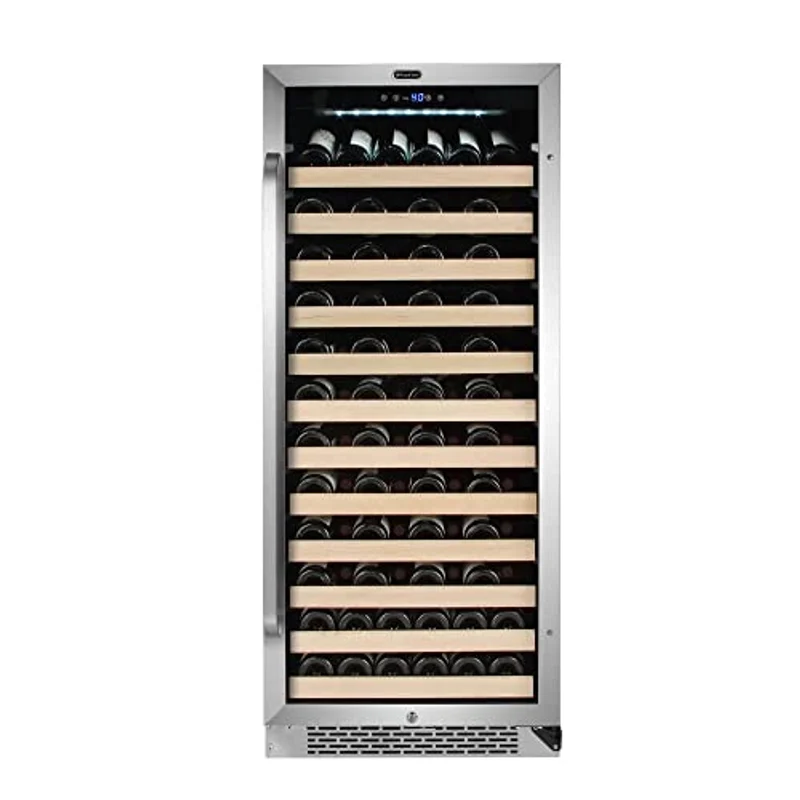
Whynter BWR-1002SD 100 Bottle
Where humidity genuinely matters, because the timescale is years
100 bottles (90 with display shelf)·Single zone·Compressor·Built-in or freestanding
A cabinet this size is usually bought for holding a collection rather than rotating through it quickly, which is precisely the case where cork drying has enough time to add up. Whynter doesn't publish a humidity spec for this unit, so if the number matters to you, add a hygrometer on day one and a water tray if it reads persistently low — a five-dollar habit that matches the multi-year job this fridge is meant to do. Our guide to large wine fridges (100 bottles and up) covers what else separates cabinets at this scale.
The size where a slow, humidity-driven problem has time to actually become one.
02Drink-it-this-year
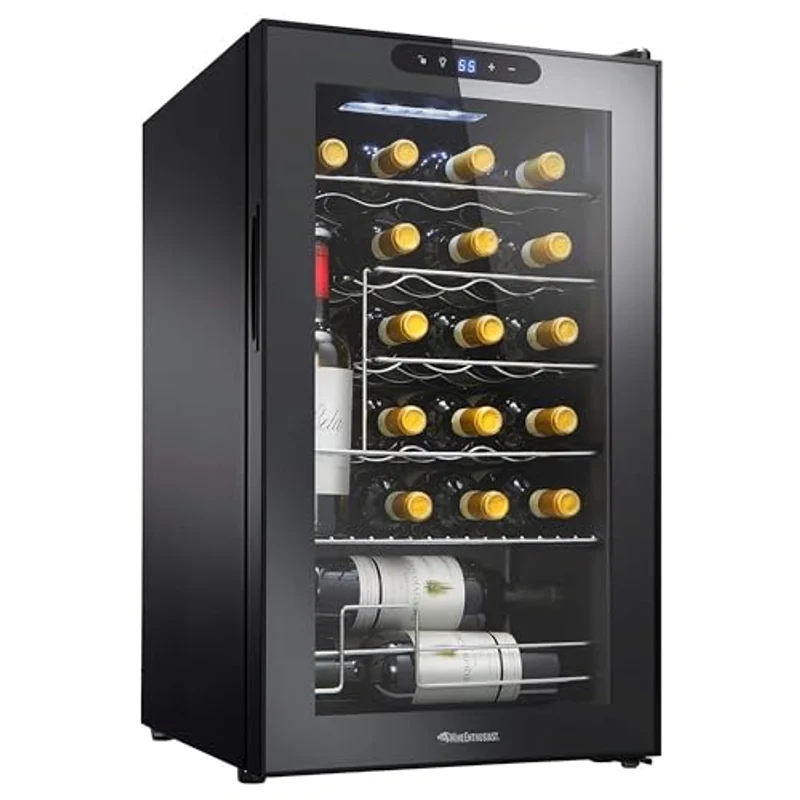
Wine Enthusiast 24-Bottle Compressor
Where the honest answer is: don't worry about it
24 bottles·Single zone·Compressor·Freestanding, 2.4 cu. ft.
An entry-size freestanding compressor cooler with upright bottle storage and a digital control panel across a 41–64°F range — the profile of a fridge most owners will cycle through within a season or two rather than hold for years. That's the exact case where this guide's timescale argument matters: if you're drinking through what you buy, the cork on any given bottle spends weeks in this cabinet, not years, and low humidity simply doesn't have time to do anything. Get the temperature right and the humidity question mostly answers itself.
Proof that the humidity question has a size and a timescale, not just a number.
03Built-in, undercounter
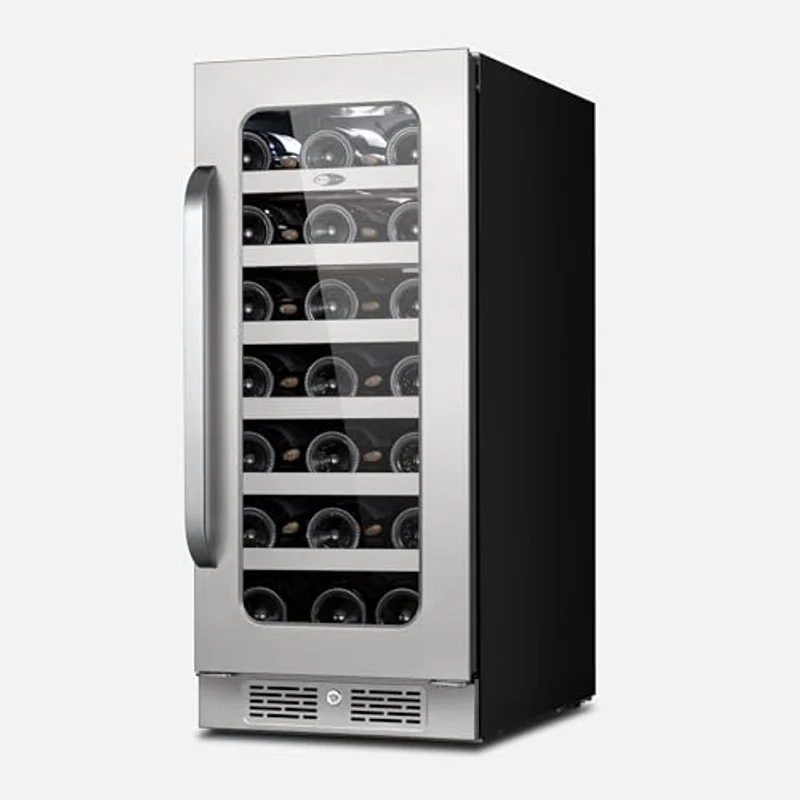
Whynter BSR-033SW 15" Built-In
A sealed cabinet with less room air exchange either way
33 bottles·Single zone·Compressor·Built-in or freestanding
Front-venting and rated by Whynter for enclosed installation in the standard 15-inch cabinet opening. A built-in unit's door gets opened less often on average than a freestanding one parked in a busy kitchen, so whatever humidity it settles at tends to stay more stable day to day — useful if you're storing cork-sealed bottles for more than a season. If you're planning the installation itself, our guide to installing an undercounter wine fridge and our roundup of the best 15-inch undercounter units cover the fit and clearance questions this article doesn't.
Stability comes from how often the door opens as much as from any spec sheet.
Who actually needs to think about this
Ignore the humidity question entirely if: your bottles are screwcapped or synthetic-stoppered, or you're realistically drinking through your fridge within a year. Neither situation gives low humidity the time or the material it needs to matter. Put your attention on temperature stability instead, which acts on a much shorter timescale and affects every closure type.
Take it seriously if: you're holding cork-finished bottles for several years or more, and especially if the fridge in question is a repurposed kitchen refrigerator rather than a dedicated wine unit. Buy a real digital hygrometer, store bottles on their side, and keep a water tray ready if the reading runs consistently low.
Figure out which case you're in before you buy anything based on humidity claims alone — capacity and cooling type matter more for most people's actual use. Our bottle-count reality check is the better starting point if you haven't settled on a size yet, and if you're deciding between one temperature zone and two, our dual-zone roundup covers that separate trade-off.
How we researched this
This guide draws on general, well-established material science for natural cork and its moisture behavior, how frost-free refrigeration works mechanically, and the published specifications and current prices for the products named. Where a product listing doesn't state a humidity specification — true of all three units above — we said so rather than inferring one from the price or the marketing copy.
We do not run a testing lab. We haven't measured the interior humidity of these specific units ourselves, and we don't publish invented scores, star ratings or review counts — the retailer API doesn't return that data for this category, and we don't fabricate what we can't source. What we can do is explain the mechanism honestly and tell you when it does and doesn't apply to your situation.
Frequently asked questions
Does low humidity actually ruin wine?
Only over a long timescale, and only for cork-sealed bottles. Sustained low humidity can slowly dry and shrink a natural cork over months and years, weakening its seal and letting in more oxygen than intended. A week or two of low readings, or any amount of time on a screwcapped bottle, isn't a real risk.
Do wine fridge "humidity control" features actually do anything?
Genuine active humidification is a feature of expensive, purpose-built cellar cooling systems, not typical consumer compressor wine fridges. What gets marketed as humidity control on most units is either the simple absence of a frost-free defrost cycle — standard across the category — or a passive water reservoir that works the same way a DIY water tray does.
Should I put a water tray in my wine fridge?
If a hygrometer shows persistently low readings and you're storing cork-sealed bottles for the long term, yes — a small, shallow, open dish of water on the lowest shelf raises interior humidity through simple evaporation. Don't overdo it: staying in the 50–70% range is the goal, not maximizing the number.
What hygrometer reading should worry me?
A sustained reading below roughly 40% over weeks or months, specifically for cork-sealed bottles you intend to hold long-term. A single low reading, especially right after the door has been opened, is meaningless. Use a digital hygrometer rather than a cheap analog dial, and judge the trend over several days, not one check.
Written by Ilane Tall. Research-based comparisons of published specifications, current prices and general material science — we do not physically test these units and we do not publish invented scores.