By Ilane Tall · Updated September 17, 2026 · Research-based.
Reader-supported: we may earn a commission when you buy through the links on this page, at no additional cost to you. It never changes which product we recommend. Prices quoted below were correct at the time of writing and move often.
The short version
Wooden shelves cost more, damp down vibration a little, and lose you two or three bottles of capacity to the wood itself. Wire shelves are cheaper, let more cold air circulate, and are the reason a budget compressor unit can sound rattly at first — the fix is almost always a felt pad, not a return.
Whichever material, the number that actually decides how many bottles fit is the bottle shape the manufacturer used to count — and that is nearly always a slim Bordeaux, not the bottle in your hand.
If shelves are removable, you can trade two slim slots for one wide one and fit a magnum. If they are fixed, you cannot, no matter what material they are made of.
Why the advertised bottle count assumes Bordeaux
Every wine fridge on the market is rated for a bottle count — 37, 45, 100 — and that number is not a measurement of your wine. It is a measurement of one specific bottle: the standard 750ml Bordeaux, a tall, narrow, straight-sided cylinder about 3 inches across at its widest. Manufacturers rack that shape nose-to-tail, shoulder-to-shoulder, in the exact spacing their shelves were engineered for, and the figure that comes out the other end is the one printed on the box.
Your bottles are probably not all Bordeaux-shaped. Burgundy and Pinot Noir bottles have sloped, wider shoulders. Champagne and other sparkling wines are wider still and noticeably heavier, because they are built to hold pressure. A Rhône or a German Riesling often comes in a taller, more slender bottle than a Bordeaux, which can actually rack better — but that is the exception, not the rule. The moment even a third of a case is Burgundy or Champagne shaped, the shelf spacing that fit 12 slim bottles across four shelves starts leaving gaps, or forcing you to skip a slot to let a fat shoulder clear the shelf above it.
This is why the honest planning number, repeated across the category regardless of price, is roughly 70–80% of the stated capacity once a real, mixed collection goes in. A 45-bottle fridge that is genuinely mixed reds, whites and a few sparkling bottles is a 32-to-36-bottle fridge in practice. That is not a defect in any specific unit — it is a property of how capacity is measured everywhere, and no shelf material changes the arithmetic on its own.
What shelf material and shelf spacing do change is how badly that gap bites. A shelf with tight, fixed slots built for Bordeaux punishes a mixed collection hard, because there is nowhere for a fat bottle to go except a slot it doesn't fit. A shelf with wider spacing, or one you can remove and space out yourself, absorbs the mismatch. That is the real argument buried inside "wood vs wire" — it is really an argument about spacing and flexibility, and the material is mostly a proxy for which one you are likely to get.
Wooden shelves: vibration, cost, capacity
Wooden shelves — usually beechwood slats set into a metal frame, sometimes a solid wood-look panel — show up almost exclusively on higher-priced compressor units, and for a specific reason: wood is a poor conductor of vibration compared with bare metal wire. A compressor's compressor pump and condenser fan both introduce a small amount of mechanical vibration into the cabinet. Sit a bottle directly on a metal wire rack and that vibration transfers with very little damping. Sit it on a wood slat and the wood absorbs some of that energy before it reaches the glass.
How much this matters for the wine itself is genuinely debated, and we will not overstate it: the wine-ages-badly-from-vibration claim is more folklore than settled science for the timescales most home fridges operate on. What is not folklore is comfort and noise — a bottle resting on a slightly damped wood shelf is less likely to develop the faint buzz or chatter that happens when a wire rack resonates at a particular compressor speed. If you have ever heard a wine fridge develop an intermittent rattle that comes and goes with the compressor cycle, it is very often glass-on-wire, not a mechanical fault.
The trade-offs are real, though. Wood shelves cost the manufacturer more, which is reflected in the price of the unit, not charged separately. And wood takes up more of the vertical space inside the cabinet than a thin wire rack does — a slat shelf plus its frame can be a half-inch or more thicker than an equivalent wire shelf, which over four or five shelves adds up to real lost height, and sometimes an entire lost row of bottles on a tall cabinet. A wood-shelved 40-bottle unit and a wire-shelved 40-bottle unit are not using their interior space identically; the wood one usually has slightly larger cabinet dimensions to compensate, which is one reason wood-shelved fridges tend to be both pricier and larger for the same rated capacity.
Wood also needs slightly more care. It should never be wiped down with anything wet enough to soak in, and a shelf that gets soaked in a spill can eventually warp or develop a slight bow, at which point bottles no longer sit level. It is a minor maintenance point, not a reason to avoid wood, but it is one more thing a wire shelf simply does not have to worry about.
Wire shelves: airflow and the price they pay in noise
Wire — almost always chrome-plated steel, sometimes vinyl-coated — is the default shelf material on budget and mid-range wine fridges, and it earns that position on merit, not just cost. An open wire rack lets cold air move through and around it far more freely than a solid wood slat does. In a compressor fridge that relies on a fan to circulate air evenly top to bottom, wire shelving is genuinely the better airflow design: it does not create the small dead zones that a solid shelf can, where the air just above the shelf runs slightly warmer than the air just below it.
The price wire pays is acoustic, not thermal. Glass sitting directly on bare metal has almost nothing between it and the vibration of the compressor and fan, and a fully loaded wire shelf can develop a faint metallic hum or buzz that a wood shelf would have damped. This is the single most common noise complaint in owner reviews of budget compressor units, and it is worth knowing before you assume the unit itself is defective: nearly always, the fix is a thin shelf liner, a strip of felt, or simply not loading bottles into the two or three slots directly above the compressor housing, where vibration is strongest. If a fridge is humming or rattling for reasons that don't resolve with a liner, that is a different and more serious problem — our guide to normal versus abnormal wine fridge noise walks through how to tell the difference.
Wire has one more advantage worth stating plainly: it is cheap to replace. A warped or bent wire shelf is a low-cost part almost any manufacturer can ship as a spare. A cracked or warped wood slat assembly is a pricier repair, and on some units it is not sold separately at all.
Wood shelves
Costs more, dampens vibration, takes up more vertical space per shelf. The shelf material you'll find on most higher-priced, larger-capacity compressor units.
Wire shelves
Cheaper, better airflow, more prone to a faint metallic hum that a felt liner usually fixes. The default on most budget and mid-size compressor units.
Removable shelves and magnum bottles
The feature that actually matters more than the material, once you own the fridge, is whether the shelves come out. A fixed shelf — riveted, welded, or slotted into a frame you cannot detach without tools — locks you into whatever spacing the factory chose. A removable shelf lets you take one out entirely and use the freed-up height for a bottle that would not otherwise fit.
This is the whole trick to storing a magnum. A standard magnum (1.5L, double the volume of a regular bottle) is taller and noticeably wider at the shoulder than a Bordeaux 750ml — wide enough that it will not slide into a slot sized for the smaller bottle, and often not tall enough clearance either, since standard shelf spacing is set for a standard bottle height. Pull one shelf out of a fixed-spacing rack and you turn two cramped slim-bottle rows into one row with real headroom, at the cost of the slots that shelf used to provide.
Before assuming a fridge can do this, check two things the listing should state, and if it doesn't, treat the answer as unknown rather than assuming yes: whether the shelves are described as removable or adjustable, and the fridge's internal height once a shelf is pulled. Neither of the three products below states a specific magnum clearance in its listing, so if a magnum is part of your plan, the safest move is to check the current Amazon listing's photos and Q&A section before buying, rather than assume — the same rule that applies to any spec a listing doesn't give.
One more practical note: removable shelves also solve the "fat Burgundy bottle" problem from the section above, on a smaller scale. Pulling every other shelf slightly forward, or removing one shelf on a half-full cabinet, is the standard workaround for a mixed collection that a fixed-spacing rack can't otherwise handle. It costs you a few slim-bottle slots to gain space for the wide ones — the same trade as the magnum case, just smaller.
The picks
None of the three units below states its shelf material in the listing we sourced, which matters enough that we are saying it plainly rather than guessing: if shelf material or magnum clearance is the deciding factor for you, check the current listing's photos and Q&A before buying. What we can speak to honestly is capacity, price and the specifications each brand does publish.
01Most flexible footprint
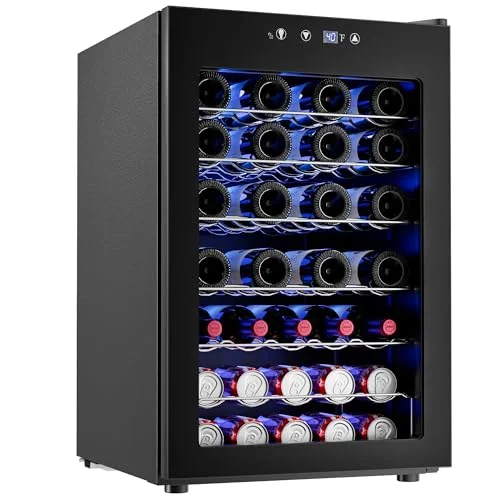
Electactic 37 Bottle / 145 Can Reversible-Door Cooler
Best if you want the option to run cans or bottles in the same cabinet
37 bottles or 145 cans·4.5 Cu.ft·Compressor·Freestanding
Electactic specifies a "quiet compressor" and a reversible stainless-and-glass door, and the 4.5 cubic foot cabinet is the largest of the three — more interior volume generally means more room to compensate for an odd bottle shape without running out of shelf. The listing does not state its shelf material or whether shelves are removable, so if either matters to your plan, confirm it on the current Amazon listing before ordering. What we can say from the published spec: this is the unit built to be run wine-only or beverage-only, which is a different flexibility question from shelving, but a genuinely useful one if your household hasn't settled on which it wants yet.
The pick if you want room to change your mind about what goes inside it.
02Most bottles for the price
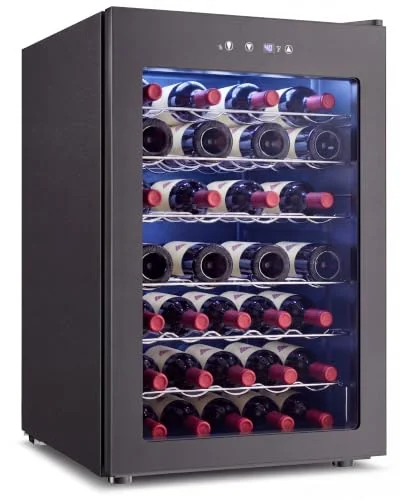
Feelfunn 45 Bottle Freestanding Wine Cooler
Best if raw capacity, not shelf material, is the priority
45 bottles·Compressor·Freestanding
Forty-five bottles at $269.99 is a straightforward capacity play, and it is worth applying the 70–80% rule from earlier before you buy: expect somewhere around 32 to 36 bottles once a mixed, real-world collection is loaded rather than slim Bordeaux stacked perfectly. Feelfunn's listing does not publish a shelf material or a removable-shelf spec, so we are not asserting either — if the fridge needs to swallow a magnum or a case of Burgundy comfortably, verify shelf spacing on the listing first.
Buy this for the bottle count on the box, and plan your real collection around 70–80% of it.
03Same capacity, alternate option
Icyglee 45 Bottle Freestanding Wine Cooler
Worth comparing against the Feelfunn before you decide
45 bottles·Compressor·Freestanding
The same rated capacity as the Feelfunn above, at a few dollars more. We list it as a direct alternative rather than a distinct pick, because the published specification does not give us a reason to prefer one over the other on shelving grounds — neither listing states shelf material or removable-shelf clearance. If one is temporarily out of stock or priced differently by the time you're shopping, treat this as the equivalent option rather than a downgrade.
Same bottle-count math applies: plan on roughly 32 to 36 bottles in real use, not 45.
Rearranging shelves without breaking the runners
Most wine fridge shelves sit on a pair of plastic or metal runners molded into the cabinet's interior side walls, the same basic idea as an oven rack. They are designed to slide out for cleaning and to be removed entirely, but they are not designed to be forced, and the runners themselves — thin plastic ridges on many budget units — are the part that actually breaks, not the shelf.
- Empty the shelf before you move it. A loaded shelf is heavy and awkward, and the extra weight is exactly what turns a smooth slide into a snapped runner tab. Take the bottles off first, every time.
- Slide it straight out, level. Support the shelf with both hands and keep it parallel to the runners as you pull. Tilting one side down to clear a bottle above it — a common shortcut — is the single most common way a plastic runner tab cracks, because it puts side-load on a ridge that was only ever designed to take weight from directly above.
- Note which runner groove it came from before you set it aside. Most cabinets have several evenly spaced grooves running up each side wall, and shelves are usually not sized identically for every groove. Photograph the inside of the cabinet with your phone if you are rearranging more than one shelf — it is a thirty-second step that saves a confusing ten minutes later.
- Reinsert at a slight upward angle, then level it. Most runner systems seat more easily if you lead with the back edge slightly raised and lower it into the groove, rather than pushing it in dead level from the front. Force applied straight-on against a groove that isn't quite lined up is what cracks a plastic runner tab.
- Load it back to front, heaviest bottles nearest the wall. This isn't a runner-safety step so much as a stability one — it keeps the shelf's weight balanced over both runners rather than cantilevered toward the door, which matters most on a fully extended shelf.
- If a runner does crack, stop using that groove rather than forcing the shelf back in. A cracked plastic tab will not get stronger with more attempts, and a shelf resting on a broken runner can drop unevenly and chip a bottle or, worse, the glass door shelf below it.
None of this is specific to wood or wire — the shelf material has nothing to do with how the runners themselves hold up. What decides that is purely how carefully the shelf is loaded, angled and slid, which is worth knowing before you rearrange a cabinet to fit a magnum or a case of oddly shaped bottles using the technique from the section above.
How we compared these — and what we cannot tell you
We compared the manufacturer specifications published on each listing, current Amazon prices, and general, well-established facts about compressor cooling, air circulation and shelf engineering that apply across the category. Where a listing did not state a spec — shelf material, whether shelves are removable, or magnum clearance, for all three products above — we said so rather than filling the gap with a guess.
We do not run a testing lab. We do not own these units and have not physically tested how their shelves handle a fully loaded case of wine, so you will not find an invented score out of ten, a star rating, or a review count on this page — the retailer API does not return them for this category, and we do not publish numbers we cannot source. What we can do honestly is explain how shelf material and spacing generally behave in a compressor wine fridge, and tell you exactly which specifications a given listing does and does not confirm.
Prices quoted here were correct at the time of writing and change frequently. Confirm the current price before buying.
Frequently asked questions
Do wooden shelves actually protect wine better than wire shelves?
Wood dampens the small mechanical vibration a compressor and fan introduce into the cabinet more than bare wire does, which mostly shows up as less shelf noise rather than a measurable difference in how the wine ages. Whether that vibration meaningfully harms wine over the timescale most home fridges are used for is not well established either way, so we won't overstate the benefit — the clearer, provable difference is acoustic comfort, not preservation.
Why does my wire-shelf wine fridge hum or rattle?
Almost always it's glass sitting directly on bare metal that is resonating slightly with the compressor's cycle, not a defect. A thin felt shelf liner or not loading the one or two slots directly above the compressor housing usually resolves it. If the noise doesn't stop with a liner, that points to a different problem worth checking against our noise and vibration guide.
Can I fit a magnum bottle in a standard wine fridge?
Only if the shelves are removable and you are willing to give up an entire shelf's worth of slim-bottle slots to gain the height and width a magnum needs. Fixed shelves generally cannot be reconfigured at all. Check the specific listing for "removable" or "adjustable" shelving language before assuming yes, since it is not something every manufacturer states clearly.
Will a 45-bottle wine fridge really hold 45 bottles?
Rarely, for a mixed real-world collection. That figure is calculated using slim, straight-sided Bordeaux bottles racked perfectly. Burgundy, Pinot and Champagne bottles are wider and often shorter-shouldered, and any bottle that doesn't match the shelf spacing wastes a slot. Plan on roughly 70–80% of the stated number — for a 45-bottle unit, closer to 32 to 36 bottles in practice.
Written by Ilane Tall. Research-based comparisons of published specifications, current prices and general product-category facts — we do not physically test these units and we do not publish invented scores.