By Ilane Tall · Updated September 1, 2026 · Research-based.
Reader-supported: we may earn a commission when you buy through the links on this page, at no additional cost to you. It never changes which product we recommend. Prices quoted below were correct at the time of writing and move often.
Quick answer
Red wine wants 55–65°F, most of it clustered around 55°F for long-term storage and a touch warmer for serving. Most wine fridges can do this easily — the trap is the handful of cheaper cabinets whose upper limit stops at 64°F or lower, which sounds close enough until you realize that leaves no headroom for a full-bodied red served properly.
If your collection is all red, or close to it, a single-zone cabinet set near 55°F is the right, cheaper answer: no divider eating shelf space, no second thermostat to babysit. The OYLUS 24" 46 Bottle is our pick for that job — a single zone across a 41–64°F range, sized for a real collection.
Only pay for a second zone if you also keep whites and want to serve both without planning ahead — see when the second zone earns its money below.
The temperature range reds actually need
Start with the number that matters and ignore the marketing copy around it. For storage — keeping a bottle in good condition until you are ready to open it — red wine wants the same thing every other wine wants: a stable temperature near 55°F (13°C). Colour does not change the storage number. What ages wine badly is heat, light, vibration, and above all swings — a cabinet that sits at a patient 57°F does less damage over a year than one oscillating between 50°F and 60°F while averaging 55°F.
Serving is where red diverges from white, and it is the part most buyers get wrong when they shop by the headline range on the box. Full-bodied reds — Cabernet, Syrah, a big Zinfandel — show best around 62–65°F. Lighter, more delicate reds like Pinot Noir or Beaujolais are better a few degrees cooler, closer to 55–60°F. Almost nobody wants a red at the 45–50°F a fridge shelf delivers; that is a white-wine number, and it mutes tannin and fruit in a red until the glass warms back up on the table.
Put those two together and the practical range a red-focused cabinet should cover is roughly 55–65°F. A single zone parked at 55°F stores everything correctly and serves most reds acceptably once poured — a glass pulled at 55°F warms into its window in a few minutes on the counter, which is a minor inconvenience, not a flaw. But if you want the cabinet itself to hold a big red at proper serving temperature, or you keep a mix of lighter and fuller reds you'd like at slightly different points, you want a unit whose upper limit clears 64°F with room to spare, not one that stops exactly there.
Why many cabinets stop at 64°F, and what that means
Look at the spec sheets across this category and a pattern shows up fast: an enormous number of compressor wine coolers are built to a 41–64°F range, full stop. It is not an accident and it is not a limitation of the compressor — it is a design choice aimed at the widest possible market. A 41–64°F unit can chill whites and sparkling at the bottom of its range and hold reds at a defensible number near the top, so one cabinet covers both colours reasonably well. That is a sensible default for a general-purpose wine fridge, and it is why you will see the exact same 41–64°F envelope quoted on cabinets from several different brands.
The catch is what "64°F ceiling" actually means for a red-heavy collection. Sixty-four degrees is inside the acceptable serving window for a full-bodied red, but only barely, and it leaves zero margin. A room that runs warm, a compressor that is a couple of degrees off its setpoint under load, or simply wanting a red a touch warmer than 64°F for a special bottle — none of that is available to you. You are at the wall the cabinet was built to. Compare that with a unit rated to 65°F or wider, which is functionally similar in most real-world use but gives you the small amount of headroom that turns "close enough" into "correct."
None of this means a 41–64°F cabinet is a bad choice for red wine — most of them are perfectly capable units, and 64°F comfortably covers the great majority of reds people actually drink day to day. The point is narrower: read the upper number on the spec sheet before you buy, understand that it is describing where the cabinet stops rather than a comfortable resting point, and decide whether that ceiling matches what you actually want to serve. If you keep mostly big, full-bodied reds and like them properly warm, look for a range that clears 64°F rather than one that ends there. Our full temperature guide breaks the numbers down by style in more detail.
The number to check before you buy: not the low end of the range, but the high end. A cabinet's low number tells you it can chill a white. Its high number tells you whether it can actually hold a red at serving temperature rather than storage temperature. For a red-focused collection, the high number is the one that decides whether the cabinet does the job you bought it for.
Single zone is fine for an all-red cellar
If reds are most or all of what you keep, resist the pull toward a dual-zone cabinet just because it looks like the more capable appliance. A second zone solves one specific problem — holding whites at a colder serving temperature than reds at the same time — and if you rarely or never store whites, you are not buying capability, you are buying a divider that eats shelf space and a second thermostat that adds nothing.
A single-zone cabinet set near 55°F stores every red correctly for the long haul and serves most of them acceptably straight from the door. For the reds that want to be warmer — a big Cabernet at 63°F rather than 55°F — the fix is thirty minutes on the counter, not a second compartment. That is a trivial cost against what a single zone buys back: the full interior available for bottles of any size, one setpoint to manage instead of two, and typically a lower price than a dual-zone cabinet of similar capacity.
Capacity is where single zone earns its keep most visibly. Because there is no fixed divider carving the cabinet into two rigid compartments, every shelf can hold whatever you actually own that month — a case of the same Cabernet, a mixed rack of five different reds, tall Burgundy-shaped bottles next to standard Bordeaux bottles. A dual-zone cabinet locks a percentage of its shelves to a colder zone whether or not you use it, and that percentage is chosen by the manufacturer, not you.
The OYLUS 24" 46 Bottle is the clearest example of this logic done at real scale: a single 41–64°F zone across 46 bottles, all of it usable for red storage, at a lower price than a dual-zone cabinet with similar total capacity. If your rack is genuinely mostly red, that is the more honest purchase.
Dual zone: when the second zone earns its money
The case for two zones is narrower than it looks on the shelf, but it is real for the right household. A dual-zone cabinet is not two separate fridges — it is one insulated cabinet split by a fixed internal divider, with a second sensor and control board managing the compartment on the other side of that divider, usually still cooled by a single compressor. What it buys you is the ability to hold two different temperatures in one appliance: a colder zone for whites at their serving temperature, and a warmer zone for reds at theirs, at the same time.
That is worth paying for in one specific circumstance: you keep a genuine mix of reds and whites, and you want both ready to pour without planning ahead or reaching for an ice bucket. If someone in the house reaches for a chilled white or a sparkling wine several evenings a week while red sits in the same cabinet, a second zone removes a real daily friction. It is a serving convenience, not a wine-preservation upgrade — storage-wise, a single zone at 55°F does the job for red and white alike — but convenience has a price people reasonably pay.
Mostly or all red
One zone, set near 55°F. More usable shelf space, one thermostat, and a lower price for a comparable capacity. Warm a glass on the counter if you want it closer to 65°F.
Genuine red-and-white mix
Two zones earn their keep if whites get poured often. Check that the upper zone's own range clears 64°F — the overall cabinet range is not the number that matters here.
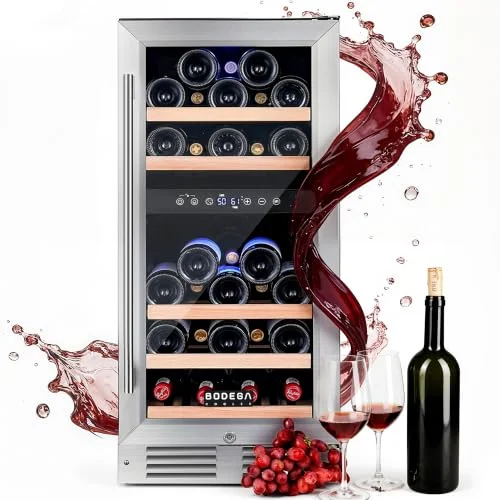
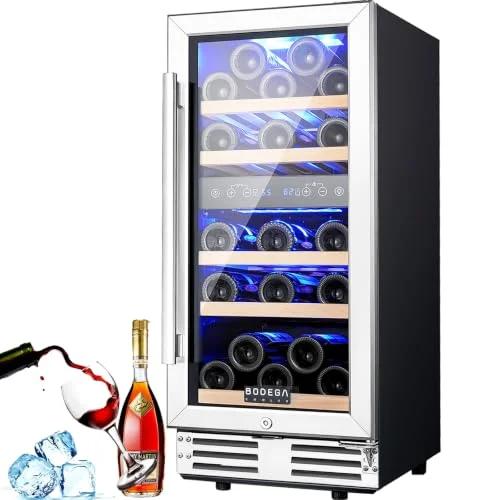
Two cautions apply if you go this route with red wine specifically in mind. First, never shop the cabinet's overall advertised range — shop the upper zone's range on its own, since that is the number that decides whether your reds actually reach a proper serving temperature. A cabinet with an overall 41–72°F spread, like the BODEGA 15" 30 Bottle, is telling you the upper zone alone can run considerably warmer than the 64°F ceiling common elsewhere in this category — genuinely useful if big reds are the point. Second, because one compressor typically serves both zones, the achievable spread narrows in a hot room; a unit that holds a wide gap at 70°F ambient will hold a smaller one at 85°F. Our dual zone vs single zone guide works through that trade-off in full, including the trap of a cabinet with two displays but very little real difference between the compartments.
The picks
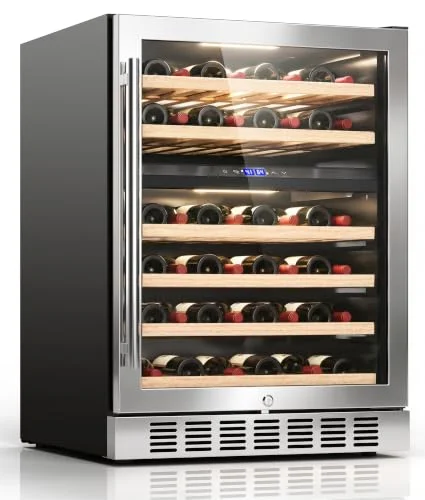
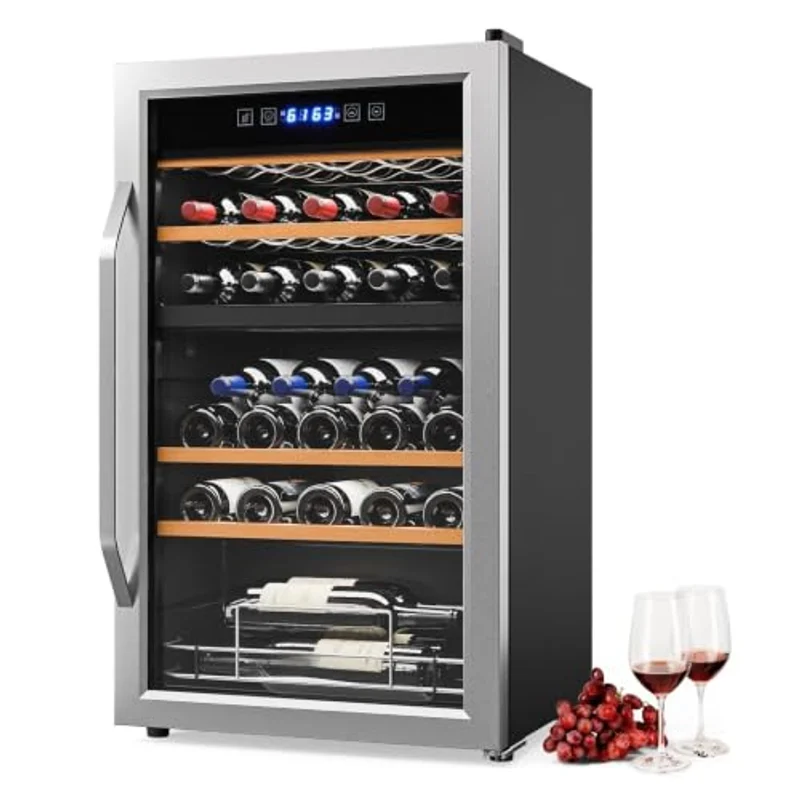
All five below are compressor-cooled, which matters more for red wine than it sounds: thermoelectric cooling can only pull about 20°F below the room, so on a warm day it may never reach even a red-friendly 60°F, let alone hold a cellar temperature near 55°F. Every unit here is selected for how well its published range serves red wine specifically, not for the widest bottle count.
Serving temperature versus storage temperature
This distinction is the single most useful thing to carry out of this guide, because almost every confusing spec sheet in this category resolves once you separate the two questions.
Storage temperature is what keeps a bottle from ageing badly while it waits. It sits near 55°F for red and white alike, and the number matters far less than stability — a bottle held steady at 57°F for years fares better than one that swings between 50°F and 60°F while averaging 55°F. If the cabinet's only job is to hold red wine safely until you are ready to open it, one zone at 55°F is not a compromise. It is the correct answer.
Serving temperature is what the wine should be when it hits the glass, and this is where red diverges from white and where most of the range confusion on spec sheets actually lives. Full-bodied reds want roughly 62–65°F; lighter reds a touch cooler, around 55–60°F. A red served at 55°F storage temperature is not wrong, exactly — it is simply below its serving window, and warms into it in a few minutes at room temperature. A red served at 45°F, the number a fridge shelf or the bottom of a dual-zone cabinet delivers, tastes muted and closed; that is a mismatch worth avoiding, not a minor one.
Put together, the practical guidance is this: buy for storage first — 55°F, held steady, is right for every bottle in the cabinet regardless of colour — and treat serving temperature as a smaller, secondary adjustment. If you want the cabinet itself to deliver a big red at 63–65°F rather than relying on the counter to finish the job, that is when the upper-limit number on the spec sheet becomes the deciding factor, and why this guide keeps returning to it. A cabinet whose ceiling stops at 64°F still gets you most of the way there for most reds; one that clears 65°F or higher removes the last small gap.
The rule that resolves most confusion: the low number on a spec sheet tells you whether the cabinet can chill a white. The high number tells you whether it can actually serve a red properly rather than just store one. For a red-focused buyer, read the high number first.
How we compared these
We compared published manufacturer specifications — bottle counts, zone counts, and the temperature range for each unit — against current listed prices, and looked specifically at where each cabinet's upper temperature limit sat relative to the 64°F wall that recurs across this category. Where a listing gives only one range for a dual-zone cabinet rather than a range for each zone separately, we treated that as an open question rather than assuming the best case.
We do not run a testing lab. We do not own these units and we do not physically test them, so there is no invented score out of ten here, and no star rating or review count either — the retailer API does not return them for this category, and we do not publish figures we cannot source. What we can do honestly is read the specifications carefully, track prices, and reason from general, well-established facts about wine service and storage temperature.
Prices quoted here were correct at the time of writing and change frequently. Confirm the current price before buying.
Frequently asked questions
What temperature is best for storing red wine long-term?
Around 55°F (13°C), the same figure that works for white and sparkling wine in storage. Colour does not change the storage number — what matters most is holding that number steady rather than letting it swing, since temperature swings damage wine faster than sitting a few degrees off ideal.
Why do some wine fridges stop at 64°F instead of going warmer?
Sixty-four degrees is a common design ceiling across this category because it lets one cabinet cover both whites at the bottom of its range and reds near the top. It comfortably serves most reds, but it is a hard wall rather than a comfortable cruising point — there is no margin above it, so a cabinet with a wider or higher ceiling gives more room for full-bodied reds served properly warm.
Do I need a dual-zone fridge just for red wine?
No. A dual zone solves the problem of holding whites and reds at different temperatures at the same time. If your collection is mostly or all red, a single zone set near 55°F stores everything correctly, serves most reds acceptably, and gives you more usable shelf space and a lower price than a comparable dual-zone cabinet. See our dual zone vs single zone guide for the full decision.
What is the difference between serving temperature and storage temperature for red wine?
Storage temperature (about 55°F) is what keeps a bottle in good condition while it waits, and it is the same for every colour of wine. Serving temperature is what the wine should be in the glass, and for red that is warmer — roughly 55–65°F depending on body, with full-bodied reds at the top of that range. A red pulled at storage temperature simply needs a few minutes to warm into its serving window; it is a minor adjustment, not a flaw in the wine or the fridge.
Written by Ilane Tall. Research-based comparisons of published specifications, current prices and general domain facts about wine storage and service — we do not physically test these units and we do not publish invented scores.