By Ilane Tall · Updated August 26, 2026 · Research-based.
Reader-supported: we may earn a commission when you buy through the links on this page, at no additional cost to you. It never changes which product we recommend. Prices quoted below were correct at the time of writing and move often.
The short version
The layout that actually holds up follows the fridge's own physics, not a shelf-styling trend. In a single-zone cabinet, warm air still rises inside the box, so the top runs a few degrees warmer than the bottom even while the compressor holds one number on the display — put whites and sparkling low, reds up top, and you've built a rough two-zone cabinet for free.
Keep a slim front row for what you're actually drinking this month, and push everything you're aging further back. That's what stops the whole cabinet getting rearranged every time you bring home a case.
The two things that quietly wreck an otherwise good system: a fat-bottomed Burgundy or Champagne bottle that won't sit in standard rack spacing, and anything pushed back far enough to block the rear vent — which turns an organizing mistake into a cooling fault.
Use the temperature gradient on purpose
A wine fridge with one thermostat is not one uniform temperature top to bottom. Warm air is lighter and rises; the cold air a compressor produces settles low, so even in a well-built single-zone cabinet there's a natural gradient of a few degrees between the top shelf and the bottom shelf. It's wider in a tall cabinet and narrower in a short one, and narrower still in units built with fan-forced circulation that actively mixes the air rather than letting it stratify on its own — but even a cabinet designed to fight the gradient rarely erases it completely once the interior is more than a couple of feet tall.
Most people either ignore this gradient or pay to eliminate it, buying a dual-zone cabinet purely to get two setpoints. There's a cheaper option first: use the gradient you already have. Storage temperature for wine, red or white, sits around 55°F — that number doesn't change by color. What changes by color is serving temperature: whites and sparkling are best poured close to 45–50°F, while reds show best closer to 60–65°F. So in a single-zone cabinet set at a sensible middle point, the bottom shelves — running a few degrees colder — are already closer to a white's serving window, and the top shelves — running a few degrees warmer — are already closer to a red's. Put whites, rosé and sparkling low, reds up top, and an unavoidable physical quirk becomes a rough, free version of what a dual-zone cabinet does on purpose with a divider and a second thermostat.
This only works if you know your own cabinet's actual spread, and finding that out costs almost nothing: a cheap stick-on or probe thermometer on the top shelf and another on the bottom for a week tells you the real gap, which can run anywhere from two to eight degrees depending on the unit and how full it is. A fuller cabinet holds temperature more evenly than a half-empty one, because the bottles themselves add thermal mass that resists swings — one more reason a cabinet you've organized properly, packed close to capacity, behaves more predictably than one with gaps everywhere.
None of this makes a single-zone cabinet a substitute for a real second thermostat if you genuinely want cellar-cold reds and pour-ready whites in the same appliance at the same time — that's a different, more deliberate purchase. If you're still weighing whether a dedicated cabinet is worth having at all versus using a kitchen fridge or a wine cellar, the gradient argument is part of the case either way: a kitchen fridge runs close to 37°F everywhere, with no usable gradient and nothing sitting at a temperature worth drinking.
Drink-now up front, keep-and-forget behind it
The single change that stops a wine fridge turning into a puzzle every time you buy a case: separate what you're going to drink soon from what you're keeping.
Set aside a small front row — the slots nearest the door, or the first spot on each shelf — for bottles you expect to open within the next few weeks. Everything else, whatever you're aging or simply not in a hurry to open, goes behind that row and stays there until it graduates into the front row on its own turn.
The reason this matters more than it sounds: every time the front row runs out and gets restocked, the front row is the only part of the cabinet that has to move. Without a defined front row, restocking means either cramming new bottles wherever there's a gap — often behind older ones — or pulling half the cabinet out to make everything fit some new way. That second scenario is the one that turns a ten-minute chore into forty-five minutes, and it's the actual reason most carefully organized wine fridges fall apart within a month.
Keep the front row genuinely small — a week or two of realistic drinking, not a whole shelf "just in case." A front row sized to your real habits cycles often enough that it never becomes its own storage problem; an oversized one just becomes a second layer of clutter you also have to dig through.
There's a second benefit, for the bottles that aren't in rotation yet. A bottle you're aging does better left alone — minimal vibration, minimal handling, minimal temperature swing from the door opening near it. Bottles kept behind an active front row get exactly that: touched only when they move up, not every time someone reaches for tonight's bottle. That's a bigger deal than it sounds for anything held for a few years, and it's the practical reason a simple front-row split beats any fancier system.
Store label-up, and read the rack without touching it
Bottles in a wine fridge are almost always stored horizontally rather than standing up — the wine stays in contact with the cork, keeping it swollen and sealed, rather than letting it dry out over months of upright storage. Once a bottle is lying on its side, though, you get to choose which way it faces, and that choice is worth making on purpose.
Store every bottle with the label rotated to face straight up, or straight out toward you, and keep that orientation consistent across the whole cabinet. The point is simple: you should be able to identify a bottle — producer, vintage, whatever's on the label — by looking, not by sliding it out, turning it over, and sliding it back. That sounds minor until you're standing in front of a rack of forty bottles trying to find the one you're saving for a specific date, at which point it's the difference between ten seconds and pulling out a third of the shelf to check labels one at a time.
There's a real cost to the alternative. Every bottle pulled out and slid back is a bottle that got handled, briefly warmed by room air, possibly jostled — small individually, and genuinely damaging in aggregate to anything you're aging for years rather than weeks. Reading the rack without touching anything isn't just tidiness; it's the front-row rule applied to the bottles that stay in place.
On a fuller rack, where labels get partially obscured by neighboring bottles no matter how you angle them, a set of reusable bottle tags or a strip of tape and a marker on the shelf edge solves the same problem more bluntly — write the wine and a drink-by date where you'll see it without moving anything. Not elegant, but the kind of system still in use a year later, which is more than can be said for most label-facing conventions once a cabinet gets crowded.
Where Champagne and Burgundy actually go
Most wine fridge racks are spaced for a standard Bordeaux-shaped bottle — straight sides, a shallow punt, roughly three inches across at the shoulder. That's the shape a manufacturer used to calculate the bottle count printed on the box, and it's also the shape a meaningful share of any real collection isn't.
Burgundy and Pinot Noir bottles run noticeably wider through the shoulder. Champagne and other sparkling wines are wider still, and heavier, with a deeper punt and thicker glass built to hold pressure. Push either into a slot sized for a slim Bordeaux bottle and one of three things happens: it doesn't fit at all, it fits but presses hard enough against its neighbors to make removing any of them a small ordeal, or it fits by sitting slightly proud of the rack, unsupported and more likely to shift than a bottle seated properly.
The fix is to stop trying to make fat bottles share space designed for slim ones. Pick one shelf — ideally near the bottom, since that's often the sturdiest shelf and, per the gradient above, the coolest zone, which suits sparkling wine's lower serving temperature anyway — and treat it as the wide-bottle shelf. If the rack has removable dividers or rungs, pull every other one on that shelf so each remaining slot is roughly one and a half bottles wide. You'll fit two Champagne bottles where the shelf was rated for three slim ones; that's the shelf worth sacrificing, and it's a better trade than letting fat bottles jam a little space on every shelf instead.
This is also where the printed capacity on a wine fridge box quietly stops matching a real collection. A cabinet's rated bottle count assumes slim bottles stacked with no waste; a realistic mix of Bordeaux, Burgundy and a few Champagne bottles fits closer to seventy to eighty percent of that number once the wide bottles have claimed their own space. Our humidity guide covers the other spec worth checking before a case of anything unusual arrives — plan storage around the lower, realistic figure from the start rather than discovering it the day nothing fits where you expected.
The mistake that turns organizing into a cooling fault
Every compressor wine fridge has to reject the heat it pulls out of the cabinet somewhere, and "somewhere" is either a grille on the back and sides of the unit (freestanding models) or a grille on the front (units built to be enclosed under a counter). Either way, that grille needs a clear path for room air to move across it continuously, not just on the day the fridge was installed — our guide to undercounter installation covers exactly which clearances matter if yours is going under a counter rather than staying freestanding.
Organizing mistakes reach that grille more often than people expect. A freestanding unit pushed flush against a wall, or with spare shelving, a case box, or a delivery still in its packaging stacked directly behind it, blocks exactly the airflow the compressor depends on. The fridge doesn't announce this as an installation problem — it just runs longer, holds its setpoint less precisely, or stops reaching setpoint at all, which looks and feels like a cooling fault because that's what it's become.
The same failure shows up inside the cabinet on a smaller scale. Many units, especially taller single-zone cabinets, pull air across an internal grille or vent near the back to keep the whole interior close to one temperature rather than stratifying badly top to bottom. Overfilling the rearmost slots, or wedging a spare shelf or a large flat item against that internal vent, chokes the same airflow from the inside instead of the outside. The result is the same: uneven cooling, a compressor working harder than it should, and — in a cabinet you've otherwise organized carefully — the top shelves running warmer than the gradient discussed earlier would predict, because the mixing that's supposed to narrow that gradient isn't happening anymore.
The practical rule: leave the last inch or two nearest any vent, internal or external, alone. It's tempting real estate when you're trying to fit one more bottle, and it's the one place in the cabinet where "just squeeze it in" has a mechanical cost rather than just a cosmetic one.
An inventory that survives contact with real life
Most wine inventory systems fail for the same reason most habit-based systems fail: they demand more effort than the payoff justifies, so they get skipped after the second or third bottle — and an abandoned system is worse than no system, because you stop trusting it's accurate.
The version that survives is boring on purpose. Skip the barcode-scanning apps and the spreadsheet with a dozen columns unless you already enjoy maintaining one — for a working cabinet under about fifty bottles, they're solving a problem you don't have yet. What actually holds up is a running list, on paper taped inside the door or in a phone note you already open, organized by shelf or zone rather than by bottle: "bottom shelf, whites — two Sauvignon Blanc, one Riesling, one sparkling" rather than a full catalog entry per bottle with vintage, purchase date and tasting notes. Update it the moment a bottle goes in or comes out, not "later" — later is when these systems die.
Tie the list to the zones already described above. If the front row is where drink-now bottles live, the list only needs to flag what's in that row and roughly when it went in; everything behind it can be tracked in bulk by shelf and grape rather than bottle by bottle. That's enough to answer the two questions an inventory actually needs to answer day to day — do I have a white in here, and is anything back there getting old — without demanding the discipline of a full cellar log.
The exception is a collection that's grown past the point where "roughly what's on each shelf" is still useful. Once you're deep into triple digits of bottles across vintages you're actually tracking for drinking windows, a proper per-bottle log starts earning its keep, and that's a different tool than the one described here. Our guide to large-capacity wine fridges covers the cabinets built for a collection at that scale, where inventory stops being optional. For everyone else, the honest goal isn't a perfect catalog — it's a list accurate enough that you check it before buying a bottle you already own three of, which is a much lower bar than most inventory apps are built for.
Three cabinets, and how each one changes the puzzle
The organizing rules above apply to almost any wine fridge, but the cabinet itself changes which rule matters most. Three real examples, at three different scales, show how.
01Mid-size, freestanding
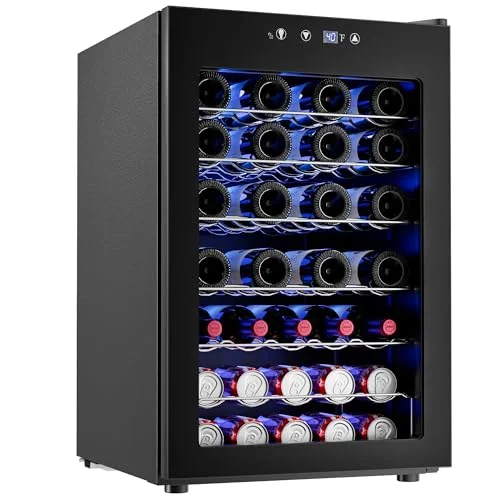
Icyglee 45 Bottle Wine Cooler
Where the front-row rule earns its keep
45 bottles·Freestanding·Black
Forty-five bottles is squarely the size where a dedicated front row pays off — enough capacity that "just eyeball it" stops working, but not so much that shelf-by-shelf zones blur together. Since it's freestanding, the clearance the manual specifies around the back and sides applies rather than a front-grille rule; leave that space clear of the boxes and spare racks an organizing project tends to generate.
The right size to practice the front-row split before a bigger collection makes it mandatory.
02Dual zone, wine & cans
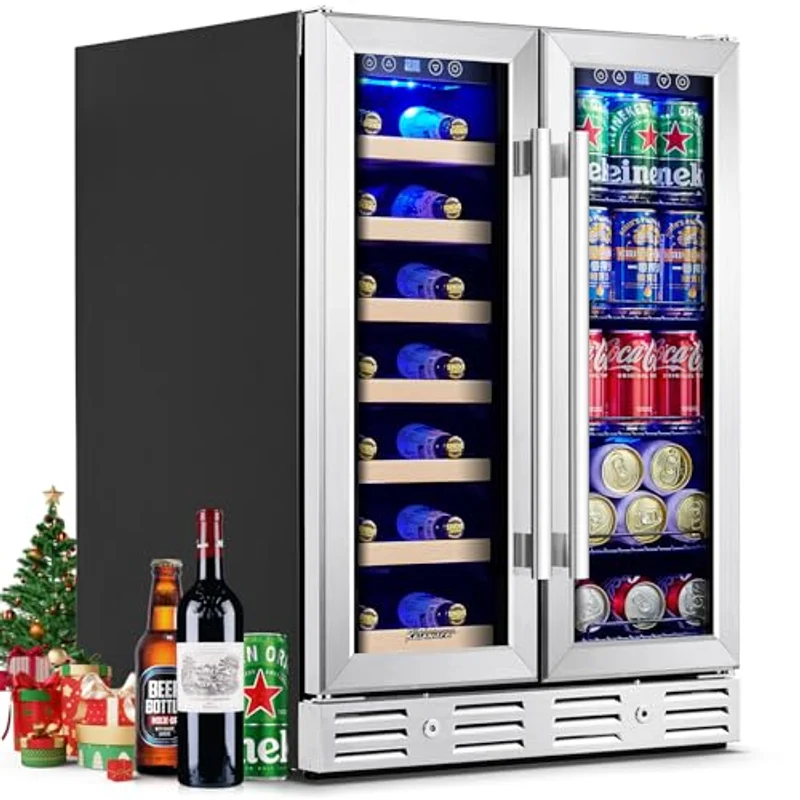
Kalamera 24" Wine & Beverage
Where the vent rule matters immediately, not eventually
20 bottles & 78 cans·24 inch·Dual zone
A real second thermostat makes the gradient question moot on the wine side, but it sharpens two other rules instead. Twenty bottle slots is a small enough wine side that the front-row split matters right away, with no room to let clutter build up first. And because it's built for either built-in or freestanding installation, if yours goes under a counter, getting the vent clearance right before you fill a single shelf matters more than usual — a blocked grille on a built-in unit is a quieter failure than on a freestanding one. For households solving the wine-versus-cans problem more broadly, our wine-and-beverage roundup covers the category.
Small wine capacity means the organizing rules aren't optional for long.
03Large single-zone collection
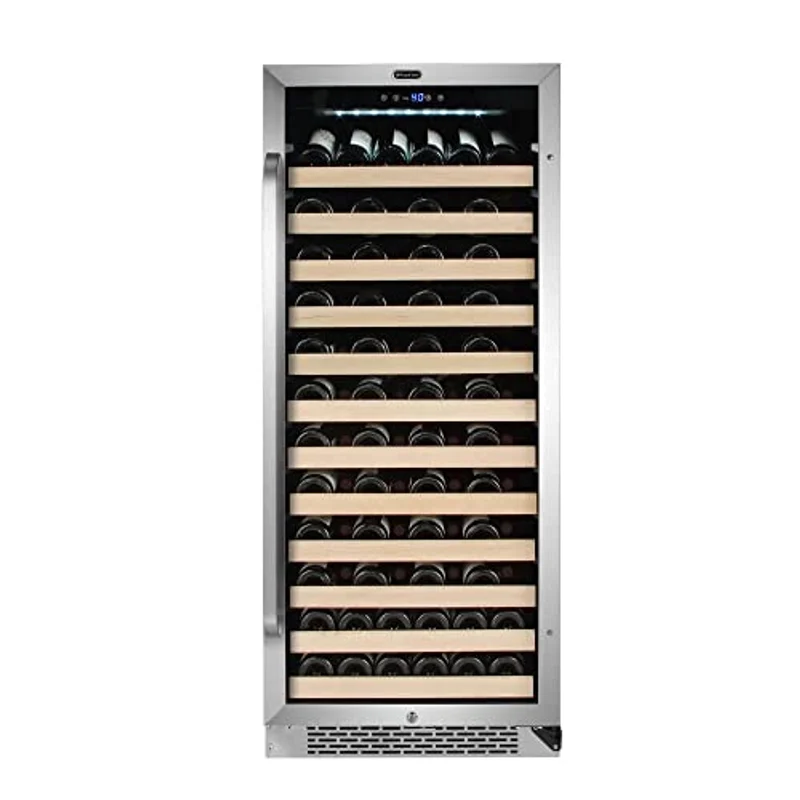
Whynter BWR-1002SD, 90-Bottle Configuration
Where every rule above stops being optional
90 bottles·Built-in or freestanding·Large capacity
At ninety bottles, the gradient is real across a cabinet this tall, the fat-bottle shelf has to be planned rather than improvised, and "eyeball the inventory" stops working well before bottle ninety. It's also the clearest case for the internal-vent caution above: a cabinet built to hold this many bottles depends on unobstructed airflow shelf to shelf even more than a smaller cabinet does. This is the scale where our large-capacity roundup and its organizing math become directly relevant rather than aspirational.
The size at which organizing stops being tidiness and starts being maintenance.
How we put this together
This guide is built from how compressor refrigeration behaves generally — heat rejection, airflow, thermal stratification — the same physics that governs any compressor appliance, plus the published capacity and installation specifications for the three products named above. Where a specification wasn't published for a given listing, we didn't guess at it, and you won't find a claim about it here.
We do not run a testing lab, and we have not physically organized or measured the temperature gradient inside these specific units ourselves. We do not publish invented scores, star ratings or review counts — the retailer API doesn't return that data for this category, and we don't fabricate what we can't source. What's in this guide is general, well-established behavior of compressor cooling and rack storage, applied honestly to real products with real published specifications.
Frequently asked questions
Does the top of my wine fridge really run warmer than the bottom?
In most single-zone cabinets, yes, by a few degrees, because warm air is lighter and rises inside the cabinet just as it would in a room. The gap is usually modest rather than dramatic, it narrows in units with fan-forced circulation, and it narrows further when the cabinet is fuller, since the bottles themselves resist temperature swings. A cheap stick-on thermometer on the top and bottom shelves for a week will tell you your own cabinet's actual spread.
Do I need a dual-zone fridge to keep whites and reds at the right temperature?
Not necessarily. A single-zone cabinet already has a rough gradient you can use — cooler at the bottom, closer to a white's serving window, and warmer at the top, closer to a red's. A dual-zone cabinet does the same job more precisely with a real second thermostat, which matters more if you want serving-ready wine of both colors on demand rather than a rough approximation.
How many bottles should I keep in the front row?
Size it to what you'll realistically drink in the next few weeks, not a whole shelf "just in case." A front row that cycles through regularly stays organized on its own; an oversized one just becomes a second area to sort through, which defeats the point of separating it from the rest of the cabinet in the first place.
Is a phone note really enough of an inventory system?
For most home collections, yes — a running list organized by shelf or zone rather than by individual bottle answers the two questions that matter day to day without the upkeep of a full catalog. A per-bottle log starts earning its keep once a collection grows into the hundreds of bottles and drinking windows genuinely need tracking.
Written by Ilane Tall. Research-based comparisons of published specifications, current prices and general compressor-refrigeration behavior — we do not physically test these units and we do not publish invented scores.