By Ilane Tall · Updated August 21, 2026 · Research-based.
Reader-supported: we may earn a commission when you buy through the links on this page, at no additional cost to you. It never changes which product we recommend. Prices quoted below were correct at the time of writing and move often.
The short version
A wine-and-beverage refrigerator is a different appliance from a two-wine-zone fridge: one side is racked for bottles at cellar temperature, the other is shelved for cans at drinking temperature. That split is real value for a household that actually drinks both from one cabinet — and it is a real cost in bottle count for anyone who does not.
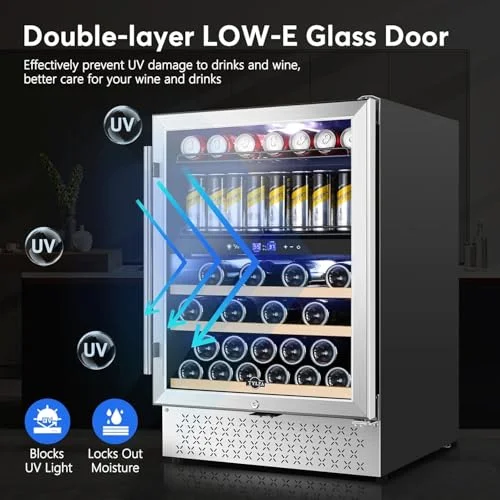
If you want one 24-inch appliance that genuinely does both jobs, the Tylza holds the most combined capacity in this set — 30 bottles and 100 cans — for the lowest price, $509.99.
If your household is close to wine-only, skip this whole category: a dedicated 24-inch wine fridge racks more bottles in the same footprint than any split cabinet can.
Check the Tylza's price on Amazon →
A wine-and-beverage fridge is not a two-wine-zone fridge
The two categories get confused constantly because they share a word — "dual zone" — and a similar-looking spec sheet. They are not the same appliance, and buying one expecting the other is the most common mistake in this corner of the category.
A dual-zone wine fridge splits its cabinet into two wine compartments: a serving zone for whites, usually around 45–50°F, and a storage zone for reds, around 55°F. Both halves are racked for bottles. Nothing in the cabinet is built to hold a can upright, and nothing runs cold enough to be a proper drinks fridge.
A wine-and-beverage refrigerator instead gives one side to wine, racked and held near cellar temperature, and the other side to cans and bottles of beer or soda, shelved rather than racked and held down near standard refrigerator temperature. It is, functionally, a wine fridge welded to a mini-fridge inside one shared cabinet with one shared compressor circuit. The two sides are not interchangeable: you cannot rack sixty cans where the wine racks are, and you cannot lay wine bottles flat on can shelving without them rolling.
Who this genuinely suits: a household that already owns, or was about to buy, both a small wine fridge and a small beverage fridge, and would rather have one 24-inch cutout under the counter than two. It is a space-and-plumbing-of-electricity decision as much as a wine decision. If you only ever wanted the wine side, this category adds cost and subtracts bottle capacity for no benefit. If you only ever wanted the can side, a plain beverage-only fridge is cheaper and holds more cans, because none of its interior is sacrificed to a wine rack.
The arithmetic: what the split costs you in bottles
This is the number that actually decides whether a wine-and-beverage unit is the right buy, and it rarely gets stated plainly.
A dedicated 24-inch single-zone wine refrigerator devotes its entire interior — typically somewhere in the 4.5 to 5.5 cubic foot range at this width — to wine racking, and commonly lands in the 45-to-50-bottle class for that footprint. The six wine-and-beverage units in this guide, which share the same 24-inch width, hold between 19 and 30 bottles on their wine side. That is roughly a third to a half of what an all-wine cabinet the same size would rack, because the rest of the interior went to can shelving instead.
So the honest framing is: you are not buying "a wine fridge with a bonus." You are buying a smaller wine fridge, in exchange for a beverage fridge sharing its footprint. That trade is worth it exactly when the can side genuinely earns its half of the cabinet — when cans and bottles were otherwise going to compete for space in your kitchen fridge, or when you were going to buy a second small appliance anyway. If your household barely drinks canned beverages, you have paid for capacity you will not use and given up bottle capacity you would have used. Our bottle-count sizing guide walks through how to size a wine-only cabinet if that turns out to be the better fit once you run this math for your own collection.
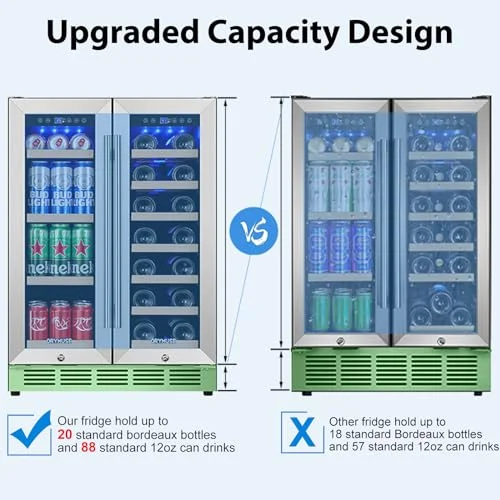
Within this set of six, the spread runs from the Tylza's 30 bottles down to 19 bottles on the ICEPURE and BODEGA. None of that is a defect — it is the direct, visible result of how much of each cabinet's interior was allocated to cans instead. A unit claiming 100 cans and 30 bottles gave meaningfully more of its interior to wine than a unit claiming 88 cans and 20 bottles; a unit claiming 58 cans and 19 bottles gave the least of all six to wine. Decide which ratio matches how you actually drink before you decide on price or finish.
Can capacity claims: what 12oz vs 16oz vs tall cans do to them
The can-count number on the box is calculated the same optimistic way bottle counts are: with the smallest, most stackable unit the shelving allows, arranged perfectly. For cans, that unit is almost always the standard 12oz slim or standard can. Switch what you actually put in the fridge and the real number moves.
- Standard 12oz cans (the shape most soda and domestic beer ships in) are what the advertised can count almost always assumes. Expect to get close to the stated figure if this is what you buy.
- 16oz cans — the common size for craft beer and many seltzers — are taller and often slightly wider. They take more vertical clearance per shelf, so a shelf that holds two rows of 12oz cans may only hold one and a half rows of 16oz cans. Plan on noticeably fewer than the box number if this is your default can size.
- Tall or "sleek" cans (some energy drinks, some sparkling water lines) are the most shelf-inefficient shape: narrow but tall, which wastes the vertical headroom a shelf was designed around for shorter cans and cuts effective capacity further.
None of the listings in this guide break out can capacity by size — they publish one number, and it is reasonable to assume that number describes standard 12oz cans stacked efficiently. If your household mostly drinks 16oz craft cans or tall seltzer cans, treat the advertised can count as an upper bound, the same way you would treat an advertised bottle count as an upper bound rather than a guarantee.
Temperature ranges: does each side reach its end
The two halves of a wine-and-beverage fridge are aiming at genuinely different numbers, and the gap between them is wider than the gap between the two zones of a dual-zone wine fridge.
Wine side
Wants to sit near 55°F — the standard long-term storage temperature for red, white and sparkling alike. This is a mild, cellar-like target, not a hard refrigeration target.
Can side
Wants to sit near 38°F — ordinary refrigerator-cold, the temperature a can needs to reach before it actually feels cold to drink.
That is a roughly 17-degree spread across one shared compressor circuit, which is a wider ask than the 10-to-15-degree spread a good dual-zone wine fridge manages between its two wine compartments. The same physics applies as in any split cabinet: one compressor is doing the cooling, and the divider, damper and secondary fan are managing how much of that cold air the warmer side is allowed to keep out. None of the six listings in this guide publish the achievable range for each side separately — they describe the feature ("dual zone," "wine and beverage") without stating how cold the can side actually gets or how far up the wine side can be held. Before you buy, check the current listing or the manufacturer's spec sheet for the two ranges individually, the same way we recommend checking per-zone ranges on any dual-zone wine fridge rather than trusting one headline number for the whole cabinet.
The practical risk sits on the can side more than the wine side. A wine compartment that runs a few degrees warmer than ideal is a mild inconvenience — wine tolerates 50–60°F reasonably well as long as it is stable. A can compartment that only reaches the mid-40s instead of the high 30s is a much more noticeable letdown, because "cold enough" for a canned drink has a narrower tolerance than "cold enough" for a bottle of red. If the can side is the half of the purchase you actually care about, that is the spec worth pressing a seller on before you buy, not after. It is also worth knowing that ambient room temperature squeezes both ends of the range the same way it squeezes any compressor fridge — our thermoelectric vs compressor guide covers why compressor cooling, which every unit in this roundup uses, is the only realistic choice for a cabinet trying to hit two different targets at once. If a unit you already own is not reaching either target, our not-cooling checklist is the faster read than assuming it needs replacing.
Built-in capability and the 24-inch opening
Twenty-four inches is the standard wide under-counter cutout in a US kitchen, one size class up from the 15-inch opening that fits a single narrow wine column. That extra width is precisely what makes the wine-and-beverage format possible at all: a 15-inch cabinet is too narrow to split usefully into a wine side and a can side, which is why nearly every combination unit on the market, including all six here, is built on the 24-inch footprint. If you are working with a narrower opening instead, our 15-inch undercounter guide covers the front-venting units that actually fit that space.
Whether a unit can be built in at all comes down to one detail: does it vent through the front, or does it rely on airflow around the back and sides? A front-venting cabinet can be enclosed in cabinetry because its heat exhausts out the front grille, back into the room. A rear-venting cabinet needs open air behind and beside it to reject heat, and sealing one into a cabinet run traps that heat, forces the compressor to run continuously, and shortens its life. Four of the six units here — the Tylza, ORYMUSE, ICEPURE and BODEGA — are described by their listings as built-in or freestanding, meaning the manufacturer rates them for either installation. The Kalamera's listing in this set does not state an installation type, and the EUHOMY's listing states only that it is a 24-inch dual-zone unit with no installation detail given at all. Confirm built-in clearance and venting directly on the current listing before you cut a hole in a cabinet for either of those two.
How the six compare
Capacity figures are each manufacturer's own. Prices were correct at the time of writing and move often — confirm the current price on Amazon before buying.
| Model | Best for | Bottles | Cans | Installation | Price | Get it |
|---|
 Tylza 24" Wine and Beverage Tylza 24" Wine and Beverage |
Best overall |
30 |
100 |
Built-in or freestanding |
$509.99 |
Get it |
 ORYMUSE 24" French Door ORYMUSE 24" French Door |
Best doors and airflow |
20 |
88 |
Built-in or freestanding |
$599.99 |
Get it |
 Kalamera 24" Wine & Beverage Kalamera 24" Wine & Beverage |
Best if you also want wine-only later |
21 |
75 |
Not stated — confirm before building in |
$526.46 |
Get it |
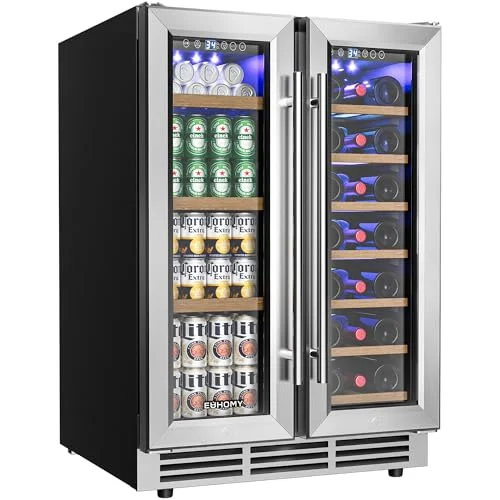 EUHOMY 24" Dual Zone EUHOMY 24" Dual Zone |
Alternative at the same price point |
Not stated |
Not stated |
Not stated — confirm before building in |
$638.26 |
Get it |
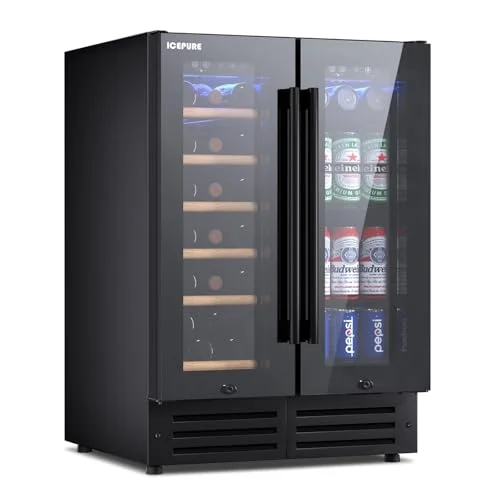 ICEPURE 24" Lockable ICEPURE 24" Lockable |
Best lockable |
19 |
58 |
Built-in or freestanding |
$699.99 |
Get it |
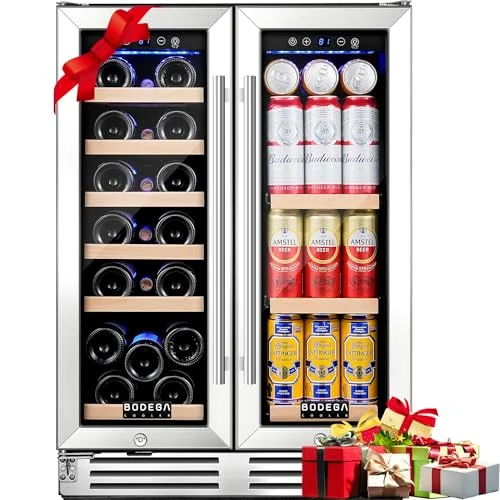 BODEGA 24" Bar Cooler BODEGA 24" Bar Cooler |
Best for a home-bar look |
19 |
57 |
Built-in or freestanding |
$659.99 |
Get it |
Our picks, and who each one is for
All six share the 24-inch width, dual-zone construction and compressor cooling. What separates them is the bottle-to-can ratio, the door hardware, and how clearly the listing states what you're actually getting.
The one situation where you should buy two separate appliances instead
There is exactly one scenario where a combination unit is the wrong answer even though it looks like the tidy solution: when your wine collection is already past 40 or 50 bottles, or is clearly heading there. At that size, none of the six units here comes close — the largest wine side in this set is 30 bottles, and that's before you've allocated any of it to cans. A cellar-sized collection needs a dedicated wine fridge sized for it, full stop; splitting a cabinet with cans at that scale just means running out of wine racking while half the fridge sits full of soda you could have kept in the kitchen refrigerator instead.
The same logic applies in reverse if canned drinks are the real daily habit and wine is occasional: a plain beverage refrigerator holds far more cans for less money than any of these six, because none of its interior is set aside for bottles you rarely reach for. Two single-purpose appliances also each run their compressor against one target temperature instead of two, which is mechanically the simpler job.
Where two separate appliances lose is space and cost: two 15-to-24-inch cutouts (or a cutout plus a countertop spot) instead of one, and two compressors to buy and eventually replace instead of one. If your kitchen has the room and the budget, and your wine and can needs are each substantial enough to want a dedicated appliance, that is the cleaner long-term answer. If you're working with one opening and want both jobs handled adequately rather than optimally, a wine-and-beverage unit like the six above is the correct trade. Our honest take on whether a wine fridge is worth it at all is a useful gut check before adding a second appliance to either plan, and if budget rather than space is the constraint, our small wine fridges under $200 guide covers where a wine-only unit's compromises land at the low end.
How we compared these — and what we can't tell you
We compared the published specifications and current Amazon prices for wine-and-beverage refrigerators listed in the 24-inch class in the US, cross-checking each listing's title against its size and variant details for bottle count, can count and installation type. Where a listing gave us a number, we used it. Where a listing didn't — the EUHOMY's capacity, the Kalamera's installation rating in this specific listing — we said so rather than filling the gap with a plausible guess.
We do not run a testing lab. We do not own these six units, we have not installed them, and we have not measured how cold either compartment actually gets in a real kitchen over a real summer. You will not find a star rating or a review count on this page: the retailer data available to us does not return them for this category, and we do not publish numbers we cannot source. What we can do honestly is read the specifications carefully, do the bottle-and-can arithmetic the listings don't spell out, and tell you plainly where a spec sheet leaves a real question unanswered.
Prices quoted here were correct at the time of writing and change frequently. Confirm the current price on Amazon before buying.
Frequently asked questions
Is a wine-and-beverage refrigerator the same as a dual-zone wine fridge?
No. A dual-zone wine fridge splits its cabinet into two wine compartments — a serving zone for whites and a storage zone for reds, both racked for bottles. A wine-and-beverage refrigerator splits its cabinet between a wine side and a can side, with the can side shelved for cans and held near ordinary refrigerator temperature rather than wine-serving temperature. They share the phrase "dual zone" in marketing copy, but they solve different problems.
Will the can side actually reach 38°F?
It should get close, but none of the six listings in this guide publish the achievable range for each side separately, so we can't confirm an exact number for any specific unit here. Because one compressor circuit is cooling both a roughly 55°F wine side and a roughly 38°F can side at once, the can side's true low end is the spec worth confirming directly with the seller before you buy, especially if the appliance will sit somewhere warm.
How many bottles do I lose by choosing a combo unit instead of an all-wine fridge?
Roughly half to two-thirds of what a same-width all-wine unit would hold. A dedicated 24-inch wine-only fridge commonly racks somewhere in the 45-to-50-bottle range, while the six wine-and-beverage units here hold between 19 and 30 bottles on their wine side — the rest of each cabinet's interior went to can shelving instead.
Can I use 16oz or tall cans instead of standard 12oz cans?
Physically, usually yes, but expect fewer than the advertised can count. Manufacturers calculate can capacity using standard 12oz cans stacked as efficiently as the shelving allows. Taller 16oz cans and narrow "sleek" or tall cans use shelf space less efficiently, so treat the box number as a ceiling for 12oz cans, not a guarantee for any can shape you happen to buy.
Written by Ilane Tall. Research-based comparisons of published specifications, current prices and manufacturer listings — we do not physically test these units and we do not publish invented scores.