By Ilane Tall · Updated September 20, 2026 · Research-based.
Reader-supported: we may earn a commission when you buy through the links on this page, at no additional cost to you. It never changes which product we recommend. Prices quoted below were correct at the time of writing and move often.
The short version
A UV-resistant glass door blocks a portion of the ultraviolet band from reaching the bottles behind it. It does nothing for the room's heat, and very little for the visible light that also degrades wine. Of the five cabinets in this guide, only one — the ICEVIVAL 15 Inch — states a UV-resistant glass door on its own listing. A claim a manufacturer doesn't make is not a claim you should assume.
Placement still does most of the work. A UV-rated door in a west-facing kitchen window gets hours of direct sun a door in an interior hallway never sees — more on that below. If you only read one more section, read reading the claim honestly, then jump to the picks.
Why light, not heat, is the wine fridge's most overlooked failure point
Most people shopping for a wine fridge focus on the number that's easiest to picture: the temperature. All of that matters, and none of it is what actually damages a bottle sitting in a glass-doored cabinet in a bright room.
The mechanism is called lightstrike, and it's a photochemical reaction, not a thermal one. Wine contains riboflavin, which absorbs light — most efficiently in the ultraviolet band, but also across the blue end of the visible spectrum — and that absorbed energy triggers a breakdown of sulfur-containing amino acids into compounds that read to a nose as burnt rubber, wet cardboard or cooked cabbage. Unlike heat damage, which accumulates slowly over months of poor storage, lightstrike can produce a detectable change within days of strong, direct exposure. It is fast, largely irreversible once it happens, and invisible until you pour the glass.
This is exactly the failure mode a display-style glass-door wine fridge is built to invite. The entire premise of a glass door is that you can see the bottles without opening it — which means they're sitting behind a pane, not an opaque wall. Put that cabinet within reach of a window, a skylight, or a bright ceiling fixture that runs most of the day, and you've built a display case for the exact energy that damages what's on display.
Bottle glass is the first layer of defense — brown and dark green glass block far more light than clear glass — but a lot of wine ships in lightly tinted or clear glass, especially whites, rosés and sparkling, which are also the styles most sensitive to riboflavin-driven off-notes. That's the case for taking the door glass seriously as a second layer, rather than assuming the bottle alone carries the job.
What "blocks 90% of UV" means on a spec sheet, and what it does not cover
Ultraviolet light sits roughly in the 100–400 nanometer band, just past the violet end of what the eye can see. A coating, tint or laminate layer built into a wine-fridge door glass to filter that band is what a "UV-resistant" or "UV-protected" claim describes — usually a film applied to or embedded in the pane, sometimes paired with a tinted outer layer.
Here is what that claim does not tell you. It says nothing about heat: a UV filter is an optical property of the glass, unrelated to insulation, and a UV-resistant single pane can transfer just as much room heat as a clear one. It says nothing about visible light — specifically the blue-violet range just above 400nm, also implicated in riboflavin-driven lightstrike — so a door that blocks most UV can still pass most of the visible spectrum straight through. And it's a spec measured on the glass in isolation, not on the finished cabinet with its door seals, hinges, and any gap where light finds its way around the pane rather than through it.
One more limit worth being explicit about: none of the five products in this guide publish an actual UV-blocking percentage. Only the word "UV-Resistant" appears, on one listing. A figure like "blocks 90% of UV" is a real claim you'll see elsewhere in the market, but treat any specific percentage as something to confirm with the seller for the exact model, not something to assume just because a door is described as UV-resistant.
Tinted double-pane glass vs. a single clear pane: the display trade every buyer makes
Across the wine-fridge category generally, the glass door comes in two broad flavors, and each one is a deliberate trade rather than a strictly better or worse option.
Single clear pane
Best label visibility — you can read what's inside from across the room without opening the door. Passes the most light of any door type, UV and visible alike, which is exactly the tradeoff for that visibility.
Tinted double-pane
An air gap between two panes, primarily there to reduce condensation and slow heat transfer, often finished with a tinted or smoked outer layer that incidentally cuts a meaningful share of visible light along with it.
The tinted double-pane build is generally the more protective option for a cabinet that has to live somewhere bright, because the tint sits in the light's path regardless of whether the marketing calls out a UV percentage. The cost is the thing the door exists to provide in the first place — you lose some of the "see the label from the couch" appeal that makes a glass door worth building into a kitchen or bar. A single clear pane is the opposite trade: the best display case, and the one that needs the most help from placement.
This is exactly where the honesty gap in this category shows up. Of the five cabinets in this guide, only the ICEVIVAL 15 Inch states anything about the door's light-filtering performance. The 15 Inch Under Counter model describes a "Stainless Steel Glass Door" — a note about the frame and trim material, not a claim about tint or UV filtering. The remaining three listings say nothing about the glass at all. That's not necessarily bad news about those cabinets — plenty of double-pane doors exist without the manufacturer marketing the fact — but don't read "wine fridge with a glass door" as a proxy for "wine fridge that filters light." Ask, or check the listing photos and Q&A, before assuming either way.
A UV door does not cancel out a sunny kitchen window — placement still does most of the work
Run the numbers on exposure and the placement decision stops being a nice-to-have and becomes the dominant variable. A cabinet standing in direct afternoon sun for even two or three hours a day absorbs an amount of light energy — UV and visible combined — that dwarfs what an interior wall position receives from ambient room lighting over the same stretch. A UV-resistant door cuts a portion of one band within that exposure; it does not turn a sun-drenched spot into a shaded one. A fridge that blocks a meaningful share of UV, sitting three feet from a west-facing window that gets direct afternoon sun, is still taking on far more total light than a fridge with an entirely clear, unprotected door tucked against an interior wall. The spec sheet doesn't know where your kitchen faces. You do.
The practical rule: pick the location first, the glass spec second. An interior wall or a shaded corner does more for the wine than any door coating can undo on its own. If the only spot available is genuinely bright, that's when paying up for the one door here that actually states UV resistance — the ICEVIVAL — earns its premium.
Light and heat compound each other near a window: more sun usually means more solar heat gain too, a separate load on the compressor. For a genuinely hot or exposed spot — a garage, a sunroom, an uninsulated bar nook — our guide to wine fridges for a garage or outdoor bar covers the heat version of this same argument.
Reading the claim honestly: no lab numbers, just what the glass construction implies
We don't run a testing lab, and nobody selling a wine fridge on Amazon has sent us a spectrophotometer reading for the door glass. What we have is what the listing states, general facts about how UV filtering and glass construction work, and no measured percentage for any specific cabinet here. Given that, this is the honest checklist we'd use before buying for light protection specifically:
- Does the listing explicitly say UV-resistant or UV-protected? If yes, that's a real claim, even without a lab number behind it. If no, don't assume it anyway — treat the door as standard clear glass until confirmed otherwise.
- Does it mention tint, smoke, double-pane, or laminate? Those are construction details that plausibly cut light exposure even when the listing never uses the word "UV."
- If the listing says nothing about the glass, ask before buying. A message to the seller or the listing's Q&A beats guessing.
- Confirm the cabinet's final location before the door spec matters much. Placement swamps the difference between a UV-filtering door and a plain one in anything but a genuinely bright spot.
None of that is a knock on the products that don't advertise a UV claim — a listing's silence on a spec is common across this whole category. It's a reason to read titles literally rather than fill gaps with what sounds plausible, the same standard we hold ourselves to when writing about them.
The picks, across a real price ladder
Five cabinets, ordered by price, spanning a compact 12-inch entry unit to a 24-inch dual-zone cabinet built for a real collection. Only one states a UV-resistant door outright; the notes below are honest about which is which.
01Best budget, glass unspecified
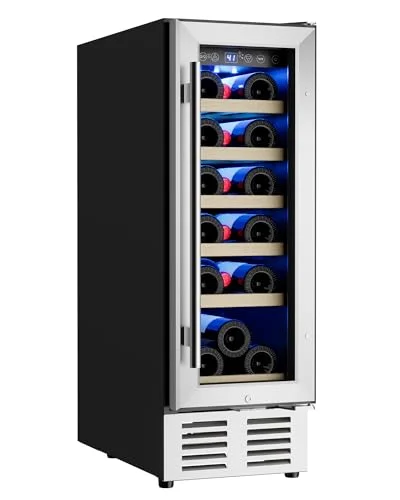
Icyglee 12" Wine Cooler, 18 Bottle
The cheapest way in — buy it for the price, not for a light claim it doesn't make
18 bottles·12 inch·Built-in & freestanding·Silver
Eighteen bottles in a compact 12-inch footprint that installs built-in or freestanding — unusual flexibility at this price. The listing says nothing about the glass door's construction, so treat it as a standard clear pane and let placement — an interior wall, out of direct sun — do the light-protection work this cabinet's spec sheet doesn't promise.
Buy this for the capacity and the price. Don't buy it expecting a light-filtering door it never claims to have.
02Best labeled UV-resistant glass
ICEVIVAL 15 Inch Wine Cooler Refrigerator
The one cabinet here whose own listing actually states UV-resistant glass
29 bottles·15 Inch – Dual Zone·UV-Resistant Glass Door·Built-in or freestanding
This is the pick if the UV-door claim is specifically why you're here. ICEVIVAL states a UV-resistant glass door directly on the listing, alongside dual-zone compressor cooling, quiet operation, digital control, and a 15-inch built-in-or-freestanding footprint. It's the only cabinet in this guide making that claim — but remember what it does and doesn't cover: the UV band, not heat, not necessarily the full visible spectrum. Pair it with sensible placement rather than treating the door as a reason to put it in a sunroom.
Buy this one specifically for the stated claim — and still keep it out of direct sun.
03Best stainless-framed glass, under counter
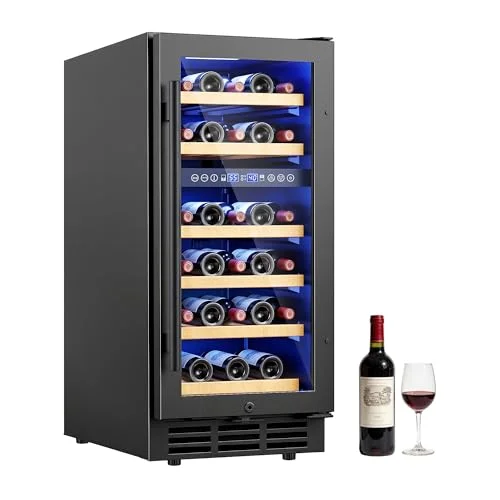
15 Inch Wine Cooler Under Counter, 30 Bottle Dual Zone
A stainless steel glass door — a fit-and-finish spec, not a light-blocking one
30 bottles / 3.1 cu.ft·15 Inch – Dual Zone·Stainless Steel Glass Door·Built-in or freestanding
The listing calls out a "Stainless Steel Glass Door," which tells you about the frame and trim — the door reads as a built-in appliance rather than a plastic-edged box — not about tint or UV filtering. Thirty bottles across two zones in 3.1 cubic feet with digital control, installing under a counter or freestanding. Worth choosing for the fit and dual-zone flexibility; don't read "stainless steel glass door" as a stand-in for "UV-protected glass door" — they aren't the same claim.
A good under-counter cabinet. The steel is about the frame, not the light coming through the pane.
04Best dual-zone, glass unspecified
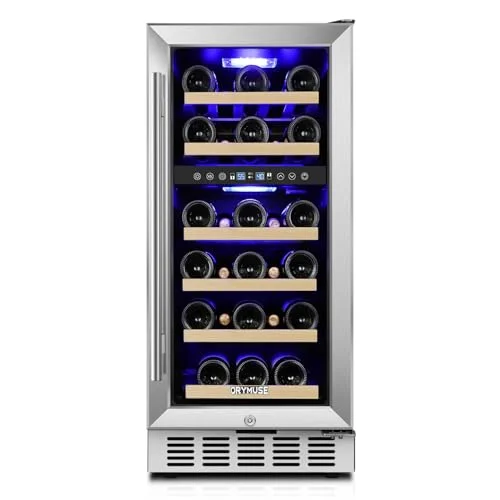
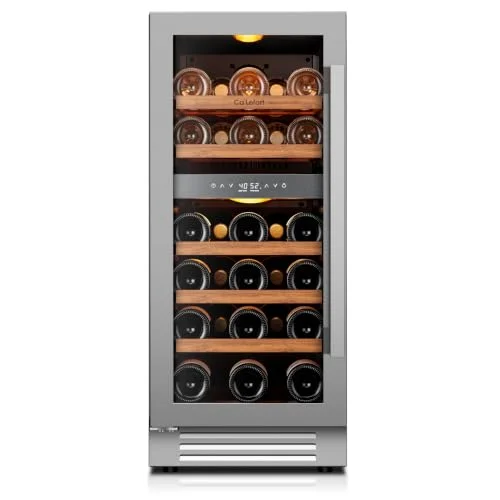
Ca'Lefort 15 Inch Dual Zone Wine Fridge, 28 Bottle
Ask before assuming — the listing doesn't describe the glass at all
28 bottles·15 Inch – Dual Zone·Built-in
Twenty-eight bottles across two zones in the standard 15-inch built-in width, and a straightforward dual-zone spec — but the title says nothing about the door glass whatsoever, no tint, no pane count, no UV language. That's where our checklist applies most directly: if light exposure matters, check the listing's photos and Q&A or message the seller, rather than assuming a "wine fridge" glass door is automatically filtering anything.
A solid dual-zone spec. The glass is simply an open question until you ask it.
05Best for a larger collection
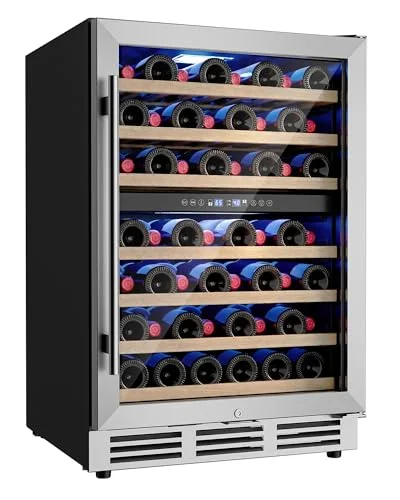
Icyglee 24" Wine Cooler Refrigerator, 54 Bottle
The move once you're past a starter rack and into a real dual-zone collection
54 bottles·24 inch·Dual Zone·Silver
Same brand as our budget pick, and the same gap: the title says nothing about glass tint or UV filtering. What it does specify is real capacity — 54 bottles across two zones in a 24-inch cabinet, the width where a wine fridge stops being a countertop appliance and starts being kitchen furniture. At this size more bottles sit exposed to whatever light the room provides, which makes placement even more important. Give it an interior wall or a shaded run of cabinetry, not a sunny end of the kitchen.
The bigger the collection behind the glass, the more placement is doing the protecting.
If light protection is the priority, buy in this order
If the cabinet is going somewhere genuinely bright, start with the ICEVIVAL, the only pick here with a stated UV-resistant door — and still keep it out of direct sun rather than treating the label as a free pass. If the spot is interior or shaded, the glass claim matters far less, and the other four cabinets compete on capacity, zones and price instead: the Icyglee 12" (budget), the stainless-framed under-counter unit (built-in fit), the Ca'Lefort (dual zone, mid-size), and the Icyglee 24" (largest collection).
Red wines also carry more tannin and phenolic compounds that partly buffer against light-driven off-flavors than delicate whites and sparkling, one more reason placement matters more for some cellars than others. If your collection leans red, see our guide to wine fridges for red wine; if it leans toward whites and sparkling, how long wine actually lasts in a wine fridge covers the storage-life side.
How we compared — and what we can't tell you
What we did
Listings, construction logic and domain facts
We compared the published titles and specifications for each cabinet, current Amazon prices, and well-documented facts about UV light, lightstrike and glass construction that apply to the category as a whole. Where a listing states a claim about the door — UV-resistant, stainless steel glass — we reported exactly that claim and no more.
What we didn't
We don't run a testing lab
We do not physically test these cabinets, we do not own a spectrophotometer, and we have no measured UV-transmission percentage for any door in this guide. We do not publish invented scores, star ratings or review counts, because the retailer data available to us doesn't include them for this set. What we can do is read the listings literally and tell you honestly where the information runs out.
Prices quoted here were correct at the time of writing and change frequently. Confirm the current price and, if light protection matters, the door's construction directly on the listing before buying. For running-cost math on a cabinet that will sit somewhere warm, see what a wine fridge costs to run per year.
Frequently asked questions
What does "UV-resistant glass door" actually mean on a wine fridge?
It means the door glass includes a coating, tint or laminate layer that filters out a portion of the ultraviolet band, roughly 100–400 nanometers, before it reaches the bottles. It's a real claim when a listing states it — the ICEVIVAL 15 Inch in this guide is the one that does — but it's specifically about UV, not about heat or the full visible-light spectrum.
Does UV-protected glass block heat too?
No. UV filtering is an optical property of the glass, unrelated to insulation. A UV-resistant single pane can transfer just as much heat from a warm room into the cabinet as an unprotected one. Heat load is a separate specification to check, not something a UV claim covers.
Is a wine fridge with a clear glass door safe near a sunny window?
Not ideally, even if the door is UV-resistant. Direct sun for hours a day delivers far more total light energy than a UV filter alone offsets. Placement away from direct window light does more for the wine than the door spec does on its own.
Do I need a UV-protected door if my wine fridge isn't near sunlight?
It matters much less. In an interior spot away from windows and skylights, ambient room lighting is a far smaller light dose than direct sun, and a standard clear-glass door there is a reasonable choice. The UV claim earns its price specifically in bright rooms.
Written by Ilane Tall. Research-based comparisons of published specifications, current prices and general category facts — we do not physically test these units and we do not publish invented scores.