By Ilane Tall · Updated September 14, 2026 · Research-based.
Reader-supported: we may earn a commission when you buy through the links on this page, at no additional cost to you. It never changes which product we recommend. Prices quoted below were correct at the time of writing and move often.
The short version
A lock on a wine fridge is inventory control, not a safe. It stops a roommate, a kid, a coworker or a cleaning crew from casually opening the door — it will not stop someone who is determined to get in, and it will not stop the whole unit from being unplugged or carried off.
Every product on this page ships with a lock built into the door by the manufacturer. Buy one of these rather than trying to add a lock to a fridge that was not built for one — see why retrofitting usually fails.
Where you put it matters almost as much as whether it has a lock at all. More on placement below.
Why a lock is a real requirement, not a gimmick
Most people who search for a "wine fridge with a lock" are not worried about a break-in. They are worried about the people who already have a key to the front door: a teenager who has figured out where the good bottles live, a roommate who treats shared appliances as shared inventory, a coworker who wanders through the break room, or a cleaning service that comes through a rental between guests. In every one of those cases, the wine fridge is usually the single most expensive, most easily identifiable thing in the room to help themselves to — a case of wine holds more resale and replacement value than almost anything else sitting in a kitchen or a common area, and unlike a locked liquor cabinet, an unlocked glass-door cooler advertises exactly what is inside.
That is the actual case for a lock. It is not there to defeat a thief who has broken into the house — a determined intruder has bigger options than a wine fridge. It is there for the much more common situation where the people with legitimate access to the space are not the people who should have access to the fridge. An office that keeps a wine cooler for client visits and events needs it locked between events, or it becomes a self-serve bar for anyone who works there. A landlord who furnishes a wine fridge in a short-term rental needs it locked, or it gets emptied by a guest on night one. A family with a teenager needs it locked for reasons that need no further explanation.
The good news is that a lock is a cheap feature for a manufacturer to include, and it shows up across price points rather than only on premium units — three of the five cabinets below cost under $260. The comparison worth making before you buy is not "locking versus not locking," since a fridge without a lock cannot be meaningfully secured after the fact (see retrofitting below). It is choosing among the units that actually ship with one, on capacity, cooling and where it needs to sit.
Key locks versus digital, and which fails
Wine fridge locks come in two families. A key lock is a small cylinder cam lock set into the door frame — the same mechanism used on filing cabinets and mailboxes, turned with a flat metal key that usually ships taped inside the box. It is cheap to manufacture, has no battery to die, and works during a power cut. A digital lock is a keypad or electronic latch, more common on premium built-in units than on the compact freestanding and countertop coolers most people buy, and it trades the lost-key problem for a dead-battery problem and, on some designs, a reliance on the unit staying powered to stay locked.
Key lock
Cheap, mechanical, works with no power. Fails when the key goes missing, gets copied, or ends up hanging on the same hook as the fridge — which defeats it as surely as having no lock at all.
Digital lock
No key to lose or copy, and a code is easier to change than a lock cylinder. Fails when the battery dies or the keypad wears out, and depends on the manufacturer's own design for what happens to the latch when power drops.
None of the five listings below advertise a digital keypad — they specify a lock without naming the mechanism, which is the standard shorthand for the mechanical cam lock that ships on the overwhelming majority of compact and mid-size wine coolers in this price range. Treat each of these as a key lock unless the product listing states otherwise at the time you buy, and do not assume a digital pad is included just because the unit has a digital temperature display; digital cooling controls and a digital door lock are two different features that get sold separately.
The practical failure mode is the same for both types, and it has nothing to do with the mechanism: the lock is only as good as where the key or the code lives. A key lock defeats a five-year-old. It does not defeat a roommate who watched you put the spare key in the utensil drawer. Whichever type you buy, the lock is doing its job only if the person it is meant to stop does not also have access to what opens it.
What a lock does not protect against
A wine fridge lock is a thin cam mechanism set into sheet metal and a glass door — it is built to deter casual opening, not to resist force. It is worth being honest about what it will not do, because the marketing on these listings tends to stop at the word "lock" and let the buyer assume more than that word promises.
It will not stop the fridge from being unplugged. Every model here is a standalone freestanding or countertop appliance, not something wired into the wall — anyone who wants the contents without the trouble of the lock can simply carry the entire unit somewhere private, or unplug it and wait. A locked door protects the bottles from someone standing in front of the cabinet; it does nothing once the whole appliance is portable.
It will not resist deliberate force. A cam lock is designed to stop a door from swinging open, not to survive a pry bar or even a firm tug on a warped hinge. If real security against a determined person is the goal, the correct tool is a locked room or a bolted-down cabinet, not a $250 countertop wine cooler.
It will not stop someone who has a matching key. Cam locks of this type are manufactured in a limited number of keying patterns, shared across many products from the same factory — the same practical reality as motel room keys or cheap luggage locks. It is a low-probability risk for a home, but a real one for a shared office that has bought several units of the same model over the years.
And it will not compensate for where the fridge sits. A locked unit in the middle of a shared kitchen still shows everyone exactly what is inside through the glass door, and still invites someone to try the door out of curiosity before they try anything else. The lock is the last layer, not the only one — placement does more of the actual work, which is the next question worth answering.
Placement in a shared space
Where the fridge goes decides how much the lock actually has to do. A locked cabinet sitting in the open, at eye level, in the busiest room in the house or office, gets tried far more often than the same cabinet tucked into a corner nobody passes on the way to anything else. The goal is not concealment — a glass-door wine fridge is not a subtle object — but reducing the number of casual, low-stakes opportunities to try the handle.
For a shared house, a bedroom, a home office, or any room with a door that closes and locks separately from the fridge is the better spot than a communal kitchen or living room, even though the kitchen is where wine fridges conventionally live. If the cabinet has to be in a common area, keep it away from the main traffic path and out of arm's reach of wherever people already gather to eat or drink, which in practice rules out kitchen islands and the spot next to the regular beer fridge.
For an office, the calculation is different: the fridge is usually meant to be seen, since it signals hospitality to clients, but it should still not be the first thing inside the front door of an open-plan space where anyone can reach it unsupervised. A countertop unit on a credenza in a manager's office or a locked conference room solves this better than a floor unit in a break room that dozens of people pass every day — which is also why the amount of noise a compressor unit makes is worth checking before it goes somewhere quiet, lock aside.
For a rental, treat the fridge the way you would treat any furnished appliance a guest has no personal stake in protecting: locked, and positioned somewhere a departing guest cannot simply carry it to a car unnoticed, which for a freestanding unit under 30 pounds is a real consideration and not a theoretical one. A countertop cube, being smaller and lighter, is actually the higher-risk form factor for portability even though it is the easiest to fit into a rental kitchen — weigh that trade-off against how much you are storing in it.
One placement rule applies regardless of the lock: a freestanding compressor unit still needs clear air at the back and sides to reject its heat, the same requirement covered in our wine fridge versus kitchen fridge comparison. A locked fridge shoved into a closet with the door sealed shut protects the wine from people and ruins it with heat at the same time — do not solve the access problem by creating a ventilation problem.
The picks
All five of these ship with a lock as a standard feature of the listing, not an accessory or an aftermarket add-on. They span from an 11-inch mini for a desk or a closet shelf to a 33-bottle dual-zone cabinet sized for a shared household that actually wants to store, not just chill, a collection.
01Best overall
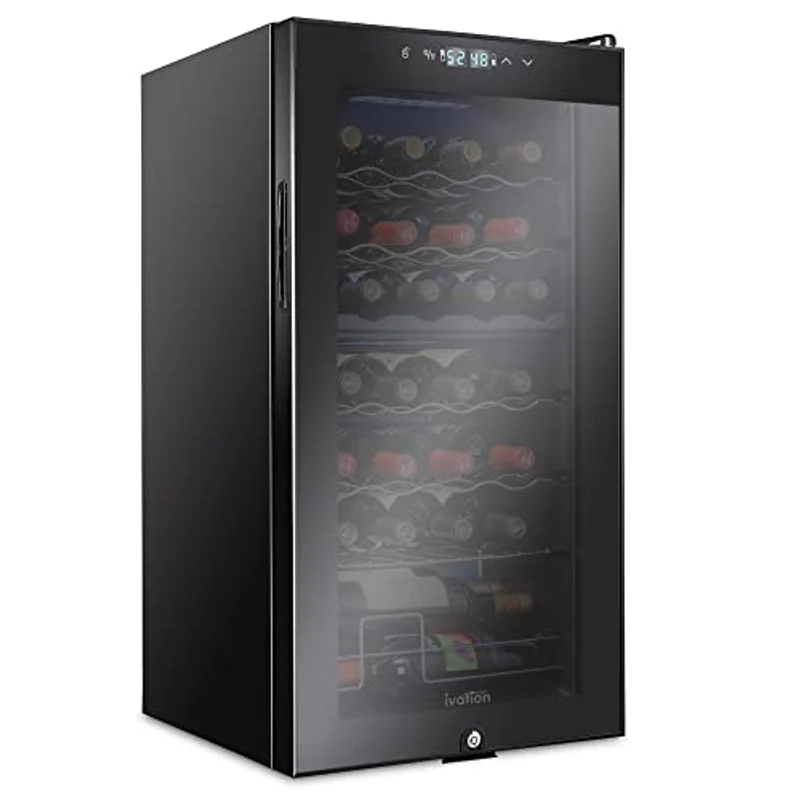
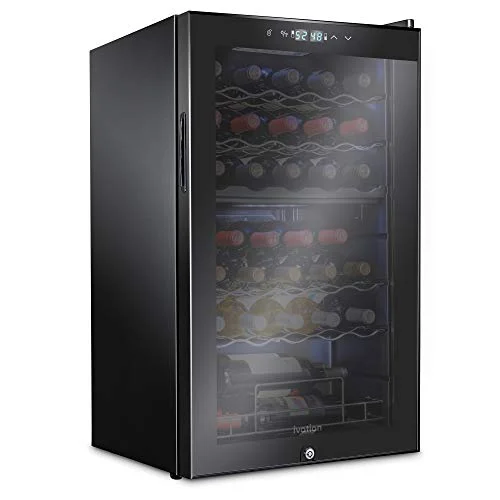
Ivation 28 Bottle Dual Zone
Best overall for a shared house
28 bottles·Dual zone·Compressor·41–64°F digital control
The largest locking cabinet on this list, and the only one with two independently controlled zones — useful in a shared house where more than one person's bottles end up in the same fridge at different serving temperatures. It is freestanding compressor cooling with a glass door and a digital temperature display, which means it holds its setpoint regardless of what the room is doing. At 28 bottles it is sized for a household collection rather than a handful of everyday bottles, which is exactly the scenario where locking the door starts to matter.
If more than one person has a key to the house, this is the size worth locking.
02Best countertop
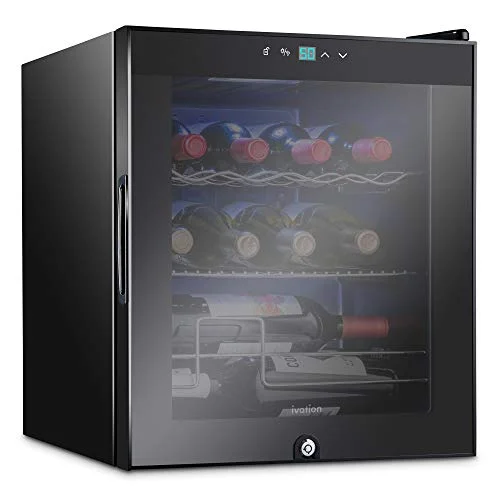
Ivation 12 Bottle Countertop Cube
Best for a desk, credenza or office counter
12 bottles·Cube·Compressor·Countertop
A cube-format countertop cooler with a locking door, built to sit on a surface rather than the floor — the right shape for a manager's office, a credenza, or any spot where a floor-standing unit does not fit the room. Compressor cooling means it is not limited by how warm the office gets, unlike a thermoelectric mini fridge. Because a countertop unit is lighter and easier to move than a full-size freestanding cabinet, position matters more here than on any other pick — see placement in a shared space above.
The lock matters most on a unit small enough that someone could just pick it up.
03Best budget
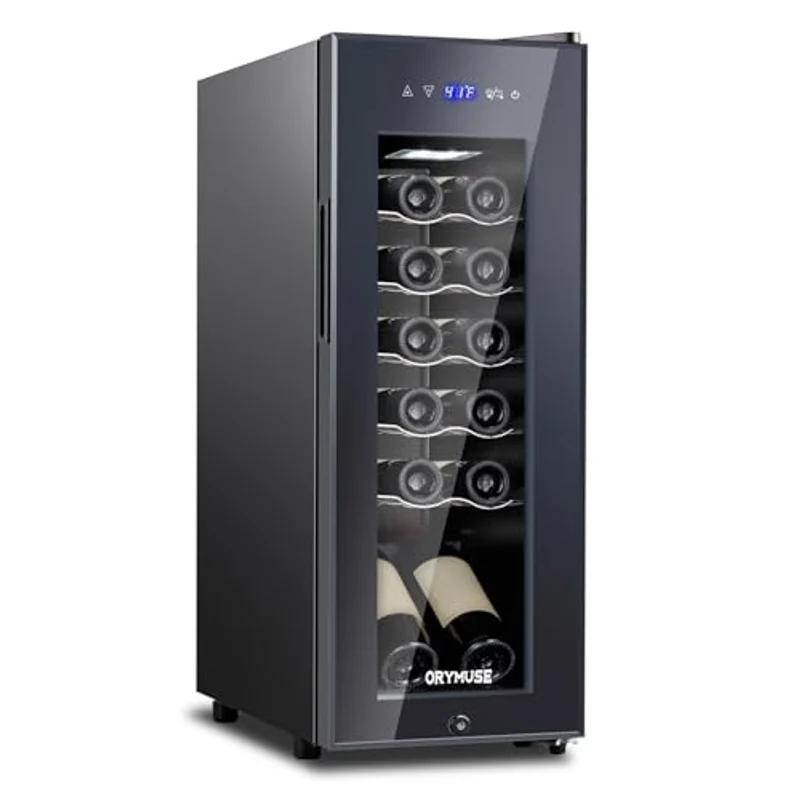
ORYMUSE 12 Bottle Mini
Best budget locking wine fridge
12 bottles·11 inch / 1.4 cu ft·Compressor·41–64°F digital control
The cheapest locking cabinet on this page, at a width of 10.7 inches — narrow enough for a bedroom closet shelf or a corner of a home office. It is genuinely compressor-cooled rather than thermoelectric, with a digital display for the 41–64°F range, and a glass door, so nothing about the cooling has been cut to hit this price; what you are trading for the lower cost is capacity and cabinet size compared with the freestanding and countertop models above.
The lock costs nothing extra here — it is standard on the cheapest option, not reserved for the expensive ones.
04Best compact freestanding
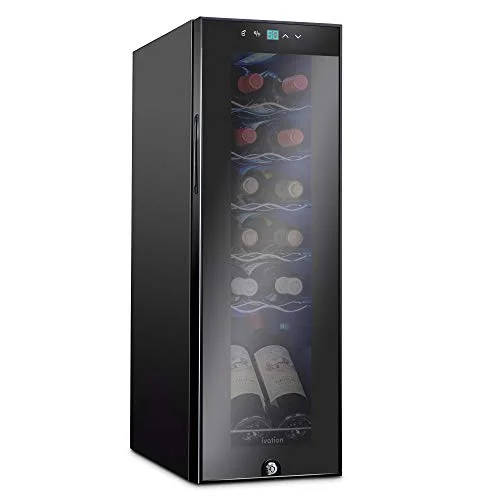
Ivation 12 Bottle Freestanding
Best compact freestanding option
12 bottles·Compressor·Freestanding
The freestanding counterpart to the countertop cube above, at the same 12-bottle capacity and the same price. Choose this one over the cube if floor or shelf space is easier to find than counter space — a bedroom corner, the bottom of a closet, or a spot next to a desk. Like every freestanding unit on this page, it needs clearance at the back to vent its heat properly; do not build it into a cabinet run.
Same lock, same cooling, same price as the cube — the only real question is floor space or counter space.
05Best for a larger shared collection
Ivation 33 Bottle Dual Zone
Best for a larger shared collection
33 bottles·Dual zone·Compressor·41–64°F digital control
The largest capacity on this page, still with a lock, still with two independent zones for red, white, or sparkling stored at different temperatures at once. At 33 bottles this is the size for a household or an office that is genuinely building a collection rather than keeping a rotating handful of bottles — and the size where an unlocked door has the most value sitting behind it. Freestanding compressor cooling with a glass door, quoted across the same 41–64°F range as the 28-bottle model above.
More bottles behind the lock is the whole argument for paying more here.
Retrofitting a lock, and why it usually fails
The instinct, if you already own a wine fridge without a lock, is to add one rather than replace the whole appliance. In practice this rarely works as well as buying a unit built with a lock in the first place, for reasons specific to how these cabinets are constructed.
The door is the problem. Most wine fridges use a double- or triple-paned insulated glass door, curved slightly and sealed around the edge with a magnetic gasket the same way a refrigerator door seals. A generic cabinet lock or hasp-and-padlock kit is designed to be screwed into flat wood or thin sheet metal, not drilled into insulated glass — and drilling into the glass pane risks cracking it or breaking the seal between the panes, which ruins the door's insulating value even if the glass survives. Once that seal is compromised, the compressor works harder to hold temperature and the unit's efficiency and lifespan both suffer, which turns a security fix into a cooling problem.
Adhesive-mounted hardware — stick-on hasps, adhesive child-safety latches — has a second, more mundane failure mode: it does not hold up to a door that opens and closes daily in a slightly humid, vibrating environment next to a running compressor. Adhesive that would happily hold a latch on a static kitchen cabinet tends to work loose within weeks on an appliance door that flexes every time it is opened.
And even hardware that survives being mounted usually changes how the door closes. A hasp or clamp fitted around the frame after the fact rarely lines up with the factory gasket the way the manufacturer's own lock does, and a wine fridge door that does not close flush loses its seal — which means the cabinet stops holding its temperature accurately regardless of whether the lock itself works. A retrofit that defeats the fridge's own insulation has solved the wrong problem.
The straightforward fix is the one this page is about: buy a cabinet where the lock was part of the door's design from the factory, keyed and gasketed to close the same way with or without it engaged. It costs the same as, or only slightly more than, an equivalent unit without one — none of the five picks above carry a meaningful premium for the lock itself.
How we compared these — and what we cannot tell you
We compared published manufacturer specifications and current listed prices for wine fridges that ship with a lock as a stated feature of the listing, rather than as an aftermarket accessory. Where a listing did not specify whether the lock is a mechanical key lock or an electronic keypad, we said so rather than guessing, and where a listing did not state a temperature range or zone count, we did not invent one.
We do not run a testing lab. We do not own these units and we have not physically tested any lock on any of them — no amount of research substitutes for trying to pick or pry a specific mechanism, and we make no claim to have done that. What this page can responsibly tell you is what each listing states, what a lock of this type is generally capable of by design, and where the honest limits of that design are. You will not find a star rating or a review count on this page: the retailer API does not return them for this category, and we do not publish numbers we cannot source.
Prices quoted here were correct at the time of writing and change frequently. Confirm the current price before buying.
Frequently asked questions
Does a lock on a wine fridge actually stop someone from opening it?
It stops casual, low-effort access — a roommate, a child, a coworker or a guest trying the handle out of curiosity or habit. It does not stop someone determined to get in, since a cam lock set into sheet metal and a glass door is not built to resist force. Think of it as inventory control for people who already have access to the room, not as security against a break-in.
Key lock or digital lock — which should I buy?
Most compact and mid-size wine coolers, including all five on this page, ship with a mechanical key lock rather than a digital keypad — it is cheaper to build, needs no battery, and works during a power outage. A digital lock trades the risk of a lost or copied key for the risk of a dead battery. Neither type is meaningfully more secure against force; the practical difference is convenience, not strength.
Can I add a lock to a wine fridge that doesn't have one?
Not reliably. The insulated glass door on most wine fridges is not designed to be drilled or clamped, and generic hasp or adhesive hardware tends to either damage the door's seal or fail to hold up to daily use next to a running compressor. A hardware retrofit that breaks the door's seal also hurts the fridge's ability to hold temperature. It is more reliable to buy a unit with a lock built in from the factory. The full explanation is here.
Where should a locked wine fridge go in a shared house or office?
Somewhere with fewer casual passersby than a communal kitchen or an open-plan office floor — a bedroom, a private office, or a corner away from the main foot traffic. Keep it away from where people already gather to eat or drink, and remember that a freestanding unit still needs clearance at the back to vent heat properly, lock or no lock. More on placement above.
Written by Ilane Tall. Research-based comparisons of published specifications, current prices and verified owner reviews — we do not physically test these units and we do not publish invented scores.