By Ilane Tall · Updated September 21, 2026 · Research-based.
Reader-supported: we may earn a commission when you buy through the links on this page, at no additional cost to you. It never changes which product we recommend. Prices quoted below were correct at the time of writing and move often.
The short version
A cabinet marketed for "red, white, Champagne or sparkling wine" is describing its temperature range, not a bottle-specific design. What actually matters for sparkling is whether the unit reaches down near 41°F, and whether the shelves can carry a heavier, wider-based bottle without it rocking every time the door opens.
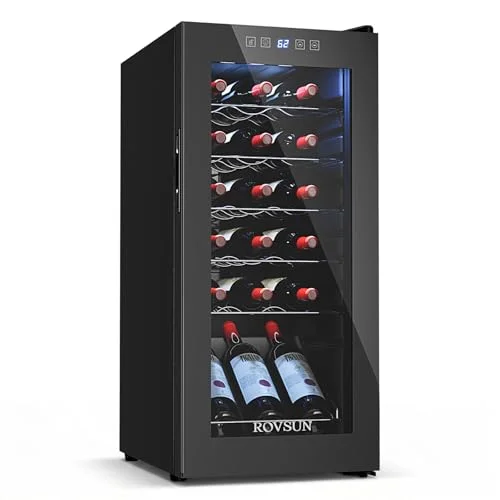
Our top pick here is the ROVSUN 14"W 18 Bottle: compressor-cooled, a published 41–64°F range, and single-zone, so the whole cabinet — not half of it — can sit at a genuine serving temperature.
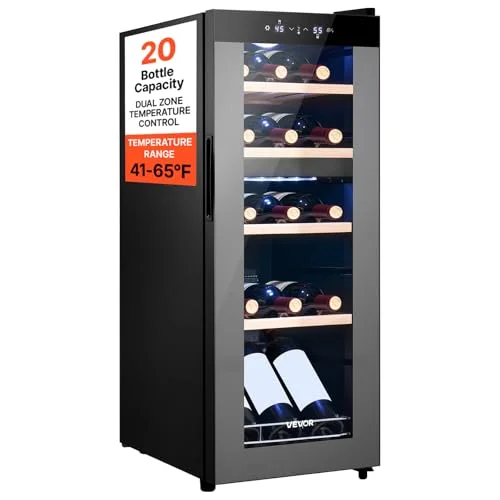
If you want a dedicated storage zone and a colder serving zone in one cabinet, skip to the VEVOR 20 Bottle Dual Zone instead.
Why sparkling wine has different storage needs than a stack of reds
A red wine collection is forgiving in a way sparkling wine is not. Reds age slowly, hold a wide serving window, and mostly just need to be kept cool, dark and still until you are ready to open one. Sparkling wine carries a variable none of that has to deal with: pressure. A sealed bottle of Champagne or other méthode traditionnelle sparkling wine holds carbon dioxide at roughly the pressure found in a truck tire, generated by the second fermentation that gives it its bubbles. That pressure is why the glass, the cork, the cage and the way the bottle sits on a shelf are all built differently from a still-wine bottle — a compromised cork or a bottle that has spent months rolling against a shelf edge is more likely to leak or lose its fizz than a still wine in the same spot would.
Light is the other variable that hits sparkling wine harder. Both still and sparkling wines are vulnerable to UV exposure, but it is a large part of why traditional Champagne bottles use dark green or amber glass in the first place. A wine fridge does not remove that risk, it adds a second layer of glass in front of the first — the specific reason a UV-protected glass door matters more for a cabinet holding sparkling wine than one holding only reds.
None of this means sparkling wine needs exotic equipment. It means pressure and light sensitivity are actively in play every day a bottle sits in the cabinet, and they compound with a third variable every buyer eventually runs into: how long the bottle sits there. Our guide to how long wine actually lasts in a wine fridge covers that fundamental — stability beats precision, and a cabinet holding a steady temperature protects sparkling wine better than one that hits the "correct" number once a day and drifts the rest of the time.
The temperature range that keeps a bottle ready to pour, not still warming up
Sparkling wine is typically served cold — most guidance puts it around 40–45°F, noticeably colder than the 45–50°F window for a crisp white and well below the roughly 55°F that is correct storage temperature for practically every style, sparkling included. That gap is the whole practical argument of this guide. A cabinet that only reaches down to the mid-to-high 40s is a fine home for a red or an everyday white, but it cannot get a bottle of Champagne to the temperature it is actually meant to be poured at — you would still be finishing the job in an ice bucket, which defeats the point of owning a dedicated fridge in the first place.
This is where the published temperature floor stops being a spec-sheet number and starts being the deciding factor. Among the products in this guide, the ROVSUN 18 Bottle and the VEVOR 20 Bottle both publish an explicit 41°F floor — cold enough to land a bottle at true pouring temperature. The Tylza 12 Bottle and the Koolatron Urban Series do not publish a specific range in the data available to us, so we are not going to guess one; check the current listing before buying if a hard number matters to you.
The other detail worth checking is how the unit gets there. Reaching 41°F reliably, and holding it while the door opens and closes on a party night, asks more of the cooling system than holding a red at 55°F does — exactly why cooling technology deserves its own section here.
Thermoelectric vs compressor, specifically for Champagne
Every small wine fridge uses one of two cooling methods, and the difference matters more here than in almost any other wine-fridge buying decision. A compressor unit works the same way a kitchen refrigerator does: it actively pumps heat out using a refrigerant cycle, and it can pull well below room temperature more or less regardless of how warm that room gets. A thermoelectric unit uses a solid-state Peltier module that moves heat with electric current instead of refrigerant — quieter and vibration-free, but fundamentally limited to cooling roughly 20–25°F below whatever the ambient room temperature is.
That ceiling is a mild inconvenience for a red wine fridge set to 60°F in a 68°F room. It is a much bigger problem for a cabinet held at 41°F for Champagne. In a normal 70–72°F kitchen, a thermoelectric unit is already close to its physical limit just reaching the high 40s, before the heat load of repeated door-opening is factored in. Push it toward the cold end of its range in a warm room and it often fails to get there, or drifts back up the moment the room warms — precisely the swing that damages a pressurized bottle's seal over time.
Compressor cooling does not have that ceiling in any practical home setting, which is why it matters more here than the general "which cooling type" question most wine-fridge guides treat as a coin flip. Two of the four products here — the Tylza and the ROVSUN — are built around a compressor. The Koolatron Urban Series is thermoelectric, marketed for kitchens, apartments and RVs — smaller spaces where quiet, vibration-free operation is a real advantage, but not spaces where a true 41°F pouring temperature is guaranteed once the room runs warm. Running a compressor colder for longer also has a cost implication; our breakdown of what a wine fridge costs to run per year covers that trade.
The heavier bottle, the deeper punt: why shelf support matters more than bottle count
Champagne bottles are not just pressurized, they are built heavier to safely contain that pressure. The glass is noticeably thicker than a still-wine bottle's, and the base carries a deeper punt — the concave indentation pushed up into the bottom — which adds structural strength around the point where internal pressure is highest. The result is a full bottle that is heavier and shaped differently at the base than the slim Bordeaux-style bottle most wine-fridge shelves are designed around.
That is exactly why bottle count is the wrong number to focus on here. A rack that comfortably holds twelve slim reds nose-to-tail does not automatically hold twelve Champagne bottles the same way — a wider, heavier base needs a shelf that supports it across its footprint rather than one that only contacts the bottle at two thin points. A bottle balanced awkwardly on a shelf built for a narrower profile is more likely to rock every time the door opens, which matters more for a heavy, pressurized bottle than a light one. None of the four products here publish a shelf-material specification in the data available to us, so we are not going to claim wood versus wire or a spacing sized for a Champagne base — confirm that from listing photos, and our guide to wine fridge shelving, wood versus wire explains what to look for.
One practical workaround that does not depend on shelf design: buy for headroom rather than the stated maximum. Advertised bottle counts are calculated using slim, uniform bottles packed with no wasted space, and a run of Champagne bottles will not pack that tightly — size up from what the label promises if several sparkling bottles will share the rack with reds and whites.
What a "Champagne or sparkling wine" claim on the box actually means in practice
Three of the four products in this guide use the phrase "Champagne or sparkling wine" directly in their titles, and it is worth being precise about what that phrase actually certifies, because it is easy to read more into it than is there. In every case we could verify, it describes the unit's achievable temperature range — that the cabinet can get cold enough to be appropriate for sparkling wine, not still wine alone. It is not a claim about shelf spacing built for a wider punt, reinforced racking rated for a heavier bottle, or any structural accommodation for the bottle shape discussed above.
That matters because the two things are genuinely separate specifications, and a listing can be accurate about one while saying nothing about the other. A unit can reach 41°F and still ship with the same slim, generic wire shelving used across a manufacturer's lineup — not dishonest marketing, just a narrower claim than "built for Champagne" might imply at first read. Treat the phrase on the box as confirmation of the temperature floor, and treat shelf width and bottle stability as a separate question for the listing photos.
The picks
Four products, ranked for one job: getting a sparkling bottle cold enough to pour and keeping it stable on the shelf while it waits. The right choice depends on whether you want a dedicated single-zone cabinet, a split storage-and-serving setup, or the smallest footprint.
| Model | Cooling | Temp range | Price | Get it |
|---|
 ROVSUN 14"W 18 Bottle ROVSUN 14"W 18 Bottle |
Compressor |
41–64°F |
$239.99 |
Get it |
 Tylza 12 Bottle Tylza 12 Bottle |
Compressor |
Not published |
$179.99 |
Get it |
 VEVOR 20 Bottle Dual Zone VEVOR 20 Bottle Dual Zone |
Not published |
41–65°F |
$299.90 |
Get it |
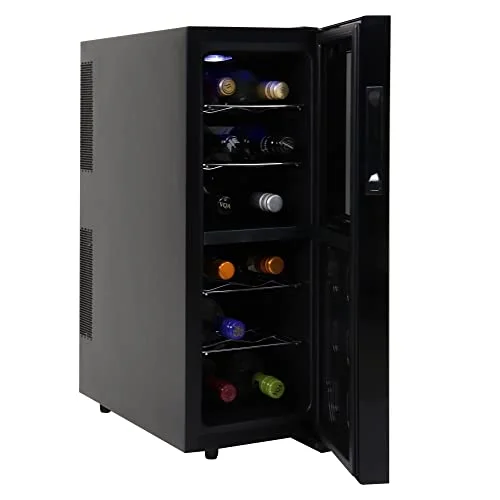 Koolatron Urban Series 12 Bottle Koolatron Urban Series 12 Bottle |
Thermoelectric |
Not published |
$252.99 |
Get it |
Figures are the manufacturers' own, based on the product data available to us. Prices were correct at the time of writing and move often.
01Best overall
ROVSUN 14"W Small Wine Fridge, 18 Bottle
The one to buy if you only buy one
18 bottles·Single zone·Compressor·41–64°F
This is the pick built around the exact requirement this guide is looking for: a published 41°F floor, delivered by a compressor rather than a thermoelectric module, so the whole 18-bottle cabinet can actually reach true Champagne pouring temperature. It is single-zone, which for a household focused on chilling sparkling and white wine is a feature, not a compromise — the entire rack runs at one cold setting instead of splitting capacity with a warmer zone you need less. The listing describes a compact 14-inch-wide freestanding cabinet with a touch-panel control and glass door.
The floor this whole guide is looking for, on a compressor that can actually hold it.
02Best with a lock
Tylza 12 Bottle Wine Fridge
Compressor cooling and a lock, in a smaller cabinet
12 bottles·Compressor·Low-E tempered glass·Lock
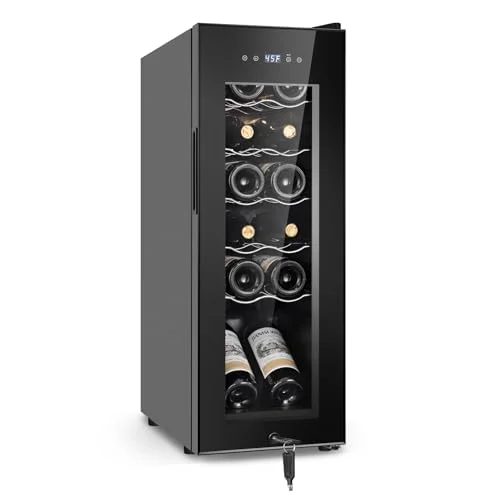
The listing names "Champagne or sparkling wine" directly alongside red and white, and it is compressor-cooled, which per the section above is the cooling type that stands a real chance of holding a serving-cold setpoint once a room warms up. The specific temperature range is not published in the data available to us, so confirm it on the current listing if a hard number matters. What is confirmed: a Low-E tempered glass door — the same UV-blocking principle that matters more for sparkling wine's light sensitivity — an LED touchscreen, and a physical lock, useful if you do not want a bottle you are saving for an occasion walking off early. See our full roundup of wine fridges with a lock if that feature decides it for you.
Compressor cooling and a lock, in the smallest footprint of the four.
03Best for storage plus serving
VEVOR 20 Bottle Wine Fridge, Dual Zone
A cellar zone and a pouring-cold zone in one cabinet
20 bottles·Dual zone·41–65°F adjustable
The published 41–65°F adjustable range is wide enough to run a genuine split: one zone parked near 55°F for reds and whites you are holding, the other pushed toward the 41°F floor to keep sparkling wine at true pouring temperature without a second appliance. That is the case for dual zone laid out in our storage versus serving section below, and it is the largest bottle count of the four at 20. The listing does not specify cooling method in the data available to us, so confirm that on the current listing if the compressor advantage covered above matters to you.
The only pick here built to hold a storage temperature and a pouring temperature at the same time.
04Only if compressor isn't an option
Koolatron Urban Series 12 Bottle, Dual Zone Thermoelectric
Quiet and vibration-free, with a real caveat for this specific use
12 bottles·Dual zone·Thermoelectric·Kitchen, apartment or RV
The listing is explicit that this is thermoelectric, marketed for kitchens, apartments and RVs — settings where a small footprint and silent, vibration-free operation genuinely matter more than the last few degrees of cooling headroom. As covered above, thermoelectric cooling is limited to roughly 20–25°F below room temperature, which makes it a harder sell for holding a true 41°F pouring temperature in a normal-to-warm room. This is the pick for a small space where quiet operation is the priority and you are willing to give a chilling bottle extra time, or a top-up in an ice bucket, rather than guaranteed pouring-cold Champagne on demand.
The RV and apartment pick — go in knowing the ambient-temperature limit applies.
Serving temperature versus storage temperature for sparkling wine
The single most useful distinction for anyone shopping this category is the one between keeping a bottle correctly and keeping it ready to drink right now, and sparkling wine is where the gap between the two numbers is widest of any style.
Storage temperature
Around 55°F, same as reds and whites. What protects a bottle over months or years is a stable temperature and protection from light and vibration — not extreme cold. A sparkling bottle held at 55°F is stored correctly.
Serving temperature
Around 40–45°F — noticeably colder than a white and far colder than a red. A bottle pulled from 55°F storage needs real time in the coldest part of a fridge, or a fast ice-bath chill, before it is actually ready to pour.
Put plainly: a wine fridge holding sparkling wine at 55°F is not doing anything wrong from a preservation standpoint, but it is not doing the job most people buy a dedicated cabinet for, which is skipping the last-minute scramble for an ice bucket. That is the entire case for choosing a unit with a genuine 41°F floor, like the ROVSUN or VEVOR picks above, over one that only reaches the high 40s: the lower number is not about ageing the wine better, it is about the bottle being at the right temperature the moment you want to open it.
If you already own a fridge that will not get cold enough: sparkling wine chills faster in an ice-and-water bath than in any fridge — roughly 20–30 minutes to pouring temperature, against two or more hours in a standard refrigerator. A dedicated cabinet with a real 41°F floor removes that last-minute step; it does not fix an already-warm bottle any faster than an ice bucket does.
How we compared — and what we cannot tell you
We compared the published specifications and current listed prices for the four products named here, focusing on what matters specifically for sparkling wine: cooling method, published temperature floor, zone configuration and price. Where a listing's title or size/variant text was the only stated authority on a spec — cooling method for the VEVOR, temperature range for the Tylza and Koolatron — we treated it as such and did not infer a number that was not explicitly given.
We do not run a testing lab and do not physically test these units, so you will not find an invented score out of ten here, and you will not find a star rating or review count either — the retailer data available to us does not include verified ratings for this category. What we can do is read the specifications carefully and say plainly where a spec sheet leaves a real question unanswered, as it does here for shelf material and two of the four products' exact temperature ranges.
Prices quoted here were correct at the time of writing and change frequently. Confirm the current price before buying.
Frequently asked questions
What temperature should a wine fridge be set to for Champagne?
Around 40–45°F for serving — noticeably colder than the roughly 55°F that is correct for long-term storage of any wine style. The ROVSUN 18 Bottle and VEVOR 20 Bottle both publish an explicit 41°F floor; check the current listing for any unit where the range is not published.
Do I need a dual-zone fridge to store both reds and Champagne?
Not strictly. A single-zone cabinet set near 55°F stores everything correctly, and you chill a bottle separately before serving it. A dual-zone unit like the VEVOR 20 Bottle earns its price if you want a bottle ready at pouring temperature at all times without that extra step — a convenience question, not a preservation one.
Is a thermoelectric wine fridge good enough for Champagne?
It depends on the room. Thermoelectric cooling, like the Koolatron Urban Series here, can typically only pull about 20–25°F below ambient temperature, so in a normal 70°F-plus kitchen it may struggle to reach a true 41°F pouring temperature. It suits a cool, stable, small space such as an apartment or RV where quiet operation matters more than the coldest possible setpoint; a compressor unit is safer if a guaranteed 41°F floor is the priority.
Does a "Champagne or sparkling wine" claim on the box mean the shelves are built for the bottle shape?
No. That phrase describes the cabinet's achievable temperature range, not a structural accommodation for a heavier bottle or a deeper punt. Shelf material and spacing are a separate spec that is not always published — check listing photos, or our shelving guide, before assuming a rack built for slim bottles holds a wider Champagne base securely.
Written by Ilane Tall. Research-based comparisons of published specifications, current prices and manufacturer data — we do not physically test these units and we do not publish invented scores.