By Ilane Tall · Updated September 29, 2026 · Research-based.
Reader-supported: we may earn a commission when you buy through the links on this page, at no additional cost to you. It never changes which product we recommend. Prices quoted below were correct at the time of writing and move often.
Why turnover changes the sizing math
Most wine fridge buying guides size the cabinet to the collection: count what you own, add a little room, done. A subscription box breaks that math, because the collection isn't static — it's a pipeline. A case a month means twelve bottles arriving on a schedule whether or not you've finished the twelve that came before, and a cabinet sized to "what I currently own" is, by definition, sized to be full right when the next box lands.
The number that actually matters for a subscription is not your current bottle count. It's your peak bottle count — the moment right after a new case arrives and before you've worked through any of it, assuming you're running a few weeks behind on drinking through the last one. For a monthly twelve-bottle club, that's realistically eighteen to twenty-four bottles of overlap if you're not draining each case before the next shows up, which most people aren't. Size for that peak, not for the tidy number that sits in the cabinet on an average Tuesday.
This is also where the manufacturer's advertised capacity needs a discount most first-time buyers don't apply. Capacity figures assume slim Bordeaux bottles racked perfectly nose to tail. Club shipments are rarely that uniform — a mixed case regularly includes a Burgundy-shaped Pinot, a wide-shouldered Rhône blend, or a Champagne bottle, and any of those eats more rack space than the spec sheet assumes. Plan on roughly 70–80% of the stated capacity actually being usable, and size your peak-bottle estimate against that real number, not the one on the box.
Put concretely: if a monthly twelve-bottle club is your only source of wine, a cabinet rated for 24 bottles is not comfortable headroom — after the realistic capacity discount, it's closer to 17–19 usable slots, which is tight the moment you're carrying any overlap at all. That's the case for buying one size class up from what a simple bottle count would suggest, the same instinct that applies to a first wine fridge for a different reason — there, you don't yet know your habits; here, you already know the habit is going to keep feeding the cabinet on a schedule.
Single vs dual zone for a mixed box
Most wine fridge advice defaults to single zone unless you have a specific reason to pay for two — and for a stable, self-selected collection, that's the right default. A subscription box argues the other way for a specific reason: you don't choose what's in it.
A curated club shipment is built to include variety on purpose — that's the pitch of the subscription itself. A typical mixed case might run six reds and six whites, or lean toward whichever the sommelier picking that month's box felt like showcasing. You don't control the split case to case, and unlike a self-built collection that drifts slowly toward one colour as your taste settles, a subscription keeps reintroducing both. That's the exact situation a second temperature zone earns its price in: reds at cellar temperature in one compartment, whites and sparkling ready to pour in the other, without shuffling a case of reds into a hallway closet every time a delivery skews white-heavy.
The Icyglee 24" Wine and Beverage Refrigerator is built around that split — two independently controlled zones in one 24-inch compressor-cooled cabinet, sized to hold a genuine mix rather than assuming one colour dominates. The Ca'Lefort 15 Inch Wine Fridge covers the same idea at a narrower, 28-bottle dual-zone footprint if a 24-inch cabinet doesn't fit the space. Both let a mixed case land and get sorted straight into the right zone instead of getting temporarily misfiled next to wine at the wrong temperature.
The caveat: if you already know your subscription tends to skew one colour — some clubs let you set a red-heavy or white-heavy preference — the case for dual zone weakens and the honest single-zone argument in our single zone guide applies instead. Check your last three or four boxes before assuming you need two zones. If they've genuinely been mixed, dual zone is worth the premium here in a way it often isn't for a self-curated collection.
Shelf layout for rotation: newest in, oldest out
Sizing and zoning solve half the problem. The other half is arranging the cabinet so a new case doesn't just get stacked on top of the old one and forgotten — which is how a subscription quietly turns into an expensive way to accumulate wine you never drink.
The fix is a rule borrowed from grocery stockrooms: first in, first out. When a new case arrives, the existing bottles move to the front or the most accessible shelf, and the new case goes to the back or the least convenient shelf. It sounds almost too simple to write down, but it's the single habit that prevents a subscription fridge from silently filling with bottles from three boxes ago while this month's case sits untouched at the front because it's easiest to reach.
The practical version of that rule is a dedicated "drink now" shelf — one shelf, ideally at eye level or the easiest one to reach, reserved for whatever is oldest and most ready to open. Every new case gets shelved behind or below it, and nothing goes on the drink-now shelf except what's already been sitting the longest. This does two things: it makes rotation visible instead of something you have to remember, and it turns "what should I open tonight" into a five-second glance instead of reading every label in the cabinet.
On a dual-zone unit like the Icyglee or the Ca'Lefort, run the drink-now shelf inside whichever zone matches what's actually oldest — it doesn't need to be a fixed zone, just a fixed shelf position within whichever compartment holds the wine that's been waiting longest. On a smaller single-zone unit, the front-most shelf is the natural candidate simply because it's the one you see first every time the door opens.
Worth writing on the shelf itself: a strip of masking tape labeled "drink now" costs nothing and does more for rotation discipline than any amount of good intentions. The cabinets here don't ship with shelf labels — this is a five-minute setup step, not a product feature to shop for.
When a wine-and-beverage hybrid makes sense
Not every household getting a wine subscription is a wine-only household. If the fridge is also expected to hold the beer, the sparkling water, or the sodas that everyone else in the house actually drinks, a pure wine cabinet forces an awkward choice: dedicate the whole thing to a subscription that one person is working through, or keep buying a second appliance for everything else that needs to be cold.
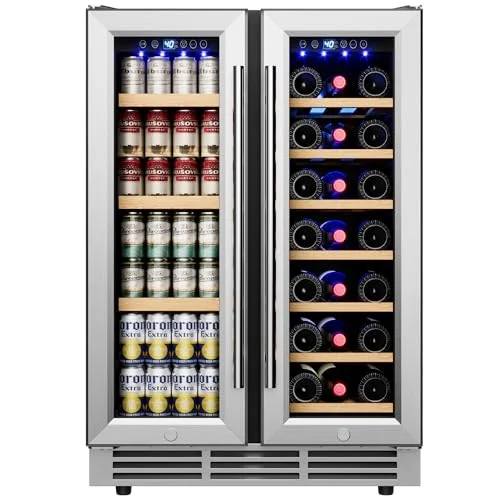
The Icyglee 24" Wine and Beverage Refrigerator is built for exactly that overlap — one 24-inch cabinet with independently controlled zones, one side racked for bottles at cellar or serving temperature, the other suited to cans and mixers at a colder setpoint. For a household where the subscription is one person's habit and the rest of the family wants a shared cold-storage spot, that's a more honest fit than a wine-only unit that ends up half-empty most weeks while the kitchen fridge gets crowded with drinks that didn't fit.
The trade to go in with clear eyes about: a wine-and-beverage split gives up total wine capacity compared to an all-wine cabinet of the same size, because part of the cabinet is doing a different job. If the subscription case genuinely needs the full width of the fridge every month with no room to spare, an all-wine dual-zone unit like the Ca'Lefort makes better use of the space. The hybrid is the right call when the household's actual problem is "we have too many cold things and not enough fridge," not when the problem is purely "we need more room for wine."
The picks
Three ways to solve the subscription problem, from the smallest committed budget to the setup built to absorb a genuinely mixed case every month.
01Smallest committed start
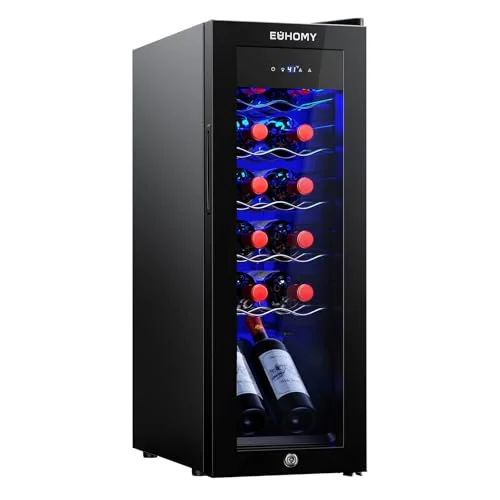
EUHOMY 12 Bottle Wine Cooler Refrigerator, With Lock
Only if your club sends a single case with no real overlap
12 bottles·Lock·Freestanding
At $188.99, this is the entry point for someone committing to a subscription for the first time and not yet sure it'll stick. Twelve bottles is enough for a single monthly case with essentially no cushion — the moment you're running even a week behind on drinking through the last box, the math from the sizing section above stops working. Treat this as the "start small and see" option, not the one to buy if you already know the subscription is a long-term habit. The lock is a genuine plus if the cabinet lives somewhere with easy access from kids or guests.
The honest starter unit — buy it expecting to outgrow it if the subscription sticks.
02Best for a mixed case
Icyglee 24" Wine and Beverage Refrigerator, Dual Zone
The pick for a household that isn't wine-only
Dual zone·24" width·Wine and beverage
At $579.99, this is the pick for the subscription that regularly mixes reds and whites and shares fridge space with cans and mixers for the rest of the household. Two independently controlled zones mean a shipment gets sorted by temperature the moment it arrives instead of getting parked at whatever temperature happens to be free, and the beverage side absorbs everything a pure wine cabinet would force into the kitchen fridge instead. The trade covered above applies here too — you're giving up some pure wine capacity in exchange for the cabinet covering more of what the household actually needs cold.
Buy it for the household, not just the subscription — the beverage side is doing real work.
03Most headroom for wine only
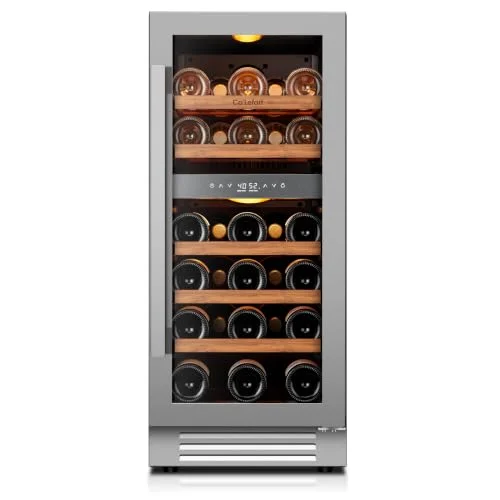
Ca'Lefort 15 Inch Wine Fridge, 28-Bottle Dual Zone
The pick if every shipment needs to stay dedicated to wine
28 bottles·Dual zone·15" width, 3.0 cu.ft
At $629.99, this is the all-wine answer to the sizing math worked through above. Twenty-eight bottles across two zones gives a monthly twelve-bottle club real headroom for the overlap between shipments — after the realistic 70–80% capacity discount, that's roughly 20–22 usable slots, comfortably ahead of the 17–19 a 24-bottle unit would actually deliver, without needing to share space with anything but wine. The 15-inch width is the standard cabinet opening, useful if there's ever a chance of building it in later, and dual zone means a mixed case sorts straight into the right compartment.
Buy this one if the fridge's only job is absorbing the next case, month after month.
The point where a subscription outgrows any of these
A monthly twelve-bottle club is the scenario this guide is built around, and all three picks above are sized for it with a reasonable margin. That margin runs out at a predictable point, and it's worth naming rather than pretending any of these units scales indefinitely.
Two things push a subscription past what a 24–28-bottle dual-zone cabinet can comfortably absorb. The first is simple accumulation: if you're joining a club to build a collection rather than to drink through each case as it arrives, the bottles you're keeping stack on top of the ones still coming in, and a cabinet sized for turnover gets treated as a cabinet for storage — a job it was never sized to do. The second is stacking subscriptions, or a club that ships more than monthly, or a larger case size — any of which multiplies the peak-overlap number from the sizing section above well past what 28 bottles can hold even before the capacity discount.
If either of those describes your situation — you're keeping more than you're drinking, or more than one shipment schedule is feeding the same cabinet — the honest move is to stop trying to make a turnover-sized unit do a storage-sized job and look at our guide to the best wine fridges overall, which covers the 100-bottle-class cabinets built for exactly that. Trying to squeeze a genuine collection into a 28-bottle rotation cabinet is the same mistake as the opposite case covered in our first wine collection guide — sizing for today's number instead of the one you're actually building toward.
How we compared these — and what we can't tell you
We compared the manufacturer-published specifications and current Amazon prices for the three units above — capacity, zone configuration, cabinet width, and the features stated on each listing. Where a listing doesn't specify a spec, such as a precise temperature range, we didn't fill the gap with an assumption; we told you to check the current listing instead.
We don't run a testing lab. We haven't bought these units, run a year of subscription deliveries through them, and timed how fast each one fills up — nobody honestly comparing wine fridges for subscription use has done that either, whatever a review implies. What we can do is read the specifications carefully, track what they cost, and reason through the sizing and rotation math that actually determines whether a cabinet keeps up with a recurring shipment. You won't find a star rating or a review count on this page: none of these listings currently publish one, and we don't estimate numbers we can't source.
Frequently asked questions
How many bottles of headroom do I need for a monthly wine club?
Size for your peak overlap, not your average bottle count — the moment right after a new case lands and before you've finished the last one. For a typical monthly twelve-bottle club, that's realistically eighteen to twenty-four bottles of true demand once you apply the usual 70–80% real-world capacity discount to whatever the box advertises. A 24–28-bottle dual-zone cabinet is a reasonable match for that; a 12-bottle unit leaves almost no room for running behind.
Do I need dual zone for a subscription box specifically?
More often than for a self-built collection, yes — because you don't choose the red-white split of a curated case the way you choose your own purchases. If your last several boxes have genuinely mixed colours, dual zone lets each shipment sort straight into the right temperature. If your club lets you set a colour preference and you've chosen one, the single-zone case in our single zone guide applies instead.
What's the simplest way to keep a subscription fridge from turning into clutter?
A first-in-first-out shelf habit: dedicate one shelf as "drink now," reserved for whatever's been in the cabinet longest, and shelve every new case behind or below it rather than on top. It turns rotation into a five-second glance instead of something you have to remember, and it's the single biggest reason a subscription cabinet does or doesn't stay ahead of what's arriving.
At what point should I stop buying a bigger dual-zone cabinet and get a real cellar unit instead?
When you're keeping more bottles than you're drinking through, or more than one delivery schedule is feeding the same fridge. Both push the peak-overlap number well past what a 24–28-bottle cabinet can hold even before the usual capacity discount. At that point the job has quietly changed from turnover to storage, and a 100-bottle-class single-zone cabinet, covered in our main wine fridge guide, is the honest next step.
Written by Ilane Tall. Research-based comparisons of published specifications, current prices and verified owner reviews — we do not physically test these units and we do not publish invented scores.