By Ilane Tall · Updated October 6, 2026 · Research-based.
Reader-supported: we may earn a commission when you buy through the links on this page, at no additional cost to you. It never changes which product we recommend. Prices quoted below were correct at the time of writing and move often.
The short version
A home-bar wine fridge does a harder job than a cellar fridge: the door opens constantly during a party instead of once a week, and whatever is inside has to be visible and ready to pour, not quietly aging in the dark.
If the bar is wine-only and the goal is simply enough bottles to survive a gathering without a mid-party restock, a single large freestanding unit is the straightforward answer. If your guests split between wine and beer, soda or mixers, a dual-zone wine-and-beverage cooler solves the real problem, which is two drink cultures fighting over one cold box.
And if the bar is not supervised the whole time it is stocked — a rec room, a finished basement, a space kids or house guests pass through — a lock stops being a nice-to-have. Jump straight to the picks if you already know which of those you need.
Why a home-bar fridge earns its keep differently
Most wine-fridge buying guides are written for a cellar: a cabinet that holds a collection at a stable 55°F and gets opened when a bottle is due, which might be once a day or once a week. A home bar is a different appliance wearing the same shape. It lives in a space where people gather on purpose, it gets opened by more than one person, and it is judged as much on what it looks like stocked as on how well it holds temperature over a decade.
That changes what actually matters when you are shopping. Bottle-aging stability — the thing a quiet storage cabinet is optimized for — is still relevant, but it is no longer the whole story. A home-bar fridge also has to survive being opened and closed dozens of times in an evening, and present its contents through a glass door so people can see what is available without asking.
The honest framing is duty cycle, not capacity alone. A 12-bottle cellar unit and a 12-bottle bar unit can be the same appliance on a spec sheet and feel completely different after three parties. Before you shop by bottle count, it is worth reading our wine fridge buying checklist — venting type, door swing and noise level matter more in a room full of guests than in a quiet hallway.
Frequent door-opening and recovery time: the spec nobody advertises
Here is the gap between how a wine fridge is marketed and how a home bar actually uses one. Every listing states a temperature range. None of the listings we have seen state how quickly the cabinet recovers after the door has been open for thirty seconds while someone digs through it looking for a specific bottle, repeated a dozen times over an evening. That is a real spec. It is simply not one manufacturers publish, and we are not going to invent a number for it.
What we can say honestly, from general refrigeration principles rather than from a test we ran: every time the door opens, the cold air that has settled near the bottom of the cabinet spills out and is replaced by warmer room air, and the compressor has to work to pull the interior back down to its setpoint. How much that matters in practice comes down to three things that are on the spec sheet, even if "recovery time" is not.
Cabinet size and thermal mass
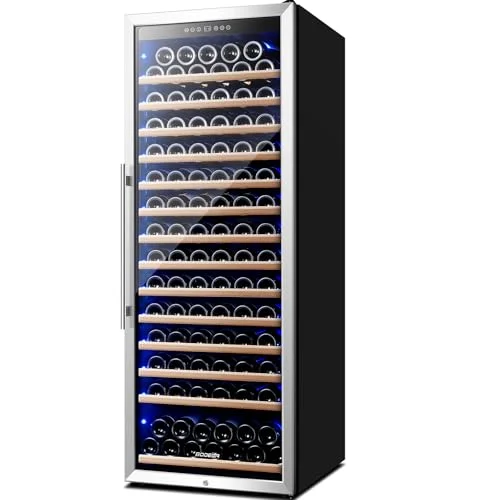
A larger cabinet holding more bottles has more total mass — glass, wine, shelving — that stays cold through a single door-opening event. A 154-bottle unit like the BODEGA 24 Inch has a lot more of that buffering than a compact 12-bottle cooler, simply because there is more cold mass in the room.
Cooling type
A compressor-cooled unit can push past a warm-air intrusion and re-establish its setpoint; a thermoelectric unit, which only pulls a fixed amount below room temperature to begin with, has far less margin to recover from repeated openings. All three picks in this guide are compressor-cooled for that reason.
The practical takeaway is not "buy the biggest fridge you can fit." It is that a bar fridge working through a stack of door-openings during a party benefits more from compressor cooling and genuine capacity than a quiet storage cabinet does, simply because it is being asked to recover more often.
Wine-only vs wine-and-beverage: hosting mixed drinkers
Almost nobody hosts a party where every guest drinks the same thing. The practical question for a home bar is not "how good is this fridge for wine" but "what do I do with the beer, the seltzer and the mixers that are also going to show up." There are two honest answers, and they point to two different products.
The first answer is a dedicated, larger wine-only fridge, and a second, separate cold space — a kitchen fridge, a standalone beverage cooler, an ice bucket — for everything else. This is the right call when wine is genuinely the point of the bar and you would rather have real bottle capacity than split a cabinet. The BODEGA 24 Inch Wine Cooler, 154 Bottle is built for exactly this: a tall, freestanding, 24-inch cabinet rated for 154 bottles, with intelligent temperature memory and humidity control plus an upgraded quiet compressor, explicitly positioned for bedroom, bar and kitchen use. If your idea of a home bar is a wall of wine that a serious gathering can draw down without running out, this is the capacity that supports it, and it does not try to also be a beer fridge.
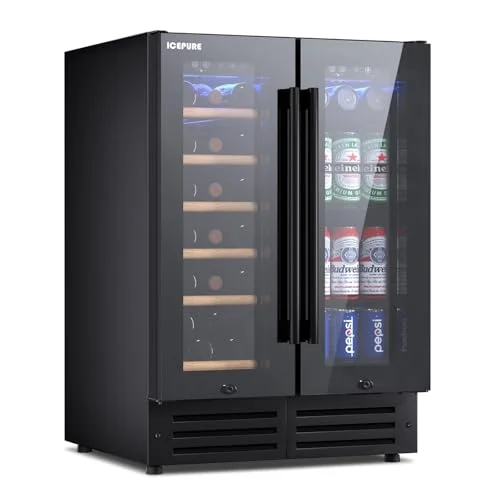
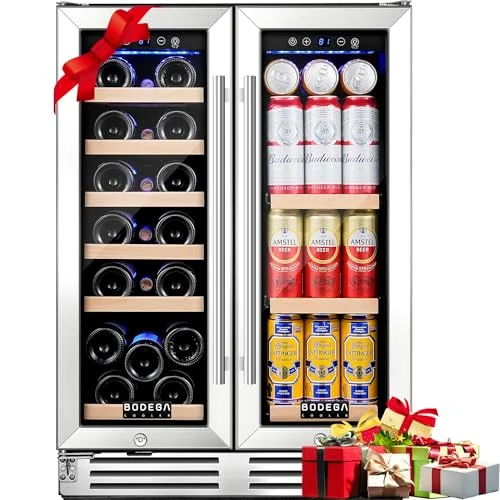
The second answer is a wine-and-beverage hybrid: one cabinet, two independently cooled compartments, wine racked on one side and cans shelved on the other. That is the better fit when the bar genuinely serves mixed company and you do not have room, budget or counter space for two separate appliances. The BODEGA 24 Inch Wine and Beverage Refrigerator (19 bottles and 57 cans) and the ICEPURE 24 Inch Wine and Beverage Refrigerator (19 bottles and 58 cans) both take this approach: dual-zone compressor cooling and two glass doors in a 24-inch footprint. Neither pretends to be a large-format wine cellar — 19 bottles is a working bar stock, not a collection — but both solve the actual problem of wine drinkers and can drinkers sharing one party. For the white-wine side of that mix, our guide to wine fridges for white wine and chilled whites covers the serving-temperature end of the question.
There is no universally correct choice here. A bar that is 90% wine with the occasional can in the back of someone's hand wants the 154-bottle unit. A bar that regularly serves a room split between wine drinkers and beer-or-soda drinkers wants a wine-and-beverage hybrid, and will be happier with 19 bottles plus real can storage than with 40-odd bottles and nowhere to put a six-pack.
A lock, for the bar that is not always supervised
A quiet storage cellar in a closet is rarely opened by anyone who was not specifically looking for a bottle. A home bar is a different social object: it sits in a room people pass through, kids wander near it, house guests browse it unsupervised, and at a big enough party nobody is standing next to it the entire night. That is the case for a lock, and it is worth checking for explicitly rather than assuming every bar fridge has one.
Of the three products in this guide, the ICEPURE 24 Inch Wine and Beverage Refrigerator is the one explicitly sold as lockable — its listing states it directly, alongside the fact that it can be installed under a counter or left freestanding. That combination is worth noticing on its own: a lockable, under-counter-capable wine-and-beverage fridge is squarely built for a bar area that is not staffed the whole time it is stocked. We did not find a lock stated in the listings for the other two products here, and we are not going to assume one exists where it is not published — if a lock is the deciding feature for your household, confirm it on the current listing first.
The honest trade-off: a lock does not make a wine fridge theft-proof or guarantee a minor cannot get into it with enough patience. What it reliably does is stop casual access — the guest who would otherwise help themselves, or the child who would otherwise open the door because it is there. For a supervised cellar in a private room, skip it and save the complexity. For a bar in a shared or semi-public space, it is worth filtering your shortlist down to units that state it.
The picks
Three units, covering the two honest answers to the wine-versus-beverage question above, plus the lockable option for a bar nobody watches all the time.
01Best all-wine capacity
BODEGA 24 Inch Wine Cooler, 154 Bottle
The one to buy when wine is the whole point of the bar
154 bottles·24 inch·Compressor·Freestanding
A tall, freestanding 24-inch cabinet rated for 154 bottles, with intelligent temperature memory, humidity control, and an upgraded quiet compressor, explicitly positioned by the listing for bedroom, bar and kitchen use. This is the honest answer to "what if I just need a lot of wine on hand" — a large cabinet whose thermal mass and compressor cooling are built for repeated door-opening during a gathering, rather than a quiet once-a-day cabinet pressed into bar duty. It is wine-only: if cans and mixers are part of the night, plan a separate cold space for them.
The pick if the bar's job is to never run out of wine mid-party.
02Best for an unsupervised bar
ICEPURE 24 Inch Wine and Beverage Refrigerator
Dual zone, lockable, and built for mixed drinkers
19 bottles + 58 cans·Dual zone·Compressor·Freestanding or built-in, lockable
Wine racked on one side, cans shelved on the other, each compartment on its own compressor-cooled zone, behind a glass door, in a 24-inch footprint that can go freestanding or under a counter. The feature that puts it here as the default recommendation for most home bars is that it is explicitly sold as lockable — the detail that matters most once the bar sits in a room that is not supervised the entire time it is stocked. Nineteen bottles plus fifty-eight cans is a working bar stock built to serve a mixed room, not a collection.
The pick when the bar serves wine drinkers and can drinkers, and nobody is watching it all night.
03Best value wine-and-beverage
BODEGA 24 Inch Wine and Beverage Refrigerator
The same mixed-drinker layout, at a lower price
19 bottles + 57 cans·Dual zone·Compressor·Built-in or freestanding
Essentially the same proposition as the ICEPURE above — a 24-inch, dual-zone, compressor-cooled cabinet with two glass doors splitting wine from cans, able to go built-in or freestanding, sold by the listing as a commercial-style black bar cooler. It is roughly $40 less than the ICEPURE. The trade is the lock: this listing does not state one, so if an unsupervised room is the use case, the ICEPURE above is the safer default. If the bar is in a private space you control, this is the same layout for less money.
The pick if you want the wine-and-beverage layout and the room is private enough that a lock is not the deciding factor.
Placement near the bar cart, and the clearance it still needs
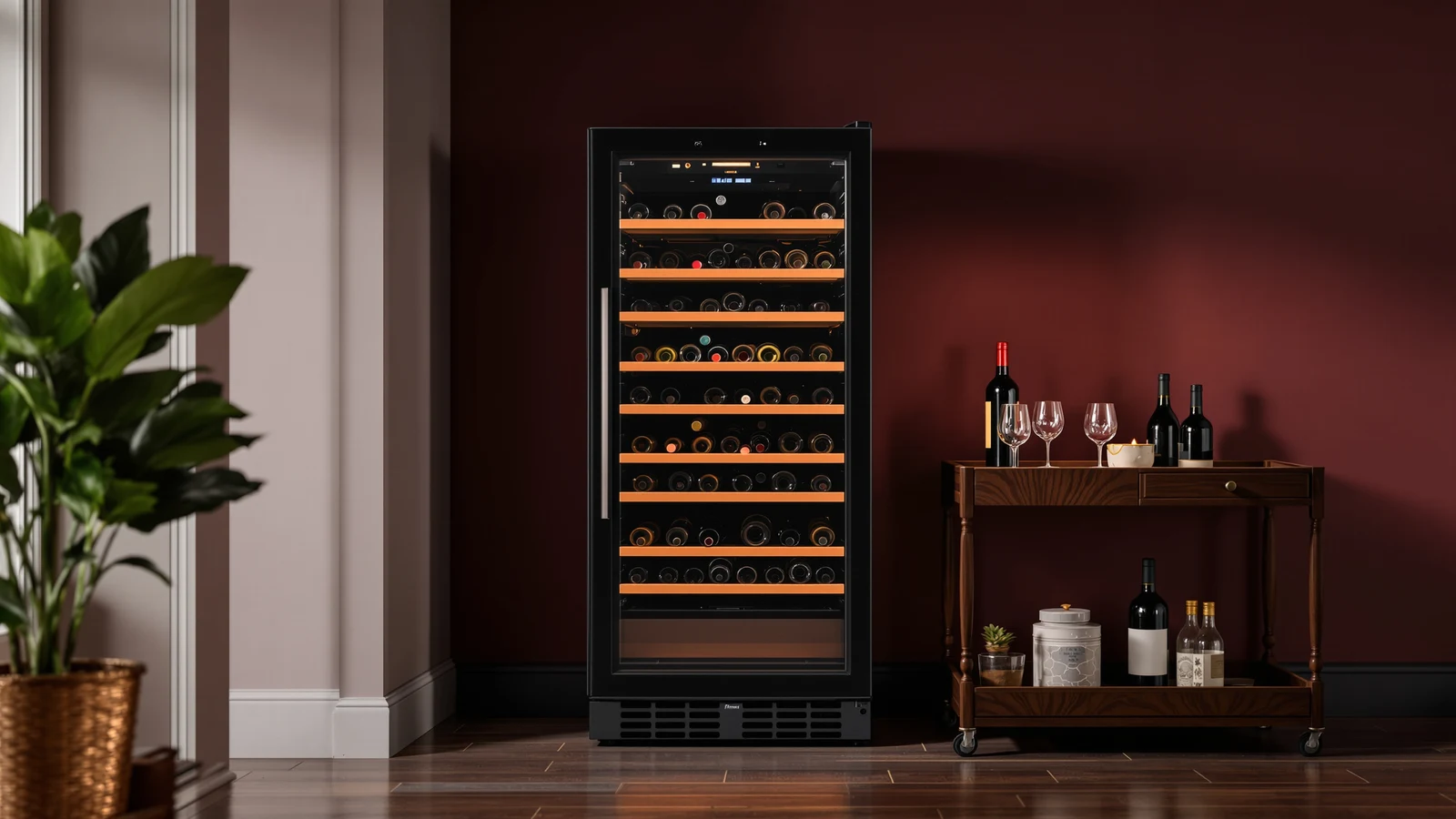
A home bar is usually built around a visual centerpiece — a bar cart, open shelving, a run of cabinetry — and the natural instinct is to tuck the wine fridge into whatever gap is left. That instinct is where a lot of otherwise good appliances die early. All three units in this guide are compressor-cooled, and a compressor rejects heat out of the back and sides of the cabinet; a freestanding unit needs that heat to have somewhere to go. Push it flush against a wall or wedge it into a cabinet opening built for a different appliance, and the compressor runs continuously while the interior still drifts warm, which shortens the fridge's working life well before any parts actually "break." Our ventilation and placement clearance guide covers the specific clearance numbers to check against the listing you buy; the two wine-and-beverage units here can go built-in or freestanding, but that only applies if the cabinet opening matches what the manufacturer specifies for built-in installation.
Next to a bar cart specifically, give the fridge room to open fully without the door catching the cart, a nearby chair, or a wall. A fridge jammed into a corner gets used less carefully — people reach in at an angle, knock bottles, and leave the door ajar because closing it properly is awkward. If the cart and the fridge are going to sit side by side permanently, it is worth checking which way the fridge door swings before committing to a layout; our guide to wine fridge door hinges explains when a reversible door actually solves that. And because a bar fridge sees more spilled mixers and condensation than a quiet storage cabinet, plan for slightly more frequent upkeep — our guide to cleaning and maintaining a wine fridge covers the door-seal and shelf maintenance that keeps a heavily used unit running as long as a lightly used one.
How we compared these — and what we cannot tell you
We compared the published manufacturer specifications and current listed prices for wine and wine-and-beverage refrigerators marketed for bar use, cross-checked bottle and can counts against the listings directly, and looked specifically for installation type, zone configuration and whether a lock was stated. Where a specification was not published — recovery time after repeated door-opening is the clearest example in this guide — we said so rather than estimating a figure to fill the gap.
We do not run a testing lab. We do not own these units and have not physically tested them, so there is no invented score out of ten here. What we can do honestly is read the specifications carefully, track the prices, and reason from general refrigeration principles about what a given spec means for how a fridge behaves under party-level use. Star ratings and review counts are not something the retailer data makes available for these listings, so you will not find them here either — we would rather tell you that plainly than paraphrase sentiment we cannot verify.
Prices quoted in this guide were correct at the time of writing and change frequently. Confirm the current price before buying.
Frequently asked questions
Do I need a dual-zone wine-and-beverage fridge for a home bar, or just a wine fridge?
It depends on who is drinking what. If the bar is overwhelmingly wine and you want maximum bottle capacity, a large wine-only unit like the BODEGA 154 Bottle is the straightforward answer. If your gatherings regularly mix wine drinkers with beer, soda or mixer drinkers, a dual-zone wine-and-beverage cooler — wine racked on one side, cans on the other, each on its own compressor-cooled zone — solves that split in one 24-inch cabinet instead of forcing you to find room for two appliances.
How many bottles should a home-bar wine fridge hold?
Enough that one busy evening does not empty it, which is a different number than a personal collection needs. A wine-only bar fridge in the 100-plus-bottle range, like the 154-bottle unit here, is built to survive a real gathering without a mid-party restock. A wine-and-beverage hybrid with closer to 19-20 bottles is sized as working bar stock rather than a deep collection, on the assumption that cans are covering a meaningful share of what gets poured.
Does a wine fridge need a lock for a home bar?
If the bar sits in a space that is supervised the entire time it is stocked — a private room, a cellar nobody but you accesses — a lock is not essential. If it sits somewhere people pass through unsupervised, such as a finished basement, a rec room, or a counter near a living area with regular foot traffic, a lock is worth filtering for specifically. Not every bar-marketed wine fridge has one; check the listing rather than assuming.
Can a home-bar wine fridge sit flush against a wall or inside a cabinet?
Only if the manufacturer rates that specific unit for built-in installation, which means it vents through the front rather than the back and sides. A freestanding compressor unit pushed flush against a wall or enclosed in a cabinet opening cannot reject its heat properly, so the compressor runs continuously without ever reaching its setpoint — a common, expensive mistake. Two of the three units in this guide can go either way, but only when the installation matches what the listing specifies.
Written by Ilane Tall. Research-based comparisons of published specifications, current prices and general refrigeration principles — we do not physically test these units and we do not publish invented scores.