By Ilane Tall · Updated October 1, 2026 · Research-based.
Reader-supported: we may earn a commission when you buy through the links on this page, at no additional cost to you. It never changes which product we recommend. Prices quoted below were correct at the time of writing and move often.
Quick answer
Whites want to live somewhere around 41–50°F, not the 55°F that stores a red just fine. On a dual-zone cabinet, that means the "other" compartment needs its own low-end number in the low 40s — not just a setting a few degrees under whatever the red side is doing.
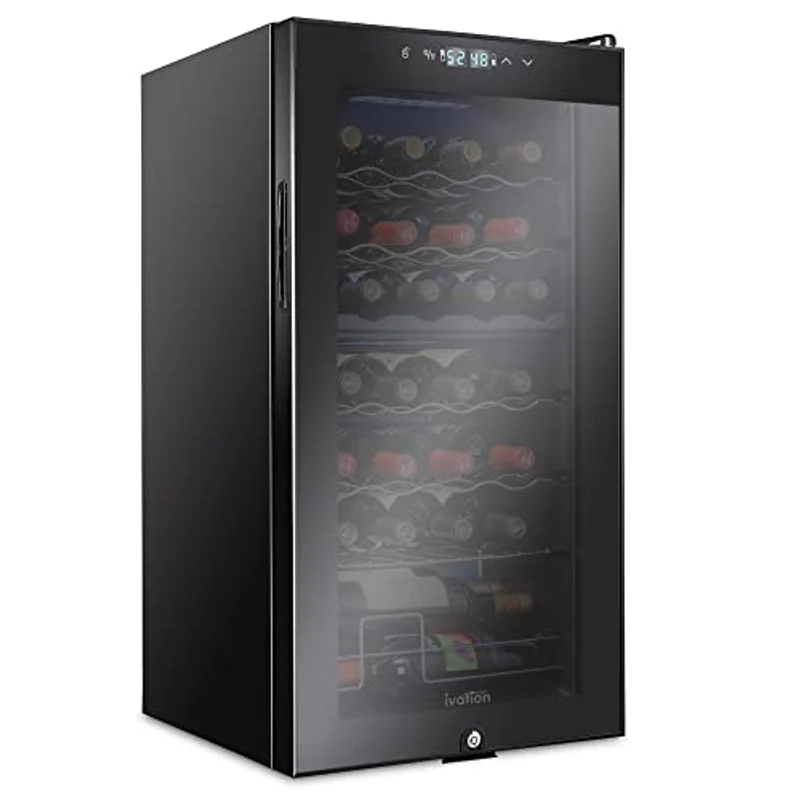
Our pick for this job is the Ivation 28 Bottle Dual Zone, which publishes a 41–64°F range with a lock and compressor cooling, so the lower zone genuinely reaches white-serving temperature rather than just a cooler shade of storage.
Before buying any dual-zone unit for this reason specifically, read how to find the real low-end number on the listing — the headline range on the box is not always the number the zone you care about can actually hit.
Why the "other zone" on a dual-zone fridge is often not cold enough for whites
Most dual-zone wine fridges are built and marketed around red wine first. That shows up in small ways that are easy to miss on a listing page: the "featured" temperature in the product photos is usually somewhere in the high 50s, the shelf layout favors the taller compartment, and the phrase "red, white, Champagne or sparkling" gets printed on the box regardless of what the second zone can actually do. The assumption baked into that marketing is that any temperature colder than the red zone counts as a "white zone." It does not.
Here is the mechanical reason. A dual-zone cabinet is not two separate refrigerators. It is one insulated box split by a fixed internal divider, almost always cooled by a single compressor and refrigerant circuit, with a second sensor, fan, or damper managing the compartment on the other side of that divider. The colder zone sets the pace; the "warmer" zone is that same cold air gently throttled, vented less aggressively, or mixed with a small resistive warming element. Because one system is doing both jobs, the spread between the two zones is narrower than the overall advertised range implies, and it narrows further in a warm room.
That narrow spread is exactly the trap for a whites drinker. If a cabinet's upper zone is tuned to sit at 58–64°F for reds, and the achievable differential between zones on that particular design is only 10–12 degrees, the "cold" zone tops out somewhere around 46–52°F. That is a perfectly fine number for a fuller white. It is not cold enough for a crisp Sauvignon Blanc or a bottle of rosé you want genuinely chilled, and it is nowhere near cold enough for sparkling wine. The listing still says "dual zone, for red and white" — it just doesn't say how cold the white side actually gets. We work through the mechanics of that shared-compressor limitation in more depth in our dual zone vs single zone guide, which is worth reading before you assume two zones automatically means two useful temperatures.
The fix is not complicated, but it means shopping differently than the box copy invites you to. Instead of trusting the phrase "dual zone" to mean "a real whites zone," check what the lower compartment's own low-end number is. A cabinet whose low zone is specified down to 41°F has real headroom for crisp whites, rosé, and a chilled pour on a hot day. A cabinet that only states one combined range for the whole unit is not telling you what you need to know, and should be treated as an open question rather than a yes.
The temperature range whites actually want, by style
Not every white wants the same number, and lumping "whites" together the way most spec sheets do hides a real range.
Crisp, lighter whites — Sauvignon Blanc, Pinot Grigio, unoaked or lightly oaked Chardonnay, most dry rosé — show best served cold, generally in the 45–50°F band. Serve one of these warmer than that and the acidity that makes the wine refreshing starts to taste flat and the alcohol becomes more noticeable. This is the style most people mean when they say "a chilled white," and it is the style that a marginal 50–52°F zone serves acceptably but not ideally.
Fuller, richer whites — oaked Chardonnay, Viognier, white Rhône blends — are generally happier a few degrees warmer, closer to 50–55°F. Serve these too cold and the oak, texture, and aromatics that are the point of the wine get muted. If your white drinking skews toward this fuller style, a zone that tops out in the low 50s is doing its job correctly, not falling short.
Sparkling wine and Champagne sit at the coldest end of the white-and-rosé spectrum, generally wanted around 40–45°F to keep the bubbles tight and the wine from foaming over the moment it is poured. That is colder than most "white zones" are built to reach, which is why we cover sparkling separately in our guide to Champagne and sparkling wine fridges — a unit that comfortably serves a Sauvignon Blanc at 47°F may still be a few degrees short of ideal for a bottle of Cava.
Put those numbers together and the honest target for a genuinely useful whites zone is a low end somewhere around 41–45°F, with enough range above that to also cover fuller whites in the low 50s. That is a wider and colder span than a lot of "dual zone" marketing implies, and it is the number worth checking before anything else on the spec sheet. Our full temperature guide breaks these figures down further, including how they interact with storage temperature.
Reading the low-end number on the spec sheet before you buy
This is the single most useful habit for anyone buying a fridge specifically to serve whites: stop reading the headline range printed across the top of the listing, and go find the number for the specific zone you plan to use for whites.
Two things commonly go wrong here. The first is a unit that advertises one combined range for the whole cabinet — say, "41–65°F" — without stating what each individual zone can reach on its own. That combined number describes the outer limits of the appliance, not what either zone actually does; the low zone might well bottom out well above 41°F once you account for the differential the shared compressor can maintain. The second is a unit where the listing genuinely doesn't publish per-zone figures at all. In either case, the honest move is to treat the low-end number as unconfirmed rather than to assume the best case, and to check the manufacturer's page or ask before buying if serving temperature for whites is the reason you're purchasing the fridge.
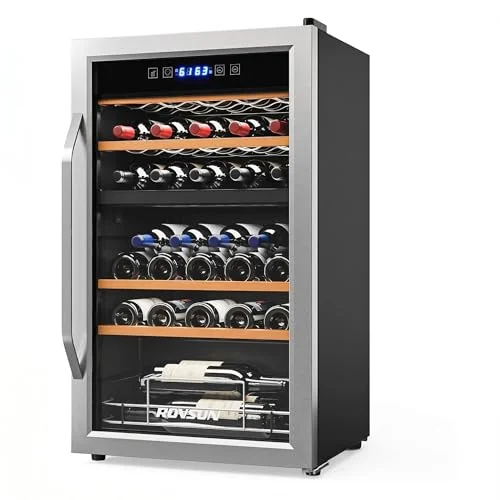
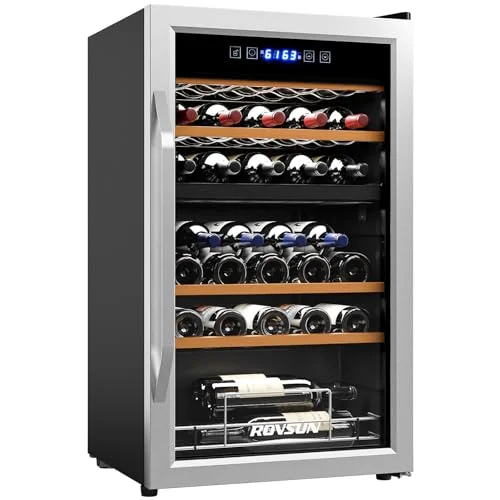
Among the units we looked at for this guide, that gap shows up clearly. The ROVSUN 33 Bottle with Independent Temp Control markets a dual zone with its own control panel per side, which is the right idea — but the listing we have does not state a specific temperature range for either zone, so we are not going to invent one here. If a low-40s whites zone is the reason you're considering it, confirm the exact figure on the current listing before you buy, not after.
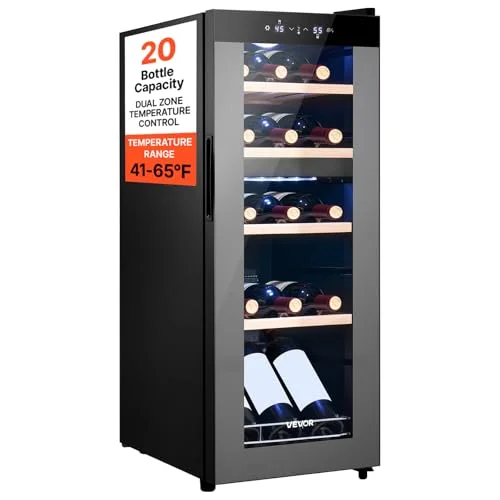
By contrast, three of the units below do publish a specific low-end number, and it is the same number in every case: 41°F. The Ivation 28 Bottle and the ROVSUN 20" 33 Bottle with Compressor both quote a 41–64°F range, and the VEVOR 20 Bottle quotes 41–65°F. A published 41°F low end gives real headroom for crisp whites and rosé, with a few degrees to spare before you're even in sparkling-wine territory. That is the number worth anchoring to, and it is a meaningfully different purchase than a cabinet that only tells you the overall span is wide.
The rule that resolves most of this: a wide overall range on the box tells you almost nothing about whether the zone you'll actually use for whites gets cold enough. Find the specific low-end figure for that zone. If the listing doesn't give you one, don't assume 41°F just because the box says the cabinet spans 41°F somewhere.
Dual zone vs a dedicated single-zone whites-only fridge
Once you've confirmed a dual-zone cabinet's low end genuinely reaches the low 40s, it's worth asking a second, more basic question: do you need the red side of that cabinet at all?
A dual-zone fridge splits its interior with a fixed divider, and that divider is a permanent decision about how many bottles go to each temperature — a decision the manufacturer made, not you. If the overwhelming majority of what you drink and store is white, rosé, or sparkling, dedicating roughly half of a cabinet to a red-temperature zone you rarely use is an expensive way to lose shelf space. A dedicated single-zone fridge, set entirely to a whites-appropriate 45–50°F, holds more total bottles for the same footprint and price, with one thermostat instead of two compartments to manage.
We don't have a single-zone product in the lineup for this particular guide, because every unit we sourced for a whites-focused range happens to be dual zone — but the case for going single-zone anyway is real, and our guide to single-zone wine fridges covers the picks for exactly that scenario. The decision comes down to the same 80%-style test that governs dual zone generally: if close to all of your bottles are white or rosé, a single zone tuned cold is the more honest buy. If you keep a genuine mix and want reds at their own temperature at the same time, a dual-zone cabinet earns its price — provided, as above, that its low zone is actually specified cold enough to do the job.
The picks
All four of the units below are dual zone, and all four are freestanding — none is rated by its manufacturer for built-in installation, so give each one clearance at the back rather than enclosing it in a cabinet run. They're ordered by how directly their published specifications support a genuine whites zone, not by bottle count.
Serving temperature vs storage temperature
It's worth separating two questions that spec sheets tend to blur together, because the answer to each is different for whites.
Storage temperature is the number that keeps a bottle from ageing badly while it waits, and — this surprises a lot of people — it does not differ much by colour. Roughly 55°F, held steady, is a defensible long-term storage temperature for white wine as much as for red. What damages wine in storage is heat, light, vibration, and above all swings, not sitting a few degrees off an ideal number. If a white is going to sit in a cabinet for months before you open it, 55°F storage is not doing it any harm.
Serving temperature is the number this entire guide has been about: what the wine should be when it actually reaches the glass, and for whites that is meaningfully colder than 55°F — generally 41–50°F depending on style, as covered above. A white stored correctly at 55°F and served at 55°F is not spoiled; it is simply served too warm, and will taste flabbier and less refreshing than the same bottle at 47°F. The entire point of a genuinely cold whites zone is closing that gap without a trip to the freezer or an ice bucket.
This is also where the companion question — what to do about the rest of the collection — comes in. If your cabinet is a genuine red-and-white mix, the upper zone on any of the picks above should be doing the opposite job: holding reds around 55–64°F rather than chilling them down to whites temperature. We cover that side of the decision, including why a surprising number of cabinets can't actually get warm enough for a full-bodied red, in our companion guide to wine fridges for red wine. Read the two guides together if you're buying one cabinet to do both jobs — the low-end number matters for whites, and the high-end number matters just as much for reds.
How we compared these
We compared the published manufacturer specifications for each unit — bottle count, zone count, and the stated temperature range where one was given — against current listed prices, with a specific focus on whether a low-end number was published for the zone a whites drinker would actually use. Where a listing stated only a combined range for the whole cabinet, or no range at all, we said so rather than assuming the best case for either zone.
We do not run a testing lab. We do not own these units and we do not physically test them, so there is no invented score out of ten here, and no star rating or review count either — the retailer data we work from does not return them for this category, and we do not publish figures we can't source. What we can do honestly is read the specifications carefully, track the prices, and reason from general, well-established facts about how white wine is served and stored.
Prices quoted here were correct at the time of writing and change frequently. Confirm the current price before buying.
Frequently asked questions
Why isn't the "other zone" on my dual-zone fridge cold enough for white wine?
Most dual-zone cabinets share a single compressor between both zones, with the colder zone setting the pace and the warmer zone being that same cold air throttled or lightly warmed. The achievable spread between zones is narrower than the cabinet's overall advertised range suggests, so a zone tuned to sit a few degrees under a red-temperature setpoint may only reach the high 40s rather than the low 40s a crisp white or a rosé actually wants.
What temperature should white wine actually be served at?
It depends on the style. Crisp, lighter whites and dry rosé are generally best around 45–50°F. Fuller, oaked whites like a rich Chardonnay are happier a bit warmer, around 50–55°F. Sparkling wine and Champagne want it coldest, around 40–45°F. A single zone reaching down to roughly 41°F comfortably covers all three.
Should I buy a single-zone fridge just for whites instead of a dual-zone one?
If the large majority of what you drink is white, rosé, or sparkling, yes — a single-zone cabinet set to 45–50°F holds more usable bottles than a dual-zone unit that dedicates roughly half its interior to a red-temperature zone you rarely use. Our single-zone wine fridges guide covers picks for that scenario. Dual zone is worth the premium only if you keep a genuine mix of reds and whites and want both ready to pour at once.
What's the difference between storage temperature and serving temperature for white wine?
Storage temperature is what keeps a bottle from ageing badly while it waits, and for white wine that's roughly the same 55°F figure that works for red — stability matters more than the exact number. Serving temperature is what the wine should be in the glass, and for white that's meaningfully colder, generally 41–50°F depending on style. A white stored at 55°F is stored correctly; it just needs a colder zone, or time in an ice bucket, before it's actually ready to pour.
Written by Ilane Tall. Research-based comparisons of published specifications, current prices and general domain facts about wine storage and service — we do not physically test these units and we do not publish invented scores.