By Ilane Tall · Updated October 7, 2026 · Research-based.
Reader-supported: we may earn a commission when you buy through the links on this page, at no additional cost to you. It never changes which product we recommend. Prices quoted below were correct at the time of writing and move often.
The short version
Fog on the outside of the door is ordinary room humidity meeting a cold glass surface. It is cosmetic, it comes back on humid days, and it is not a sign anything is wrong.
Fog trapped between the panes of a double- or triple-layer door is a broken seal. It does not wipe off, because it is not on a surface you can reach, and it will not clear on its own — see why that one needs a warranty claim.
Fog inside the cabinet, on the bottles or the back wall, is almost always a door that was left ajar or a gasket that has gone soft — see how to tell which.
Fog on the outside of the glass: this one is normal
Start with the least alarming version, because it is also the most common. A wine fridge keeps its interior well below room temperature, which means the outer face of the glass door runs cold too — often colder than the dew point of the air in the room. When warm, humid air drifts across that cold surface, the water vapor in it condenses the same way it does on a glass of iced water on a summer porch. The fridge did nothing wrong; the room's air did exactly what humid air does against anything cold.
This is why outside fog tends to come and go with the weather and with what else is happening in the room. A kitchen running a dishwasher or a pot of pasta pushes humidity up for an hour and the door mists over; an hour later, with the air dried back out, it clears. The same unit in a dry climate or a well-ventilated room may almost never show it. It is also more common in apartments and small kitchens with less air exchange, and more common in basements and converted closets than in an open, air-conditioned room.
None of this is reducible by the fridge. Wiping the glass with a dry cloth clears it in seconds, and it will likely come back the next time the room gets humid enough. If it bothers you cosmetically, the fix lives on the room side — a dehumidifier, better ventilation, or simply not putting the unit directly across from a stove — not on the appliance side.
Fog trapped between the panes: a broken seal that will not clear on its own
This is the version that actually means something is wrong, and it looks different enough from outside fog that the two should never be confused once you know what to check.
A double- or triple-layer glass door — the kind described on the EUHOMY 12 Inch Wine Cooler's listing as a "Double-Layer Tempered Glass Door" — works by sealing a thin pocket of air between two or more panes. That trapped air is what insulates the cold interior from the warm room; it is the same principle behind a double-glazed window. As long as the seal around the edge of that pocket stays intact, the air inside it stays dry and the fog you see, if any, is only ever on the outer-facing surface of the outermost pane.
If that edge seal fails — from a manufacturing defect, a knock during shipping, or age — humid room air finds its way into the gap between the panes. Once in there, it has nowhere to go. It condenses against the cooler inner pane the same way outside air condenses on the cold glass, except this time the moisture is sealed inside the door itself. You cannot wipe it away, because there is no surface to reach: the fog sits inside the glass assembly, visible but untouchable. It often looks hazier and more persistent than surface fog, sometimes with faint streaking or a cloudy patch that stays in roughly the same spot regardless of the weather.
The test that tells them apart: run a dry cloth over the glass. Surface fog wipes off immediately. Between-the-panes fog does not move at all — because you are not touching it.
This is a seal failure, not a usage mistake, and it does not improve with time, a lower setpoint, or a drier room. Once moisture is inside a sealed glass unit, it stays there and typically gets worse, not better, as it cycles through repeated temperature swings. It is also worth checking for on a new unit before you fill it with wine — the buying checklist covers what to inspect in the first days of ownership, and a double-pane door is one of the items worth a careful look under good light.
Fog inside the cabinet: a door left ajar, or a worn gasket
The third version shows up on the bottles, the shelves, or the back wall inside the cabinet rather than on the glass at all. The cause is almost always one of two things, and they are easy to tell apart once you know what to look for.
A door left slightly open is the more common and the more obvious cause. Even a door that looks closed can be caught on a bottle neck or a shelf edge, leaving a gap too small to notice but large enough to let warm, humid room air flood the cold interior continuously. The fridge responds by running harder to compensate, the moisture in that incoming air condenses the moment it hits the cold surfaces inside, and you get fog, frost, or beaded water on whatever is closest to the opening. The fix here is simply to check the latch and make sure nothing — a bottle, a tilted shelf, a reversed hinge that no longer sits flush — is holding the door a few millimeters open. If the door was recently reinstalled or the hinge was swapped, our guide to reversible hinges covers the alignment issues that can leave a door slightly proud of the frame.
A worn or warped gasket is the quieter version of the same problem. The gasket is the flexible rubber or vinyl strip running around the inside edge of the door that forms the actual seal when the door swings shut — distinct from the glass-pane seal described above, which is sealed inside the door itself. Gaskets lose their shape over years of opening and closing, through grease and dust buildup, or simply through age and the rubber hardening. A worn gasket lets in a slow, continuous trickle of humid air exactly like a door left ajar, just slower and easier to miss, because the door still looks and feels closed. The classic check is the dollar-bill test: close the door on a bill so half hangs outside, then pull. A healthy gasket grips it with resistance the whole way around; if it slides out with no resistance at any point, that section of the gasket is no longer sealing. Regular gasket cleaning and inspection is covered in our wine fridge cleaning and maintenance guide, and it is the single most effective way to catch this before it becomes a bigger problem.
Either cause tends to show the same secondary symptom worth watching for: the compressor running for noticeably longer stretches than usual, because the unit is fighting a continuous, small heat and moisture leak it was never designed to handle.
The humidity and temperature combination that fogs a door fastest
Fog of any kind is really just a dew-point problem: it forms wherever a surface runs colder than the dew point of the air touching it, and the fog gets heavier the wider that gap is and the more moisture the air is carrying. Two conditions stack on top of each other to make it happen fastest.
The first is room humidity. Warm air can hold far more water vapor than cool air, so a warm, humid room — a kitchen in summer, a space near a shower or a laundry machine, a garage during a humid spell — pushes the dew point up close to room temperature itself. The second is how cold the glass or the cabinet runs. A dual-zone unit with its lower compartment set toward the cold end for white wine or sparkling — the kind of serving-temperature zone covered in our guide to wine fridges for white and chilled wine — presents a colder surface to the room than a single zone held at a gentler cellar temperature, and a colder surface sits further below the dew point of the same room air.
Put a cold-running zone in a warm, humid room and you get the worst of both: a wide gap between the glass temperature and the dew point, and plenty of water vapor available to condense into it. The same unit in a dry, climate-controlled room, or run at a milder single-zone setpoint, may show barely any fog at all. This is also why outside fog is seasonal for most owners — it tracks the room's humidity, not anything the fridge is doing differently from one month to the next.
The picks used in this guide
None of these three units are a "fix" for condensation — no wine fridge, at any price, is immune to a humid room meeting cold glass. They are useful here because each illustrates one of the points above: a compact single-zone cooler with the kind of double-layer glass door whose seal is worth checking on arrival, and two dual-zone 15-inch coolers that put a colder serving zone right behind the same door a warmer cellar zone would run less cold.
01Compact single zone
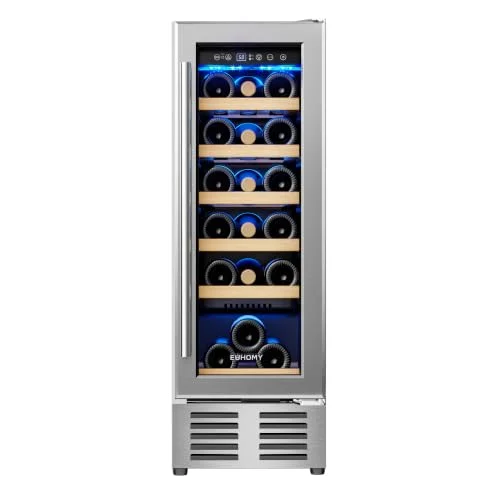
EUHOMY 12 Inch Wine Cooler Refrigerator
18 bottles, double-layer tempered glass door
18 bottles·Single zone·Built-in or freestanding
Its listing specifically calls out a double-layer tempered glass door — the construction described above, where a sealed air pocket between two panes does the insulating. On any unit built this way, that edge seal is the part worth a careful look in the first days of ownership, under good light, from an angle, before the cabinet is loaded with bottles and the door becomes harder to inspect closely. It also lists a temperature memory function, which keeps the setpoint after a power outage rather than reverting to a default.
Worth knowing the construction before you decide whether a cloudy patch is routine or a seal issue.
02Dual zone, 33 bottles
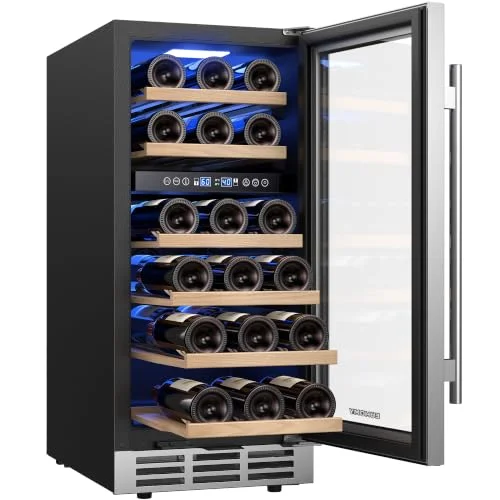
EUHOMY 15 Inch Wine Fridge
33 bottles across two independently set zones
33 bottles·Dual zone
Two zones mean two different glass-surface temperatures behind the same door, which is exactly the setup discussed above: whichever zone is set colder presents a wider gap to a humid room and is the one more likely to show surface fog first. That is a property of running any dual-zone cabinet cold, not a flaw specific to this model — it is simply the clearest real-world example of the trigger this guide walks through.
A good illustration of why dual-zone owners see fog more often than single-zone owners in the same kitchen.
03Dual zone, 30 bottles
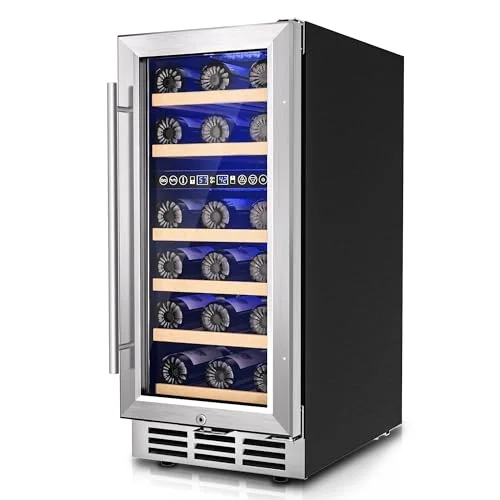
Icyglee 15" Wine Cooler Refrigerator, Silver
30 bottles, dual zone
30 bottles·Dual zone
A second 15-inch dual-zone cabinet, included here for the same reason as the EUHOMY above: two setpoints behind one door means uneven surface temperature, and that unevenness is exactly where to expect fog to appear first and linger longest if the room stays humid. Beyond zone count and bottle capacity, we do not have a published breakdown of the door construction for this listing, so we are not asserting anything about its seal type one way or the other — check the current listing for that detail before buying.
If a dual-zone cabinet fogs unevenly across its two halves, this is the pattern to expect, not a defect.
When to live with it, and when to call it a warranty claim
Sort the fog by where it sits and the decision mostly makes itself.
Outside fog is not a defect and is not warranty territory. It is a function of your room's humidity meeting a cold door, and no manufacturer will — or should — replace a unit for doing what physics predicts. If it bothers you, address the room: a small dehumidifier nearby, better airflow, or relocating the unit away from a stove or a steam-producing appliance will do more than anything the fridge itself can offer.
Fog between the panes is exactly the opposite. A sealed glass unit that has let moisture in has failed, full stop, and it will not resolve itself — it is far more likely to spread than to clear. This is squarely a manufacturing or shipping-damage issue, and it is worth raising with the seller or manufacturer promptly rather than living with it, especially since most standard appliance warranties run on a clock that starts at delivery. Photograph it as soon as you notice it — from an angle that makes clear the haze is inside the glass rather than on a surface — and keep the order confirmation and listing details handy, since the specific warranty terms and length are stated on each product's own listing rather than being uniform across sellers.
Fog inside the cabinet depends on the cause. If it is a door caught on a bottle or a shelf, that is a five-minute fix and not a product issue at all. If it is a gasket that fails the dollar-bill test on a unit that is still fairly new, that is reasonable grounds for a warranty claim too — a gasket should seal properly for a meaningful stretch of ordinary use, and one that has already gone slack on a recent purchase points to a part that was never seated or molded correctly. A gasket that has simply hardened after years of daily use, on the other hand, is ordinary wear, and the fix is a replacement gasket rather than a claim on a long-expired warranty — covered in the maintenance guide linked above.
How we compared these — and what we cannot tell you
We compared the published specifications and current prices for the units named in this guide, and anchored every claim about condensation and seals in general building-physics and appliance-construction facts rather than in anything specific to an individual listing we could not verify. Where a spec — a door's pane construction, a temperature range, an installation type — was not stated on a given listing, we said so rather than filling the gap with a guess.
We do not run a testing lab. We do not own these units and we do not physically test them, so there is no invented score out of ten here, and no star rating either — the retailer API does not return ratings or review counts for this category, so we do not publish numbers we cannot source. What we can do is read the specifications carefully, track prices, and explain the physical mechanisms — dew point, sealed glazing, gasket wear — that actually govern whether a given door fogs.
Prices quoted here were correct at the time of writing and change frequently. Confirm the current price before buying.
Frequently asked questions
Is fog on the outside of my wine fridge's door normal?
Yes. The outer face of a wine fridge door runs colder than room temperature, and whenever humid room air meets that cold surface, some of its moisture condenses — the same thing that happens on a cold glass of water. It wipes off with a dry cloth and tends to return whenever the room gets humid again. It is not a sign of a fault.
Why does fog between the glass panes not go away?
Because it is not on a surface you can reach. Double- and triple-pane doors seal a pocket of dry air between the panes for insulation; if that edge seal fails, humid air gets into the pocket and condenses against the inner pane with nowhere to escape to. It is trapped there permanently until the door or the seal is replaced, which is why this version is a warranty issue rather than something to wipe away.
My wine fridge door was left open overnight and there's fog inside — is that bad?
It explains the fog, and it is not damage by itself, but check two things: that nothing is holding the door slightly ajar (a bottle, a tilted shelf, a misaligned hinge) and, if the door looked fully closed, whether the gasket still seals properly with the dollar-bill test. A door that was genuinely left open is a one-time event; a gasket that has gone soft will keep causing the same fog every day until it is replaced.
Will turning the temperature up stop the fogging?
It can reduce outside fog, because a milder setpoint narrows the gap between the glass and the room's dew point — but it does nothing for fog trapped between the panes, which is a sealed-unit failure independent of what the thermostat is set to. Raising the temperature enough to meaningfully cut condensation also raises your wine's storage temperature, so it is a trade worth making deliberately, not a free fix.
Written by Ilane Tall. Research-based comparisons of published specifications, current prices and general appliance-construction facts — we do not physically test these units and we do not publish invented scores.