By Ilane Tall · Updated October 11, 2026 · Research-based.
Reader-supported: we may earn a commission when you buy through the links on this page, at no additional cost to you. It never changes which product we recommend. Prices quoted below were correct at the time of writing and move often.
Quick answer
A home wine fridge is specified for a handful of door-openings a day. A restaurant or small bar opens it constantly through service — the compressor almost never rests, and a flimsy lock becomes a real liability once staff and guests share the space behind the bar.
For most independent restaurants and small bars, a freestanding compressor unit with real capacity and, ideally, a confirmed lock is the right tier — not a countertop model, and usually not true commercial refrigeration either. The GarveeHome 80 Bottle is the one to buy if you need volume; the ORYMUSE 30 Bottle / 110 Can earns its place behind a bar pouring both wine and cans; the BODEGA 24 Inch 154 Bottle is for once the wine list outgrows an 80-bottle cabinet.
None of these are certified commercial refrigeration. Read when to stop buying residential units before you commit a wine-program budget to one.
Where a residential-grade unit breaks down under commercial use
Every wine fridge sold on Amazon, including the three in this guide, is designed and rated as a residential appliance — a statement about the assumptions baked into the engineering, and those assumptions are the first thing commercial use violates.
A residential wine fridge is designed around a usage pattern where the door opens a few times a day, each opening lasts seconds, and the compressor cycles on, pulls the interior back to setpoint, then rests for a long stretch. Manufacturers size the compressor, insulation and door gasket for that rhythm, because that is the rhythm a kitchen or a den actually produces.
A service floor does not produce that rhythm. A busy small bar can open a wine fridge door forty or fifty times across a single night, each opening dumping a slug of room-temperature air into the cabinet. At home that happens once before dinner, with the rest of the evening to recover. In a restaurant, the next opening often arrives before the last one has been fully corrected — the core of the problem covered next.
Three specific failure points follow from that gap between design assumption and actual use:
- The compressor runs far closer to continuously, generating more heat and wear in a month than it would see in a year of home use.
- The door gasket and hinge see orders of magnitude more cycles — this is where seals degrade first and where cold air starts leaking out around the door even when the unit still "runs."
- The lock, if there is one, becomes load-bearing rather than decorative. At home a cylinder lock is a nice-to-have. Behind a bar shared by multiple staff and sometimes the public, it is the only thing standing between your wine list and shrinkage — a point this guide returns to below.
None of this means a residential unit cannot work in a small commercial setting — thousands of independent restaurants run exactly that equipment successfully. It means the margin for error is thinner, and the point at which you outgrow residential equipment arrives sooner than most buyers expect. We walk through that threshold at the end of this guide.
Duty cycle and recovery time: what constant door-opening does to a compressor
"Duty cycle" is the ratio of time a compressor spends running to the total time it could be running. A compressor with a low duty cycle — on for a few minutes, off for twenty — is operating comfortably within its design margin. One pushed toward a high duty cycle, running almost continuously to chase a setpoint it keeps losing, is operating at the edge of what it was built for.
Constant door-opening pushes duty cycle up in a direct, physical way. Every opening replaces cold air with warm, humid room air, and the compressor has to run to pull that heat back out. If the next opening arrives before recovery finishes, the compressor never gets the "off" period it was designed around — it is effectively asked to hold a moving target instead of a fixed one.
Recovery time — how long a unit takes to return to setpoint after the door closes — is the number that actually describes how a wine fridge will behave in service, and manufacturers essentially never publish it. In its absence, two published specs act as reasonable proxies: a genuine compressor system rather than thermoelectric, and a stated wide operating range, which signals headroom rather than a unit running flat-out to hold a narrow factory default.
Thermoelectric cooling has no moving refrigerant cycle — quieter and cheaper, but it can only pull the interior down by a fixed amount below room temperature, with essentially no reserve to absorb a spike in door-openings. A bar that gets busy, with bodies and kitchen heat pushing the room warmer, is exactly the condition that breaks that narrow margin. Compressor cooling has an active refrigerant cycle that can work harder when asked to — the reserve a high-traffic bar draws on, which is why all three products here use it.
The GarveeHome 80 Bottle and the ORYMUSE 30 Bottle / 110 Can are both compressor units with a published 41–64°F range — wide enough to suggest real cooling headroom. The BODEGA 24 Inch 154 Bottle adds a feature aimed at a related problem: an intelligent temperature memory system that restores the cabinet's last setpoint automatically after a power interruption, so a breaker trip during service doesn't leave the cabinet drifting until someone notices.
Capacity math for a wine list, not a personal collection
A home buyer sizes a wine fridge around a collection that grows slowly and gets opened occasionally. A restaurant or bar sizes storage around a wine list that has to survive a specific, recurring event: the busiest night of the week, without someone running to a back-of-house case mid-service.
Run the math the way a buyer actually should: count the wines by the glass and by the bottle on the list, multiply by how many of each you want ready at the start of service, then add a buffer for a strong Friday rather than an average Tuesday. A list with twelve by-the-glass wines, two bottles of each held ready, is already twenty-four bottles committed before a single bottle sale happens — add floor stock for the ten most popular bottle-sale wines at three each, and the baseline is past fifty before any backup case is counted.
That arithmetic is why bottle count, not footprint or price, should be the first filter for a commercial buyer. Here is how the three products in this guide land against it:
- BODEGA 24 Inch, 154 bottles. Sized for an actual wine list rather than a personal cellar — a full by-the-glass and by-the-bottle program with floor stock, without mid-rush restocks. The pick once the list itself needs the room.
- GarveeHome 80 Bottle. A genuinely useful middle tier — a focused list with backup, at close to half the price and a fraction of the footprint. The capacity most small independent restaurants and neighborhood bars actually need.
- ORYMUSE 30 Inch, 30 bottles and 110 cans. The lowest wine-bottle count of the three, deliberately so: this is a dual-zone wine-and-beverage unit, not a wine-only cabinet, built for a bar pouring both wine and packaged drinks from one footprint.
One caution applies to all bottle-count figures in this category: manufacturer capacity numbers assume slim, uniform bottles packed with no wasted space. A real wine list mixes Burgundy, Champagne and Bordeaux shapes, and a backup case rarely racks that efficiently. Plan your service-night math against a number below the advertised capacity, not the number on the box.
Locks and staff access in a shared service area
A lock on a home wine fridge is a minor feature. Behind a bar or in a restaurant back room, it is closer to a cash-handling control: multiple staff and sometimes the public move through the same space over a shift, and a wine fridge sitting unlocked in that traffic is an open invitation an owner or GM will eventually have to account for at inventory time.
This matters more for wine than for most bar inventory, because shrinkage is unusually hard to catch in the moment. A missing case of beer is obvious at a glance; a single bottle of a $60 Cabernet quietly walking out during a slow Tuesday is not — it surfaces weeks later as a gap between pour-cost projections and actual sales, with no way to trace which shift it left through.
Here is where the specifications create a real decision point: the data we have access to does not confirm a cylinder lock as a listed feature on the GarveeHome 80 Bottle or the ORYMUSE 30 Bottle / 110 Can. That doesn't mean either lacks one, only that we won't claim a feature the available specs don't state. If a lock is a requirement, confirm it directly on the current listing before you buy.
Where a lock is confirmed, treat it as one control among several, not a complete solution — a locked cabinet still needs a key policy: who holds a key, and what happens when a manager is off.
If the lock is confirmed
Treat the key the same way you treat the liquor cage key — logged, limited to management or a short list of trusted keyholders, and never left in the lock during service.
If the lock is not confirmed
Place the unit somewhere with its own access control — a locked back room or a manager's station — rather than counting on the cabinet itself to do that job.
The picks
All three of the following are compressor-cooled units with published specifications that hold up against the duty-cycle and capacity questions above. None are certified commercial refrigeration — see the next section for when that distinction starts to matter for your budget.
How the three compare
| Model | Best for | Capacity | Cooling | Installation | Price | Get it |
|---|
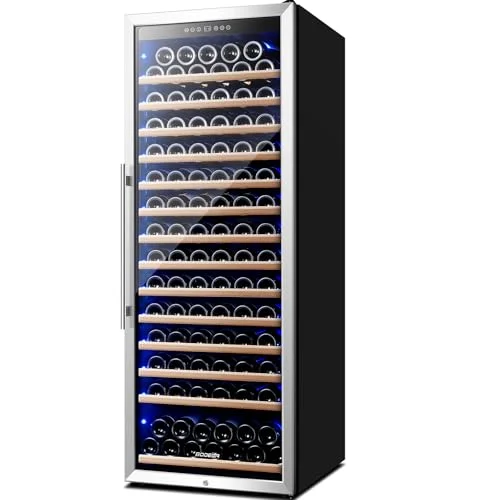 BODEGA 24 Inch 154 Bottle BODEGA 24 Inch 154 Bottle |
A full wine list |
154 bottles |
Compressor |
Tall freestanding |
$1,089.99 |
Get it |
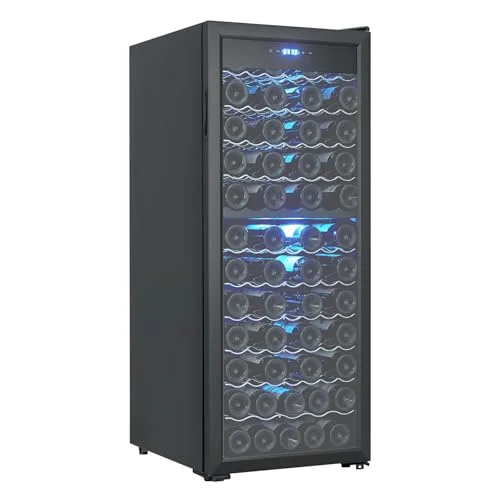 GarveeHome 80 Bottle GarveeHome 80 Bottle |
A small bar's working list |
80 bottles |
Compressor |
Freestanding |
$686.41 |
Get it |
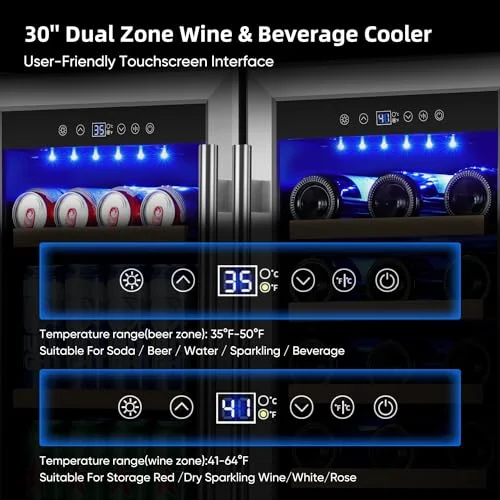 ORYMUSE 30" Wine & Beverage ORYMUSE 30" Wine & Beverage |
Wine and cans together |
30 bottles + 110 cans |
Compressor |
Built-in or freestanding |
$799.99 |
Get it |
When to stop buying residential units and budget for true commercial equipment instead
Every unit in this guide is a residential appliance pressed into commercial service. That works for a large share of independent restaurants and small bars, but it has real limits, and buying past them with a bigger residential cabinet instead of the right equipment is a false economy.
True commercial refrigeration — sold through foodservice equipment dealers rather than general retail — carries NSF and/or ETL certification, continuous-duty compressors engineered for the load, and often a service contract a residential warranty does not provide. It also carries a price that typically starts well above what any unit here costs, frequently several times over, before installation. A practical way to think about the threshold, based on the duty-cycle and capacity math above:
- Door-opening frequency is the strongest signal, not sales volume. A unit opened for a quick pour forty or fifty times a night is operating at a duty cycle residential engineering did not anticipate, regardless of total dollar volume.
- A pattern of early compressor failure is the clearest sign you've already crossed the line. One failing early can be bad luck. A second or third within a short window, on units run the same way, is the duty cycle telling you something the spec sheet could not.
- Health-department or insurance requirements can force the decision regardless of volume. Some jurisdictions and insurers specify NSF or ETL-listed equipment for certain storage uses — a compliance question for your local authority and carrier, not one this guide can answer generally.
- A wine program generating meaningful nightly revenue justifies the premium on its own, since the downtime risk of a failed residential unit mid-service is the more expensive outcome.
For a large share of independent restaurants and small bars — a focused list, moderate nightly traffic — a well-chosen residential-grade unit like the three above is a sound, considerably cheaper choice than commercial refrigeration, provided you respect the duty-cycle and lock considerations above. The point to budget past it is when the pattern of use shows the limits directly: repeated early failures, a health or insurance requirement, or revenue that has outgrown what a residential compressor should reasonably carry every night.
How we compared these
We compared published specifications and current listed prices for the three products above against the demands of a commercial service environment — door-opening frequency, cooling type, capacity relative to a working wine list, and stated features like lock and power-interruption handling. Where a specification was not stated, including the lock feature on two of the three units, we said so rather than assuming it.
We do not run a testing lab, and we have not placed these units in a working restaurant or bar under service conditions. What we can do honestly is read the specifications carefully, track prices, and reason through how cooling type, capacity and feature set map onto what a service floor actually demands.
Prices quoted here were correct at the time of writing and change frequently. Confirm the current price, and any feature you're relying on, directly on the listing before you commit a wine-program budget to it.
Frequently asked questions
Can I use a regular home wine fridge in my restaurant or bar?
Many small restaurants and bars do, successfully, and every product in this guide is residential-grade rather than certified commercial equipment. The risk isn't that it won't work at all — constant door-opening pushes the compressor toward a far higher duty cycle than it was engineered around, which tends to shorten its working life. A compressor-cooled model with a wide published temperature range gives more margin against that risk than a thermoelectric unit.
How many bottles of capacity does a small bar actually need?
Size it to your busiest realistic night: count the wines by the glass and by the bottle on your list, decide how many of each you want ready at the start of service, and add floor stock for your best-selling bottle-sale wines. Compare that total against a figure meaningfully below the advertised capacity, since those figures assume uniformly slim bottles packed without wasted space.
Do I need a lock on a wine fridge used behind a bar?
If multiple staff or the public share access to the space, a lock is a real inventory control rather than a nice-to-have — wine shrinkage is unusually hard to trace after the fact. Confirm directly on the listing whether a given unit includes one; the published specifications for two of the three products here do not list a lock.
At what point should I buy true commercial refrigeration instead?
When the pattern of use shows the limit directly: repeated early compressor failures on units run the same way, a health-department or insurance requirement for NSF- or ETL-listed equipment, or nightly revenue high enough that commercial-grade reliability is justified by the cost of downtime during service.
Written by Ilane Tall. Research-based comparisons of published specifications, current prices and general domain facts — we do not physically test these units and we do not publish invented scores.