By Ilane Tall · Updated October 14, 2026 · Research-based.
Reader-supported: we may earn a commission when you buy through the links on this page, at no additional cost to you. It never changes which product we recommend. Prices quoted below were correct at the time of writing and move often.
The short version
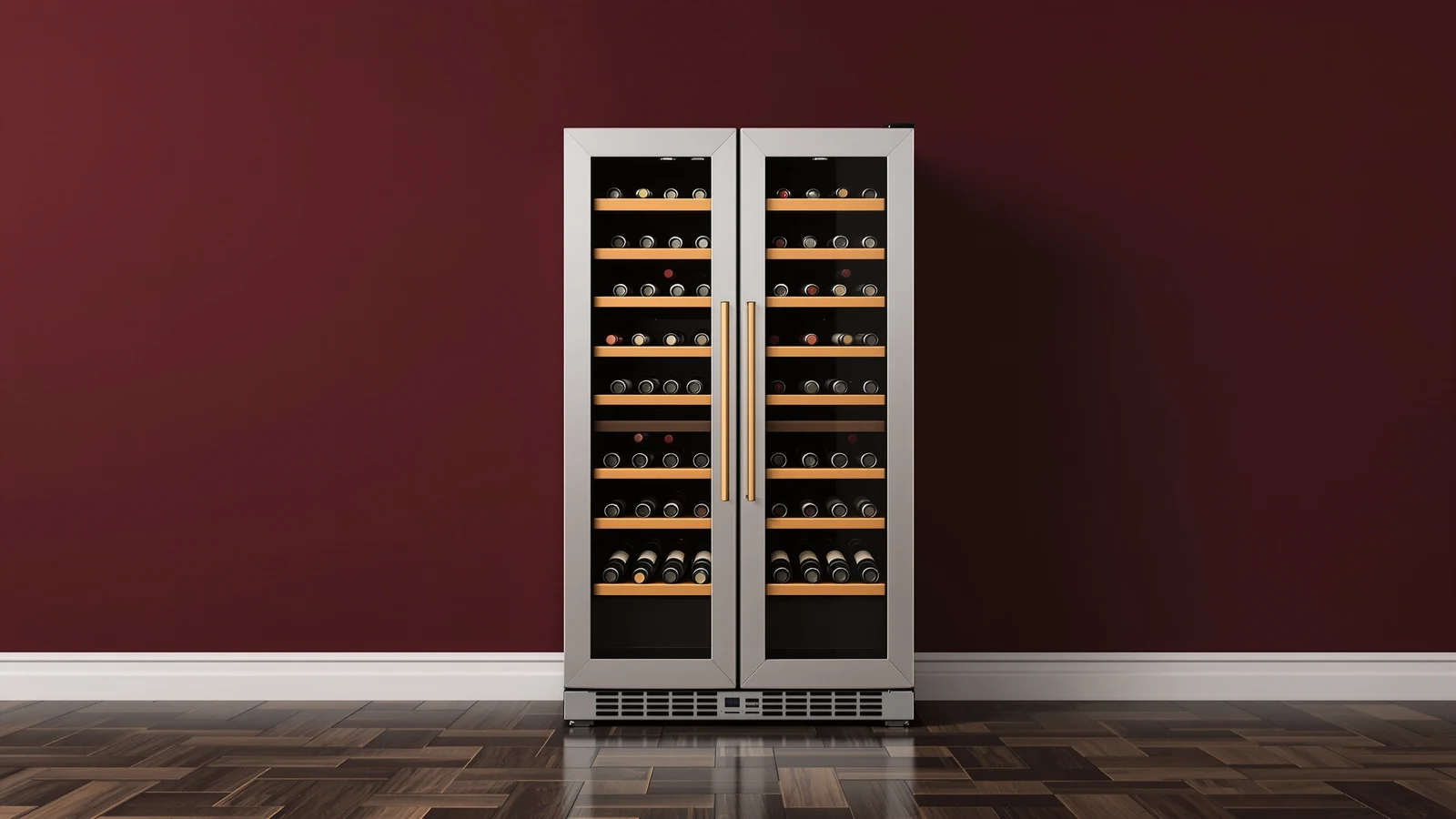
A French door splits one wide door into two narrower leaves that each swing through roughly half the arc. In a galley kitchen or an island run where a single wide door would hit a cabinet, an island edge or someone standing at the stove, that narrower swing is the entire reason the feature exists.
The cost is a center seam — one more place where two gaskets meet instead of one continuous door seal — which is why French doors show up almost exclusively on wider 24-inch dual-zone cabinets built with the gasket engineering to back it up, not on narrow 15-inch units.
If you already know the clearance problem you're solving, jump to the picks. If you're not sure a French door is the right feature for your layout, measure the swing radius first — it takes five minutes and it is the only number that actually settles the question.
What a French door actually buys you: swing clearance, not cooling
Start with what a French door is not. It is not a different compressor, a wider temperature range, or a cabinet that holds meaningfully more bottles than the same footprint with one door. The dual-zone split that so often travels with a French-door front — one zone behind each leaf — is a separate feature that happens to pair naturally with two doors, not a consequence of the door design itself. Plenty of single-door cabinets run dual zones internally with no center seam at all.
What a French door genuinely changes is the arc the door sweeps through when it opens. A single 24-inch door, hinged on one side, has to swing open almost 90 degrees before it clears the opening enough to pull a bottle from the back of a shelf — and because it is one continuous panel the full width of the cabinet, that swing projects the full 24 inches (plus the door's own thickness) out into the room. Split that same 24-inch opening into two leaves hinged on opposite sides, and each door only has to cover roughly half that width. The two doors can open to a narrower angle and still clear the opening, and the projection into the room from either leaf is roughly half of what the single wide door needed.
That is the whole case for the feature, stated plainly: a French door exists to shrink how far a door has to swing into the room to use the fridge, in situations where a single wide door would hit something. It is a clearance solution, not a cooling or capacity upgrade. If your installation has no clearance problem — an open floor plan, a fridge on an end run with nothing to its left or right — a French door buys you a nicer-looking cabinet front and nothing else functionally, at the cost discussed below.
The tradeoff: a center seam is one more place for a seal to fail
Every wine fridge door depends on a continuous gasket to keep cold air in and room-temperature, humid air out. A single-door cabinet has exactly one perimeter to seal: top, bottom, and the two long sides of one door, against one continuous frame. A French-door cabinet has two separate doors, each with its own perimeter gasket, meeting in the middle at a vertical seam where there is no frame behind them — just the two door edges pressed against each other, or against a thin mullion strip.
That center seam is structurally the weakest point in the enclosure. A single door's gasket compresses evenly against a rigid frame all the way around. A French door's center seam depends on both leaves closing to the same plane and the two edge gaskets meeting cleanly, which is a tighter manufacturing tolerance than sealing one door against one frame. Over years of the door swinging, the hinges settling slightly, and the cabinet itself expanding and contracting with temperature, that seam is the first place a gap tends to open — before the outer gaskets, which still have a full frame to compress against.
In practice this shows up as a narrow strip of warmer, more humid air leaking in down the middle of the cabinet, which is also where condensation and fogging are most likely to start. If you already own a French-door unit and notice fogging concentrated down the center rather than evenly across the glass, that is consistent with a center-seam leak rather than a general door-seal problem — our guide to wine fridge condensation and a foggy glass door walks through diagnosing which one you actually have.
None of this means a French door is a bad design — it means it is a design with one more failure point than a single door has, in exchange for a real clearance benefit. The products worth buying are the ones built with enough structure around that center seam — a rigid mullion, door-aligned hinges, double-paned glass on both leaves — that the tradeoff stays theoretical rather than becoming a five-year problem.
Why French doors show up on 24-inch dual-zone cabinets, not 15-inch units
Look across the wine-fridge category and the pattern is consistent: French doors appear almost exclusively on 24-inch-wide cabinets, and almost never on narrow 15-inch undercounter units. That is not a styling accident. It is a direct consequence of the clearance math above.
A 15-inch door is already narrow. Even swung open close to 90 degrees, a 15-inch single door projects a relatively short distance into the room, and the opening itself is small enough that most kitchen layouts can accommodate the swing without hitting anything. Splitting a 15-inch opening into two 7.5-inch leaves would shrink the swing further, but at that width there is very little left to gain — and a lot to lose. Each leaf would be narrow enough that the hinges, the glass pane and the gasket hardware crowd a very small panel, and the center seam would sit in the middle of an already-tight 15-inch footprint where structural room for a proper mullion barely exists. The tradeoff stops making sense: you would be adding a seam and manufacturing complexity to solve a clearance problem that a 15-inch door mostly doesn't have.
A 24-inch cabinet is a different proposition on both sides of the equation. The single-door version has a real swing-clearance problem — a 24-inch door swinging open is a meaningfully large obstruction in a kitchen run, enough to interfere with an adjacent cabinet, an island, or a person standing at an adjacent appliance. And the 24-inch width leaves enough room for each French-door leaf to be a proper 12-inch panel with its own frame, hinge and glass pane, plus genuine structural room for a mullion at the center seam. The economics of the dual-zone compressor split also favor 24 inches: a cabinet wide enough to hold a meaningful bottle-and-can capacity on each side of an internal divider is naturally wide enough that two doors solve a real swing problem instead of a marginal one. That is why the four products below are all 24-inch dual-zone units — it is close to the only size class where a French door earns its complexity.
For the fuller picture on how width drives what a cabinet can and can't do — door style included — our guide to 12-inch vs 15-inch vs 24-inch wine fridges covers the rest of that decision.
Independent door opening: does it actually save cold air per zone?
The other claimed benefit of a French-door dual-zone cabinet is that opening one door only exposes one zone, leaving the other sealed and undisturbed. This is true as stated, and it is worth being precise about how much it actually buys you, because the marketing copy tends to oversell it.
Inside a dual-zone cabinet, the two compartments are already separated by a fixed internal divider — a horizontal or vertical panel that exists specifically to let each zone hold its own setpoint, independent of a single door design. That divider is doing the real work of keeping the zones thermally apart; it is present whether the cabinet has one door or two. What a French door adds on top of that is simply that you are not opening a panel that spans both zones at once. On a single-door dual-zone unit, opening the one door to reach the lower zone also briefly exposes the upper zone's compartment to room air at the same moment, because they share one door opening even though the compartments themselves stay physically divided inside.
So the honest version is: independent doors reduce how much room air reaches the zone you are not using, at the moment you open the fridge — a real but modest effect, bounded by the fact that the internal divider was already doing most of the separation. It is not a claim that French doors cool more efficiently, hold temperature more precisely, or use less electricity than a single-door dual-zone cabinet of the same size; we have not seen a manufacturer publish numbers suggesting that, and we are not going to estimate one. If independent zone access matters to you — for instance, a household that opens the white-wine side daily while the red-wine side is opened rarely — a French door is the feature that delivers it; if both zones get opened together most of the time anyway, the benefit mostly disappears.
The picks
All four of the following are 24-inch dual-zone cabinets with French-door fronts, which tracks with the pattern above — none of them is a 15-inch unit, because the category essentially doesn't make that cabinet.
01Best overall
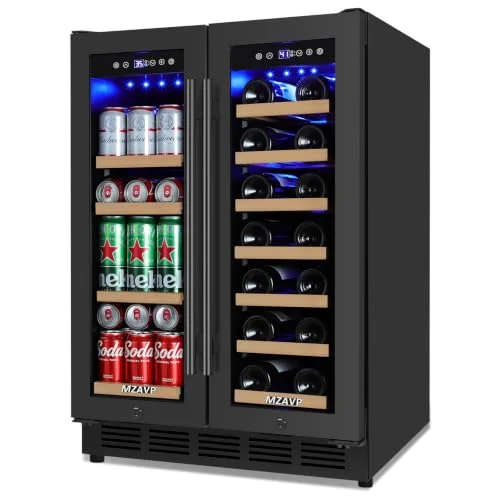
MZAVP 24 Inch Wine and Beverage Refrigerator (34.25")
The French-door pick with the most headroom for a tight kitchen run
21 bottles + 88 cans·Dual zone·Built-in or freestanding·34.25 inches
A French door with a glass front on one side and a second French door on the beverage side, splitting wine from cans across a dual-zone, 24-inch-wide cabinet rated for built-in or freestanding installation. The 34.25-inch size line is worth reading carefully if you are shopping for an undercounter opening: confirm it against your cabinet's height clearance before you order, since that figure is the authority on fit here, not a guess from the photos. Beyond that, this is the straightforward case for the feature — a wide dual-zone cabinet where a single door would be the widest, most awkward-swinging panel in the kitchen.
The French door earns its seam here: 88 cans and 21 bottles behind a single wide opening would be a door you'd resent swinging open daily.
02Best upgraded compressor
ORYMUSE 24 Inch Dual Zone Wine and Beverage Refrigerator
The pick if compressor reliability behind the seam matters most
88 Can and 20 Bottle · 4.65 cu.ft·Dual zone·Built-in or freestanding
ORYMUSE markets this specifically on an upgraded compressor, in a 24-inch French-door cabinet built for either under-counter or freestanding placement. That compressor emphasis is directly relevant to the center-seam tradeoff discussed above: a cabinet that has to work a little harder to recover from the extra air exchange two doors allow benefits from the margin a stronger compressor provides. At 4.65 cubic feet and 88 cans plus 20 bottles, the capacity split is close to the MZAVP above, which makes this mostly a question of which compressor specification and price you'd rather have.
The specific feature to check if you're worried about a French door's seam catching up with the cooling system over time.
03Best glass-door capacity
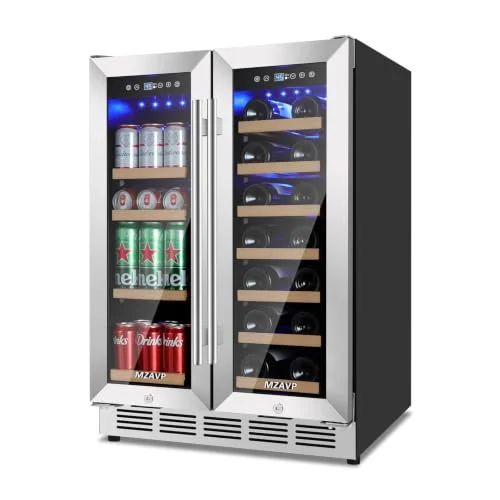
MZAVP 24 Inch Wine and Beverage Refrigerator (Glass Door)
Near-identical to the top pick, for households that want the visible glass front on both zones
20 Bottles + 88 Cans · 4.65 cu.ft·Dual zone·Built-in or freestanding
A second MZAVP listing at essentially the same capacity and footprint as the pick above, built around a glass French door rather than a mixed glass-and-solid front. If the deciding factor for your kitchen is how the cabinet looks stocked through the glass rather than any difference in cooling, this and the top pick are close enough in specification that price and finish are the real distinguishing factors — check both listings' current price before deciding, since they move independently.
Functionally the same clearance and seam tradeoff as the top pick, in a different door finish.
04Best for a home bar
BODEGA 24 Inch Wine and Beverage Refrigerator
Two full glass French doors, styled for a bar rather than a kitchen cabinet run
19 Bottles + 57 Cans·Dual zone·Built-in or freestanding
BODEGA's listing describes this as a commercial-style black bar cooler with two full glass doors — a slightly different emphasis than the two MZAVP cabinets above, which pair a glass door with a more mixed front. The two-glass-door layout is worth a specific look if the cabinet is going into a bar area where both zones are meant to be visible at a glance, rather than a kitchen run where one side might sit against a wall. Nineteen bottles and 57 cans is a modest step down in capacity from the other three picks, which tracks with a cabinet built around two matching glass panels rather than maximizing shelf space behind a mixed front.
The pick when both French-door panels being glass matters more than squeezing out the last few bottles of capacity.
Measuring swing radius for two doors instead of one
Before buying any French-door cabinet, spend five minutes with a tape measure in the actual spot it will live — this is the step that settles whether the feature is solving a real problem for your kitchen or just adding a seam for no reason.
Start by marking the cabinet's intended footprint on the floor with tape: the width and depth from the product listing, in the exact spot the unit will sit. Then, for a single-door cabinet you're comparing against, measure out from the hinge side through roughly a 100–110 degree arc — more than the common assumption of 90 degrees, since you want enough swing to lean in and reach the back shelf, not just crack the door. Mark where the leading edge of that door lands. That mark, measured straight out from the cabinet face, is the single door's full swing projection into the room.
For a French-door cabinet, repeat the same arc measurement on each leaf independently, using roughly half the cabinet's width as each door's radius rather than the full width. Because the two doors hinge on opposite outer edges and meet in the middle, each one sweeps a smaller arc and lands closer to the cabinet face than the single wide door did. Mark both leading edges. The number that actually matters is not the two doors' individual projections — it's whether either one, at its fully open position, clears the nearest obstacle: an island edge, an adjacent cabinet, a walkway, or a person standing at the stove or sink.
The practical test: if your tape-measure mark for a single 24-inch door's swing lands inside an island, a neighboring cabinet, or a walkway you need to keep clear, that is the specific, concrete case for paying the French-door premium and accepting its center seam. If the single door's full swing clears everything in the room with room to spare, a French door is solving a problem you don't have, and a single-door dual-zone cabinet is the simpler, fewer-seams choice.
One more thing worth checking at the same time: clearance above and in front of the cabinet for pulling a tall bottle or a case of cans straight up and out, not just the door's side swing. A French door's narrower individual leaves can sometimes mean a slightly narrower reach-in angle on each side even though the overall opening is the same width — worth a dry run with a full box of cans if the unit is going somewhere genuinely tight.
How we compared these — and what we cannot tell you
We compared the published manufacturer specifications and current listed prices for the French-door, dual-zone 24-inch wine and beverage refrigerators available in this category, read each listing for door configuration, capacity split, installation type and any stated compressor or build detail, and reasoned from general refrigeration and door-seal principles about what a center seam means for a cabinet's cooling and durability over time. Where a listing gave a size line — like the MZAVP's 34.25-inch figure — we treated that as the authority on fit and did not estimate a dimension the listing doesn't state.
We do not run a testing lab. We have not physically installed or used these cabinets, so there is no invented score out of ten here, and no claim about how a center seam actually performs after five years of swinging — that would require long-term ownership data we don't have. What we can do honestly is read the specifications carefully, track the prices, and explain the mechanical tradeoff a French door represents so you can weigh it against your own kitchen. Star ratings and review counts are not available from the retailer data for this category, so you will not find paraphrased owner sentiment here either — we would rather say plainly that we don't have it than invent a pattern we cannot verify.
Prices quoted in this guide were correct at the time of writing and change frequently. Confirm the current price before buying.
Frequently asked questions
Does a French door wine fridge cool differently than a single-door one?
No — the compressor, refrigerant circuit and zone dividers are the same technology either way. A French door changes how the door opens and how many gasket seams the cabinet has, not the cooling mechanism. Any cooling difference between two cabinets comes from their compressor and insulation, not their door count.
Why don't 15-inch wine fridges come with French doors?
Because a 15-inch door is already narrow enough that its swing rarely causes a clearance problem, and splitting that width into two leaves leaves very little room for a proper mullion, hinge and gasket on each side. French doors solve a real problem on wider 24-inch cabinets and mostly add complexity without a matching benefit at 15 inches, which is why the category concentrates almost entirely on 24-inch dual-zone units.
Is the center seam on a French door likely to leak?
It's the structurally weakest point in the enclosure compared with a single continuous door seal, because it depends on two separate gaskets meeting cleanly rather than one gasket compressing against a rigid frame. Well-built units address this with a rigid mullion and properly aligned hinges. If you notice fogging concentrated down the middle of a French-door cabinet rather than spread evenly, that's consistent with a center-seam issue worth checking.
Do independent French doors actually keep each wine zone colder?
They reduce how much room air reaches the zone you aren't opening at that moment, but the internal divider between zones is already doing most of that separation regardless of door count. It's a real but modest benefit, not a claim that French doors cool more efficiently or hold a tighter temperature than a single-door dual-zone cabinet of the same size.
Written by Ilane Tall. Research-based comparisons of published specifications, current prices and general refrigeration and door-seal principles — we do not physically test these units and we do not publish invented scores.