By Ilane Tall · Updated October 21, 2026 · Research-based.
Reader-supported: we may earn a commission when you buy through the links on this page, at no additional cost to you. It never changes which product we recommend. Prices quoted below were correct at the time of writing and move often.
Quick answer
Buy capacity you'll only use for a few weeks a year, not capacity sized to an average Tuesday. A mixed wine-and-beverage cabinet — wine on one side, cans on the other — covers guests who don't drink wine without a second appliance. Favor a seamless or French-door front where people will be standing in the way, and plan now for what the extra space becomes in January. See the sizing math first — it gets everything else right or wrong before you've opened a bottle.
Hosting is a capacity spike, not a steady state
Most wine fridge buying advice — including ours, on our main wine fridge guide — is written for a steady-state household: the same six to twelve bottles cycling through at roughly the same pace every week. That math falls apart the moment you host. A single Thanksgiving dinner or a week with out-of-town family staying over can put more bottles and cans through a cabinet in a few days than a normal household moves in two months.
That changes the sizing question. Size for your average week and you get a cabinet that's comfortably full in July and hopelessly undersized on December 23rd, with warm bottles stacked on the counter. Size for the spike and the cabinet looks oversized most of the year — and exactly right for the one week it has to earn its price.
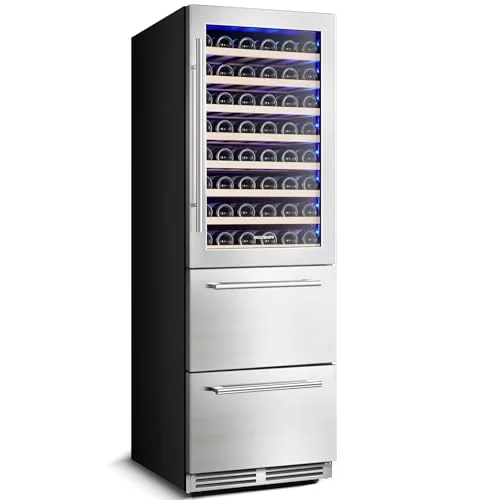
The practical rule: count the worst week you actually host, not the week you wish you hosted less. Work backward from that night — bottles opened, cans consumed, plus a buffer for the ones left unopened — and buy to that number. A cabinet rated for 80-plus bottles and well over a hundred cans, like the BODEGA 24" 2-in-1 Dual Zone (88 bottles, 149 cans), is absurd for a household that drinks two glasses a week; it's exactly right for one hosting the extended family every December without three coolers of ice in the kitchen.
The households that get this wrong tend to repeat the mistake: buy a mid-size fridge sized for the quiet months, discover it can't absorb a holiday week, then add a second small fridge or a stack of coolers — costing more in total while scattering drinks across the one kitchen guests are actually looking at. If your year-round collection sits closer to fifty or eighty bottles with no beverage side needed, our guide to wine fridges between 50 and 80 bottles is the better starting point — the units here are deliberately oversized for a surge.
Mixed wine-and-beverage cabinets: not everyone at the party drinks wine
The second mistake is sizing correctly for wine and ignoring everyone who isn't drinking it. A holiday gathering is rarely all-wine: there's the in-law who only drinks beer, the teenager who wants soda, the driver on sparkling water. A wine-only cabinet, however large, does nothing for any of them — and the kitchen fridge, already full of side dishes, isn't where those drinks live for a week.
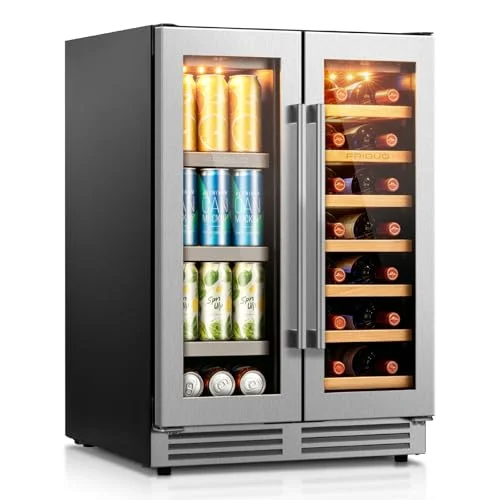
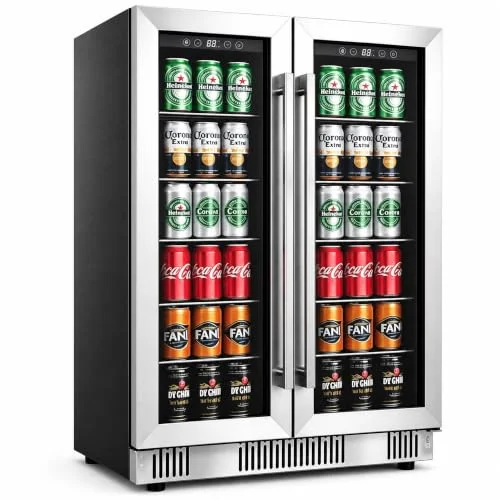
A mixed wine-and-beverage refrigerator solves this with one cabinet instead of two appliances. The 24" Seamless Wine and Beverage Refrigerator is built around exactly this scenario — its listing is explicit that it's sized for a home party, with 20 bottles of wine on one side and room for 88 cans on the other, behind one stainless-steel glass door. The BODEGA 24" 2-in-1 runs the same idea at larger scale: 88 bottles and 149 cans, with independently controlled zones so wine holds cellar temperature while cans run cold enough for beer and soda.
The trade to understand first applies to any dual-zone cabinet: the divider is physical, and cans take rack space that would otherwise hold bottles. That's the right trade for a hosting cabinet, where the point is covering every guest rather than maximizing wine storage — but if your gathering is genuinely wine-only, an all-wine cabinet gets more bottles per dollar.
Where a dedicated beverage side isn't an option — small kitchen, tight budget, no 24-inch opening to spare — a lower-cost entry like the himio 24" Dual Zone Built-In at $339.99 still gives two independently set compartments for wine; pair it with a cooler of ice for cans and you've covered most of the gap for less money. himio's listing doesn't publish bottle or can counts for this model, so check the current listing for exact capacity first.
Recovery time after a dozen door-openings in one evening
A fridge that holds temperature perfectly when nobody is touching it tells you nothing about how it behaves at a party, where the door opens every few minutes for hours. Each opening lets warm kitchen air flood the cabinet and pushes the compressor into a recovery cycle — and how fast that recovery happens is a function of cooling type, not of how many bottles the box claims to hold.
Compressor-cooled units, which is what every fridge on this page uses, pull heat out actively rather than relying on a passive differential — they recover from a door-opening on their own schedule, largely independent of how hot the kitchen gets from the oven and a crowd standing around it. Thermoelectric coolers, which only pull the interior down to roughly 20°F below room temperature, lack that active pull: in a kitchen warmer than usual, a thermoelectric unit can lose ground on every opening and never fully recover before the next. For a party cabinet, compressor cooling is the difference between merely cool by the end of the night and one that actually held its setpoint.
Dual-zone units add a variable worth knowing before the party: because one compressor typically serves both zones, heavy traffic on the beverage side can transiently affect how hard the system works to hold the wine side, and vice versa. No manufacturer publishes a recovery-time spec, so there's no number to quote and we won't invent one — just give a compressor cabinet a few minutes of closed-door time between the heaviest stretches of traffic where you can. If a unit runs constantly rather than cycling even on a normal day, our guide to compressor cycling noise covers normal behavior versus an actual problem.
Why a seamless or French-door front matters more in a crowded kitchen
Door design is easy to ignore shopping alone and hard to ignore the moment ten people are in your kitchen. A single hinged door on a 24-inch cabinet needs real swing clearance, and in a kitchen where people are circulating with plates and glasses, that swing radius is exactly where someone is standing. A French-door configuration — two narrower doors opening from the center — needs roughly half the clearance on either side, which matters far more at a party than on a quiet Tuesday.
A seamless front solves a related but different problem: integration. The 24" Seamless Wine and Beverage Refrigerator uses a flush stainless-steel-and-glass front so the cabinet reads as part of the kitchen rather than an appliance bolted on afterward — no protruding handle to catch a sleeve or tray, no visual break in a run of cabinetry guests will stand in front of all evening.
None of the four units here ship with French doors specifically — a distinct hardware style worth seeking out if your kitchen is small and your guest count is large. Our guide to wine fridges with French doors covers units built around that configuration. What you can act on today: don't plan a single-door cabinet's swing path through the spot the serving table sits on the night it matters.
The picks
Four units, ladder-priced, built around the same idea: cover a surge, not a steady state. Each is a dual-zone wine-and-beverage cabinet rather than an all-wine unit, because the gatherings this guide is written for are rarely all-wine gatherings.
01Most capacity for the biggest night
BODEGA 24" 2-in-1 Dual Zone Wine & Beverage Refrigerator
Most capacity for the biggest night
88 bottles + 149 cans·Dual zone·Compressor·Built-in or freestanding
This is the cabinet for a household that genuinely hosts at scale — a full holiday dinner, a New Year's party, a week of family staying over. Eighty-eight bottles and 149 cans in one 24-inch footprint, split across independently controlled zones, with soft LED lighting so the cabinet doubles as part of the party rather than hiding in a corner. Rated for built-in or freestanding installation. The honest caution: this is a lot of cabinet for a household that doesn't host like this every year, and that capacity sits mostly empty most weeks.
Buy this if December's guest count is what actually sets your fridge needs.
02Built for a home party, by name
24" Seamless Wine and Beverage Refrigerator
Built for a home party, by name
20 bottles + 88 cans·Dual zone·Compressor·Under-counter or freestanding
The listing for this one doesn't leave the use case to guesswork — it's explicitly sold as a party cabinet. Twenty bottles of wine and 88 cans behind one seamless stainless-steel glass door, the flush, handle-light front that matters most where guests are standing right in front of it all evening. Rated for under-counter or freestanding installation, with wine at storage temperature on one side and drinks at serving temperature on the other, at well under half the price of the largest pick here.
The pick when kitchen traffic, not raw capacity, is the constraint.
03Quiet enough for a living room
Tylza 30" Dual Zone Wine and Beverage Refrigerator, Quiet Black
Quiet enough for a living room
30" wide·24" depth·Dual zone·Compressor
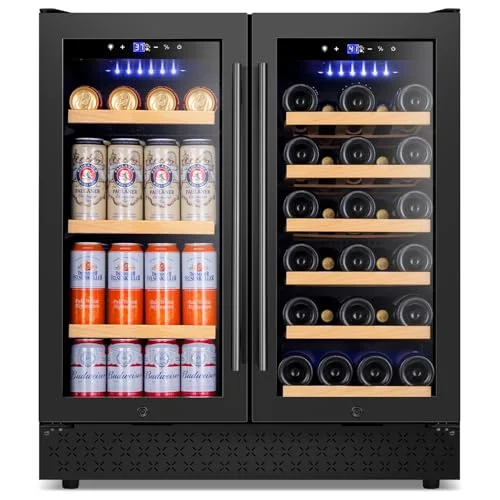
Most of this list is sized for a kitchen; this one is wide enough — 30 inches — to stand alone in an open-concept living or dining space, where a party actually happens rather than just where the food is staged. Tylza markets it specifically as a quiet unit, which matters more a few feet from where people are talking than tucked into a kitchen corner. The 24-inch depth keeps it from protruding into a walkway. Tylza's listing doesn't publish a bottle or can count for this model, so check the current listing if exact capacity is the deciding factor.
The pick if the fridge needs to live where the party is.
04Lowest cost of entry
himio 24" Dual Zone Built-In Cooler
Lowest cost of entry
24" built-in·Dual zone·Compressor
If you host occasionally rather than at scale, and don't want to spend four figures on a cabinet that sits half-empty most of the year, this is the floor of the category: a 24-inch dual-zone unit built for installation under a counter, at the lowest price here. It won't match the BODEGA's raw capacity or the Seamless pick's party-specific layout — himio doesn't publish bottle or can figures for this model, so confirm capacity on the current listing before buying — but it still gives two independently controlled zones for a fraction of the cost, enough for a reds-and-whites or wine-and-a-few-cold-drinks split at a smaller gathering.
The pragmatic pick for frequent, modest hosting rather than an annual blowout.
What to do with the extra capacity in January
A cabinet sized for a holiday surge is, by definition, oversized the rest of the year — and the question nobody answers is what to do with that empty space once the family has gone home.
The first move costs nothing: run both zones at a single storage temperature. Wine at roughly 55°F and the beverage side turned toward general storage turns the cabinet into a large wine cellar with a spare compartment — better than running it at full party-mode settings to hold six bottles.
The second move: let the beverage side keep doing what it does best, at a smaller scale — a dedicated, always-cold space for sodas and sparkling water that otherwise crowd the kitchen fridge. A genuinely useful year-round job, even without fifty guests.
The third option, worth considering for a serious collection: let the oversized unit become secondary storage while a smaller one handles daily use, and move it to a cooler, more stable room such as a basement rather than a kitchen that swings in temperature every time the oven runs. Our guide to wine fridges for a basement or cellar room covers what changes when the room, not the kitchen, does the storing. If the cabinet stays visible, see our guide to wine fridges with LED display lighting for what makes it earn its keep as a display piece too.
How we compared these — and what we can't tell you
We compared published specifications, current listed prices and stated capacities for mixed wine-and-beverage refrigerators available in the US, selecting cabinets built around dual-zone, high-throughput use rather than steady-state storage. Where a listing states a bottle or can count, we used it; where it doesn't, as with the himio and Tylza units here, we said so instead of estimating.
We do not run a testing lab. We have not hosted a party with these specific units, timed their recovery after a dozen door-openings, or measured sound pressure across a room. No manufacturer publishes a recovery-time spec for any wine fridge we've found, and we aren't going to invent one. What we can tell you — compressor versus thermoelectric behavior, the clearance math on hinged versus French doors, the trade a zone divider makes with rack space — is general domain knowledge about how these appliances work, not a claim about any one unit's party performance. Prices quoted here were correct at the time of writing and change frequently; confirm the current price before buying.
Frequently asked questions
How much capacity do I actually need for a holiday party?
Size to your worst week, not your average week. Count what a real past gathering actually consumed, add a buffer for unopened bottles, and buy to that number. North of fifty bottles plus a beverage side, a large mixed cabinet like the BODEGA (88 bottles, 149 cans) is the right scale; smaller, more frequent hosting is better served by a lower-cost 24-inch dual-zone unit.
Should I buy a wine-only fridge or a wine-and-beverage unit for entertaining?
If every guest drinks wine, an all-wine cabinet gets more bottles per dollar. If your gatherings mix wine, beer and soda drinkers, a mixed wine-and-beverage cabinet covers everyone from one appliance instead of a separate cooler of ice for the non-wine drinks.
Will the compressor keep up with a dozen door-openings in one evening?
A compressor-cooled unit actively pulls heat out rather than relying on a passive differential, so it recovers from repeated door-openings on its own schedule instead of losing ground permanently. No manufacturer publishes an exact recovery-time figure, but compressor cooling is the right category for this job — thermoelectric, which only pulls about 20°F below room temperature, is the wrong one for a crowded, warm kitchen.
What do I do with all that extra capacity after the holidays?
Turn both zones toward one storage temperature and let the cabinet act as general wine storage, keep the beverage side running as year-round soda overflow, or shift it to secondary storage in a cooler room like a basement while a smaller unit handles daily use.
Written by Ilane Tall. Research-based comparisons of published specifications and current prices — we do not physically test these units and we do not publish invented scores.