By Ilane Tall · Updated October 15, 2026 · Research-based.
Reader-supported: we may earn a commission when you buy through the links on this page, at no additional cost to you. It never changes which product we recommend. Prices quoted below were correct at the time of writing and move often.
The short version
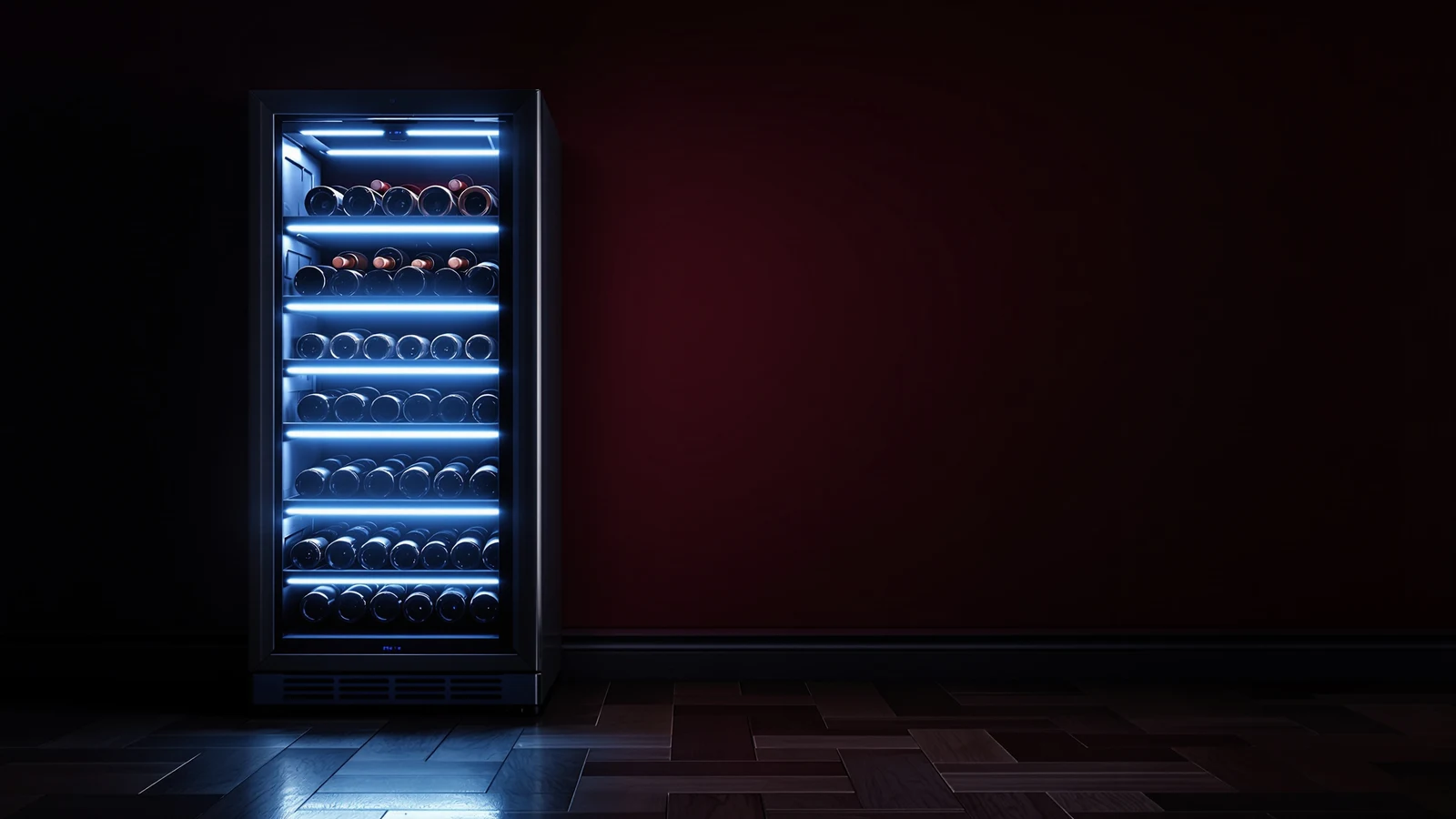
An LED in a wine fridge is a display feature first and a storage feature a distant second. Most of them light the shelf edge and the glass door rather than the whole cabinet interior, which is exactly backward if you actually wanted even illumination — and exactly right if what you wanted was bottles that glow from an open shelf or a bar nook.
The honest tension underneath all of this: constant light, even a cool-running LED, is still light, and long-term wine storage wants darkness. None of that makes a lit cabinet a bad buy — it makes it a different kind of buy than a cellar unit, with a different rule for how you use it.
If you already know you want this feature, jump straight to the picks. If you're deciding between a fixed warm-white glow and a color-changing party light, read that section first — it's the decision that actually divides these products.
Why some buyers want a wine fridge to be seen, not just used
Most wine-fridge buying guides assume the goal is storage: keep the bottles at a stable temperature, out of the light, until you're ready to drink them. That's the right goal for a collection you're building for the long haul, and it's the premise behind almost everything else we write on this site. But it isn't the only reason people buy a wine fridge, and treating it as the only reason misses a real segment of buyers who are shopping for something else entirely.
A lit wine fridge on open shelving, in a bar nook, or built into an entertaining space is doing a second job: it's furniture. It's the thing a guest notices when they walk into the room, the same way a backlit liquor shelf or an under-cabinet light strip is furniture. The bottles inside are real and will eventually be opened, but in the meantime they're also doing visual work — color, texture, the soft glow of glass and foil against dark wood or black steel. For that buyer, a unit that lights up is not a nice-to-have. It's close to the entire point of putting it where they're putting it.
This is a legitimate and common use case, and it deserves a guide written for it rather than a footnote in a cellar-storage article. The products below were chosen because the LED is a genuine, stated feature of each listing, not an afterthought — and because the honest version of this guide has to say plainly where a display light helps and where it works against what the same cabinet is also trying to do, which is keep wine in decent shape until you drink it.
What the LED actually lights: shelf edge versus the whole cabinet interior
Read enough listings in this category and a pattern becomes clear: "LED lighting" rarely means the same thing twice. It is worth being specific about what you're actually buying, because the difference changes both how the cabinet looks and how much light the bottles are exposed to.
On most of the units here, the LED strip runs along the shelf edge or the top of the cabinet interior, throwing light downward and outward through the glass door rather than flooding the whole box evenly. That's a deliberate design choice, not a cost-cutting shortcut: a shelf-edge strip lights the labels and the neck of each bottle — the part a person standing across the room actually sees — without needing enough fixtures to evenly illuminate a tall, narrow interior the way a refrigerator case at a wine shop does. It's a display light aimed at the glass front, not a flood light aimed at every shelf.
A smaller number of units, and the countertop-format cabinets in particular, light more of the interior at once simply because the cabinet itself is smaller — there's less volume for a given LED strip to fill, so the effect reads as fuller illumination even though the fixture itself may be similar. None of the four products below claim to evenly flood a tall multi-shelf interior top to bottom the way a commercial display case does, and we're not going to imply otherwise. If a listing doesn't specify where the LED sits or how much of the interior it covers, treat the marketing photo as aspirational and the shelf-edge assumption as the safer default.
What this means practically: buy for the glow you'll see from across the room — the glass front lit from inside, the top few bottles picked out clearly — rather than expecting the back shelf of a tall cabinet to be as bright as the front. If you want genuinely even interior lighting because you're photographing the bottles or using the fridge as the focal point of a display wall, say so in the listing's Q&A before you buy, since none of the four products here publish a lux figure or a diagram of coverage, and we won't invent one.
The honest tension: light exposure and long-term storage don't mix
This is the part of the pitch that display-lighting marketing copy skips, and it's worth stating plainly rather than burying it in a caveat at the end.
Wine is damaged by heat, by vibration, and by light — specifically ultraviolet and, to a lesser extent, visible light, which can degrade the compounds responsible for a wine's color and aroma over months and years of exposure. That's the entire reason bottles are shipped in tinted glass, why serious cellars are kept dark, and why the tinted or UV-filtered glass on a wine fridge door exists in the first place: it's not a style choice, it's protecting the contents from exactly the kind of constant light a display feature introduces on purpose.
An LED strip inside the cabinet runs cool compared with an incandescent bulb — LEDs produce very little of their output as heat, which is the one genuine advantage they have over older display lighting and the reason manufacturers can put them inside a sealed, insulated box without warming the interior meaningfully. But "runs cool" answers the heat half of the storage question and says nothing about the light half. A bottle sitting three inches from an LED strip that's on for twelve hours a day is getting meaningfully more light exposure than the same bottle in a dark, closed cabinet — regardless of how little heat that LED throws off.
The honest version: a display light does not meaningfully speed up spoilage for a bottle you're going to open within a few months — the exposure is real but the timescale for light damage is measured in seasons and years, not weeks. The tension only matters for a bottle you intend to age past that window, sitting on the same lit shelf as everything else.
That's not a reason to avoid these products. It's a reason to treat the light as a feature you turn on when it's doing its job — being seen — and off for anything you're actually aging, which is exactly what the last section of this guide covers.
If condensation or a foggy door is part of what's pushing you toward a glass-front display unit in the first place, that's a separate mechanism worth understanding on its own — our guide to wine fridge condensation and a foggy glass door walks through what causes it and what it means for the cabinet, lit or not.
Color-changing LEDs as a party feature versus a fixed warm-white display light
Once you've accepted the basic tension above, the real decision these products force on you is a style one: do you want a light that shifts color, or one that holds a single warm tone all the time?
A fixed warm-white light is the quieter, more furniture-like choice. It reads as intentional lighting design rather than a feature being shown off — closer to the soft glow of a display case in a wine shop than to anything that calls attention to itself. BODEGA markets its dual-zone 15-inch cabinet specifically around this: a "Soft LED" built into both zones, aimed at a steady glow rather than an effect. If the fridge is going into a kitchen, a dining area, or anywhere it needs to look considered rather than novel, a fixed warm-white light is almost always the better match, and it's the one that ages well — a color-cycling light that felt fun when the cabinet was new can start to feel like a distraction once the novelty wears off and the fridge is just part of the room.
A color-changing LED is a different, more deliberately decorative choice, and it's worth being honest about what it's for: it's a party and entertaining feature, not a wine-preservation feature and not really a furniture feature either. EORICE's 24-inch dual-zone unit is built around exactly this — its listing specifies an LED blue light, a single accent color rather than a full cycling spectrum, paired with what EORICE describes as smart fast cooling. A blue-lit glass front reads dramatically at night, in a bar area, or anywhere the fridge is meant to be a conversation piece rather than quiet storage furniture. It's also the choice that tells you most clearly: this cabinet's lighting is for show, and the storage tension described above applies to it more than to any fixed warm-white unit here, simply because an accent light like this tends to get left on more often — that's the whole point of it.
Neither choice is wrong. The honest way to decide is to ask where the fridge is actually going and who's going to see it. A kitchen or dining-adjacent cabinet usually wants the fixed warm-white treatment; a home bar, basement entertaining space, or anywhere you're hosting wants the accent color, with the understanding that it's a lighting effect layered on top of a wine fridge, not the other way around.
Placement for maximum visibility: open shelving, a bar nook, eye level
A lit wine fridge only does its decorative job if it's placed where the light is actually seen, and this is the part buyers tend to get wrong after spending the money on the feature itself.
Open shelving is the single best setting for a display unit. A cabinet on an open shelf, rather than built into a run of closed cabinetry, has light spilling out on multiple sides rather than just through the front glass — the glow reads from across a room, not just to someone standing directly in front of it. This is also where a smaller, countertop-format unit earns its keep: a compact 12-bottle cabinet on an open shelf above a bar cart or sideboard is a genuinely striking object in a way the same unit tucked into a cabinet run never will be.
A bar nook — a dedicated pour station, a wet bar, a converted closet set up for entertaining — is the second obvious placement, and it's where a built-in-capable unit earns the installation effort. A cabinet recessed into millwork with a lit glass front reads as a designed feature of the room rather than an appliance someone plugged in, which is exactly the effect most buyers in this category are chasing.
Eye level matters more than either of those choices. An LED shelf light is designed to be seen face-on through the glass door; mounted low, near the floor, most of that light is wasted on the ceiling of the cabinet below eye level rather than on the row of bottles a standing adult actually looks at. Where the layout allows it, put the cabinet somewhere the glass front sits roughly between waist and shoulder height for someone standing in the room — a counter, a credenza, a built-in run at kitchen-counter height — rather than on the floor or on a high shelf where the glow mostly disappears from normal sightlines. Our guide on choosing the right wine fridge width covers the sizing side of fitting a unit into a specific run of cabinetry or counter space, which is worth reading alongside this if you're planning a built-in bar nook from scratch.
The picks
All four of these state LED lighting as a specific, named feature on the listing — not a generic "illuminated interior" claim with nothing behind it. We've ordered them by what each one does best for a display setup rather than by price.
01Best overall
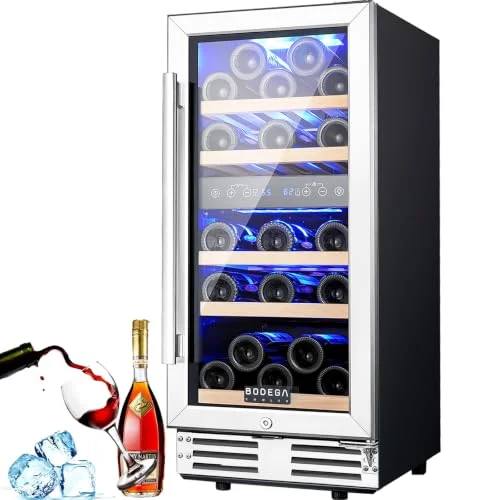
BODEGA 15 Inch Dual Zone Wine Fridge, Soft LED
The steady warm-white glow for a kitchen or dining-adjacent build
32 bottles·Dual zone·41–68°F·Built-in or freestanding
BODEGA's listing names "Soft LED" as a dedicated feature across both zones of this 15-inch, 3.2-cubic-foot cabinet, which is the fixed warm-white treatment this guide recommends for anywhere the fridge needs to look like considered lighting design rather than a novelty. The 32-bottle figure is this specific listing's stated size, split across a dual-zone divider, so expect a meaningfully lower per-zone count than that headline number once the cabinet is actually loaded. Rated for built-in or freestanding installation, which makes it a realistic pick for a recessed bar-nook build as well as an open-shelf placement.
The pick if the light needs to look like it belongs there, not like a feature being demonstrated.
02Best for a small open shelf
Qgnaewnoyj 12 Bottle Thermoelectric Countertop with LED Lighting
The cheapest way to put a glowing cabinet on open shelving
12 bottles·Thermoelectric·Countertop·Freestanding
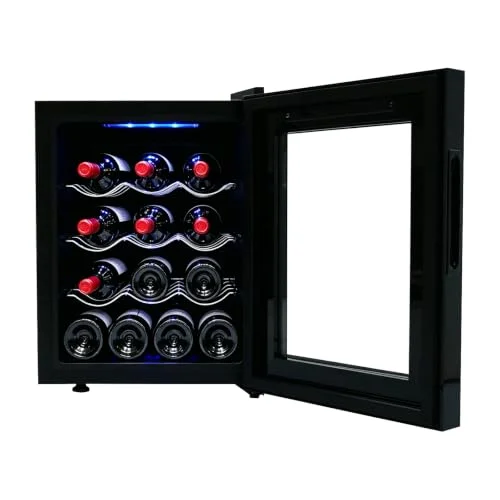
A small, stainless-steel, freestanding countertop cabinet with LED lighting named directly in its listing title — this is the pick for a bar cart, a sideboard, or an open shelf where a full-size dual-zone unit would overwhelm the space. Twelve bottles is a modest capacity, and thermoelectric cooling means it won't hold a tight setpoint in a warm room the way a compressor unit will, so treat this as a serving-and-display cabinet for bottles in active rotation rather than a long-term storage solution. For that job — a small, lit, eye-catching object near where people are actually pouring — it's the most accessible entry point in this guide by a wide margin on price.
Small, cheap, and genuinely striking on an open shelf — just don't ask it to be a cellar.
03Best glass-door showcase
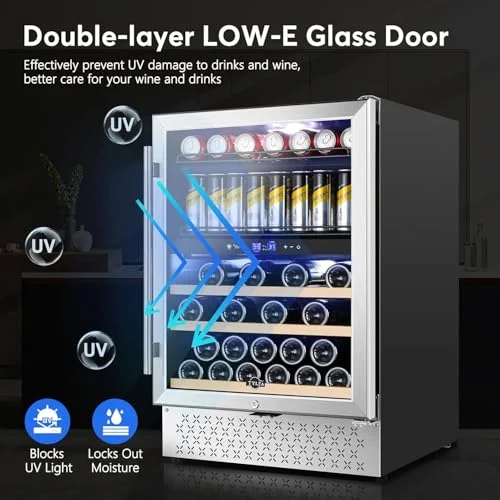
Tylza 24 Inch Dual Zone, Double-Layer Glass Door, LED Light
The clearest front-of-glass view, with a lock for a shared bar area
30 bottles + 100 cans·Dual zone·24" depth·Built-in or freestanding
Tylza's listing pairs its LED light with a double-layer glass door — a detail worth calling out for a display unit specifically, since a better-insulated glass door runs less condensation risk than a single pane, which matters more on a cabinet whose whole job is staying clear and visible. The 24-inch-depth figure in this listing is the specification to confirm against your counter or cabinet opening before ordering; it's the authority on fit here, not the capacity numbers on their own. A built-in lock is also listed, worth it for a wine-and-beverage unit living in a shared bar or entertaining space rather than a private kitchen.
If the glass itself needs to stay clear for the display to work, this is the one built with that in mind.
04Best color accent
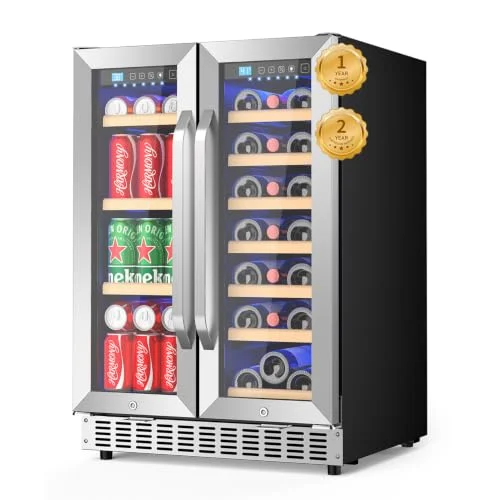
EORICE 24-Inch Dual Zone with LED Blue Light
The deliberate party-feature pick, not the quiet-furniture one
21 bottles + 60 cans·Dual zone·4.2 cu.ft·Smart fast cooling
EORICE names its LED blue light directly in the listing, alongside smart fast cooling, in a 4.2-cubic-foot dual-zone cabinet with a glass door. This is the one pick in this guide built around an accent color rather than a fixed warm-white glow, and we'd recommend it on exactly that basis: a home-bar or entertaining-space cabinet where the lighting is meant to be noticed, not blended in. Because an accent light like this tends to stay on more than a quiet display light does — that's the point of it — it's also the pick where the honest tension between constant light and long-term storage applies most directly; see the "when to turn it off" guidance below before you load it with anything you plan to age.
The pick for a bar that wants to be noticed, with the storage caveat that comes with it.
When to turn the lights off: for a bottle you're actually aging past a season
Here is the practical rule that resolves the tension this whole guide has been building toward, and it's simpler than it sounds.
For bottles in active rotation — anything you expect to open within the next few months, which is how most people actually use a display-lit fridge — leave the light on. The exposure over that timeframe is real but small next to the benefit you bought the feature for, and it's the use case these four products are genuinely built around. A display cabinet that's never lit is a storage unit that happens to have a glass door; if you're not going to use the light, a cheaper unit without it is the better purchase.
The exception is any bottle you are deliberately setting aside to age past a season — a vintage you're holding for a year or several, something you bought specifically because it will improve with time rather than to drink this month. That bottle belongs somewhere the light is off: a back corner of a shelf angled away from the strip, a dedicated single-zone cellar unit kept dark, or simply a cabinet with the light switched off if the unit allows it independently of the compressor. None of the four products above publish whether their LED can be switched off separately from the cooling system — if that control matters to you, confirm it in the listing's Q&A before buying, since it's exactly the kind of detail a product photo won't show and we won't guess at.
Put plainly: a display light and an aging bottle are not compatible on the same shelf for years at a time, and no amount of "runs cool" marketing changes that. The fix isn't to avoid these products — it's to be deliberate about which bottles live under the light and which don't, the same way a serious collector keeps a serving rack near the kitchen separate from the cellar proper. If your collection is genuinely split between bottles you're drinking soon and bottles you're aging, a single lit display cabinet usually can't serve both jobs well, and our guide to wine fridges under $500 for a growing collection is a better starting point for the aging side of that split.
How we compared these — and what we cannot tell you
We compared the published manufacturer listings for LED lighting, capacity, zone configuration, cooling type and price across wine fridges that name lighting as a specific feature rather than an unspecified "illuminated interior," and reasoned from general facts about light exposure, UV-filtered glass and LED heat output that apply across the category. Where a listing states a size or depth figure — like Tylza's 24-inch depth or EORICE's 4.2-cubic-foot rating — we treated that line as the authority on fit and did not estimate a dimension the listing doesn't give.
We do not run a testing lab. We have not installed or photographed these cabinets lit in a room ourselves, so there's no invented brightness rating or lux figure here, and no claim about exactly how visible any one unit's glow is from a specific distance — that would require direct measurement in a room we don't have. None of these products carry a published rating or review count from the retailer data, so you won't find a star rating or paraphrased owner sentiment in this guide either; we'd rather say we don't have that data than invent a pattern we can't verify.
Prices quoted in this guide were correct at the time of writing and change frequently. Confirm the current price before buying.
Frequently asked questions
Will a wine fridge's LED light damage the wine inside?
Not meaningfully for a bottle you'll open within a few months — the exposure is real, but light damage to wine is a slow process measured in seasons and years, not weeks. The risk is specific to a bottle you intend to age for a year or longer on the same lit shelf; for that bottle, keep the light off or store it somewhere dark instead.
Should I buy color-changing LEDs or a fixed warm-white light?
A fixed warm-white light reads as considered lighting design and suits a kitchen, dining area or anywhere the cabinet needs to look like furniture rather than a feature being shown off. A color accent like a blue LED is a deliberate party and entertaining feature, better suited to a home bar or an entertaining space where the fridge is meant to be noticed.
Where should I put a wine fridge if I want it to be seen?
Open shelving shows off the glow best, since light spills out from multiple sides rather than just through the front glass. A bar nook or a built-in run of millwork is the second strongest placement. In either case, position the glass front roughly between waist and shoulder height for someone standing in the room — an LED shelf light mostly disappears from view if it's mounted near the floor or high above eye level.
Should I leave the display light on all the time?
For bottles you expect to open within the next few months, yes — that's the use case the feature is built for, and the light exposure over that timeframe is small. For any bottle you're deliberately aging past a season, switch the light off or store that bottle somewhere dark instead; constant light and long-term aging don't mix well on the same shelf.
Written by Ilane Tall. Research-based comparisons of published specifications, current prices and general facts about light exposure and wine storage — we do not physically test these units and we do not publish invented scores.