By Ilane Tall · Updated October 25, 2026 · Research-based.
Reader-supported: we may earn a commission when you buy through the links on this page, at no additional cost to you. It never changes which product we recommend. Prices quoted below were correct at the time of writing and move often.
Quick answer
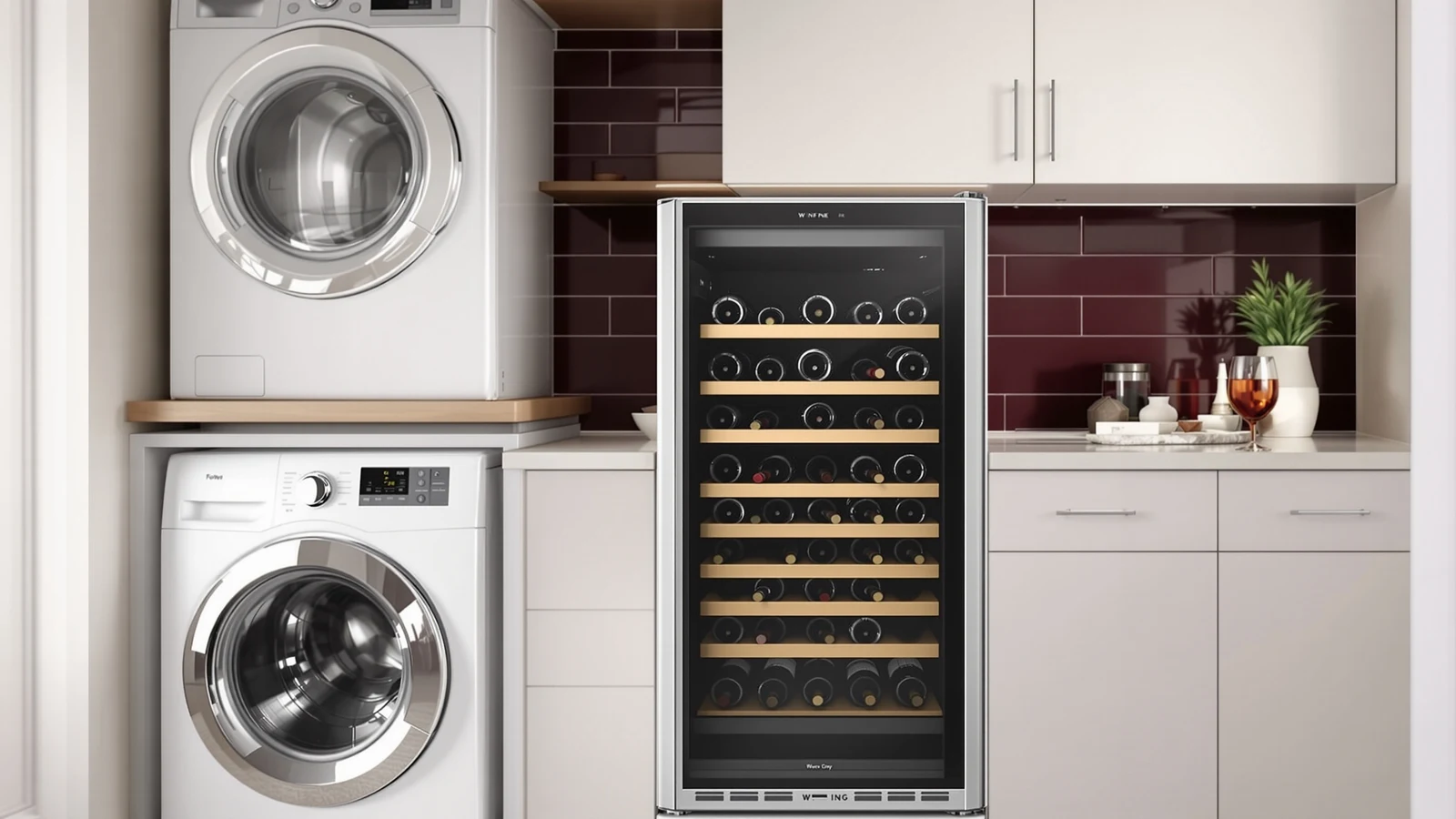
A laundry room doesn't need a fridge built for the basement's slow, constant dampness — it needs one that can shrug off the short, intense humidity spike every wash and dry cycle produces, and one narrow enough to actually fit the leftover gap next to the machines. Go to the picks if you already know that part.
Skip the glass-and-LED display units built to be the centerpiece of a kitchen. In a mudroom, a sealed cabinet and a gasket that still seals tight after a year of vibration from the washer matter more than lighting. And if the room is an unconditioned mudroom off a garage, check what a hot summer does to a compressor before you buy.
Why a laundry room is a different humidity problem than a basement
Most wine fridge buying advice treats humidity as one problem: a damp room is bad for the cabinet's electronics and seals, so buy accordingly. A basement earns that framing honestly — an unfinished or semi-finished basement often sits at a chronically elevated relative humidity, day in and day out, because the room is below grade and surrounded by cool earth that condenses ambient moisture. The air in a basement is wet more or less all the time.
A laundry room or mudroom is a completely different kind of wet. A washing machine's fill, agitation and spin cycle runs for roughly thirty to sixty minutes and then stops; a dryer vents warm, moisture-laden air for a similar window, and even a properly ducted dryer leaks some of that warm humid air back into the room around the door seal and the lint trap housing. In between loads, a laundry room with reasonable ventilation returns to something close to normal household humidity. The exposure a wine fridge sees here is a repeated spike-and-recover pattern, not a sustained soak — more like a bathroom after a hot shower than like a root cellar.
That distinction matters for what you should actually shop for. A basement-grade concern is about an appliance's cabinet and compressor tolerating sustained high ambient humidity over months. A laundry-room-grade concern is about the door gasket and cabinet seams resisting repeated condensation cycles — moisture settling on a cool cabinet surface during a humidity spike, then drying off again before the next load — without the seal degrading or trapped moisture finding its way to the electronics. It's a shorter, sharper stress, and it rewards solid build quality at the door more than it rewards whatever a listing claims about operating in "high humidity" generally. For the room that actually does run humid around the clock, our guide to wine fridges for a basement or cellar room covers that different problem in full.
Before anything about cooling or capacity, a laundry room forces a hard constraint most kitchens never do: the space left over after two full-size appliances and whatever else the room needs to hold. A standard washer or dryer runs roughly 27 to 28 inches wide, and a side-by-side pair in anything but a dedicated laundry suite usually eats the whole available wall. What's left is frequently a single narrow slot — sometimes the width of a stud bay, sometimes a counter run above a folding station — and rarely a full 24-inch kitchen-style cabinet opening.
That's the reason width, not capacity, should be the first filter in this room. Of the three products covered below, the Icyglee 12" 18 Bottle is the one sized for the tightest version of that slot: a 12-inch-wide cabinet is narrow enough to fit beside a washer and dryer pair in a space that would reject anything wider, while still holding 18 bottles. The other two products here are both built to a 15-inch width, which needs a genuinely wider gap or counter run — workable in a larger mudroom or a laundry room with a dedicated appliance wall, not workable in a tight closet-style setup.
Two clearances matter as much as the cabinet's own width. First, the door swing: a wine fridge's glass door adds depth when it opens, and in a mudroom that often doubles as a walkway, that swing needs to clear the path to an exterior door without blocking it even partway. Second, the dryer's exhaust path: never place a fridge directly in front of or immediately beside a dryer vent duct run, where you'd be forced to route it around the cabinet or compress its bend radius to make room. A vent that has to kink around an appliance is a maintenance problem waiting to happen, independent of anything to do with the wine fridge itself.
Sealed cabinet construction over a decorative display front
A wine fridge destined for a dining room or an open kitchen is often sold — and bought — partly as furniture: LED strip lighting to showcase labels, a mirrored or stainless display finish, wide glass meant to be seen from across the room. None of that is the point of a laundry room purchase. Nobody wanders through a mudroom to admire the wine fridge; the job here is to hold bottles at a stable temperature while absorbing the room's humidity bursts and a washer's vibration, and come back for more tomorrow.
What should carry the weight in that decision is the cabinet and door construction, not the lighting package. A tight-sealing door gasket is what actually keeps condensation and humid air from working its way into the cabinet interior and around the control board during a laundry cycle; a glass display door you can see through at a glance is still useful here (all three fridges in this guide have one, because you still want to check on bottles without opening the door and losing the cold air), but it's doing a practical job, not a decorative one. The 15" Under-Counter Dual Zone, 30 Bottle model's stainless steel glass door is a reasonable match for this room precisely because stainless resists the kind of surface moisture and minor corrosion that a painted or laminate finish handles less gracefully over years next to a washer — a general property of the material, not a specific claim the listing itself makes.
The other thing worth planning for in this room: a washer's spin cycle transmits real vibration through a shared floor, and over months that can walk a nearby appliance's leveling feet out of adjustment. A wine fridge that's drifted slightly out of level puts uneven pressure on its own door gasket, which is exactly the seal you're relying on to keep humidity bursts out. It's worth a periodic check with a level, and if the door on yours ever stops closing flush, our guide to seal and leveling problems walks through the fix before you assume the unit is simply defective.
The picks
Three products, each solving a different version of the space problem. None of these carry a published rating or review count in our data, so none is claimed here — judge them on the specification, not on invented stars.
01Best for a narrow slot
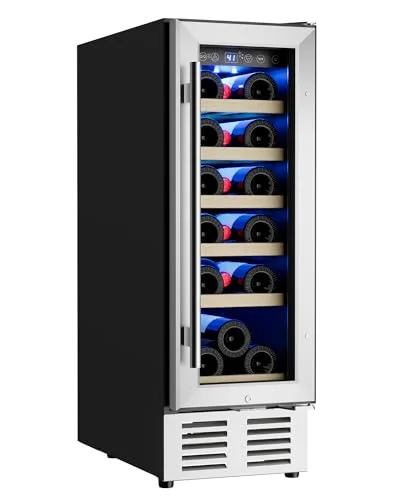
Icyglee 12" 18 Bottle Wine Cooler
Best for a narrow slot next to full-size machines
18 bottles·12" width·Built-in & freestanding
At 12 inches wide, this is the narrowest option in this guide, sized for the kind of leftover gap a laundry room actually leaves you rather than a full kitchen cabinet opening — and it still holds 18 bottles in that width. Because the listing rates it for both built-in and freestanding installation, it's designed to be enclosed in a cabinet run without the venting problem a purely freestanding unit would have if boxed in, which matters directly for the tight-footprint installs this room tends to require. The silver finish is plain rather than showy, which is exactly the point in a utility space. The listing doesn't break out zone count, so if running two separate temperatures matters to you, confirm that detail before buying.
The one to check first if the gap next to your machines is genuinely narrow.
02Most capacity for a wider gap
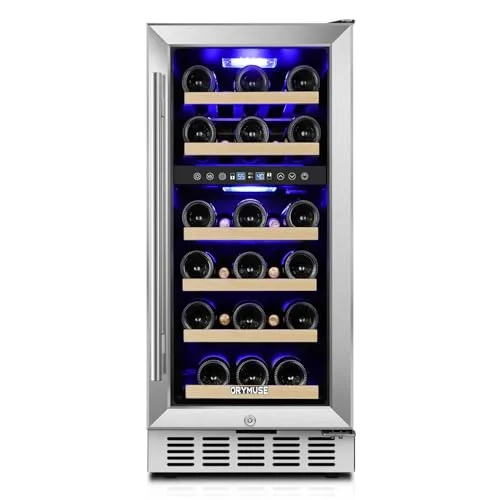
EUHOMY 15" 33 Bottle Dual Zone Wine Fridge
Most capacity for a wider gap
33 bottles·Dual zone·15" width
If the laundry room has a real counter run or a dedicated appliance wall rather than a single narrow slot, the extra three inches over the Icyglee buys a lot: 33 bottles across two independently set zones, nearly double the capacity in a width most mudrooms with a proper utility counter can still accommodate. The listing doesn't state a built-in installation rating, so plan on this one living freestanding with clear air behind it rather than boxed into a cabinet — confirm directly with the listing if you specifically need a built-in-rated unit for this width.
The capacity option, if your room gives you a counter instead of a closet.
03Best for an enclosed cabinet run
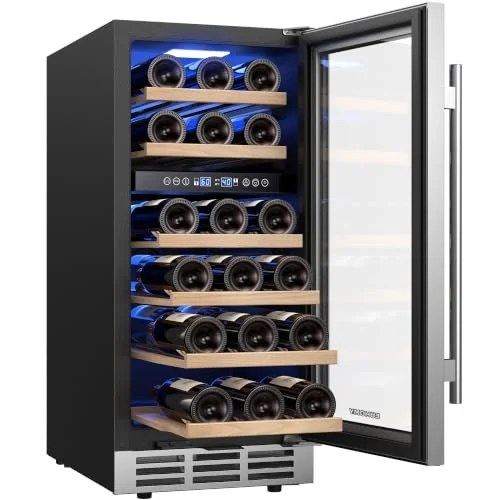
15" Under-Counter Dual Zone Wine Cooler, 30 Bottle
Best for building into a cabinet run
30 bottles / 3.1 cu.ft·Dual zone·Built-in or freestanding
This one is explicitly rated by the listing for built-in or freestanding use, which is the specification that matters most if the plan is to box it into a cabinet alongside the laundry counter rather than leave it standing in the open. Thirty bottles across two zones in 3.1 cubic feet, with a stainless steel glass door and digital temperature control that lets you confirm the setpoint without opening the door — useful in this room specifically, since every door opening is also a chance for humid room air from a recent laundry cycle to roll into the cabinet.
The pick if the fridge is going behind a cabinet front, not standing in the open.
Standard outlet access, and why a dedicated circuit is rarely the issue here
It's tempting to assume a laundry room's electrical setup is the hard part of this purchase, since the room already has to support a washer on its own circuit and often an electric dryer on a separate 240-volt circuit. In practice, that's rarely what decides whether a wine fridge fits. A compact wine fridge is a small-appliance-class load, well within what a standard 15- or 20-amp, 120-volt household circuit handles — the same class of circuit that already runs a utility light, a vacuum, or a hand iron in most laundry rooms. It does not need the washer's circuit or anything resembling the dryer's 240-volt outlet, which wouldn't power it correctly even if a cord happened to reach.
What decides it is simpler and more mundane: whether there's a standard grounded outlet within reach of wherever the fridge ends up sitting. Laundry room receptacles are required to be GFCI-protected under modern electrical code, which is exactly the right kind of outlet for a small refrigeration appliance near a water source — no different from what a kitchen counter outlet already provides. The actual planning problem is usually that the laundry room's outlets were placed for the washer and a utility light, not anticipating a second appliance, so the fridge ends up a few feet from the nearest receptacle. Resist the extension-cord shortcut: an appliance that runs continuously belongs on a proper receptacle, not a cord shared with other laundry equipment. If the gap between the fridge's planned spot and the nearest outlet is more than a cord's safe reach, that's a case for an electrician to add a receptacle — a small job, and one worth doing once rather than running a cord indefinitely.
When the room runs too warm in summer for a compressor to stay efficient
A laundry room or mudroom is frequently the least climate-controlled room in a house — it's often adjacent to a garage, built over an unconditioned crawlspace, or simply not prioritized on the same thermostat zone as the living space. That matters more in summer than people expect. A compressor-cooled wine fridge is built to hold its setpoint regardless of the room, which is the whole reason compressor cooling is the right call for a utility space rather than a thermoelectric unit that only pulls a fixed amount below ambient — but "regardless of the room" has limits. As ambient temperature climbs, a compressor has to work harder and run longer to hold the same internal setpoint, and manufacturers generally design and rate these units around a normal indoor ambient range rather than a garage-adjacent room that can swing into the high 80s or 90s in summer.
There's a second, laundry-room-specific wrinkle: a dryer actively exhausts heat into the room every time it runs, on top of whatever the season is already doing to the space. A fridge placed close to a dryer's heat output, or in a mudroom that already runs warm through an exterior door, is working against a double load in July. None of the three listings in this guide state a maximum rated operating ambient temperature, which is common for this category — if your laundry room is reliably warm through the summer, that's a case for treating any wine fridge's efficiency as an open question rather than a settled one, and for giving the unit placement away from the dryer's exhaust and away from a sun-facing exterior door, rather than assuming compressor cooling makes placement irrelevant.
How we compared these — and what we cannot tell you
We compared the published width, capacity, zone count, installation rating and current listed price for each product against the listing itself, and did not fill in any specification — cooling architecture, per-zone temperature range, maximum operating ambient — that the listing doesn't state. Where a detail mattered to this room's specific problems and the listing was silent on it, we said so directly rather than guessing.
We do not run a testing lab. We have not installed any of these units in an actual laundry room and measured how they hold up to humidity cycling or washer vibration over time, and none of the manufacturers here publish independent data on either. You will also not find a star rating or a review count on this page: the retailer data we draw from does not return them for this category, and we do not publish numbers we cannot verify. What we can do honestly is reason from the published specifications and from general, verifiable facts about appliance construction, electrical code and refrigeration physics — and keep that reasoning separate from anything that would require us to have actually tested the product.
Prices quoted here were correct at the time of writing and change frequently. Confirm the current price before buying.
Frequently asked questions
Is a laundry room too humid for a wine fridge?
Not in the way a damp basement is. A laundry room's humidity comes in short bursts during a wash or dry cycle and then returns to normal, rather than sitting elevated around the clock. What matters most here is the quality of the door gasket and cabinet seams rather than a rating for sustained high ambient humidity — the stress is shorter and sharper, closer to a bathroom after a shower than a root cellar.
What size wine fridge fits next to a washer and dryer?
Measure the leftover gap after the machines first. A standard washer or dryer runs about 27 to 28 inches wide, which often leaves only a narrow slot. A 12-inch-wide unit fits spaces a 15-inch unit cannot; a 15-inch unit needs a genuinely wider counter run or dedicated appliance wall. Also check the fridge's own door swing against any walkway to an exterior door, and keep it clear of the dryer's exhaust duct run.
Does a wine fridge in a laundry room need its own electrical circuit?
Usually not. A compact wine fridge is a small-appliance-class load that a standard 15- or 20-amp, 120-volt GFCI-protected outlet handles fine — the same kind of outlet already common in a laundry room, not the washer's or a 240-volt dryer outlet. The more common real-world issue is simply that the room's existing outlets weren't placed with a second appliance in mind, which is a case for adding a receptacle rather than running an extension cord long-term.
Will a wine fridge run efficiently in an unconditioned mudroom in summer?
Compressor cooling holds its setpoint far better than thermoelectric cooling as a room warms, but it isn't unlimited — the compressor works harder and runs longer as ambient temperature climbs, and a mudroom near a garage or exterior door can run hot in summer. A running dryer adds its own heat on top of that. None of the products in this guide publish a maximum rated operating temperature, so in a room that reliably gets hot, keep the fridge away from the dryer's exhaust and away from direct exterior heat, and treat high-summer efficiency as unverified rather than assumed.
Written by Ilane Tall. Research-based comparisons of published specifications, current prices and general domain facts — we do not physically test these units and we do not publish invented scores or review sentiment.