By Ilane Tall · Updated November 27, 2026 · Research-based.
Reader-supported: we may earn a commission when you buy through the links on this page, at no additional cost to you. It never changes which product we recommend. Prices quoted below were correct at the time of writing and move often.
The short version
No — not in any way that matters at the exposure levels an interior LED produces. The wavelength that damages wine is UV, LEDs sold in wine fridges emit essentially none of it, and the duration is seconds per day, not the weeks of continuous exposure that ruin wine in a sunlit store window.
The real protection is the UV-blocking tinted glass door, which is doing its job every hour the fridge is closed, light on or off. The bulb is a display feature layered on top of that, not a substitute for it.
If you are aging a bottle past a season, the one habit worth adopting isn't avoiding the LED — it's leaving the fridge in a dim room, because ambient room light reaching the glass adds up over months in a way a few seconds of LED exposure per day does not.
What actually damages wine through light
"Light hurts wine" is true, but it is also vague enough to be misleading when applied to a kitchen appliance. The damage mechanism is specific: ultraviolet radiation, in the roughly 300–400 nanometer range, breaks down riboflavin (vitamin B2) naturally present in wine. That breakdown produces compounds that react with sulfur-containing amino acids and generate mercaptans — the same family of sulfur compounds responsible for the smell of struck matches and wet wool. Winemakers call the result "lightstrike" or "light taste," and it is a real, measurable off-flavor, not folklore.
Two variables decide how much lightstrike a bottle picks up: the wavelength of the light and how long the bottle sits in it. UV wavelengths do almost all of the damage. Visible light in the blue end of the spectrum (around 400–450nm) can contribute at high intensity and long exposure, which is why green and amber glass bottles — not clear ones — are the historical default for wine. Visible light further up the spectrum, toward red and yellow, does essentially nothing to the compounds in question. Duration matters as much as wavelength: a bottle that gets an hour of harsh light does measurably worse than one that gets the same light for a minute, and the effect compounds over days and weeks, not seconds.
This is the frame to hold onto for everything below. The question is never "does this fridge have light in it." The question is: what wavelength, at what intensity, for how long.
Why an LED bulb is a different physics problem than a sunlit window
The classic lightstrike case study is a case of wine left in a store window, or a bottle on a sunlit shelf for a season. Direct and indirect sunlight both carry a meaningful UV-A and UV-B component, and a bottle sitting in it gets exposed for hours a day, every day, for weeks. That combination — real UV, high intensity, long duration — is exactly the scenario lightstrike research is built around, and it is why wineries ship in UV-filtering cartons and tell retailers to keep bottles out of display windows.
A standard white or warm-white LED bulb, the kind used in almost every modern wine fridge including the three compared below, works on a different principle entirely. LEDs generate light through electroluminescence in a semiconductor, not by heating a filament or exciting a gas — and the semiconductors used in consumer lighting are chosen specifically to emit in the visible range. Measured UV output from a standard interior LED is negligible, typically reported in the literature as near zero, several orders of magnitude below a fluorescent tube and incomparably below direct sun. The old display fear — fluorescent retail lighting quietly lightstriking wine on a shelf — came from fluorescent tubes, which do emit a small but non-trivial UV component through their phosphor coating. LEDs mostly do not share that mechanism.
Intensity and duration compound the gap. A wine fridge's interior LED is typically rated in the single-digit watts, illuminates a sealed interior rather than an open display case, and in ordinary use is lit for seconds at a time — when the door opens, or briefly when you check the cabinet — rather than continuously for hours. Stack "negligible UV," "low intensity," and "seconds of exposure" together and the result is a light source that, by the mechanism that actually causes lightstrike, is doing close to nothing to the bottles behind the glass.
Sunlit store window
Real UV-A/UV-B, high intensity, hours a day for weeks. The documented lightstrike scenario — and the reason retailers are told to keep wine out of direct light entirely.
Interior LED bulb
Negligible UV output, low wattage, lit for seconds at a time inside a sealed cabinet. A different physics problem, not a smaller version of the same one.
The display-light paradox
There is a genuine irony worth naming, because it is the part of this question people actually mean to ask. A wine fridge with a glass door and an interior light is, by design, built to be looked at — the bottles are the display, and the light exists to show them off. A plain, light-tight cellar or a cabinet with a solid door is built to be ignored. On the surface, the display unit sounds like the worse choice for long-term storage.
In practice the paradox mostly dissolves once you separate the two light sources a display-style fridge is exposed to. The interior LED, as covered above, is low-intensity and brief. The light the cabinet is actually "displaying" bottles under for meaningful stretches of time is ambient room light — the kitchen's overhead fixtures, a window across the room, daylight through a nearby glass door — shining on the cabinet's glass door for however many hours the room is occupied and lit. That ambient light is the one that accumulates like the sunlit-window scenario, because it is continuous and it is the room's light, not the fridge's.
So the honest version of the paradox is: a display-style wine fridge is not more exposed because it has a bulb inside it. It is more exposed, if at all, because it has a window (the glass door) looking out onto however bright the room is — and that exposure exists whether or not you ever turn the interior LED on. The feature people worry about and the feature actually worth worrying about are not the same feature.
Reading "adjustable blue light" and "3 Color LED Light" claims for what they are
Listings increasingly promote lighting as a named feature — "3 Color LED Light," "adjustable blue light," soft-white versus blue-toned interior lighting you can cycle through. It's worth being precise about what these claims are and are not.
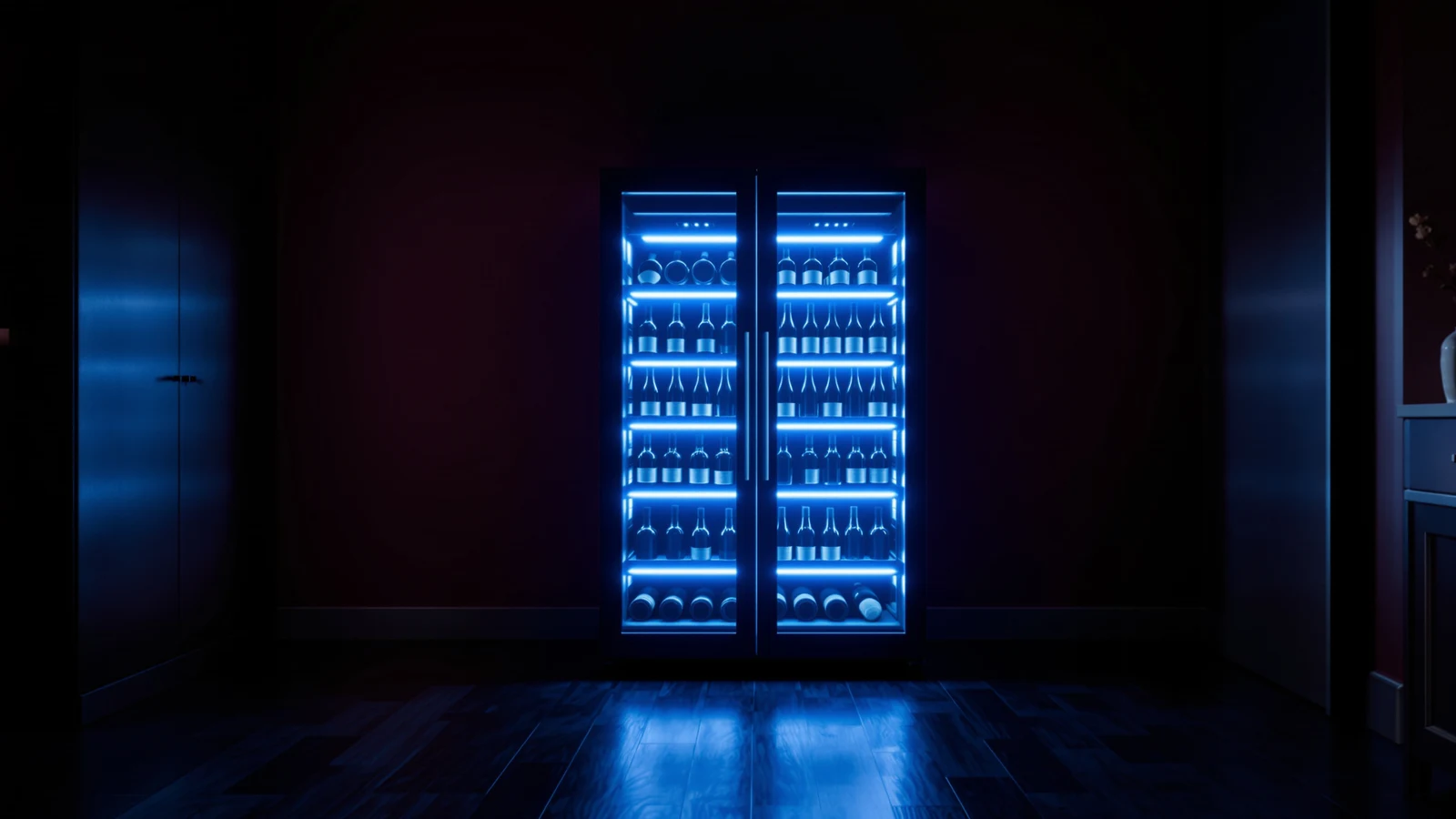
They are a display and ambiance feature. Multi-color LED lighting exists to make a glass-door cabinet look good in a kitchen or a bar — the same reason under-cabinet lighting and accent lighting exist elsewhere in a home. It photographs well, it reads as premium on a product listing, and it genuinely changes how the cabinet looks sitting in a room.
They are not a preservation specification. No manufacturer we found publishes a wavelength, UV output, or lux rating alongside a "3 Color LED" claim, because the feature was never engineered against lightstrike research — it was engineered to look good. A blue-toned LED setting might, in theory, sit at a slightly shorter wavelength than a warm-white setting, but a consumer LED's blue channel is still visible light, not UV, and the exposure duration argument above applies regardless of which color is selected. Treat "adjustable" or "multi-color" exactly the way you'd treat a dimmer switch on a kitchen light: a usability and aesthetics control, not a spec that changes what's happening to the wine.
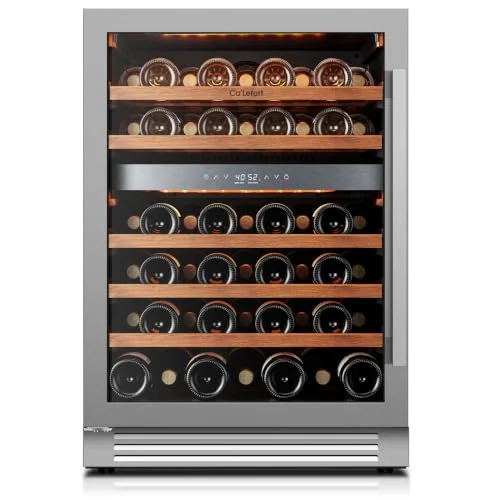
The Ca'Lefort 24 Inch Dual Zone, for instance, lists a 3 Color LED Light among its features alongside a glass door and adjustable temperature control. That is an accurate description of a nice-to-have — pick the tone that suits the room — and it should be read as exactly that, not folded into a claim about wine safety one way or the other.
Where the UV-blocking glass door is doing the actual protective work
If there is one component in a wine fridge actually engineered against light damage, it's the door, not the bulb. Wine fridge glass doors are near-universally tinted — a smoked or dark-toned glass rather than clear — specifically because manufacturers know the cabinet will often sit somewhere with ambient room light hitting it for hours a day, and the tint is there to filter the wavelengths that matter before they ever reach a bottle.
This protection is independent of the interior light and independent of whether the door is opened. A tinted, UV-filtering door does its job continuously, around the clock, regardless of the LED setting inside. It is also, unlike the bulb, directly tied to the thing that actually causes measurable damage: it blocks UV and attenuates high-intensity visible light from the room before it ever reaches the glass of the bottle. A cabinet that gets this right and skips the fancy interior lighting entirely is, by the physics in this article, better protected than one with elaborate multi-color LEDs and a poorly filtered door.
None of the three products compared below publish a specific UV-transmittance figure for their glass — that's a spec Amazon listings in this category essentially never report, so we won't invent one. What we can say honestly: a glass door is the standard, expected design in this category precisely because manufacturers treat light exposure through the door as the real variable, which lines up with everything the lightstrike research says about where the risk actually comes from.
The picks, and when to just turn the light off
For the overwhelming majority of wine — bought to drink within the next year, held at a stable temperature — none of this is a reason to avoid an LED-lit cabinet or to leave the light off out of caution. The exposure math simply doesn't support it. All three cabinets below use compressor cooling with a glass door, which is the combination that matters for day-to-day storage regardless of lighting.
There is one case where the conservative move is worth making anyway: a bottle you specifically intend to age for several years past where you'd normally drink it. Not because the LED will meaningfully lightstrike it on its own, but because every variable you can remove from a multi-year hold is one less thing to think about, and turning off a light you don't need costs nothing. If that describes a bottle in your cabinet, flip the interior light off for that one and keep the cabinet itself out of a sunlit room — that second habit does far more than the first, for the reasons covered above.
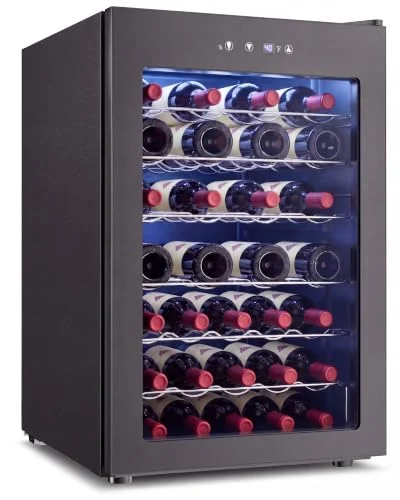
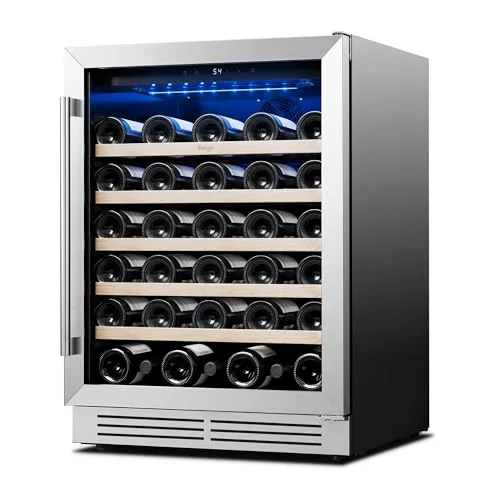
Below are the three cabinets referenced through this piece. None is marketed around lighting as a preservation feature — they are listed on their cooling type, capacity, and door construction, which is the correct way to shop this category.
How we compared these — and what we cannot tell you
We compared the published specifications and listed prices for the three cabinets above, plus the general physics and food-science literature on lightstrike — the UV-driven riboflavin reaction that gives light-damaged wine its struck-match smell. Where a listing promotes a lighting feature, we read the manufacturer's own description of it rather than assuming either a benefit or a risk the listing doesn't claim.
We do not run a testing lab. We have not measured the UV output of these specific bulbs with a spectrometer, and no Amazon listing in this category publishes that figure, so we have not invented one. What we have done is apply the well-established mechanism of lightstrike — wavelength and duration — to the known characteristics of consumer LED lighting versus sunlight and fluorescent tubes, which is published, general science rather than a claim about any one product. None of the three cabinets above have a published star rating or review count in our data, so none is shown here; we do not estimate one.
Prices quoted here were correct at the time of writing and change frequently. Confirm the current price before buying.
Frequently asked questions
Should I keep the wine fridge light off to protect the wine?
For ordinary storage, no — the exposure from an interior LED is low-intensity, nearly UV-free, and brief, and it isn't the mechanism behind documented lightstrike damage. The one case where turning it off is a reasonable precaution is a bottle you intend to age for several years past a normal drinking window, where removing every avoidable variable costs nothing.
Is blue LED light worse for wine than white LED light?
Not meaningfully at the exposure levels involved. A blue-toned consumer LED setting is still emitting visible light, not the ultraviolet wavelengths that drive the riboflavin reaction behind lightstrike, and the duration of exposure inside a fridge is seconds, not the hours of continuous exposure the lightstrike research is based on. The color options on these fixtures are an ambiance choice.
Does the tinted glass door actually block UV?
Tinted or smoked glass doors are the standard design across this category specifically because manufacturers expect the cabinet to sit somewhere with hours of ambient room light hitting the door. None of the three products compared here publish a specific UV-transmittance percentage, so we won't quote one, but the tinted glass is the component doing continuous, passive protection — unlike the interior bulb, which only runs briefly.
Does a "3 Color LED Light" feature mean a cabinet is better at preserving wine?
No. It's a display and ambiance feature, marketed the same way accent lighting is marketed anywhere else in a home. No manufacturer publishes a wavelength or UV spec tied to these color options, because the feature wasn't engineered against lightstrike research — it was engineered to look good behind a glass door.
Written by Ilane Tall. Research-based comparisons of published specifications and current prices — we do not physically test these units and we do not publish invented scores.