By Ilane Tall · Updated November 20, 2026 · Research-based.
Reader-supported: we may earn a commission when you buy through the links on this page, at no additional cost to you. It never changes which product we recommend. Prices quoted below were correct at the time of writing and move often.
The short version
A dual-zone wine fridge almost always runs on one compressor. The "two zones" are two compartments divided by a fixed baffle, with a second fan or damper managing how much cold air crosses into the warmer half — not two independent refrigeration systems.
Because they share one compressor and one box, the zones are never fully isolated from each other, or from the room. Open the upper door for a minute while hosting and the lower zone feels it too; let the kitchen hit 85°F in August and the whole spread narrows.
The smaller the cabinet, the less room there is to hold a wide gap between zones. A 20-inch freestanding unit and a 36-inch built-in column are not solving the same engineering problem, even if both say "dual zone" on the box. Before you trust a wide advertised range, check what each zone is rated for separately — the whole-cabinet number on the label is not that answer.
The baffle-and-fan approach: one compressor doing two jobs
Open up almost any dual-zone wine fridge under about $700 and you will find the same layout. A single compressor sits at the back or bottom, connected to one evaporator coil and one refrigerant loop — exactly like a single-zone unit. What makes it "dual zone" is a fixed internal divider, usually a horizontal panel somewhere around the midpoint of the cabinet, plus a second thermostat, a second sensor, and some mechanism — a motorized damper, a second circulation fan, sometimes a small resistive heater — that lets the two halves run at different setpoints off the same source of cold air.
In practice that means one of two things is happening below the two front-facing displays. Either the coldest air is generated near one zone and metered into the other through a vent that opens and closes to hold the warmer zone's setpoint, or air is pulled from both compartments, mixed and cooled centrally, and routed back to each zone through separate ducts with independent dampers. Both approaches get real use out of a single compressor cycle. Neither one gives the two compartments a cooling source of their own.
This is not a defect — it is the only way to make dual-zone cooling affordable. A genuine two-compressor wine fridge, with a fully separate refrigeration circuit for each compartment, exists mostly at the high end of built-in columns, and it costs accordingly. The baffle-and-fan approach is the mechanism that makes a $320–$400 dual-zone cabinet possible at all. Understanding that it is a shortcut, not a second appliance bolted to the first, is the key to predicting how the fridge will actually behave.
What "dual zone" usually means
One compressor, one refrigerant circuit, a fixed divider, and a damper or fan that lets the warmer compartment run a few to a dozen-plus degrees above the colder one.
What it is not
Two separate fridges sharing a cabinet. The warmer zone's setpoint is a managed offset from the cold source, not an independently generated temperature.
Why the two zones are never fully independent
Because both compartments answer to the same compressor cycle, events in one zone show up in the other, just dampened. Two mechanisms drive most of it.
The first is the door. Open the upper zone's door for a few minutes while you pour drinks for guests, and the compressor has to work harder to recover that lost cold air. On a baffled single-compressor design, the lower zone is drawing from the same cycle, so its recovery can lag too — usually a smaller, slower swing than the zone that was actually opened, but a swing all the same. On a true single-zone fridge this is a non-issue because there is nothing to compare against; on a dual-zone unit it is the first place buyers notice that the two zones are not acting like separate appliances.
The second is ambient heat. A compressor's job gets harder as the room gets warmer, and a baffled dual-zone design is already asking the compressor to maintain a gap between two compartments, not just hold one number. In a 70°F room that gap is easy. In an 85°F garage or an un-air-conditioned kitchen in July, the compressor is working near its ceiling just to hold the colder zone, and there is less headroom left to also hold the warmer zone away from it — which is why the achievable spread between zones shrinks as the room heats up, even though the listing's temperature range does not change.
Neither effect makes the fridge faulty. Both are a direct, predictable consequence of sharing one compressor and one insulated box between two setpoints, and they are the main reason the gap between zones in real use tends to run narrower than the gap implied by the cabinet's overall advertised range.
Where a wider gap gets harder to hold as the cabinet shrinks
Capacity and temperature control are not separate specifications — they trade against each other inside the same insulated volume, and that trade gets worse as the cabinet gets smaller.
A compact 20-inch-wide dual-zone unit has a small volume of air in each compartment and a shorter, tighter duct run between them. That is efficient for cooling a small space quickly, but it also means the two zones sit physically close together, separated by a thinner slice of insulation and a shorter airflow path than a larger cabinet allows. Any damper managing the exchange between zones is working across a shorter distance, with less buffer air on either side to smooth out a swing. The result is that a narrow, compact dual-zone cabinet can usually hold a modest differential — enough to separate a serving-temperature white from a storage-temperature red — but asking it to hold a wide, double-digit gap between zones, especially in a warm room, pushes against the physical limits of how much that small a box can insulate one half from the other.
A larger cabinet with the same baffle-and-fan mechanism has more insulated volume per zone, a longer run between the two compartments, and simply more total air mass buffering each side from the other's swings and from the room. The mechanism is identical — still one compressor, still a baffle — but the physics of a bigger box give it more room to work, so the realistic differential it can sustain, especially under a warm-room or frequent-door-opening load, tends to hold up better than the same mechanism crammed into a narrower footprint.
This is also where counter-depth and standard-depth cabinets diverge in a way that matters for dual zone specifically: a deeper, larger-volume unit is not just fitting more bottles, it is giving the same cooling mechanism more thermal mass and more ducting room to keep two setpoints apart.
Larger built-in units: more engineering room, better separation
Built-in dual-zone columns in the 24-inch-and-up range are not simply bigger versions of a 20-inch freestanding cabinet — they are usually built to a different engineering standard, and that shows up specifically in how well the zones hold apart.
A built-in unit has to vent its heat through a front grille rather than off the back and sides, which forces a more deliberate internal layout: a dedicated compressor compartment, a longer and more controlled airflow path, and — because the cabinet has to run reliably enclosed in a run of kitchen cabinetry for years — generally a sturdier compressor and more insulation than a freestanding unit sized for a spare corner of a room. All of that extra engineering room benefits the dual-zone mechanism directly. More insulation between the zones means less bleed-through when one side cycles; a longer, better-controlled duct run means the damper or fan managing the exchange between compartments has more distance to work with; a compressor sized for continuous built-in duty has more headroom left over after maintaining the colder zone to also hold the warmer zone away from it.
None of that makes a larger built-in column a two-compressor appliance — it almost certainly is not. It is still one compressor and a baffle, the same mechanism described above. What changes is the margin that mechanism has to work with, which is exactly why a well-specified built-in dual-zone unit can sustain a wider, steadier gap between its two compartments than a compact freestanding cabinet attempting the same split in a fraction of the volume. If a dual-zone fridge is going into a cabinet run, confirm it is actually rated for built-in installation first — enclosing a freestanding unit starves its compressor of the air it needs regardless of how many zones it has, a mistake covered in more detail in where to put a wine fridge when your kitchen has no room.
What "independent digital zones" promises — and what it leaves out
"Independently controlled zones" or "independent digital temperature zones" is accurate marketing language, and it is also doing less work than it sounds like it is. What it is promising is real: two separate control panels, two separate setpoints you can dial in on your own, and a thermostat in each compartment that is not simply mirroring the other. That part of the claim generally holds up on every dual-zone unit we have looked at, cheap or expensive.
What it is not promising, and what the phrase lets a reader assume by implication, is two independent cooling sources. "Independent" describes the control electronics — the two thermostats and displays — not the refrigeration hardware behind them, which on the large majority of dual-zone cabinets at consumer prices is the single shared compressor and baffle described above. A listing that leads with "independent zones" and never mentions the per-zone temperature range, or quotes only one range for the whole cabinet, is telling you the control layer is real without telling you how far apart the two compartments can actually sit once that control layer asks them to.
The practical read: "independent digital zones" tells you that you can set two different numbers. It does not tell you how far apart those two numbers can actually be held, especially in a warm room with the door getting opened. That second fact lives in the per-zone spec sheet, not the feature bullet.
This is also why a wine-and-beverage hybrid — a cabinet with bottles racked on one side and cans shelved on the other — is a different, and in one sense simpler, proposition. The beverage side is typically meant to run well below any wine serving temperature, so the gap it needs is wide and one-directional rather than a narrow band meant to separate two wine-serving temperatures. The mechanism behind it is still usually one compressor and a baffle, but the target is less delicate to hit because nobody is expecting the can side to land within a few degrees of a specific wine number.
The picks: from a budget freestanding unit to a larger built-in
All three of these quote one overall temperature range for the whole cabinet rather than breaking out a separate figure for each zone — which, per the mechanism above, is normal for this category and not a reason to rule any of them out. It is a reason to treat the headline range as the ceiling of what the mechanism can do, not a guarantee of exactly how far apart the two zones will sit in your kitchen.
01Budget freestanding
Bonnlo 33 Bottle Dual Zone
The least expensive way into a real dual-zone compressor cabinet
33 bottles·Dual zone·Compressor·Freestanding
A compressor-cooled, 33-bottle freestanding cabinet quoting a 41–64°F overall range for $319.99 — the baffle-and-fan mechanism in its most affordable form. At this width and price, expect a workable gap between zones for the usual job of parking whites cooler than reds, but do not expect the full 23-degree span to apply separately to each half; that number describes the cabinet's outer limits, not a confirmed per-zone spread. It is freestanding, so it needs clearance at the back and sides — do not enclose it.
Real dual-zone compressor cooling at the price most of the category still sells a single zone for.
02Step-up freestanding
ROVSUN 20"W Dual Zone
A touch-panel step up, same mechanism, same width class
33 bottles·Dual zone·Compressor·Freestanding
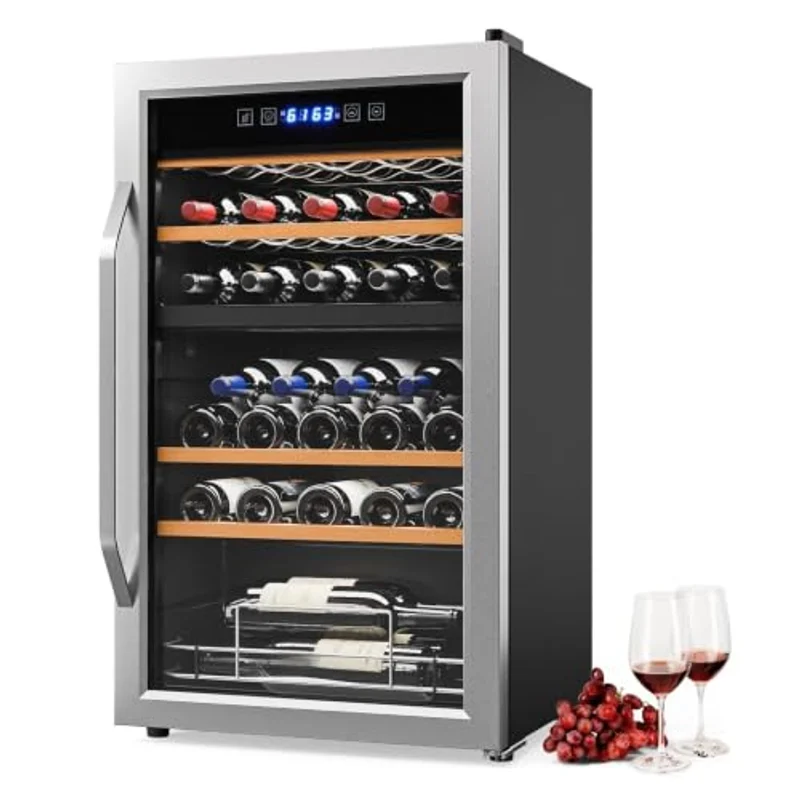
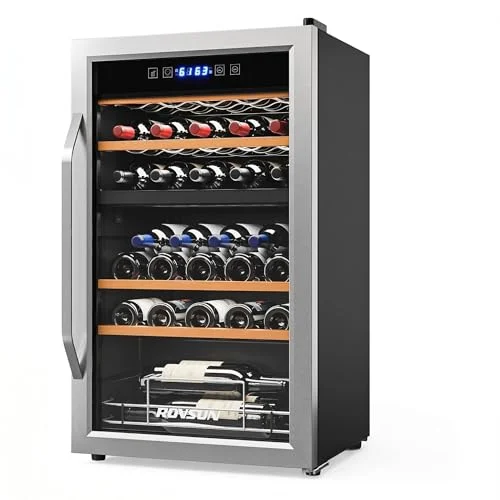
Twenty inches wide, compressor-cooled, 33 bottles, touch-panel control and a glass door, at $399.99 and the same quoted 41–64°F overall envelope as the Bonnlo above. The control panel is a step up; the underlying cooling mechanism is the same one-compressor, one-baffle approach, so it faces the same squeeze described above — a narrow cabinet asking for a wide gap, which gets harder to sustain in a warm room or with frequent door-opening. Freestanding only; it needs the same rear clearance.
Nicer controls, same physics underneath — worth it for the touch panel, not for a wider zone split.
03Larger built-in
EdgeStar 24" 36 Bottle Built-In
More cabinet, more engineering room for the same split
36 bottles·Dual zone·Built-in or freestanding·Reversible door
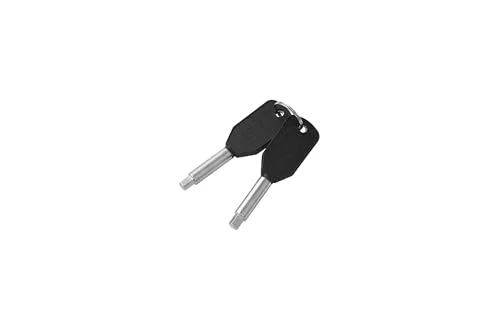
A 24-inch, 36-bottle dual-zone cabinet rated for built-in installation, with a reversible door, LED lighting, digital display and an integrated door lock, at $1,299.00. EdgeStar's listing does not break out a per-zone temperature range any more than the two units above do — check the current listing for the exact figures before you buy — but the larger, built-in-rated cabinet has the insulation and airflow room described above that a compact freestanding unit does not, which is the practical argument for stepping up in size rather than just in price when a wider, steadier zone split actually matters to you.
The jump in price buys cabinet volume and build quality more than it buys a fundamentally different cooling method.
The honest test: are your two zones really behaving independently?
You do not need a thermometer to get a useful answer here, though an inexpensive one in each compartment helps. Three checks, roughly in order of how easy they are to run.
- Read the spec sheet for a per-zone range, not a cabinet range. If the only number published is one overall span for the whole unit — as with all three picks above — that is not evidence the zones are weak, but it is evidence nobody has told you how far apart they can actually sit. Ask the manufacturer or the seller for the per-zone figures before assuming the best case.
- Open one zone's door for two or three minutes during a normal week and watch the other zone's display. A small, temporary uptick in the zone you did not open is normal on a shared-compressor design and nothing to worry about. A large, slow-to-recover swing suggests the cabinet is already working near its limit for your room's temperature.
- Compare behavior in summer and in winter, or near the fridge and across the room from a heat source like an oven. If the gap between your two zones visibly narrows as the room gets warmer, that is the compressor-and-baffle mechanism running out of headroom exactly as described above — not a malfunction, but useful information about how much margin your specific unit actually has in your specific kitchen.
If any of those checks disappoints you on a unit you already own, running both zones at the same setpoint recovers most of the practical benefit of a single-zone fridge, though not the shelf space the divider took up. For a deeper look at whether two zones were the right call for your collection in the first place, see our guide to advertised bottle counts versus real capacity, since a divided cabinet loses more usable shelf space to its partition than the bottle count on the box suggests.
How we compared these — and what we cannot tell you
We compared published manufacturer specifications and current listed prices for the three units above, and we described the baffle-and-fan cooling mechanism based on how dual-zone compressor wine fridges are generally built and documented across the category, not on a teardown of any specific unit. Where a manufacturer does not publish a per-zone temperature range — which is the case for all three picks here — we said so rather than estimating one.
We do not run a testing lab. We do not own these units and we do not physically test them, so there is no bench-measured temperature differential in this article and no invented score out of ten. What we can do honestly is explain how the mechanism works, where its physical limits are, and what questions to ask a listing or a manufacturer before you assume a wide advertised range applies equally to both halves of the cabinet. If you are shopping on warranty terms as well as specs, our guide to what's actually covered is worth reading before checkout, since a compressor and a control board are often covered on very different timelines.
Prices quoted here were correct at the time of writing and change frequently. Confirm the current price before buying.
Frequently asked questions
Does a dual-zone wine fridge have two compressors?
Almost never at consumer prices. The overwhelming majority of dual-zone wine fridges, including all three picks above, use one compressor and one refrigerant circuit, with a baffle, fan or damper managing the split between the two compartments. Genuine two-compressor dual-zone units exist mainly in high-end built-in columns and cost accordingly more.
Why does my lower zone warm up slightly when I open the upper zone's door?
Because both compartments draw on the same compressor cycle. Opening one zone's door forces the system to work harder to recover, and on a shared-compressor design that extra load can produce a small, temporary effect in the other zone too. A brief, modest uptick is normal; a large, slow-to-recover swing suggests the unit is already near its limit for the room it's in.
Can a small dual-zone fridge hold a 20-degree gap between zones?
It depends on the cabinet size, the room temperature and how often the doors are opened, and most listings do not publish the per-zone figure that would answer this directly. In general, a compact freestanding cabinet has less insulated volume and a shorter duct run between zones than a larger built-in unit, which makes a wide, double-digit gap harder to sustain, especially in a warm room. Check the manufacturer's per-zone range before assuming the headline figure applies to both halves equally.
What does "independent digital zones" actually mean on a listing?
It means the cabinet has two separate control panels and thermostats that you can set independently — that part is real. It does not mean there are two independent cooling systems behind those controls; on most dual-zone units at consumer prices, one shared compressor and a baffle are doing the work for both displays. The phrase describes the control layer, not the refrigeration hardware.
Written by Ilane Tall. Research-based comparisons of published specifications and current prices — we do not physically test these units and we do not publish invented scores.