By Ilane Tall · Updated November 17, 2026 · Research-based.
Reader-supported: we may earn a commission when you buy through the links on this page, at no additional cost to you. It never changes which product we recommend. Prices quoted below were correct at the time of writing and move often.
Quick answer
A kitchen island has no back wall, which means a wine fridge built into it is enclosed on every side that matters — the back, and usually both ends. Only a unit the manufacturer rates for built-in installation, with venting at the front rather than the rear, survives that. Our top pick for an island build is the 15 Inch Wine Cooler Under Counter, Dual Zone 30 Bottle with Stainless Steel Glass Door at $449.99 — it is explicitly sold as built-in or freestanding.
Everything else in this guide runs the same 15-inch width and dual-zone layout, so the deciding factor is rarely bottle count. It is whether the listing actually states a built-in rating, how the two exposed faces will look from both sides of the island, and how the electrician gets power there without a cord crossing the floor.
If none of the three units here fit your specific cutout, measure first — our note on measuring the cutout from the countertop down covers the two numbers people skip.
Why an island forces the built-in question on day one
Against a kitchen wall, a wine fridge gets a choice most people never think about: freestanding units sit in the open with a few inches of air behind and beside them, exactly like a dorm-room mini fridge, and nothing about the room changes that. A wine fridge going into an island does not get that choice. The moment the cabinetmaker frames an opening into an island run, the back of that opening is either the inside of another cabinet, a structural panel, or dead air sealed off from the room — never open space with a free path for hot air to leave.
That turns an install decision that is optional against a wall into a requirement on an island: the fridge has to be rated for enclosed, built-in installation, full stop. There is no freestanding option here the way there is in a corner of a kitchen or a garage. An island cabinet is, by definition, a box with a door on one side and nowhere obvious for heat to go. Whatever goes into that box needs to be designed to vent out the front it's designed to vent out of — not improvise.
This is also why an island build is usually decided before the appliance is, not after. The cabinetmaker needs the exact width, depth and venting requirement of the unit to frame the opening correctly, which means the wine fridge has to be chosen — or at least narrowed to a model family — before the island carcass goes in, not picked off a showroom floor once the cabinetry is finished. Working backward from an already-built opening with the wrong clearance is a far more expensive fix than picking the right 15-inch unit up front.
Front-venting only: why a rear-venting unit overheats inside an island
A standard compressor-cooled wine fridge rejects the heat it pulls out of the cabinet somewhere — usually out the back and sides, the same way a kitchen refrigerator does, which is why a refrigerator always ships with a few inches of clearance behind it. That design works fine freestanding. Seal that same unit into an island cabinet with cabinetry pressed against the back and both sides, and the heat it is trying to reject has nowhere to go. It recirculates back into the compressor compartment, the compressor works harder to compensate, runs hotter and longer than it was designed to, and in the worst case overheats and fails — often well inside the warranty period, and in a way that reads to the owner as a defective unit rather than the wrong installation.
A unit built for enclosed installation solves this with a front vent: the grille that does the heat rejection sits on the front face, usually low, below or beside the door, so the heat exits into the kitchen the same way it would if the door were open, instead of needing airflow behind a sealed panel. That is the single specification that separates a wine fridge that can live inside an island cabinet from one that cannot, and it has nothing to do with bottle count, zones, or price.
Of the three units in this guide, the 15 Inch Wine Cooler Under Counter, Dual Zone 30 Bottle states its installation flexibility directly in the listing — "Built-In or Freestanding" — which is the specific language to look for before enclosing any wine fridge in cabinetry. The Albott and EUHOMY listings describe bottle count, zones and the 15-inch footprint, but their titles do not state a built-in or front-venting rating the way the third unit's does. That is not a mark against either appliance — plenty of 15-inch wine coolers are built to vent front-first — but it is a gap in what we can confirm from the listing alone, and it is exactly the gap you cannot skip past on an island. Open the full spec sheet or product description on the listing, or ask the seller directly, and get the built-in clearance figures in writing before a cabinetmaker frames an opening around either one.
The check that takes thirty seconds and saves a compressor: search the listing for the words "built-in" and a stated clearance in inches — top, sides, and front vent location. If neither appears anywhere in the spec sheet, treat the unit as freestanding-only and keep it out of an enclosed island run, regardless of how the photos stage it.
Both sides are visible now: finish and handle choices that matter more here
Against a wall, a wine fridge has one public face — the door, seen from the kitchen. An island puts the appliance in the middle of the room, which means the side facing the sink or the stove is on display exactly as much as the side facing the living area. Scuffed trim, a visible compressor grille, or a handle that reads fine from one angle and awkward from the other are all problems a wall installation hides and an island does not.
Door finish is the first thing to settle, because it is also the specification most listings actually state. The 15 Inch Wine Cooler Under Counter ships with a stainless steel glass door per its listing — a finish that reads consistently from either side of an island and matches stainless hardware elsewhere in the kitchen without needing to coordinate a second material. Albott and EUHOMY list bottle count, zones and the 15-inch width, but neither listing title specifies door trim material, so confirm the exact finish and handle style on the product page before you commit to a look for a fixture that two sides of the room will see every day.
Handle orientation matters almost as much as finish. On a wall installation, a handle that swings slightly off-center is invisible because only one approach angle exists. On an island, people walk past and reach for the door from both the room side and the work-aisle side, so a handle mounted flush and centered reads better from every angle than one designed with a single "front" in mind. Check the product photos for the handle's position relative to the hinge before ordering, since a handle crowding one edge of a 15-inch door is a tighter fit on an island than it would ever be against a wall.
Routing power to an island without a cord across the walkway
A wall-mounted wine fridge sits a few feet from an existing outlet, usually behind the unit or in the adjacent cabinet, and the cord never becomes a household hazard. An island sits in open floor space, often several feet from the nearest wall outlet, and a cord run across a kitchen walkway is exactly the kind of thing a home inspector flags and an insurance claim gets complicated by.
The fix is to plan the circuit before the cabinetry closes up, not after. In most kitchen remodels, the electrician runs a dedicated line up through the subfloor or down from an overhead run into the island base during the rough-in phase, terminating in an outlet box mounted inside the cabinet, directly behind or beside where the fridge will sit. That keeps the cord entirely inside the cabinet run — no visible cord, no walkway crossing, and a connection point an inspector can sign off on the same way they would any other fixed appliance circuit.
Three practical points worth raising with the electrician specifically, since they are easy to miss on a kitchen that is otherwise finished: a dedicated outlet behind a built-in wine fridge is standard practice precisely because retrofitting one after the counter and cabinetry are installed means cutting into finished work; a GFCI-protected circuit is the norm in most current kitchen codes for any outlet serving an appliance near a sink or counter, and an island counts; and the outlet needs to be reachable for service without pulling the fridge all the way out of its cutout, which argues for position low and to one side rather than directly behind the unit's centerline. None of this is specific to any one of the three units in this guide — it is the same wiring problem regardless of which 15-inch dual-zone cooler ends up in the opening — but it is the step people discover they skipped only after the cabinets are already sealed.
Panel-ready fronts versus a visible branded door
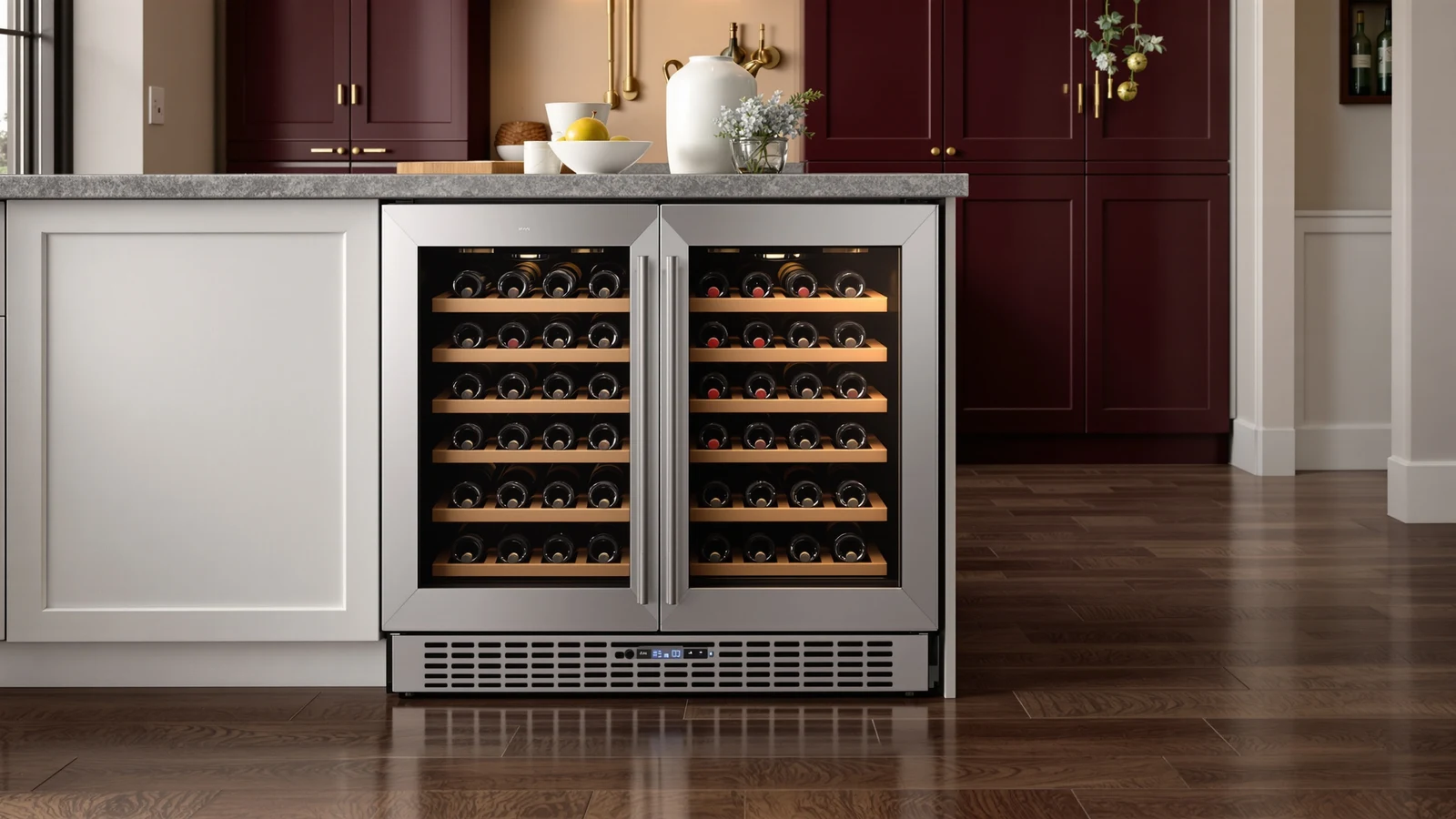
Panel-ready built-in appliances — the category most familiar from full-size refrigerators — accept a custom cabinet panel that matches the surrounding millwork, so the appliance effectively disappears into the island face rather than announcing itself as a separate fixture. It is a real feature in the broader built-in appliance market, and it is also a feature generally reserved for four-figure, full-width built-in wine storage rather than the 15-inch, sub-$500 dual-zone category this guide covers. None of the three units here are sold as panel-ready: each ships with its own finished door and glass front, meant to be seen rather than concealed behind cabinetry.
That is a reasonable trade at this price and size, but it changes what "both sides visible" means in practice. Instead of matching the fridge to the surrounding cabinetry, the honest approach is to treat the unit's own door — glass, with whatever trim the listing specifies — as a deliberate design element in the island face, the same way a glass-front beverage drawer or a built-in coffee system is allowed to look like an appliance rather than disappear. If matching the island's millwork exactly is the priority, that points toward a different, considerably more expensive product category than any of the three picks below, and is worth knowing before you shop rather than after a 15-inch glass door shows up and reads as the wrong decision.
The picks for an island install
All three run the same 15-inch width and dual-zone layout, which is the footprint that fits a standard island opening without reframing the cabinetry. The difference between them is installation rating, finish, and price — read in that order for an island build.
01Best for a true island build
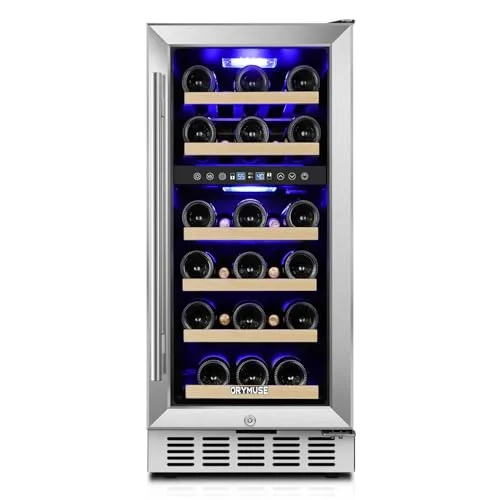
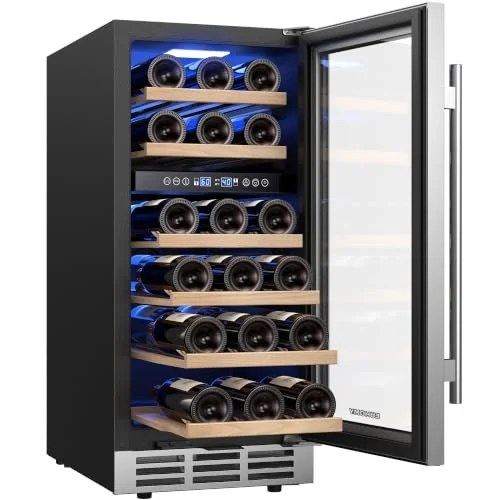
15 Inch Wine Cooler Under Counter, Dual Zone 30 Bottle with Stainless Steel Glass Door
Built-in or freestanding, stated directly on the listing
30 bottles / 3.1 cu.ft·Dual zone·Stainless steel glass door·Built-in or freestanding
This is the one unit in the group whose listing states the installation flexibility an island actually requires: built-in or freestanding, with a stainless steel glass door that reads the same from either side of the cabinet. Thirty bottles across two zones in a 3.1-cubic-foot cabinet is a sensible capacity for the standard 15-inch opening, and digital temperature control gives a visible, checkable setpoint rather than a dial with no numbers. For an island specifically, the built-in rating is the detail that matters most — it is the one piece of information the other two listings in this guide do not state up front.
The pick to start with if the appliance is going into a sealed island cabinet and nowhere else.
02Most bottles in the 15-inch footprint
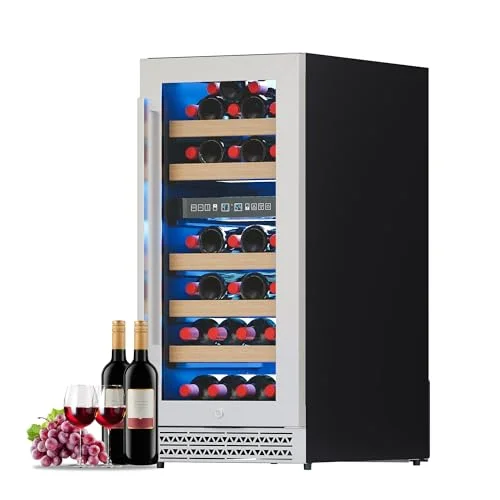
EUHOMY 15 Inch Wine Fridge, 33 Bottle Dual Zone Wine Cooler Refrigerator
The largest capacity of the three, if the install question checks out
33 bottles·Dual zone·15-inch footprint
Thirty-three bottles across two zones is the most capacity of the three units here, in the same 15-inch width the island opening is framed for. The listing confirms the bottle count, zone split and footprint, but — unlike the pick above — its title does not state a built-in or front-venting rating, so that is the first thing to verify on the full product page or with EUHOMY directly before this one goes into a sealed cabinet rather than an open nook. If the clearance figures check out in writing, it is the capacity leader of the group; if they do not appear anywhere, treat it as a freestanding unit and place it somewhere with open air behind it instead.
Worth the extra capacity once the built-in rating is confirmed in writing, not before.
03Lowest price in the group
Albott 15 Inch Wine Fridge, Dual Zone 31 Bottle Wine Cooler
The budget option in the same footprint
31 bottles·Dual zone·15-inch footprint
At $312.68 this is the least expensive of the three, with 31 bottles split across two zones in the same 15-inch width as the other two picks. As with the EUHOMY above, the listing title covers capacity and zone layout but not a stated built-in or front-venting rating, so the same rule applies: pull up the full spec sheet and confirm clearance language before sealing this into an island cabinet. If the install question resolves in its favor, the price gap to the stainless-steel pick above is the clearest reason to choose it; if it does not, that price gap is exactly what a failed compressor under warranty will cost you back in service calls.
The right call once you've done the thirty seconds of checking the listing for built-in language.
Measuring the cutout from the countertop and the cabinet carcass before ordering
A wine fridge that is the right width on paper can still fail to fit a specific island, because two different measurements govern the opening and most buyers only check one of them.
The first is the opening in the cabinet carcass itself — the rough framed width, depth and height the cabinetmaker built, before the counter goes on. This is the number on the cabinet shop drawing, and it should be checked against the appliance's stated width with the clearance the manufacturer requires on each side, not against the appliance's width alone. A 15-inch-wide fridge needs a 15-inch opening plus whatever side clearance its installation instructions call for — treating the two numbers as the same is how a unit that measures fine on a tape ends up unable to physically slide into its cutout.
The second, and the one people skip, is the clearance from the underside of the countertop down to the top of the appliance once it's seated in the opening. Overhang varies by countertop material and edge profile — a thick stone counter with a bullnose edge eats more vertical clearance than a thin laminate top does — and a unit that clears the cabinet opening by a comfortable margin can still have its door catch the counter's overhang on the way open. Measure from the finished countertop underside down to the cabinet floor, subtract the appliance's stated height, and confirm what is left is still enough for the door to swing clear and for any top-mounted vent or control panel to breathe.
Both numbers should be in hand before you order, and ideally before the cabinetmaker finishes the island — reframing an opening after the countertop is templated and cut is a project in itself, not a return. If there is any doubt about which of the three units in this guide will fit a specific cutout, confirm exact dimensions on the listing against both measurements rather than against the 15-inch headline width alone.
How we compared these — and what we cannot tell you
We compared the published titles, capacity figures and current listed prices for each of these three 15-inch dual-zone units, and read them specifically for what they do and do not state about built-in installation, door finish and clearance — the questions an island build actually turns on. Where a listing's title confirmed a built-in or freestanding rating, we said so; where it did not, we said that too, rather than assuming one way or the other.
We do not run a testing lab, we do not own these units, and we have not physically installed any of them into an island cabinet ourselves — so you will not find a measured airflow number or a compressor temperature reading for a specific unit on this page. What we can do honestly is explain how compressor-cooled appliances behave when enclosed versus when they are given clearance, which is established refrigeration and cabinetry practice, and tell you exactly what each listing does and does not confirm. Capacity, zone count and price come from the manufacturer listings; where a listing does not specify a dimension, a finish or a clearance figure, we have said so rather than estimated one.
Prices quoted here were correct at the time of writing and change frequently. Confirm the current price, and the built-in clearance specification, directly on the listing before ordering.
Frequently asked questions
Can I put any 15-inch wine fridge into a kitchen island?
Only if it is rated by the manufacturer for built-in, enclosed installation with front venting. An island cabinet has no back wall and usually no open sides, so a freestanding unit that rejects heat out the rear has nowhere for that heat to go once it is sealed in. Check the listing for the words "built-in" and a stated clearance before ordering — if neither appears, treat the unit as freestanding-only.
Does an island wine fridge need its own dedicated electrical circuit?
In practice, yes — not because the appliance draws unusual power, but because an island sits away from existing wall outlets and a cord crossing open floor space is a hazard most kitchens shouldn't have. The standard fix is a dedicated line run through the subfloor or overhead into the island base during rough-in, terminating in an outlet mounted inside the cabinet, usually on a GFCI-protected circuit.
Why don't any of these units have a panel-ready front to match my cabinetry?
Panel-ready fronts — where the appliance accepts a custom cabinet panel and disappears into the surrounding millwork — are mostly a feature of larger, four-figure built-in refrigeration, not the 15-inch, sub-$500 dual-zone category covered here. Each of the three units in this guide ships with its own finished glass door, meant to be seen rather than concealed, which is the realistic design choice at this size and price.
What measurement do people get wrong most often when fitting a wine fridge into an island?
The clearance between the top of the appliance and the underside of the countertop, not the width of the cabinet opening. Countertop overhang varies by material and edge profile, and a unit that fits the framed opening with room to spare can still have its door catch on the counter above it. Measure from the finished countertop down to the cabinet floor and subtract the appliance's height before ordering.
Written by Ilane Tall. Research-based comparisons of published specifications and current prices — we do not physically test these units and we do not publish invented scores.