By Ilane Tall · Updated November 10, 2026 · Research-based.
Reader-supported: we may earn a commission when you buy through the links on this page, at no additional cost to you. It never changes which product we recommend. Prices quoted below were correct at the time of writing and move often.
The short version
Between $300 and $500, dual-zone compressor cooling is the norm, not the exception. The extra money inside the band buys a wider usable temperature spread between zones, UV-resistant glass, and a quieter compressor — not a different cooling technology.
All five cabinets here are freestanding or built-in-capable at 15 to 19 inches wide. None of them is a 24-inch built-in, and none holds more than about 33 bottles. If you need either of those, this band isn't the one to shop in — see when $500 isn't enough.
Bottle count and cabinet size don't move together the way the box suggests — the 33-vs-28 comparison below is the clearest proof we found at this price.
Why $300 is where compressor cooling stops being optional
Under $300, a listing can get away with not mentioning cooling technology at all, because a meaningful share of what's sold there is thermoelectric: silent, cheap to build, and only able to pull the interior to roughly 20°F below whatever the room is doing. That's fine in a climate-controlled office. It is not fine for anything billed as a serious wine fridge in a kitchen that sees 80°F in summer.
Cross $300 and that ambiguity mostly disappears. Every cabinet in this guide's $349.99–$429.99 range states its cooling type outright, and in every case where it's stated, it's compressor — the NewAir 19" and the ICEVIVAL 15" both list "quiet compressor cooling" directly in the product title. That's not a coincidence of which five products we picked; it reflects where the category actually sits. Below $300, you have to go looking for the word "compressor" in the fine print. Above it, brands lead with it, because at this price buyers are shopping for a second (or first serious) appliance and know enough to ask.
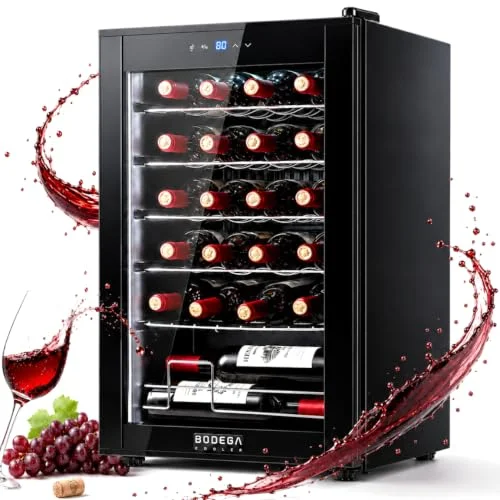
The BODEGA COOLER 24 Bottle is this guide's baseline, not a pick: at $259.99, it sits just under this band's $300 floor. Its listing doesn't state a cooling technology or a zone count, which is itself the point — at this price point you often have to dig into the full listing to find out what's inside the cabinet, rather than reading it off the title. See the current listing if 24 bottles for under $260 is what you need and you're willing to verify the rest yourself. We don't carry it further in this guide because we can't confirm the one spec that defines the $300 line.
Two of the five products we're covering here — the ROVSUN 33 Bottle and the EUHOMY 15" — don't use the word "compressor" in their listing titles, even though both advertise independent dual-zone control, a feature that's hard to deliver well on thermoelectric hardware. We won't assert a cooling technology that isn't stated; confirm it on the full listing before buying either one. The NewAir and the ICEVIVAL are unambiguous on this point, and that unambiguity itself costs money relative to the sub-$300 shelf.
Within this band, the jump from $349.99 to $429.99 isn't buying a different category of cooling. It's buying three narrower things, and it's worth knowing which cabinet actually delivers each one before you pay for it.
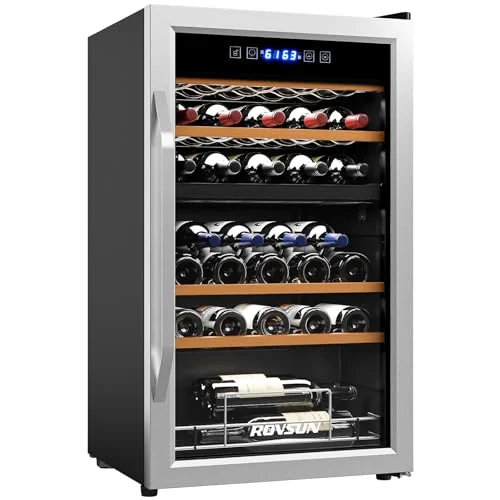
A wider, genuinely independent dual-zone range. Every cabinet in this guide except the sub-$300 baseline is dual zone, so "has two zones" stops being the differentiator inside this band — the differentiator is how far apart the two zones can actually sit, and whether the listing tells you. The ROVSUN 33 Bottle leads with "Independent Temp Control & LED Control Panel" as a named feature, which is the right thing to look for; a dual-zone unit that only lets its two halves drift a few degrees apart is decorative. Our thermostat accuracy guide covers why the number on the display and the number at the middle shelf are rarely identical, which matters more once you're running two setpoints instead of one.
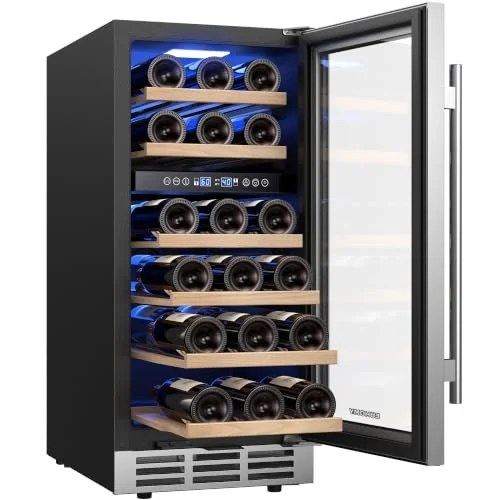
UV-resistant glass. The ICEVIVAL 15" is the one cabinet here that states this explicitly. Ordinary glass doors let UV through, which degrades wine over months the same way leaving a bottle on a sunlit counter does, just slower. It's a real spec, not a marketing word, but it's also one you'll only find stated on some listings in this band — absence of the claim doesn't necessarily mean absence of the feature, but we only credit a cabinet with it when the listing says so.
A compressor quiet enough to live in a kitchen or living room. Compressor cooling at any price makes some noise; "quiet compressor cooling," called out specifically on the NewAir 19" and the ICEVIVAL 15" listings, is the manufacturer committing to a lower noise floor than the category average. Neither listing gives us a decibel figure, so we won't invent one — but naming it as a selling point in the title is itself a signal the budget tier skips.
What $500 inside this guide does not buy: a 24-inch built-in footprint, a furniture-grade cabinet, or capacity much past 33 bottles. If your household is outgrowing 33 bottles, our guide to 20-to-45-bottle fridges covers the capacity question across a wider price spread.
15-inch undercounter vs 19-inch freestanding: which fits your cutout
Width decides this purchase before price or capacity does, because a wine fridge that doesn't fit the gap in your kitchen doesn't get returned for a refund — it gets lived with, badly, or shipped back at your expense. Three widths show up across this band.
The ICEVIVAL 15" Dual Zone and the EUHOMY 15" Dual Zone both target the standard 15-inch cabinet opening, the same width most undercounter dishwashers and most built-in wine fridges use. Only the ICEVIVAL's listing explicitly states it's rated for built-in or freestanding installation; the EUHOMY's listing gives the width and dual-zone capacity but doesn't make an install-type claim either way, so confirm that directly with the listing or manufacturer before cutting cabinetry around it. Enclosing a unit that isn't rated for it is the single most expensive mistake in this category — a freestanding compressor vents from the back and sides, and sealing that exhaust into a cabinet run makes the compressor run continuously until it fails early.
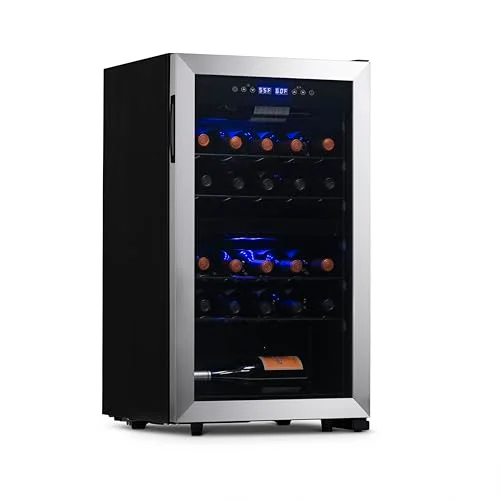
The NewAir 19" Dual Zone is wider, at 19 inches, and its listing states built-in or freestanding capability directly, along with stainless steel construction and a glass door. Nineteen inches is a less common cabinet opening than 15 — it fits some kitchen layouts and not others, so measure before you shop rather than after.
The ROVSUN 33 Bottle Dual Zone is freestanding only, with no built-in claim on the listing. That's a real constraint, not a missing detail: don't plan to box this one into a cabinet run regardless of how the gap measures.
If none of these three widths match your cutout, our 12-inch wine fridges guide covers the narrower end of the market that this one doesn't reach.
Bottle count vs. cabinet size: why 33 isn't always bigger than 28
It's tempting to read bottle count as a proxy for how much cabinet you're getting, and in this band that assumption breaks in both directions.
Compare the EUHOMY 15" Dual Zone, rated for 33 bottles, against the NewAir 19" Dual Zone, rated for 28. The EUHOMY is four inches narrower and holds five more bottles. That isn't a printing error — it's what rack geometry and shelf spacing do inside a cabinet. The zone divider's placement, the angle of the racks, and how much depth each shelf gives a bottle neck all move independently of the cabinet's outer footprint. A wider box with shallower shelving can hold fewer bottles than a narrower box engineered to pack them tighter.
The same point shows up again inside the single 15-inch width class. The ICEVIVAL 15" Dual Zone is rated for 29 bottles (per its own size listing — its title headline rounds to "28 Bottle," but the specific size/variant data states 29) and the EUHOMY 15" Dual Zone for 33, at the same nominal width. Four bottles of difference inside an identical footprint comes entirely from internal layout: how the zone divider is placed, how many shelves each zone gets, and how much clearance each shelf leaves above the bottle beneath it.
The practical takeaway: don't shop this band by bottle count alone, and don't assume a bigger number means a bigger appliance. Shop by the width you've measured, then compare bottle counts only among cabinets that actually fit. Treat every advertised count as an upper bound rather than a plan — slim Bordeaux-shaped bottles rack more efficiently than wide-shouldered Burgundy or Champagne bottles, so a mixed cellar typically seats fewer bottles than the number on the box, regardless of which of these five you choose.
The picks across the range
Four cabinets, ordered by price, each solving a slightly different version of the $300-to-$500 brief.
When $500 isn't enough, and it's time to look higher
This band tops out at 33 bottles, 19 inches wide, and freestanding-or-built-in at best. Three signs you've outgrown it before you spend a dollar in it:
- You need a true 24-inch built-in footprint. Nothing here is rated for the wider cabinet cutout a kitchen remodel typically plans around. That's a different product category, not a better version of these five.
- You're already past 33 bottles, or expect to be within a year. Buying twice is more expensive than buying once at the right size. Our 20-to-45-bottle guide is the better starting point if your collection is the growing kind.
- You want brand-level build quality, not just a stated spec sheet. At $300–$500, you're trusting the listing's own words for cooling type and install rating, as the EUHOMY and ROVSUN gaps show. Climb to $600–$800 and you're choosing among established built-in brands instead. Our NewAir vs. Whynter vs. EdgeStar comparison covers names that show up most often once you're shopping that tier.
If none of those apply, the width you've already measured should decide it before the price does — a cabinet that doesn't fit the gap isn't a bargain at any of these four prices.
How we compared these — and what we won't claim
We compared published manufacturer specifications — bottle capacity, cabinet width, zone count, cooling technology where the listing names it, glass and finish claims, and current listed price — for every wine fridge priced between $300 and $500 that we could verify against the product database. Where a listing's title and its own size/variant data disagreed, as with the ICEVIVAL's 28-vs-29 bottle count, we used the more specific figure and said so.
We do not run a testing lab. We don't own these five units and haven't physically tested any of them, so there is no score out of ten on this page. We also don't publish star ratings or review counts: the retailer data we draw from doesn't return them for this category, and rather than paraphrase review sentiment we don't have, we anchored every claim here to what the manufacturer states, the price, and general facts about how compressor and thermoelectric cooling behave. Where a listing didn't state a spec — cooling type for the ROVSUN and EUHOMY, install rating for the EUHOMY — we said that plainly instead of guessing.
Prices quoted here were correct at the time of writing and change frequently. Confirm the current price before buying.
Frequently asked questions
Is it worth paying over $300 instead of buying a cheaper thermoelectric fridge?
If the cabinet will ever sit in a room that gets warm — a kitchen in summer, a garage, an uninsulated sunroom — yes. Thermoelectric cooling only pulls the interior to roughly 20°F below ambient and loses control entirely once the room gets hot enough. Every cabinet in this guide that states its cooling technology states compressor, which holds its setpoint regardless of room temperature. That reliability, not extra bottles, is what the jump past $300 is mainly buying.
Do I need dual zone if I'm spending $300 to $500?
Probably, because at this price it's close to the default rather than an upgrade — four of the five cabinets here are dual zone. The real question inside this band isn't "one zone or two," it's whether the listing names independent temperature control, like the ROVSUN does, or leaves the two-zone spread unstated.
Will a 15-inch wine fridge fit under my kitchen counter?
Fifteen inches is the standard undercounter cabinet opening, so a 15-inch cabinet is the right width for that cutout — but width alone doesn't make it safe to enclose. Only install a unit under a counter if the listing itself states a built-in or built-in-or-freestanding rating, as the ICEVIVAL's does. Enclosing a freestanding-only unit, or one whose listing doesn't make the claim either way, traps the exhaust heat and shortens the compressor's life.
Why does a 33-bottle fridge sometimes cost less, or take up less space, than a 28-bottle one?
Bottle count depends on shelf spacing, rack angle, and how the zone divider is placed inside the cabinet — not just on the cabinet's outer dimensions or its price. In this guide, the 33-bottle EUHOMY is four inches narrower than the 28-bottle NewAir. A bigger number on the box describes the inside of that specific cabinet, not the size of the appliance sitting in your kitchen.
Written by Ilane Tall. Research-based comparisons of published specifications and current prices — we do not physically test these units and we do not publish invented scores.