By Ilane Tall · Updated November 8, 2026 · Research-based.
Reader-supported: we may earn a commission when you buy through the links on this page, at no additional cost to you. It never changes which product we recommend. Prices quoted below were correct at the time of writing and move often.
The short version
NewAir, Whynter and EdgeStar all make 15-inch wide undercounter wine fridges rated for built-in installation, which is a smaller club than the countertop market suggests. Beyond the shared width, they diverge on construction: NewAir leans on wood shelving and a "precision cooling" claim, Whynter pairs a cylinder lock with double-paned glass at a single zone, and EdgeStar builds in a reversible door and its own integrated lock.
None of these three publish a star rating or review count for the models we cover here, so pick on specification fit — cabinet depth, zone count, lock type — rather than on a score that does not exist for this category.
If you only read one section, read reading the warranty page before you read any spec sheet — it tells you more about what happens after year one than the cooling claim does.
Why these three, specifically
Most of the wine fridge market is countertop units: freestanding boxes meant to sit on a counter or in an open nook, vent from the back or sides, and die quickly if you enclose them. That is most of what shows up when you search "wine fridge," and it is a different product category from what this page is about.
NewAir, Whynter and EdgeStar all also build to the 15-inch built-in class — the standard undercounter opening used across kitchen cabinetry, matched to the same width as a dishwasher drawer or a standard base cabinet bay. A unit in this class vents through the front, through a grille below the door, so the heat it rejects has somewhere to go even when the cabinet is enclosed on three sides. That is the single specification that actually matters for a built-in installation, and it is also the one a shopper cannot verify by looking at a product photo — it has to be stated by the manufacturer and confirmed before the unit goes anywhere near a cabinet run.
We picked these three because each publishes one 15-inch built-in model with enough spec detail to compare honestly: a NewAir 15" Dual Zone, 28 Bottle, a Whynter BSR-033SW, 33 Bottle, and an EdgeStar 15 Inch, 23 Bottle. Same width, same undercounter intent, three different approaches to what goes inside that 15-inch envelope. For the wider field of options at this capacity tier, our roundup of wine fridges with 20 to 45 bottles covers freestanding models too; this page stays narrowly on the three built-in specialists.
NewAir
Dual zone, wood shelving, a stated precision-cooling claim. Built-in or freestanding.
Whynter
Single zone, cylinder lock, double-paned glass. Built-in or freestanding.
EdgeStar
Dual zone, reversible door, integrated locking hardware.
NewAir: wood shelves and a precision-cooling claim
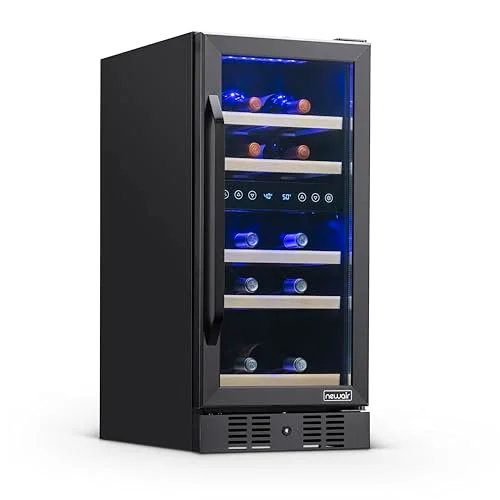
The NewAir 15" Dual Zone Wine Fridge is built for 29 bottles and sold with a 28-bottle size/variant listed, in black stainless steel with a glass door, and NewAir markets it as either built-in or freestanding depending on how it is installed. It is a dual-zone unit, which at this width is a real engineering choice rather than a free upgrade: splitting a 15-inch cabinet into two compartments means each half is working with less shelf space and less airflow than a single-zone unit the same size, a trade-off we cover in more general terms in our dual zone vs single zone comparison.
Two things stand out in NewAir's own description of this model. The first is the wood shelving — NewAir markets the interior racks as wood, which is the traditional cellar material and a point of differentiation from the chrome wire shelving that shows up on cheaper units; wood does not telegraph vibration into the bottle resting on it the way bare wire can, and it reads as a more finished interior behind the glass door. The second is the "precision cooling" language NewAir uses for the model, aimed at red and white wines kept at their own zone temperature. We have no independent way to verify what "precision" means in degrees beyond what NewAir states, and the listing does not give us a published per-zone range to check it against — so we report the claim as NewAir's claim, not as a number we measured.
At $530.11, this is the middle price of the three. The honest way to read that number: you are paying for dual-zone capability and the wood-shelf finish, not for materially more capacity than the single-zone Whynter below it.
Whynter: the safety-lock-and-glass approach at this size
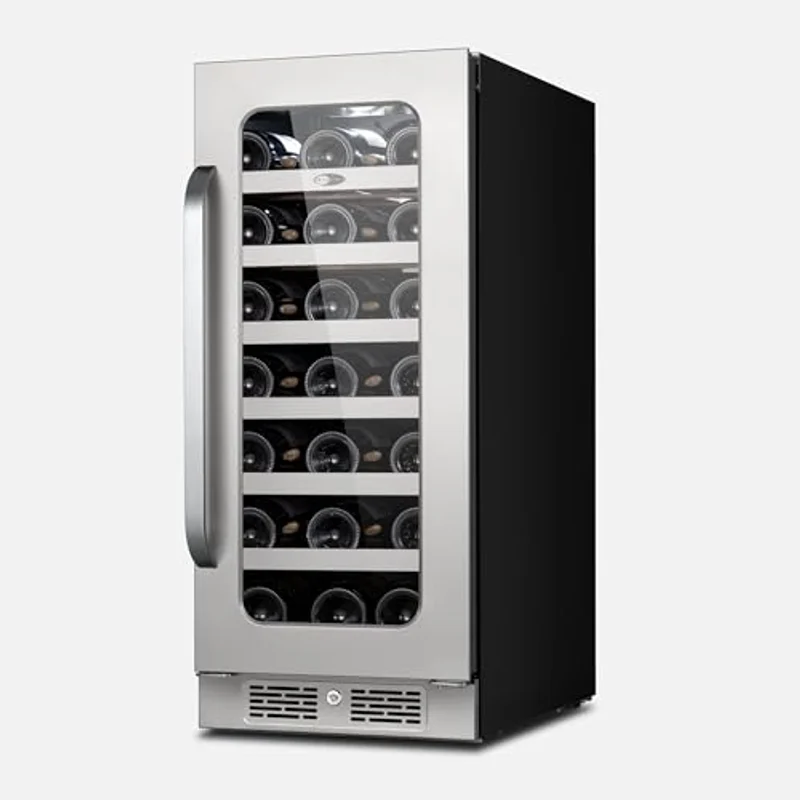
The Whynter 15" Built-in Undercounter Wine Refrigerator, BSR-033SW, holds 33 bottles — the highest capacity of the three at the same 15-inch width, which is the direct benefit of staying single zone. Splitting a narrow cabinet in two leaves each compartment too small to be genuinely useful; staying single zone here means the entire interior volume goes to storage instead of being divided by a partition.
Whynter's approach to this size is built around two features working together: a cylinder lock and double-paned glass on the door. The lock is a straightforward security feature — useful in a rental, a shared household, or anywhere a cabinet is accessible to people who should not be opening it unsupervised. The double-paned glass matters more than it sounds: a single pane of glass is a poor insulator and a UV window into the cabinet, and running a compressor behind a single pane means fighting heat gain through the door itself all day. Two panes with an air gap between them cut that heat transfer and block more UV than a single pane would, which is part of why the unit can hold a stable interior temperature without the compressor running constantly.
At $499.99, the BSR-033SW is the least expensive of the three and the highest-capacity. The trade is the one zone — fine for a household that drinks mostly one color, less fine for a household that wants reds and whites held at different temperatures in the same cabinet.
EdgeStar: reversible-door hardware and integrated locking
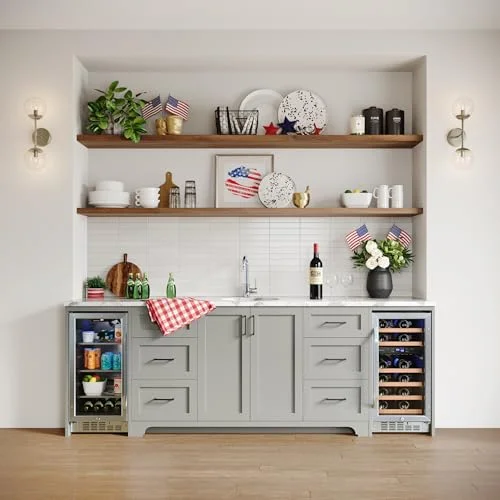
The EdgeStar 15 Inch 23 Bottle Built-In Dual Zone Wine Cooler is the lowest-capacity and highest-priced of the three at $869.00, and the reason is hardware rather than cooling power. EdgeStar builds this unit with a reversible door — the hinge can be moved from one side to the other, which matters enormously in a built-in installation where the cabinet opening is fixed and the door has to clear an adjacent appliance, an island edge, or a walkway, something a non-reversible door simply cannot do if the kitchen layout does not cooperate. Combined with integrated locking hardware built into the door itself rather than a separate add-on lock, this is the unit built around the installation constraints a kitchen actually has, more than around squeezing in the most bottles.
It is also a dual-zone unit, like the NewAir, which at 23 bottles in a 15-inch cabinet means a meaningfully smaller compartment on each side than either of the single-zone alternatives offers in total. That is the real cost of this design: two zones and a reversible door in a narrow footprint, at the price of total capacity and at a premium over the other two.
If the installation is flexible — an open run of cabinetry with no adjacent obstruction — the reversible door buys you little. If it is not, EdgeStar's hardware solves a problem the other two do not address at all.
Reading a warranty and support page across three brands
None of NewAir, Whynter or EdgeStar publish a star rating or a review count for the specific models covered here — the retailer listings simply do not carry that data for this category, and we do not invent one to fill the gap. What a shopper can actually read, and should, is each brand's warranty and support page, because that is where the real difference between three similarly specified built-in units tends to show up.
A warranty page answers three questions worth checking before you buy, not after something fails: how long is the compressor covered versus the rest of the unit (compressors are frequently covered longer than cabinetry or electronics), does the warranty require you to register the product or keep a dated receipt, and does the brand run its own support line or route claims through a third party. None of that shows up in a product listing's bullet points, and all of it matters more over a five-year ownership period than a half-degree difference in the cooling claim on page one.
This matters more for built-in units specifically than for freestanding ones. A freestanding unit that fails can be pulled out, boxed, and shipped back without much disruption. A unit built into a cabinet run with custom trim around it is a bigger project to remove, so the support and warranty terms — how a claim gets handled, whether a technician comes to you or you ship the unit — carry more weight in the built-in class than they do for a countertop cooler you can swap in an afternoon.
| Model | Capacity | Zones | Door | Price | Get it |
|---|
 NewAir 15" Dual Zone, 28 Bottle |
28 bottles |
Dual |
Glass, wood shelves |
$530.11 |
Get it |
 Whynter BSR-033SW, 33 Bottle |
33 bottles |
Single |
Double-paned glass, cylinder lock |
$499.99 |
Get it |
 EdgeStar 15" Dual Zone, 23 Bottle |
23 bottles |
Dual |
Reversible, integrated lock |
$869.00 |
Get it |
The picks, one per brand
There is no single winner here because the three units are not solving the same problem — they are solving three different versions of the same 15-inch opening.
Which one you should actually buy
Buy the NewAir if you keep both reds and whites and want them at separate temperatures in a built-in cabinet, and you are comfortable taking the "precision cooling" description as marketing language rather than a published number. The wood shelves are a real, checkable feature; the precision claim is not independently verifiable from what NewAir publishes.
Buy the Whynter if a single zone covers your collection and you want the most bottles the 15-inch class offers at the lowest of these three prices. The cylinder lock and double-paned glass are concrete, specified features rather than marketing language, which makes this the easiest of the three to evaluate on the sheet alone.
Buy the EdgeStar only if the installation genuinely needs a reversible door — an island edge, an adjacent appliance, a walkway that dictates which way the door has to swing. If your cabinet run is open on both sides, you are paying EdgeStar's premium for a feature you will not use, and the Whynter or NewAir will hold more wine for less money.
Across all three, do the same check before buying any of them: confirm the unit is explicitly rated by the manufacturer for built-in installation, not just physically small enough to fit the opening. A unit that is only rated for freestanding use and gets enclosed anyway has nowhere to reject its heat, so the compressor runs constantly and the interior never holds its setpoint — the most expensive mistake in this category, and one that applies equally to all three brands here. If you are at the stage of comparing fridges above this price tier, our guide to premium wine fridges over $800 covers what the extra money buys past where EdgeStar sits.
How we compared these — and what we cannot tell you
We compared the manufacturer-published specifications, current listed prices and stated construction details for one 15-inch built-in model from each brand — capacity, zone count, door and lock hardware, and shelf material where the brand states it. We did not weight any brand's own marketing language, like NewAir's "precision cooling," as a verified figure; where a brand makes a claim with no accompanying number, we say so rather than repeating it as fact.
We do not run a testing lab. We do not own these three units and have not installed any of them ourselves, so there is no physical comparison behind this page and no score out of ten. None of the three listings carry a star rating or review count for the specific models we cover, and we have not substituted paraphrased sentiment for data we don't have — there is no review data behind this particular set of ASINs to draw on. What we can do honestly is read the three spec sheets side by side, confirm each brand's stated installation type, and tell you where the engineering actually differs.
Prices quoted here were correct at the time of writing and change frequently. Confirm the current price on each listing before buying.
Frequently asked questions
Are NewAir, Whynter and EdgeStar interchangeable at this size?
Not quite. All three fit the same 15-inch undercounter opening, but they split that space differently: NewAir and EdgeStar both divide it into two zones, which costs shelf space, while Whynter keeps the entire cabinet as one zone and uses the extra room for more bottles. Choose based on whether you actually need two separate temperatures, not on brand name alone.
Does a reversible door matter if I'm not sure yet where the fridge will go?
It matters most when you already know the cabinet run has something on one side — an island corner, another appliance, a walkway. If the installation is flexible and open on both sides, a reversible door is a feature you are unlikely to ever use, and EdgeStar's premium over the other two becomes harder to justify.
Why don't any of these three show a star rating?
The retailer listings for these specific models do not carry a rating or review count, and we do not fill that gap with an estimate. Rather than invent a number, we compare what is actually published: capacity, zone count, hardware and price.
Is "precision cooling" a real specification?
It is NewAir's own description of the model, not a figure we can verify independently. Where a brand publishes an exact temperature range per zone, we report that range; where the only thing published is descriptive language like "precision," we say that plainly rather than treating it as a measured claim.
Written by Ilane Tall. Research-based comparisons of published specifications, current prices and brand-stated construction details — we do not physically test these units and we do not publish invented scores.