By Ilane Tall · Updated November 3, 2026 · Research-based.
Reader-supported: we may earn a commission when you buy through the links on this page, at no additional cost to you. It never changes which product we recommend. Prices quoted below were correct at the time of writing and move often.
Quick answer
20 to 45 bottles is the size most households land on after a countertop starter cabinet stops being enough: big enough for real variety and a case or two in reserve, still small enough to stay a freestanding appliance rather than a built-in commitment. Expect $235 to $400 here, with the jump mostly explained by capacity and whether a second temperature zone is included.
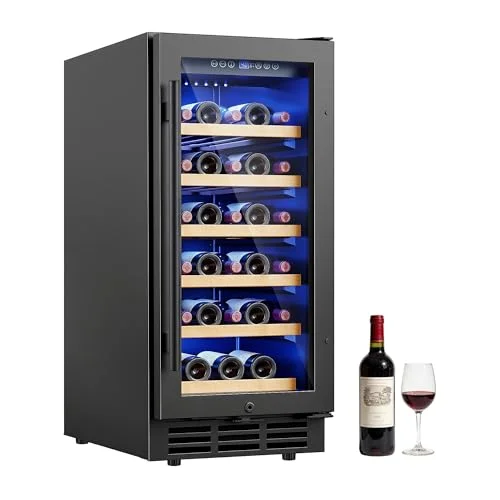
If a straightforward cabinet with no frills is the goal, the Yeego 34 Bottle at $223.42 is the cheapest way into this band. If you genuinely keep reds and whites in rotation, the Bonnlo 33 Bottle Dual Zone at $319.99 is the one built for that.
Already outgrowing a 45-bottle cabinet within months of buying one? See when to skip this band entirely and go straight to our 50-to-80-bottle guide.
Why 20 bottles starts feeling small, and 45 is where the next price class begins
Twenty bottles sounds like plenty until it is doing real work. A household that opens even one bottle a week, and keeps the cabinet roughly half full for rotation rather than running it down to empty, is cycling through a 20-bottle cabinet in well under a year — faster if anyone buys by the case or hosts more than occasionally. At that point the cabinet stops functioning as storage and starts functioning as a single shelf you are constantly refilling, with no slack for the bottle you are saving for a date you have not picked yet. That restocking pressure, more than any single spec, is the real signal that a starter cabinet has been outgrown.
Forty-five bottles is the upper edge for a different reason: it is roughly where the structural shift that happens around 50-plus bottles begins to apply — sturdier shelving to carry real weight, a bigger compressor and better internal circulation across a larger box, and often a wider footprint than the narrow freestanding units common at this size. None of that is true yet at 20 to 45 bottles. Nearly everything in this band is still a single compressor cooling a single insulated box with a handful of wire or slatted shelves — the differences between a 28-bottle cabinet and a 45-bottle one are mostly shelf count and cabinet height, not fundamentally different engineering. That is also why the price climbs gradually through this band instead of jumping the way it does once a cabinet crosses into mid-size territory. For a household that only needs a dozen or so bottles — a single room, a small apartment — staying below this band entirely is the better call; our dorm room wine fridge guide covers that smaller tier directly.
What this band actually buys
Stepping up from a sub-20-bottle starter unit into the 20-to-45-bottle range buys four things, in roughly this order of importance.
01
Real shelves
Still wire or slatted racks at this size, but enough of them — typically 7 to 10 — to actually separate bottles by style rather than stacking them three deep.
02
A visible dual-zone option
Below 20 bottles, dual zone is rare and often token. In this band it becomes a real, meaningfully priced option — the Bonnlo 33 Bottle Dual Zone here is the clearest example.
03
Headroom for a case or two
Enough spare capacity above what is in daily rotation to absorb a wine-club shipment or a holiday haul without immediately overflowing.
04
A wider price spread
$235 to $400 across the four cabinets here, tracking almost exactly with capacity and whether a second zone is included — not with brand or finish.
Whatever the listing calls itself — wine cooler, wine fridge, even "wine chiller" in Bonnlo's case — the name tells you almost nothing about how it performs; the specifications do. Our breakdown of what those names actually mean is worth a look if a listing's title is doing more marketing than informing, which is common at this price point.
Single zone vs dual zone at this size, and which wastes fewer bottles on the divider
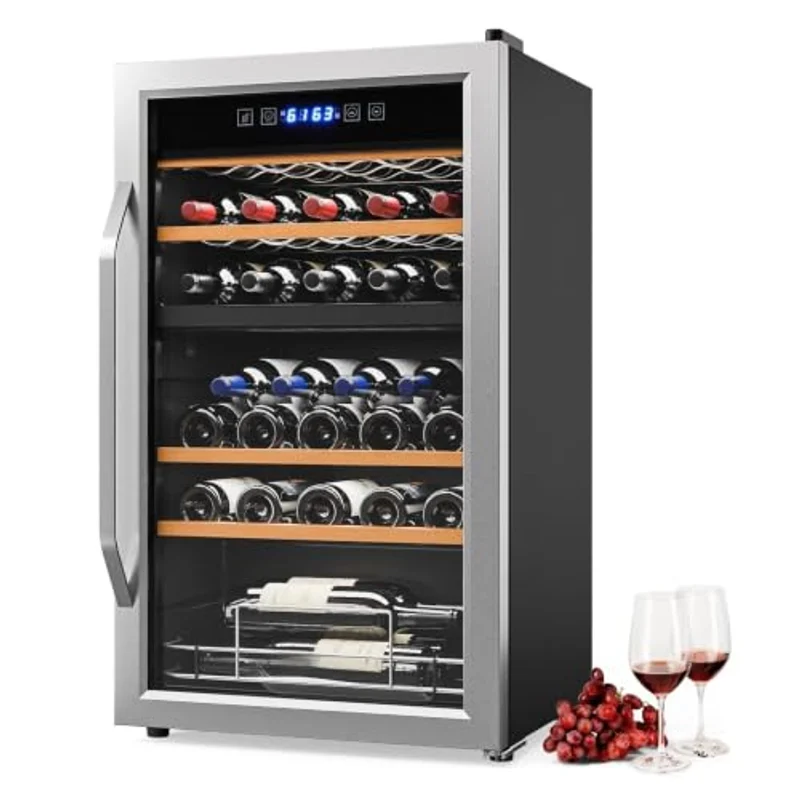
Of the four cabinets in this guide, only the Bonnlo 33 Bottle explicitly advertises dual zone, with a stated 41–64°F range and digital temperature control. The Yeego 34 Bottle and the Feelfunn 45 Bottle do not break out a zone configuration in their listings at all — no mention of a divider, no second thermostat, no per-zone range. Treat both as single-zone cabinets unless you confirm otherwise directly with the seller; a listing that wanted credit for a second zone would say so, the way Bonnlo's does.
Single zone (Yeego, Feelfunn)
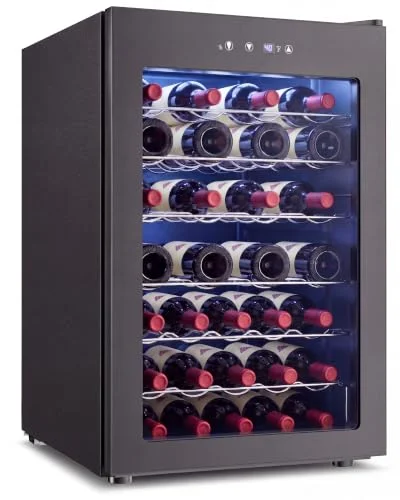
One thermostat, the full cabinet available for whatever you own this month. Set 55°F and the entire 34 or 45 bottles is usable, with no shelf space lost to a partition.
Dual zone (Bonnlo)
A 41–64°F range split by a fixed divider into a cooler compartment for whites and a warmer one for reds — useful only if the per-zone spread, not just the headline range, is actually wide.
The divider math matters more at this size than on a larger cabinet. A 33-bottle cabinet split into two compartments gives up a bigger proportional share of its capacity to the partition than a 52-bottle cabinet would, simply because there is less total shelf space to begin with. Discount Bonnlo's 33 bottles by the usual 70–80% real-world factor — advertised capacities assume slim Bordeaux bottles stacked perfectly — and the realistic figure is closer to 23 to 26 bottles, split unevenly across two compartments whose ratio you do not control. And as with any dual-zone cabinet, the 41–64°F figure is the whole unit's range, not necessarily the spread between its two zones individually; a cabinet where the warmer zone can only run a handful of degrees above the colder one is dual zone on the display and close to single zone in practice.
The decision reduces to the same 80% rule that applies at every size: if more than about four-fifths of what you store is one color, a single zone keeps every bottle of capacity usable and costs less per bottle besides. The Bonnlo's dual zone earns its $319.99 only if the household genuinely keeps both reds and whites moving through the cabinet at once and wants to serve a chilled white without a stop in the kitchen fridge first.
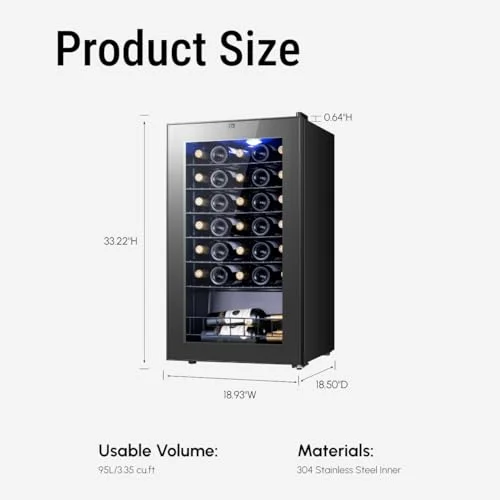
Physically, freestanding cabinets in this band typically run somewhere in the 14-to-17-inch-wide range and need a few inches of clear air behind and beside them to reject heat — enclosing any freestanding unit, regardless of brand, is the single most common way to kill its compressor early. None of the four cabinets in this guide state a built-in rating. That matters most for the ICEVIVAL 15 Inch: 15 inches happens to be the standard width of a built-in undercounter cutout, but its listing describes it plainly as a freestanding wine fridge. A 15-inch width alone is not a built-in rating — do not assume the two are the same just because the dimension matches.
If the actual goal is a true built-in installation at this capacity — tucked into a finished cabinet run rather than sitting on a counter — look for a listing that states front-venting and a built-in clearance rating, which none of these four provide. Our comparison of four 24-inch wine fridges is the better starting point if you are set on a wider, built-in-capable footprint instead.
And if the cabinet is going anywhere near a finished kitchen or a rental, a safety listing is worth checking before the zone configuration or the shelf count — it is what a landlord or an insurer actually looks for. Our guide to wine fridges that carry an ETL or UL certification covers which units state one, since none of the four here publish that certification in the specifications supplied.
The picks across the range
Four cabinets spanning the low end of this tier to its ceiling, chosen to cover the decisions this band actually forces: price, raw capacity, zones, and footprint.
When to skip this band entirely and go straight to the 50-to-80-bottle guide
Three signals say this tier is already too small, and that buying within it would just mean replacing the fridge again in a year or two. The first is restocking pace: if a 45-bottle cabinet is reliably back near empty within a few weeks, rather than months, your actual consumption has already outgrown this band. The second is a genuinely mixed, actively poured collection of both reds and whites — the dual-zone option here, Bonnlo's 33 bottles, still gives up a large share of its already-modest capacity to the divider, where a bigger dual-zone cabinet loses proportionally less. The third is buying by the case on a recurring basis; a 20-to-45-bottle cabinet has no headroom to absorb that more than once.
If any of those describe your household now, skip straight to our guide to wine fridges between 50 and 80 bottles rather than buying here and upgrading again shortly afterward — the structural differences covered there are exactly what a collection at that pace needs, and none of the four cabinets here are built for it.
How we picked, and how we compared
We pulled listings from our product database stating a capacity between roughly 20 and 45 bottles, then narrowed to the four that cover the real range of this tier: the cheapest straightforward option, the highest raw capacity, the one dual-zone cabinet at this size, and the narrowest footprint. We compared them on stated capacity, price, zone configuration and cooling type where specified, and price per bottle. Where a listing did not state a spec — zone configuration for the Yeego and the Feelfunn, a built-in clearance rating for all four — we said so rather than guessing.
We do not run a testing lab. We do not own these units and have not physically compared them, so you will not find an invented score out of ten here, nor a star rating or review count — our product data does not supply either figure for this category. What we can do honestly is read the specifications carefully, track the prices, and explain the trade-offs this tier actually makes.
Prices quoted here were correct at the time of writing and change frequently. Confirm the current price before buying, and whichever cabinet arrives, check it over in the first few minutes using our delivery and unboxing checklist — a cracked internal shelf or a dented door is far easier to resolve before the return window closes than after a year of ownership.
Frequently asked questions
What's the real difference between a 20-bottle cabinet and a 45-bottle one?
Mostly shelf count and cabinet height, not fundamentally different engineering — both are typically a single compressor cooling a single insulated box. The practical difference is headroom: a 45-bottle cabinet can absorb a case or two of new wine without immediately needing to be drunk down, where a 20-bottle cabinet in regular use is often back to nearly empty within months.
Do I need dual zone at 33 bottles, or is it wasted on a cabinet this size?
It depends entirely on whether you keep both reds and whites moving through the cabinet at once. A divider wastes a bigger share of a 33-bottle cabinet's already-modest capacity than it would on a larger one, so dual zone only earns its price here if the second zone gets used regularly. If your collection leans heavily toward one color, a single-zone cabinet like the Yeego or the Feelfunn holds more usable bottles for less money.
Can any of these go built into a cabinet run?
Not based on what their listings state. None of the four cabinets in this guide publish a built-in clearance rating, including the 15-inch ICEVIVAL, which matches the standard built-in cutout width but is sold as a freestanding unit. Enclosing a freestanding wine fridge blocks the airflow it needs to reject heat and shortens the compressor's life, so treat all four as needing open air on the back and sides unless you confirm otherwise with the seller.
When should I skip this size entirely and buy bigger?
Once a 45-bottle cabinet is reliably emptying out within weeks rather than months, once the collection is genuinely mixed and actively poured in real volume, or once case-quantity purchases are a recurring habit rather than an occasional treat. At that point, the structural upgrades covered in our 50-to-80-bottle guide — more shelving, a bigger compressor, often a wider cabinet — are worth the higher price rather than buying again at this size.
Written by Ilane Tall. Research-based comparisons of published specifications, current prices and public product data — we do not physically test these units and we do not publish invented scores.