By Ilane Tall · Updated October 30, 2026 · Research-based.
Reader-supported: we may earn a commission when you buy through the links here, at no additional cost to you. It never changes which product we recommend. The four prices below were pulled from our product database on different days between September 11 and October 28, 2026, and move often.
The short version
Divide price by bottle count and the ranking changes completely. The Icyglee 45 Bottle works out to about $7.33 a bottle — the cheapest storage in this catalog — while the Allavino 50 Bottle Dual Zone costs $25.08 a bottle for almost the same capacity.
The band that actually earns its price here is the 40–50 bottle, freestanding, single-finish tier — see where the value peaks and why. The two priciest cabinets on this page aren't bad value; they just aren't selling bottles. They're selling a second temperature zone, a built-in rating, or a stainless finish.
If none of those three things matters to you, buy by the math below. If one of them is the actual reason you're shopping, ignore the ranking and buy the feature instead.
The simple math nobody puts on the listing
Every listing leads with the same numbers: price, bottle count, a photo of the finish. None of them alone tells you whether you're getting a good deal. The number that does is price divided by bottle count — and no retailer page calculates it for you.
Run it on the four cabinets we carry data for:
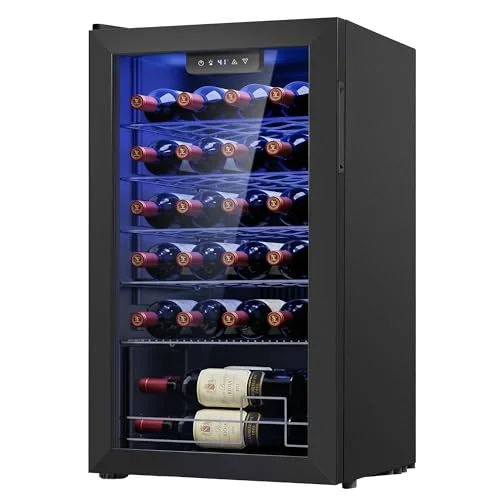
- Icyglee 25 Bottle — $219.99 ÷ 25 bottles = $8.80 per bottle
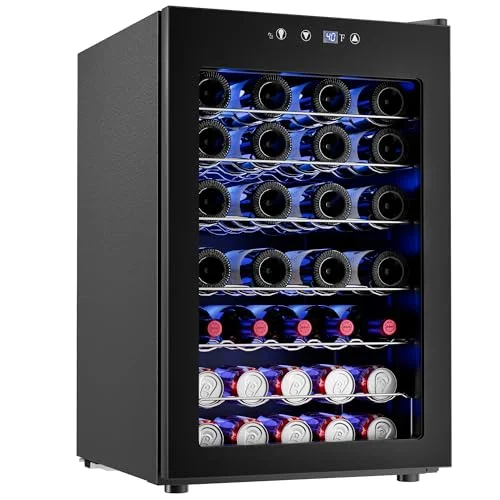
- Icyglee 45 Bottle — $296.49 ÷ 45 bottles = $7.33 per bottle
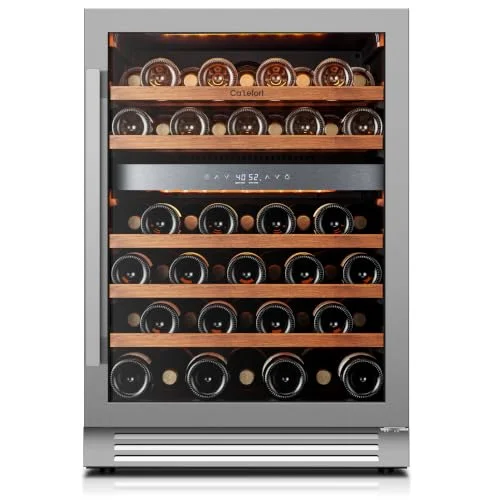
- Ca'Lefort 24 Inch 51-Bottle Built-In — $683.98 ÷ 51 bottles = $14.12 per bottle
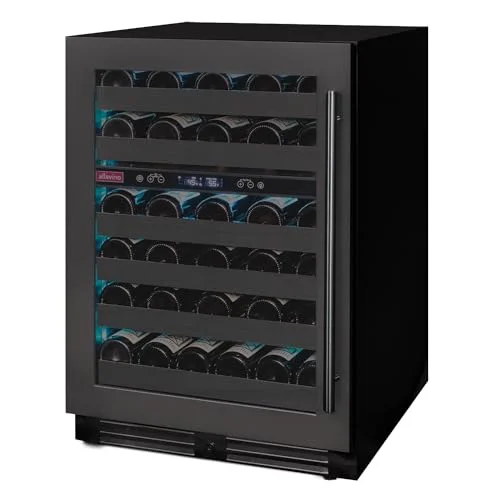
- Allavino 50 Bottle Dual Zone — $1,254.20 ÷ 50 bottles = $25.08 per bottle
Ranked by sticker price, the order is exactly what you'd expect. Ranked by what each dollar buys in storage, it barely resembles it. The two Icyglee units — smaller and bigger versions of the same line — sit at the bottom of the cost-per-bottle scale. The two units that change more than just size sit far above them, and not because they hold meaningfully more wine.
Why the curve isn't a straight line
If price per bottle only tracked capacity, it would fall steadily as cabinets got bigger. It doesn't, because a wine fridge's price is made of two different kinds of cost: the part that scales with how many bottles fit inside, and the part that doesn't move no matter how big the cabinet is.
The fixed part — compressor, control board, door hardware, insulation, the shell itself — costs roughly the same whether the interior holds 25 bottles or 45. Spread that cost over more racking and the price per bottle drops. That's what happens between the two Icyglee units: same brand, same finish, same installation type, and the bigger one is cheaper per bottle because the extra capacity is riding on hardware already paid for.
$8.80
Icyglee 25 Bottle
The starting point — small, single-finish, freestanding.
$7.33
Icyglee 45 Bottle
Same line, just more capacity. Cost per bottle drops.
$14.12
Ca'Lefort 51 Bottle
Dual zone and a built-in rating added. Price jumps, bottle count barely moves.
$25.08
Allavino 50 Bottle
Dual zone and stainless steel — nearly the Ca'Lefort's capacity, nearly double its cost per bottle.
Then the curve bends back up. The Ca'Lefort holds 51 bottles — six more than the Icyglee 45 — for more than double the cost per bottle. The Allavino holds 50, essentially tying the Ca'Lefort, yet costs nearly twice as much per bottle again. Neither jump is explained by storage space; both are explained by what changed alongside it — a second zone, a built-in rating, a stainless exterior. Once a cabinet competes on those things instead of bottle count, price climbs faster than capacity, and the per-bottle number climbs with it.
The number that makes this concrete: the Ca'Lefort and the Allavino hold almost exactly the same amount of wine — 51 bottles versus 50. The extra $534.32 you'd pay to go from one to the other buys zero extra storage. It buys a stainless finish and whatever else differs between them.
What the expensive end is actually paying for, when it isn't more bottles
Once price stops tracking capacity, it's worth asking what it's tracking instead. For the two higher-cost units here, the listing data points to a few specific answers.
A second temperature zone. Both the Ca'Lefort and the Allavino are listed as dual zone — a second thermostat, sensor and divider managing two setpoints off one cooling system. That's real added hardware, not a marketing label, and it's why dual-zone cabinets generally cost more than single-zone ones of similar size.
Installation engineering. The Ca'Lefort is rated for a 24-inch built-in opening at 5.65 cubic feet. A built-in cabinet vents through the front rather than the back — a more expensive cooling design than a freestanding box that just dumps heat out behind it.
Finish, hardware and brand. The Allavino specifies a black stainless steel exterior and a left-hinge door — choices about how it looks next to a kitchen, not about capacity. More broadly in this category, the premium tier tends to add heavier glass and better-sealing hardware, and an established wine-storage brand commands a different price than one that added a wine fridge to a general appliance catalog. Neither Icyglee listing specifies glass detail, hinge type or zone count — check the current listing before assuming either way.
If a built-in installation is the actual goal, a safety listing matters more than any of this — see our guide to ETL and UL certified wine fridges before buying for a rental, a dorm, or anywhere an inspector checks for it.
Where dollar-per-bottle value actually peaks on this catalog
The Icyglee 25 and Icyglee 45 are the cleanest comparison here, and it's worth saying why: same brand, same finish, same installation type — the only thing that changes between them is capacity. That isolates the variable we actually care about, which is exactly what the Ca'Lefort-versus-Allavino comparison can't do, since those two change capacity, zone count, installation and finish all at once.
Within that clean pair, the 45-bottle size wins at $7.33 a bottle versus $8.80 — the peak of dollar-per-bottle value on this specific catalog, past the point where fixed costs are still expensive per bottle but before the price starts buying a second zone or a built-in rating. It's a catalog-specific finding, not a universal law: a different brand's 60-bottle unit could bend the curve back upward if it adds a feature the 45-bottle size doesn't have. The test is always the same — check what else changed before crediting the size.
One caution before chasing the lowest number on the page: price per bottle says nothing about how a cabinet holds up over years of use. A seal that stops closing flush or a cabinet that's never been leveled will cost more in lost wine than any per-bottle saving — see what actually causes that before it becomes the bigger problem.
The picks, ranked by value — and by who should buy which one anyway
Ranked purely on dollars per bottle, the order below holds. But the right purchase depends on which question you're answering: "which stores wine cheapest" or "which has the specific feature I need." Each note below says which one it answers.
When paying more per bottle is still the right call
This isn't an argument that the cheapest cost per bottle is always correct — it's an argument for knowing when you're paying for storage and when you're paying for something else, so the extra money is a decision, not an accident.
Noise. A compressor fridge makes an intermittent hum; where it sits decides whether that's irrelevant or a nightly irritation. If the cabinet is going somewhere people sleep near it, see our guide to quiet operation for a bedroom or nursery before buying by price per bottle alone.
Warranty support and brand longevity. A built-in unit isn't something you casually swap out if it fails in year three — pulling it means redoing the cabinetry opening, not rolling a new box into the same spot. That's a real reason to weight a brand's track record more heavily for a built-in purchase than for a freestanding one you could replace in an afternoon.
A finish that matches the room. If every other appliance in the kitchen is stainless steel, a black cabinet reads as a mismatch every time you walk past it, regardless of cost per bottle — a legitimate reason to pay the Allavino's premium for its stainless exterior.
An installation requirement you can't work around. If the space is a 24-inch cabinet opening and nothing else, a freestanding unit isn't a candidate at any price. The Ca'Lefort's built-in rating isn't a premium feature in that scenario — it's the only thing on this page that actually fits.
Who should ignore the ranking entirely
Three groups, specifically: anyone installing under a counter, where only a built-in-rated unit is safe to enclose; anyone who already wants two independently controlled zones for reds and whites at once, which rules out both Icyglee units since neither lists a second zone; and anyone matching a specific kitchen finish, where a black cabinet next to stainless appliances is the actual problem being solved, not storage cost.
For everyone else — anyone whose only question is how to store the most wine for the least money, in whatever freestanding size fits the available floor space — the math above is the whole decision.
A worksheet: run this math on any listing before you buy
- Find the stated bottle capacity in the title or spec line — the number the listing commits to, not an idealized "holds up to" figure in a diagram.
- Divide the current price by that number. That one figure is the thing no listing calculates for you.
- Only compare that figure within the same installation type. Freestanding against freestanding, built-in against built-in — built-in is also paying for venting and a cabinet-opening fit.
- List every feature that isn't capacity before blaming the price on size. A second zone, a finish, a hinge side, a safety listing — each moves the dollar figure without moving the bottle count.
- Redo it again right before checkout. A ranking from last week can already be stale — which is why the four prices in this guide carry four different capture dates.
One thing the worksheet can't fix on its own: advertised bottle counts assume slim, uniform bottles. A collection with oversized or magnum-format bottles eats more rack space per bottle than the published number implies, which quietly worsens the real cost per bottle on every cabinet — see our guide to wine fridges for magnums and oversized bottles if that's part of your collection.
How we compared
We pulled the published listing data for these four wine fridges — capacity, price, zone count where stated, and installation type — and ran the one calculation none of the listings perform themselves: price divided by bottle count. We do not physically test these units, we do not own them, and we don't run a testing lab. This site also does not publish star ratings or review counts for any product, including these four; retailer data for this category doesn't reliably provide them, and we'd rather publish nothing than invent a number.
Frequently asked questions
Is the cheapest price per bottle always the best wine fridge to buy?
No. Price per bottle measures storage efficiency, not fit. A dual-zone cabinet, a built-in rating, or a finish that matches the rest of your kitchen are real reasons to pay more per bottle — the math just tells you how much you're paying for them, not whether they're worth it to you.
Why does a bigger wine fridge sometimes cost more per bottle than a smaller one?
Because capacity isn't the only thing changing. In this catalog, the Ca'Lefort 51-Bottle and the Allavino 50-Bottle hold almost the same number of bottles as each other, yet cost $14.12 and $25.08 per bottle. The extra money is going into a second temperature zone, a built-in installation rating, or a stainless-steel finish — not into more storage.
Does price per bottle account for installation costs?
No — it's sticker price divided by stated capacity, nothing else. A built-in model may also need cabinetry work that a freestanding model doesn't, which is a real cost the per-bottle math doesn't capture. Factor it in separately if you're installing under a counter.
How often should I redo this math before buying?
Every time, right before you buy. The four prices in this guide were pulled from our product database on different days between September and October 2026, and prices in this category move often enough that a ranking computed a month ago can already be stale.
Written by Ilane Tall. Research-based comparisons of published specifications, current prices and the math retailers don't show you — we do not physically test these units and we do not publish invented scores.