By Ilane Tall · Updated October 31, 2026 · Research-based.
Reader-supported: we may earn a commission when you buy through the links on this page, at no additional cost to you. It never changes which product we recommend. Prices quoted below were correct at the time of writing and move often.
The short version
If the fridge is warm but still running, check the gasket, the hinge and the condenser coil first — those are $0–$40 fixes you can usually do yourself in under an hour, and they cause most of the complaints people assume are "the compressor."
If it's the compressor itself — the unit runs non-stop, never reaches temperature, and the cabinet is hot to the touch — get a real repair quote before you decide anything. On most wine fridges under about $600, that quote lands close enough to a new entry-level unit that repair rarely wins.
And check the calendar before you check anything else: a unit already past its typical compressor lifespan is a bad candidate for a sealed-system repair no matter what the quote says — see the age cutoff below.
First, confirm what actually failed
Before you spend a dime, figure out which of four things is actually broken: the door gasket, the thermostat or control board, the fan, or the compressor. The order you check them in matters as much as the checking itself, because the cost difference between the first item on that list and the last one is roughly the difference between a drugstore purchase and a new appliance.
Work from cheapest and most common toward most expensive and least common, not the other way around:
- Gasket. The fridge runs more than it should, the interior never quite reaches its setpoint, and you can feel cold air leaking out around the door frame — or see visible cracking, flattening, or a gap in the rubber seal. This is the single most common reason a wine fridge "stops cooling properly" and it has nothing to do with the sealed system.
- Thermostat or control board. The display reads a temperature that doesn't match a separate thermometer placed inside, the unit cycles on and off erratically rather than holding steady, or an error code is lit. The compressor itself may be fine; it's just being told the wrong thing to do, or not told anything at all.
- Fan. You can hear the compressor running, but the temperature is uneven top to bottom, or there's a new grinding, ticking, or rattling noise instead of a steady hum. Internal circulation fans fail independently of the compressor fairly often, especially on dual-zone and larger single-zone units that depend on forced air to keep the whole cabinet at one number.
- Compressor. The unit runs constantly and never reaches temperature, the outside of the cabinet near the back or underneath is noticeably hot, and you may hear a loud click or buzz every few minutes as an overload relay trips and resets without the compressor actually starting. The worst version of this is silence: no hum, no vibration, nothing — the compressor isn't running at all.
The reason the order matters: a repair technician's house call is itself a cost, often $75–$150 just to show up, before any parts or labor. If you call that technician first and the answer turns out to be a $15 gasket, you've paid a diagnostic fee to be told something you could have confirmed yourself by running a hand along the door seal. Rule out the cheap, common failures first. Only escalate to a paid diagnosis once you've confirmed the fridge is still cycling but genuinely can't hold temperature with the door sealed and the coils clean.
The cheap fixes that are almost always worth doing yourself
Four problems account for a large share of "my wine fridge isn't cooling" complaints, and none of them involve the refrigerant system:
- Gasket replacement. Manufacturer replacement gaskets typically run $15–$40 and most are held on with a screw-in channel or adhesive strip rather than being permanently bonded. A warm hairdryer softens old adhesive enough to peel the gasket free, and the new one presses in along the same channel. No specialized tools required.
- Hinge adjustment or replacement. A door that sags, doesn't sit flush, or pops open on its own is usually a loose or worn hinge, not a failing latch mechanism. Tightening the mounting screws fixes most of these; a worn hinge pin is a cheap replacement part on most models.
- A stuck shelf. Wood shelving absorbs humidity inside a wine fridge and can swell just enough to bind against the rails. Removing the shelf, letting it dry out, and lightly sanding the edges that contact the rail usually frees it. This is cosmetic, not a cooling problem, but it's the kind of thing that gets lumped into "the fridge is broken" when it isn't.
- A dirty condenser coil. The coil — usually on the back or underneath the unit — sheds heat from the refrigerant. A coating of dust, lint, or pet hair insulates it, which forces the compressor to run longer and harder to hit the same setpoint and can look exactly like a unit that's losing its cooling power. A vacuum with a brush attachment or a coil brush, run over it twice a year, solves this before it becomes a complaint.
All four are $0–$40 jobs that take under an hour, and together they resolve a genuinely large share of the "my wine fridge isn't holding temperature" reports that never actually reach the sealed system. If you've checked all four and the unit still can't hold its setpoint, that's the point where a real compressor question starts.
The compressor question
A compressor problem isn't a parts swap. The compressor sits inside a sealed loop of refrigerant lines, and fixing it means an EPA-certified technician recovering the existing refrigerant, replacing or repairing the compressor, brazing the lines back together, pulling a vacuum on the system, and recharging it with refrigerant — all licensed, specialized work that a general appliance repair visit doesn't cover.
That labor is the expensive part, not the compressor itself. A sealed-system repair quote on an entry-level wine fridge commonly lands somewhere in the $200–$400 range once you add parts, refrigerant, and the technician's time — and that's before accounting for the service call. Measure that against the unit itself: the Whynter BSR-033SW 33-bottle built-in costs $499.99 new. A repair quote anywhere near that number isn't really a repair decision anymore; it's a down payment on the same unit failing again, outside of any warranty, with none of the manufacturer support a brand-new purchase comes with.
The math doesn't improve much at a higher price point either. The GarveeHome 80-bottle compressor unit runs $686.41 new. A sealed-system repair at 50–60% of that price, performed by a third party, with no warranty behind the work, is rarely the better bet than simply replacing it — especially once you factor in that a fridge old enough to need this repair is also old enough that its gasket, insulation, and control board are closer to their own end of life.
Warranty math: what's actually left on the clock
Before paying anyone for a sealed-system repair, find out what's actually still covered — this is the step people skip, and it's the one most likely to save real money.
Most wine fridges in this category carry a standard limited warranty on parts and labor, usually one year from purchase, covering exactly the kind of gasket, control board, or fan failures described above. If the unit is still inside that window, the fix is a phone call to the manufacturer, not a local repair invoice — you shouldn't be paying for any of this out of pocket.
Separately, many manufacturers back the sealed system — specifically the compressor — with a longer warranty, sometimes five years or more, but with an important catch: that typically covers the part itself, not the labor to remove, replace, and recharge the system, and often only through the manufacturer's own authorized service network rather than a local appliance repair shop. If your unit is inside the sealed-system window but outside the general warranty, it's worth a call to confirm whether the part is free even if you still owe for labor — that math can still beat a from-scratch repair on a unit you'd otherwise be ready to replace.
If you're shopping for the replacement anyway, this is also the moment to check how a unit is certified, not just how it's warrantied. A safety listing from ETL or UL is frequently what determines whether a landlord, an insurer, or a campus housing office will actually let you plug the thing in — our guide to ETL- and UL-certified wine fridges covers which models carry it. That matters even more if the fridge is going into a dorm room, where appliance rules are usually stricter than anywhere else in a house — see our dorm room wine fridge guide for what campus housing policies typically require.
The age cutoff: why an old unit is rarely worth a sealed-system repair
Even a fair repair quote can be the wrong call if the fridge is simply old. Compact compressors in wine and beverage refrigerators are commonly cited as lasting somewhere in the neighborhood of 8 to 12 years with reasonable care — shorter in a hot garage or an enclosed cabinet that was never meant to be airtight, longer in a climate-controlled room with clear airflow around the back.
If a unit is already at or past that window, a sealed-system repair is a bet that everything else inside it — the door seal, the control board, the foam insulation that's been absorbing humidity cycles for a decade — will also hold up for several more years. That's a bad bet on an appliance that just told you, directly, that one of its core components already failed. Put the repair money into a replacement instead and you start that clock over on every part, not just the one that happened to die first.
The flip side is just as useful: if the compressor fails on a unit that's only three or four years old, repair is a far more defensible call, because the rest of the appliance is presumably still well within its working life. Age, more than the repair quote itself, is usually the deciding variable.
If the honest answer is replace, three realistic starting points
Once you've ruled out the cheap fixes, gotten (or estimated) a real repair quote, and checked the age of the unit against the cutoff above, here are three replacement points at three different budgets — not a ranked "best" list, just realistic options depending on what you're replacing and what you're willing to spend. For a deeper look at how price relates to actual bottle capacity across sizes, our cost-per-bottle guide walks through the math in more detail.
01Direct built-in swap
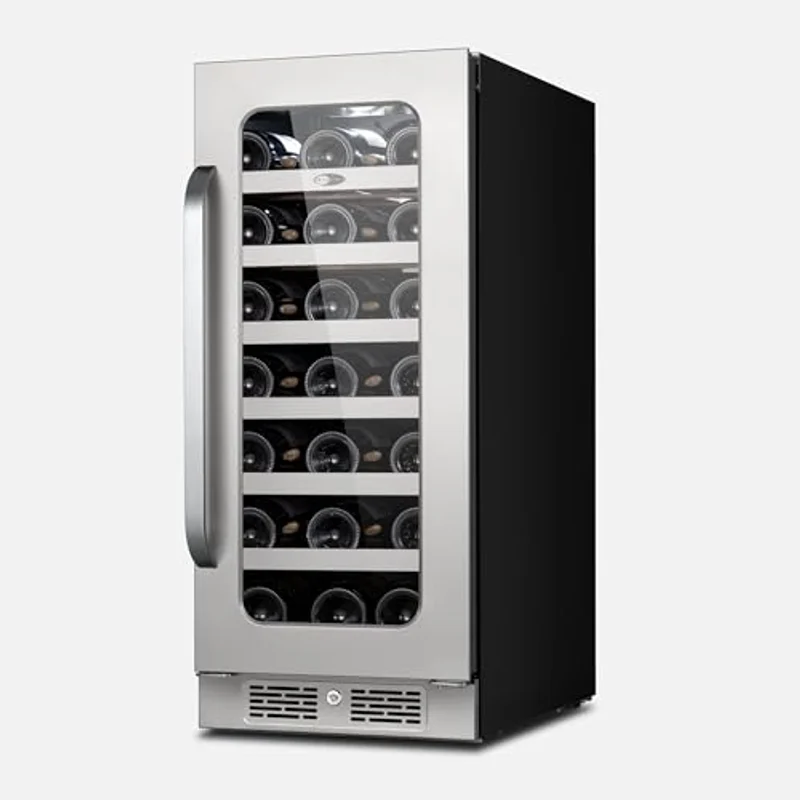
Whynter 15" Built-in Undercounter Wine Refrigerator, 33 Bottle (BSR-033SW)
The closest thing to a drop-in replacement for a dead 15-inch built-in
33 bottles·Single zone·Compressor·Built-in or freestanding
If the unit that failed was a 15-inch built-in, this is the straightforward replacement: the same standard cabinet width, front-venting so it's rated for an enclosed opening, and compressor cooling rather than thermoelectric, so it holds its setpoint regardless of what the kitchen is doing. At $499.99 it's also well under what a sealed-system repair on almost any comparable unit would cost, which is the whole point of this guide.
The reference point every other replacement option in this price range gets measured against.
02Same footprint, confirm before you buy
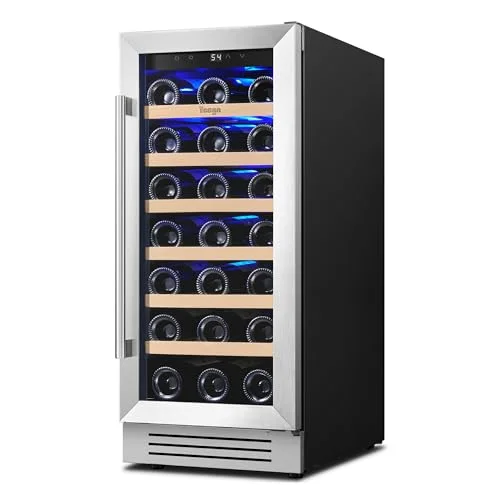
Yeego 15 Inch Wine Fridge with 33 Bottle
A same-size, same-capacity alternative — with specs you should verify on the listing
33 bottles·15-inch footprint
Same 15-inch width and the same 33-bottle capacity as the Whynter above, at a slightly higher $365.64. Its listing doesn't publish the same install-clearance or zone detail that Whynter states outright, so before ordering it as a built-in replacement, confirm on the current listing whether it's rated for an enclosed cabinet or freestanding use only — don't assume either way. It's a reasonable second option to compare against the Whynter if that one is out of stock or you simply want to see current pricing side by side.
Worth comparing, but read the listing's own clearance specs before you commit it to a cabinet cutout.
03Upgrading capacity, not just swapping
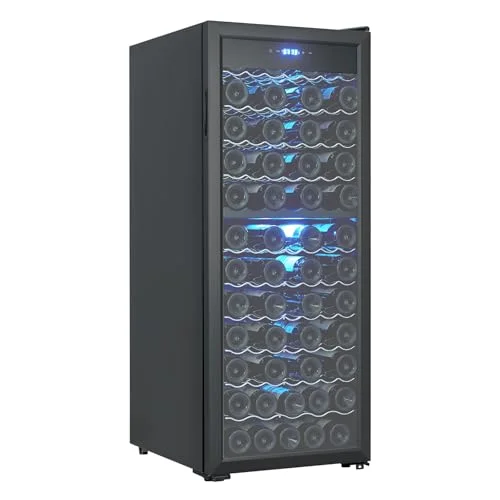
GarveeHome 80 Bottle Compressor Wine Cooler Refrigerator
For a replacement that also solves "we never had enough room"
80 bottles·Compressor·41–64°F·Freestanding
If the dead unit was undersized to begin with, this is the point where replacing it also fixes that: 80 bottles, adjustable shelves, a digital temperature display, and a 41–64°F compressor-cooled range, all freestanding at $686.41. Because it's compressor cooling rather than thermoelectric, it isn't silent — if it's replacing something in a bedroom or nursery, read our quiet-operation guide first. It also needs clear air space at the back and sides, the same way the smaller freestanding units do, which matters if it's going somewhere tight like a laundry room or mudroom.
The replacement that trades "like for like" for "finally big enough."
One more sizing note before you order: if the unit you're replacing was holding oversized bottles — magnums, large-format Champagne, anything wider than a standard 750ml — none of the capacity numbers above translate directly, since they're all calculated on slim Bordeaux-shaped bottles. Our guide to wine fridges for magnums and oversized bottles is the faster way to size that replacement correctly than guessing from the bottle count alone.
What to actually do with the broken unit
Once the replacement is ordered, the dead fridge is still sitting there, and it's not trash in the ordinary sense — it contains refrigerant, which most municipalities don't allow in regular curbside pickup.
- Parts. If you or someone you know does appliance repair as a hobby, the fan, shelving, door, and control board can sometimes be harvested for a similar model. For most people this isn't worth the time it takes versus the value recovered, but it's worth a five-minute ask before the unit leaves the house.
- Scrap and recycling. Appliances with a sealed refrigerant system fall under EPA Section 608, which requires the refrigerant to be properly recovered before the unit is scrapped — you can't just set it at the curb in most areas. Many municipal bulk-pickup programs and appliance recyclers handle this specifically and some utilities run rebate programs, commonly in the $25–$50 range, for turning in an old refrigeration appliance.
- Dealer trade-in or haul-away. Ask before the replacement ships, not after. A number of retailers and delivery services that install built-in units will take the old one away at the same visit, sometimes for free or for a small fee — which saves a separate trip and solves the refrigerant-disposal problem at the same time.
How we compared these — and what we cannot tell you
We compared published manufacturer specifications, current listed prices, and general, widely cited facts about compressor lifespan and sealed-system repair costs. We do not run a testing lab, we do not own these specific units, and we have not had a technician diagnose any of them for this guide — so you won't find an invented repair quote or a specific dollar figure claiming to be "the" cost of your repair. Repair pricing varies by region, technician, and the exact failure, and we're not going to pretend otherwise with a number we made up.
You also won't find a star rating or a review count on this page. The retailer API doesn't return them for this product category, and we don't publish figures we can't source. What we can do honestly is lay out the order in which to check a failing unit, the kind of repair costs that are publicly documented for this class of appliance, and real, current prices for realistic replacements.
Frequently asked questions
How can I tell a gasket problem from a compressor problem without calling anyone?
Run your hand around the door seal while the unit is running — a gasket problem usually means you can feel cold air escaping, or see a visible gap, crack, or flat spot in the rubber. A compressor problem looks different: the unit runs continuously without ever reaching its setpoint, the cabinet is noticeably warm to the touch near the back or bottom, and you may hear a loud click or buzz every few minutes rather than a steady hum.
Is a sealed-system repair ever worth it?
Mainly when the unit is still well within its typical lifespan — roughly the first three or four years — and the repair quote is meaningfully below the price of a comparable replacement. On an entry-level fridge in the $200–$500 range, a $200–$400 sealed-system repair quote is close enough to the cost of a new unit that replacement usually wins, especially once the unit is past the 8–12 year range commonly cited for this class of compressor.
What's a fair price for a gasket or thermostat fix?
A replacement gasket typically runs $15–$40 as a part, and most people can install it themselves with no special tools. A thermostat or control board swap is a bigger job — often $40–$120 in parts, plus labor if you're not comfortable doing it yourself — but it's still well below the cost of sealed-system work, because it doesn't involve handling refrigerant.
What should I do with the wine fridge once it's replaced?
Don't put it out with regular trash — it contains refrigerant that's regulated under EPA rules and needs to be recovered properly. Ask a repair-minded friend if any parts are worth salvaging, check whether your municipality or utility runs an appliance recycling or rebate program, and ask the retailer or installer delivering your replacement whether they'll haul the old one away at the same visit.
Written by Ilane Tall. Research-based comparisons of published specifications, current prices and widely documented repair facts — we do not physically test these units and we do not publish invented scores.