By Ilane Tall · Updated October 28, 2026 · Research-based.
Reader-supported: we may earn a commission when you buy through the links on this page, at no additional cost to you. It never changes which product we recommend. Prices quoted below were correct at the time of writing and move often.
The short version
A sealed wine fridge has almost no air exchange with the room, so any smell introduced inside it — factory plastic, a shared can of beer, a damp cork — stays and concentrates instead of dissipating. An activated-carbon filter doesn't mask or neutralize that smell; it physically traps odor molecules on a bed of extremely porous carbon as air passes through it.
It earns its keep in a mixed wine-and-beverage cabinet, a fresh-from-the-box unit, or a garage near fuel and paint fumes. It's close to irrelevant in a wine-only cabinet you empty and refill every few weeks — and if yours has no filter, an open box of baking soda does a meaningful fraction of the job for about two dollars.
Where that smell actually comes from
Open the door and get a faint wall of smell, and the instinct is to blame the wine. It's almost never the wine. Three things are doing it, and they stack.
The cabinet is sealed, which is the whole problem. A kitchen refrigerator cycles a lot of air every time the door opens, and the kitchen itself is ventilated. A wine fridge is built to do the opposite: a tight gasket, a door opened once a week instead of twenty times a day, an interior deliberately isolated from the room so the compressor isn't fighting incoming heat and humidity. That's correct engineering for a stable temperature — and exactly the condition that lets any odor-producing material inside, foam insulation, plastic shelf liners, a rubber gasket, slowly off-gas into a small, static volume of air with nowhere to go. The smell doesn't dilute away the way it would in an open room. It accumulates.
Natural cork is not airtight, on purpose. A cork stopper allows an extremely slow, controlled gas exchange between the bottle and the outside world — that trace permeability is part of how certain wines age, and it runs in both directions. Over months and years, the cabinet's air can pick up a faint trace of what's inside the bottles: must, wet wood, sometimes a chemical note if a cork absorbed something unpleasant before it reached you. A fridge holding forty corked bottles for years is a different chemical environment than one emptied every month, simply because there's more cork, more time, and more chance for that slow exchange to add up.
A shared compartment imports somebody else's smell. The biggest, most avoidable source. Wine-and-beverage units split one cabinet between bottles and cans — beer, soda, sparkling water. Beer carries strong, volatile aromatic compounds from hops and malt, and a can that's sat under pressure in a warm delivery truck can arrive carrying a faint residue of that smell on its exterior. Put that can in the same sealed air with wine bottles for weeks, and the air, eventually the corks, can pick up a trace of it. A brand-new unit adds its own version: fresh plastic, adhesive and packing-foam smell that a kitchen fridge airs out in days because it's opened constantly, and a wine fridge does not.
What "carbon purification" is actually doing, chemically
Strip the marketing language and an activated-carbon filter is one thing: a cartridge packed with carbon — usually derived from coconut shell or a similar organic source — processed at high heat to open up an enormous network of microscopic pores. A gram of it can carry a few hundred square meters of internal surface area, folded into a piece small enough to hold in your hand.
That surface area is the entire mechanism. Odor and volatile organic compounds — the molecules behind the smell of plastic, hops, mildew or sulfur — are drawn to the porous carbon surface and stick to it through weak molecular attraction, a process chemists call adsorption (not absorption; the molecules stay on the surface rather than soaking into the material). It's a physical trap, not a chemical reaction. The filter isn't neutralizing the smell or converting it into something odorless; it's pulling the offending molecules out of the air and holding onto them.
Three honest limits follow directly from that mechanism, and no listing advertises any of them:
- It only works on air that actually passes through it. A cartridge sitting in a corner is not filtering anything — it needs airflow to bring odor molecules to its surface.
- It saturates. Every pore that traps a molecule can't trap another. A filter adsorbing new-plastic smell for eight months has less remaining capacity than it did on day one, and most cartridges aren't cleaned and reused — they're a periodic replacement part, like the carbon filter in a range hood or a water pitcher.
- It is not selective. It traps odor compounds broadly rather than one specific smell, which is why the same filter helps with new-plastic smell, cork must and stray beer aroma alike.
A circulation fan and a filter cartridge are not the same feature
Listings get genuinely misleading here, not always on purpose. "Air circulation system," "fresh-air technology" and "carbon filter" get used almost interchangeably in bullet points — two different parts doing two different jobs.
Circulation fan
Evens out temperature so the top shelf of a tall cabinet isn't warmer than the bottom. No filtering medium — if anything it spreads an odor more evenly rather than removing it. Moving a smell around isn't the same as taking it out.
Carbon filter cartridge
A separate, consumable part containing activated carbon. Air has to be routed across or through it, often with help from that same fan, to do anything. This is the part that actually removes odor molecules rather than redistributing them.
A unit can have a fan with no filter, a filter with barely any fan to move air across it, or both working together properly. The only way to know which you're getting is to find the word "carbon" or "activated carbon filter" explicitly in the specification sheet — not inferred from "air circulation" language alone. If a listing only says the cabinet "circulates fresh air" without naming a carbon element, treat that as a fan claim, not a filtration claim.
The question to ask for odor control specifically: does the listing name a replaceable carbon filter cartridge as an included or available part? If yes, confirm you can actually order a replacement later. If the only language is about airflow or circulation, assume there's no filtration happening — just redistribution.
When a carbon filter genuinely earns its keep
A mixed wine-and-beverage cabinet. The clearest case. Any unit splitting its interior between bottles and cans is deliberately storing two aromatic sources in one sealed air volume, exactly the scenario adsorption filtering was designed for. If you're shopping a 24-inch dual-zone Velieta-style wine-and-beverage fridge, a stated carbon filter is worth confirming on the listing — mixed storage is exactly where it has real work to do.
A brand-new unit's factory smell. Every new appliance off-gasses adhesive, foam and plastic compounds for its first weeks of running, and a sealed cabinet traps that smell instead of airing it out the way an open kitchen does. A filter shortens that break-in noticeably; propping the door open for a day or two before loading bottles does nearly as much for free.
A garage or utility space with fumes nearby. Gasoline, two-stroke oil, fresh paint and solvent fumes are exactly the class of volatile compound activated carbon is good at trapping, and a gasket is not a perfect seal against them over months of use. If a unit lives near parked cars or a workbench, a filter does real, continuous work — and it's worth confirming the door seals flush in the first place, since a door that isn't sealing properly lets garage air in regardless of what filter is inside.
When it's close to irrelevant
The counterpart case is just as clear. If the cabinet is wine-only and you turn bottles over in weeks rather than years — a dorm-style fridge stocked for a semester, or a starter collection emptied and restocked every month — there isn't enough time for any of the mechanisms above to build up. A compact, fast-turnover wine fridge spends most of its life with fresh bottles that haven't sat long enough to off-gas anything, with nothing foreign sharing the air. Paying extra for carbon filtration there is buying a feature you'll rarely give enough time to matter — the same logic applies to any cabinet used for short-term chilling before a party rather than long-term storage.
The picks
None of the three units below are recommended here because they're confirmed to include a carbon filter — that's a spec not every listing states, and we don't assert a feature we can't confirm. What we can do honestly is match the product class to the scenario it fits, and say exactly what to verify before you buy.
01Mixed wine-and-can cabinet
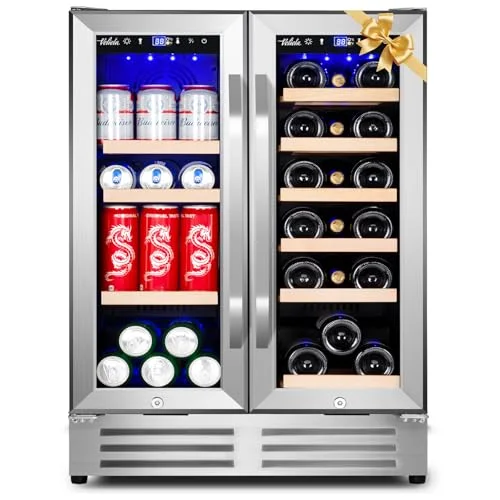
Velieta Wine and Beverage Refrigerator, 18 Bottles + 88 Cans
The scenario where filtration matters most
18 bottles + 88 cans·Dual zone·24" depth·Glass door
The exact product class discussed above: one compressor-cooled, dual-zone cabinet holding wine on one side and 88 cans, by the listing, on the other — the mixed-storage case a carbon filter is built for. Check the current listing for an explicit "activated carbon filter" line before assuming it's included; we're flagging the scenario, not the spec.
Right form factor for the problem — confirm the filter on the listing itself.
02Upgraded dual zone
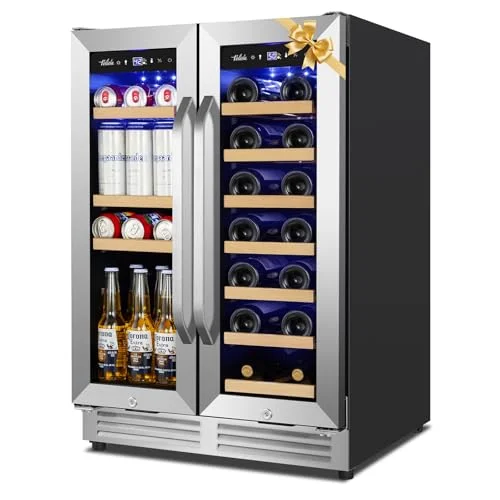
Velieta 24" Upgraded Dual Zone Wine and Beverage Refrigerator
Same mixed-storage case, newer revision
Dual zone·24" depth·Wine and beverage cooler
The newer, higher-priced revision of the same wine-and-beverage concept: one 24-inch cabinet, two zones, wine and cans sharing the sealed interior. Same logic applies — any stated odor-filtration feature here is doing genuine work, because what it would filter is built into how the fridge gets used. The listing doesn't give us a bottle or can count, so check the current page for those numbers and any filter spec.
Buy it for the mixed-storage layout; verify the filtration claim on the page.
03Wine-only, fast turnover
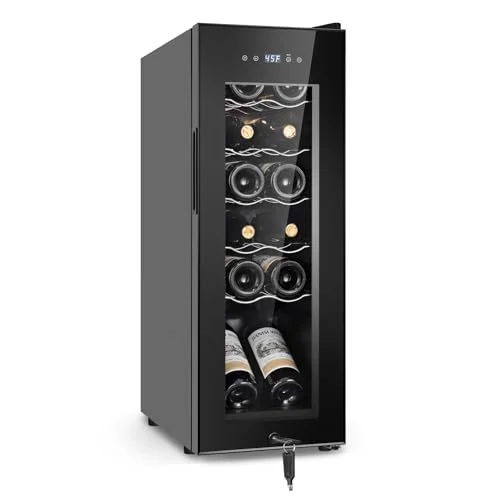
Tylza 12 Bottle Wine Fridge
Where filtration earns you the least
12 bottles·Compressor·LED touchscreen·Lock
A small, wine-only cabinet with a compressor, a low-E tempered glass door and a lock, in a 24-inch-depth footprint. Twelve bottles is a quick-turnover size — a collection restocked often enough that nothing sits long enough to off-gas much. The honest "don't bother" case above: a filter has little to do here, and the money is better spent on the compressor or the lock.
A good small wine fridge — just not where carbon filtration pulls its weight.
The low-cost fix: an open box of baking soda
If your fridge has no filter at all — or you'd rather not wait for a replacement cartridge — an open box of baking soda is not a folk remedy. It's the same chemistry that's kept kitchen refrigerators from smelling like last week's leftovers for decades, and it works through a genuinely different mechanism than activated carbon.
Baking soda, sodium bicarbonate, is mildly alkaline and amphoteric, meaning it reacts with both acidic and basic odor compounds rather than just physically trapping them the way carbon does. Many of the sharper smells in a closed space — sulfur-ish notes, mustiness, certain packaging compounds — are mildly acidic, and the bicarbonate neutralizes a portion of them through an actual chemical reaction, plus a smaller amount of adsorption similar to carbon's. It's slower and lower-capacity, which is why it isn't sold as a filtration product — but in a small sealed volume with a long dwell time, "slow" isn't disqualifying.
Three practical notes: leave the box open rather than sealed, since it needs air contact to do anything; replace it every one to three months, since it has a finite capacity even though it looks unchanged on the shelf; and keep it away from labels or damp surfaces, since a tipped, condensation-soaked box can leave a residue.
It won't out-perform a properly engineered carbon cartridge against a sustained source like a can of beer six inches from your best bottle, but for the ordinary staleness that builds up in any sealed cabinet, it closes most of the gap for the cost of a box you probably already own.
How we compared this
This article is built on the published specifications and current listings for the products named above, plus established chemistry about activated-carbon adsorption and sodium bicarbonate's odor-neutralizing properties — the same science behind the filters in range hoods and water pitchers, and the reason baking soda has sat in refrigerators for generations. Where a listing doesn't state whether a unit includes a carbon filter, we've said so rather than guessing.
We do not run a testing lab, and we don't publish an invented score out of ten for how well a unit controls odor. What we can do is explain the mechanism correctly, be specific about which scenarios make it relevant, and flag where a listing's language describes a different part than the filtration feature it's sometimes placed next to.
Frequently asked questions
Does a carbon filter remove the taint smell from a corked bottle?
No. Cork taint — often a wet-cardboard or musty smell, caused by the compound TCA — develops inside a sealed bottle, independent of the cabinet's air. A carbon filter manages the shared air in the fridge, not a chemical fault sealed inside one bottle.
How often does the carbon filter need replacing?
It depends on the cartridge and how much it's adsorbing, and manufacturers don't publish a universal number, so we won't invent one. A filter in a mixed wine-and-beverage cabinet saturates faster than in lighter use. Check the product's manual for a stated interval, and treat a returning smell as the practical sign regardless of the calendar.
Will baking soda really do as well as a built-in filter?
For everyday staleness, it closes most of the gap through a genuinely different chemical mechanism. Against a strong, sustained source like a shared can of beer, a dedicated carbon cartridge with proper airflow will outperform a box sitting passively on a shelf.
Is a smelly wine fridge a sign something is broken?
Almost always no — it's new-unit off-gassing, cork permeability over years, or shared storage with cans, all normal and explained above. The exception is a sharp electrical or burning smell, which is a mechanical problem, not an odor-filtration question.
Written by Ilane Tall. Research-based comparisons of published specifications, current prices and general product chemistry — we do not physically test these units and we do not publish invented scores.