By Ilane Tall · Updated November 1, 2026 · Research-based.
Reader-supported: we may earn a commission when you buy through the links on this page, at no additional cost to you. It never changes which product we recommend. Prices quoted below were correct at the time of writing and move often.
The short version
"Cooler," "fridge," "refrigerator," "cellar" and "chiller" are marketing words, not categories. They carry no fixed technical meaning, and manufacturers routinely use two or three of them in a single product title for the same box.
The words that do mean something specific are compressor, thermoelectric, dual zone, single zone, built-in and freestanding. Those are the six lines to find in the spec block before you compare anything.
Below, three real listings prove the point — one of them uses three different naming words at once and still leaves out the one spec that actually decides whether the unit will work in a warm room.
Why manufacturers can't agree on one name
There is no regulatory body, trade association or industry standard that assigns "wine cooler," "wine cellar" or "wine refrigerator" to a specific product category. Unlike, say, a refrigerator's energy-guide label or a mattress's advertised firmness scale, nothing forces a seller to pick one word and stick to it. The result is that the name on a listing is chosen the way any other headline is chosen: for whichever word a shopper is most likely to type into a search bar that week.
"Wine refrigerator" sounds technical and serious, so premium and built-in units lean on it. "Wine cooler" sounds casual and approachable, so budget countertop units lean on it. "Wine cellar" borrows the prestige of an actual underground room full of bottles, so it shows up on everything from a $139.99 countertop unit to a genuine temperature-and-humidity-controlled walk-in. "Chiller" shows up occasionally on compact units marketed toward drinks generally, not just wine. None of this is coordinated, none of it is regulated, and a brand will frequently use two or three of these words inside one listing title because each word is a separate keyword a different shopper might search.
That is not deception in the legal sense — nobody is claiming the appliance does something it does not do by calling it a cellar instead of a cooler. But it does mean the product name carries zero information about capacity, cooling method, number of temperature zones or installation type. Treat the name the way you would treat a book's title: evocative, chosen to sell, and completely separate from the table of contents.
What "wine cellar" actually means on a listing
A real wine cellar is a room: dug into or built against earth, humidity typically held near 60–70%, temperature held near 55°F year-round by thermal mass and often by dedicated cooling equipment, usually dark, usually built for bottles that will age for years or decades. It is architecture, not an appliance, and building one properly is a construction project measured in thousands of dollars.
When "wine cellar" appears in an Amazon listing title, it almost never refers to that. It refers to a freestanding or countertop electric cabinet — the exact same category of appliance sold next to it as a "wine cooler" or "wine fridge." The word is doing marketing work, not describing a room-replacement feature. A handful of larger built-in units do approach cellar-like stability because of their size and insulation, but that comes from the compressor, the insulation thickness and the cabinet volume — not from the word "cellar" printed on the box.
The clearest way to see this is to put two listings that use different names next to each other and read only the spec block, the way you would when comparing different 24-inch brands that all describe themselves slightly differently. Strip the title away and what is left — bottle count, cooling type, number of zones, installation style — is identical in kind whether the label says cellar, cooler or fridge.
The practical rule: if a listing calls itself a "wine cellar" and the price is under roughly $500, assume it is a standard compressor or thermoelectric cabinet, not a room-replacement system. If it genuinely promises climate-controlled cellar conditions at that price, that claim deserves more scrutiny, not less.
Cooler vs fridge vs refrigerator: no technical difference
Set "cellar" aside and the remaining three words — cooler, fridge, refrigerator — are even more interchangeable. There is no cooling method, temperature range or construction detail that separates a "wine cooler" from a "wine refrigerator." Both terms get applied to compressor units and to thermoelectric units. Both get applied to 6-bottle countertop models and 180-bottle built-in columns. A company will frequently sell what is functionally the same cabinet under both names in different markets, or even in the same listing title, purely because shoppers search for both phrases.
"Chiller" is the least common of the four and tends to appear on compact units aimed at beverages generally — sometimes wine, sometimes a mix of wine and cans — but again it describes nothing about the cooling technology inside. None of these four words tells you whether the unit will hold its temperature in a hot garage, whether it has one zone or two, or whether it can be built into a cabinet run. Reading the name and stopping there is the single most common way people end up with the wrong appliance.
The words that do carry real technical meaning
Unlike the naming words above, these four terms describe something fixed and checkable. They are the ones worth reading for, every time.
Compressor
A compressor unit uses the same refrigeration cycle as a kitchen fridge: a compressor, a refrigerant loop and a condenser coil. It can pull its interior down to a set temperature regardless of how warm the room gets, and it makes an intermittent hum and some vibration while doing it. If the fridge will live anywhere that gets warm — a kitchen, a garage, an uninsulated mudroom — this is the specification that matters more than anything else on the listing, including the name.
Thermoelectric
A thermoelectric unit cools using the Peltier effect — current passed through a semiconductor junction moves heat from one side to the other, with no compressor and no moving refrigerant. It is silent and vibration-free, which is exactly why it suits a bedroom, nursery or home office; quiet operation is the whole case for choosing one. The tradeoff is that it can typically only cool to roughly 20°F below the surrounding room, so in a warm space it may never reach a proper storage temperature. A listing's name never tells you which of these two technologies is inside — only the spec sheet does, and sometimes not even that, as the picks below demonstrate.
Dual zone (vs single zone)
A zone is a compartment with its own thermostat. Dual zone means two separately controlled sections, typically split by a fixed internal divider, usually so reds can sit at a higher storage temperature while whites sit colder and ready to pour. Single zone means one compartment at one temperature. Neither word says anything about cooler-vs-cellar naming — a dual-zone unit can be labeled cooler, fridge, refrigerator or cellar with equal likelihood — but it changes how the cabinet is actually used far more than any naming choice does.
Built-in (vs freestanding)
Built-in means the manufacturer has engineered the unit to vent through the front, so it can be enclosed in a cabinet run without trapping its own heat. Freestanding means it rejects heat from the back and sides and needs open air there to survive. This is purely a ventilation-and-installation spec, unrelated to the name on the box, and getting it wrong is the single most expensive mistake in the category: enclosing a freestanding compressor unit causes it to run continuously and fail early. A model's safety certification matters here too — if the unit is going anywhere a landlord, insurer or campus housing office will inspect, check for an ETL or UL listing the same way you'd check for a built-in rating, because neither shows up in the product name either.
How to compare two listings with different names, fairly
Once the name is off the table as a signal, comparing two wine storage listings becomes mechanical. Open the spec block or bullet points on each listing and look, in order, for:
- Bottle capacity — and remember it is usually calculated with slim Bordeaux bottles, so plan on roughly 70–80% of the stated number once wider Burgundy or Champagne bottles are mixed in.
- Cooling method — compressor or thermoelectric. If the listing does not say, that is itself useful information: it means you should not assume compressor-grade performance.
- Number of zones — single or dual, and ideally the temperature range of each zone individually, not just the cabinet's overall range.
- Installation type — built-in or freestanding, and whether a clearance or ventilation requirement is stated.
- Any secondary feature actually specified, such as a carbon filter for odor control. Features like this are easy to miss entirely if you are scanning the title instead of the bullets — see our breakdown of what carbon filtration actually does for an example of a spec that matters and is never reflected in the product name.
If two listings — one called a "cooler," one called a "cellar," one called a "refrigerator" — match on all five points, they are functionally the same purchase regardless of what either seller named them. If they diverge on even one, that is the real difference worth paying for or avoiding, and the name told you none of it.
Three real listings, labeled by what they're actually called
Here is the point made concrete, with three current listings rather than a hypothetical. Read the name each one was actually given, then read what the spec line underneath tells you that the name does not.
01Listed as both "fridge" and "cellar"
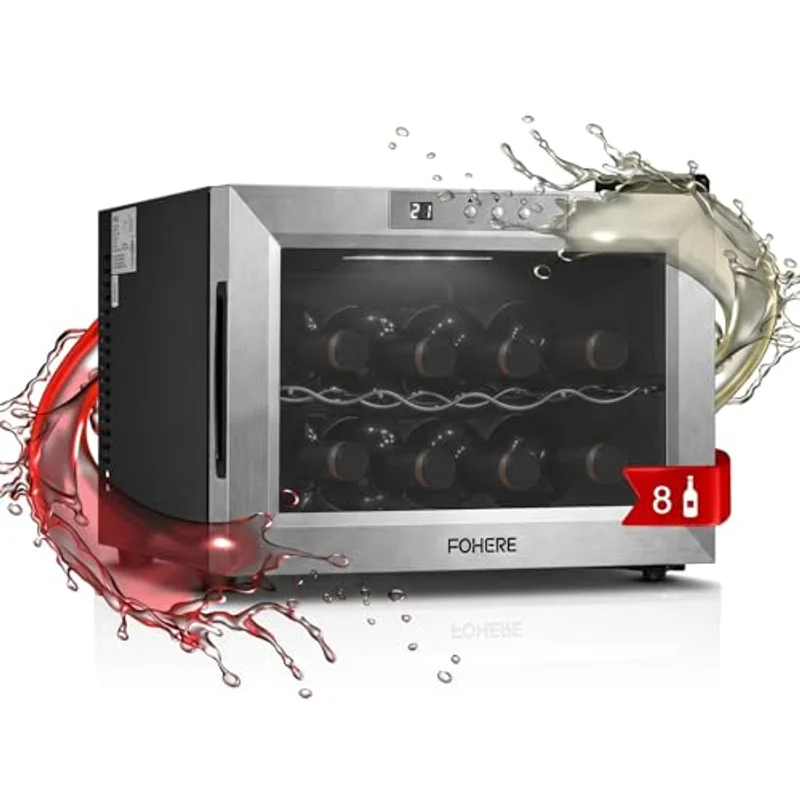
FOHERE 8 Bottles Small Wine Fridge
Called a "wine fridge" and a "wine cellar" in the same title
8 bottles·Countertop·Double glass doors·Digital control
The full listing title is "Countertop Wine Fridge … Wine Cellar for Bar, Home, Office" — the exact pattern this article is about, in one sentence. It is an 8-bottle countertop cabinet with double glass doors, an LED interior light and digital temperature control, in stainless. What the title does not tell you, and what we have no verified specification for on this listing, is whether the cooling is compressor or thermoelectric. At this size and price, check that line on the live listing yourself before assuming either way — it is the one spec that decides whether this belongs on a kitchen counter or only in a cooler room.
Two naming words, zero technical content — read the bullets, not the title.
02Listed as "Wine Cellar," officially
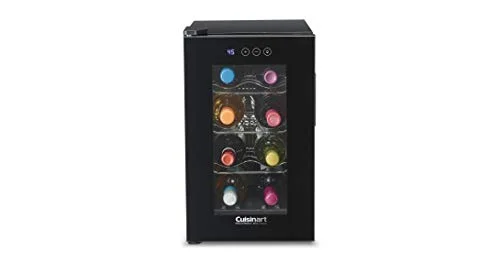
Cuisinart CWC-800CEN 8-Bottle Private Reserve Wine Cellar
A recognizable kitchen-appliance brand still calls it a "cellar"
8 bottles·Countertop·"Private Reserve" model line
This is useful specifically because Cuisinart is not an obscure listing-stuffed brand — it is a mainstream kitchen-appliance name, and its own model name is "Wine Cellar." That settles any doubt about whether "cellar" signals something more serious than "cooler": it does not. This is the same 8-bottle countertop class as the FOHERE above, at a higher price, under a more established brand name. Compare the two on bottle count and price per bottle the way you would use our cost-per-bottle breakdown, not on which one sounds more like a real cellar — because neither is one.
A household name still uses "cellar" as a model name, not a technical claim.
03Listed as "cooler," "refrigerator" and "fridge" at once
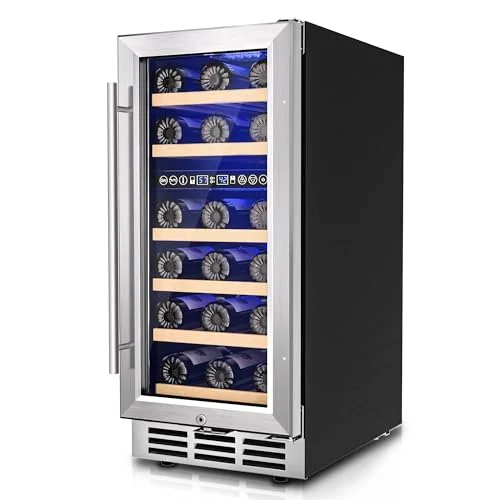
Icyglee 15" Wine Cooler Refrigerator, 30 Bottle Dual Zone
Three naming words stacked in one title, still missing the key spec
30 bottles·Dual zone·15" width·Silver
The title alone reads "Wine Cooler Refrigerator … Wine Fridge" — cooler, refrigerator and fridge in a single product name, describing one cabinet. What it does confirm, because it's stated directly, is genuinely useful: 30-bottle capacity and dual zone, in a 15-inch width. What it does not confirm is compressor versus thermoelectric cooling, which matters even more on a dual-zone unit, since thermoelectric dual-zone cabinets struggle to hold a real spread between the two compartments once a room warms up. Treat the zone count and bottle number as read; treat cooling technology as unverified until you check the listing yourself.
Three names in one title, and the one spec that decides performance still isn't one of them.
A short glossary — the terms that actually matter
- Compressor
Standard refrigeration cycle. Holds its setpoint in any room temperature, hums intermittently, suits kitchens and garages.
- Thermoelectric
Peltier-effect cooling with no compressor. Silent and vibration-free, but limited to roughly 20°F below room temperature.
- Dual zone / single zone
Whether the cabinet has one or two independently controlled temperature compartments, split by a fixed internal divider.
- Built-in / freestanding
Built-in vents through the front and can be enclosed in a cabinet run. Freestanding vents from the back and sides and must have open air there.
- Bottle capacity
A manufacturer figure based on slim Bordeaux bottles stacked perfectly. Real-world capacity with mixed bottle shapes runs lower, typically 70–80% of the stated number.
- "Wine cellar" (on a listing)
Almost always a marketing word for a standard electric cabinet, not a climate-controlled room. A genuine cellar is architecture, not an appliance you can buy in this price range.
How we compared these — and what we can't tell you
We compared the published listing titles, bullet specifications and current prices for the units named in this article, and read them the same way we are recommending you do: ignoring the naming word and checking capacity, cooling method where stated, zone count and installation type. Where a specification — most often cooling method on the units above — was not published on the listing, we said so rather than guessing at it from the name, the price bracket or the category norm.
We do not run a testing lab. We do not own these units and we do not physically test them, so you will not find a lab verdict or an invented score out of ten here. You also will not find a star rating or review count on this page: the retailer data available to us does not return them for every listing, and we do not publish a number we cannot source. If a repair question comes up later in ownership, our repair-or-replace decision guide works through that honestly too.
Prices quoted here were correct at the time of writing and change frequently. Confirm the current price before buying.
Frequently asked questions
Is a "wine cellar" appliance actually a climate-controlled room?
No — almost never, at least not at the price and scale sold on a typical listing. A genuine wine cellar is a room with controlled humidity and temperature, built into or against earth. When "wine cellar" appears in a product title on a marketplace listing, it refers to the same kind of freestanding or countertop electric cabinet sold under "wine cooler" or "wine fridge." The word describes the marketing angle, not the engineering.
What's the actual difference between a wine cooler and a wine refrigerator?
None that is fixed or reliable. Both terms are applied to compressor units and thermoelectric units, to single-zone and dual-zone units, to small countertop models and large built-in columns. Some brands even use both words in the same product title. The name tells you nothing about what is inside the cabinet; the spec block does.
Why does one listing use three different names for the same appliance?
Because each naming word is a separate search term a different shopper might type, and sellers write titles to be found under all of them at once. There is no rule preventing a single product from being called a wine cooler, a wine refrigerator and a wine fridge in one title, and in practice this happens constantly across the category.
What should I actually read on a listing instead of the product name?
Bottle capacity, cooling method (compressor or thermoelectric), number of temperature zones, and installation type (built-in or freestanding). Those four specifications determine how the unit will actually perform and fit in your space. If a listing does not state the cooling method, treat that as missing information rather than assuming it based on the name or the price.
Written by Ilane Tall. Research-based comparisons of published listings, specifications and prices — we do not physically test these units and we do not publish invented scores.