By Ilane Tall · Updated November 5, 2026 · Research-based.
Reader-supported: we may earn a commission when you buy through the links on this page, at no additional cost to you. It never changes which product we recommend. Prices quoted below were correct at the time of writing and move often.
The short version
Past $800, bottle count barely moves — a $400 cabinet and a $1,300 cabinet can hold a similar number. What changes is compressor duty cycle, insulation thickness, glass construction, and whether the cabinet is finished to live built into cabinetry rather than tucked in a corner.
If none of that matters — if you just want reliable cold storage for thirty bottles — a $400 cabinet in the 20-to-45-bottle class does the same core job for a fraction of the cost. Read the last section before spending four figures out of habit.
If you do have a reason to spend more — built-in installation, a large or mixed collection, wine and beverages in one footprint — the four cabinets below show what that money buys.
What actually changes above $800
Every wine fridge does the same basic job: hold a sealed, insulated box a few degrees below room temperature, indefinitely, without much swing. A $250 cabinet and a $1,300 one are not "better at cooling" in some abstract sense — four specific components get upgraded as the price rises, each for a different reason.
Compressor grade. Every cabinet in this guide uses compressor cooling, not thermoelectric — that stops being optional once you are spending real money, since thermoelectric can only pull about 20°F below room temperature and gives up in a warm kitchen or garage. What differs at the premium tier is how hard that compressor has to work. A better-insulated, better-sealed cabinet lets it cycle on and off rather than running continuously, which is quieter, cheaper to run, and puts less wear on the one mechanical part that actually fails.
Insulation. A cheap cabinet's walls are a thin foam layer doing the minimum job of keeping the inside cold. A premium cabinet's walls are thicker, often higher-density, and critically the door seal is tighter and better gasketed. That is the difference between a compressor that runs in short, infrequent bursts and one that runs nearly nonstop fighting a leaky door. Reversible-door models, like the EdgeStar below, also tend to ship with better-fitted hardware, since a door that can be rehung to open either direction has to seal properly in both configurations.
Glass construction. Below $300, doors are commonly single- or double-pane glass with a basic UV-resistant tint. Above $800, double- and triple-paned glass becomes the norm, with a denser tint. This matters twice over: UV light degrades wine even through tinted glass, and a single pane is a poor insulator — often the weakest point in the whole thermal envelope. A better door loses less cold air to the room, which again means less compressor runtime.
Finish. Fingerprint-resistant stainless, a lock mechanism that still turns smoothly after daily use, LED lighting that does not yellow — these separate a cabinet you are proud to have in a kitchen from one you hide in a basement. None of it affects whether the wine inside is stored correctly. All of it affects whether the appliance still looks premium five years in, which matters if it sits in a kitchen island rather than a utility room.
Capacity stops being the whole story
In the budget-to-midrange market, capacity is almost the entire decision: more bottles per dollar is simply better, all else equal. Above $800 that logic breaks down, because price stops scaling with bottle count the way it used to.
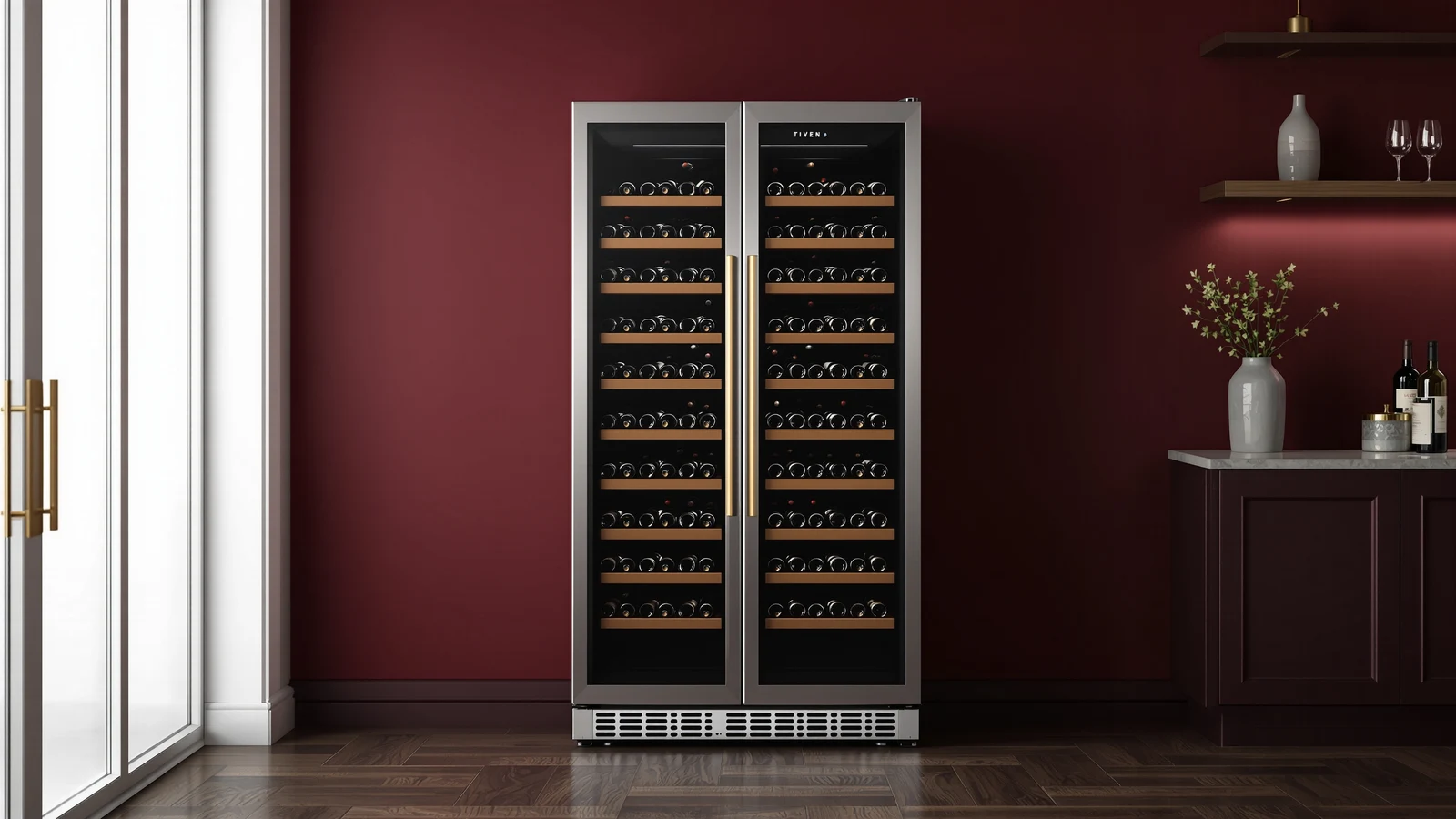
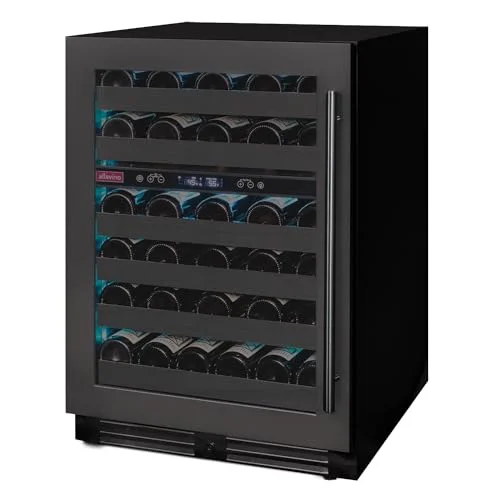
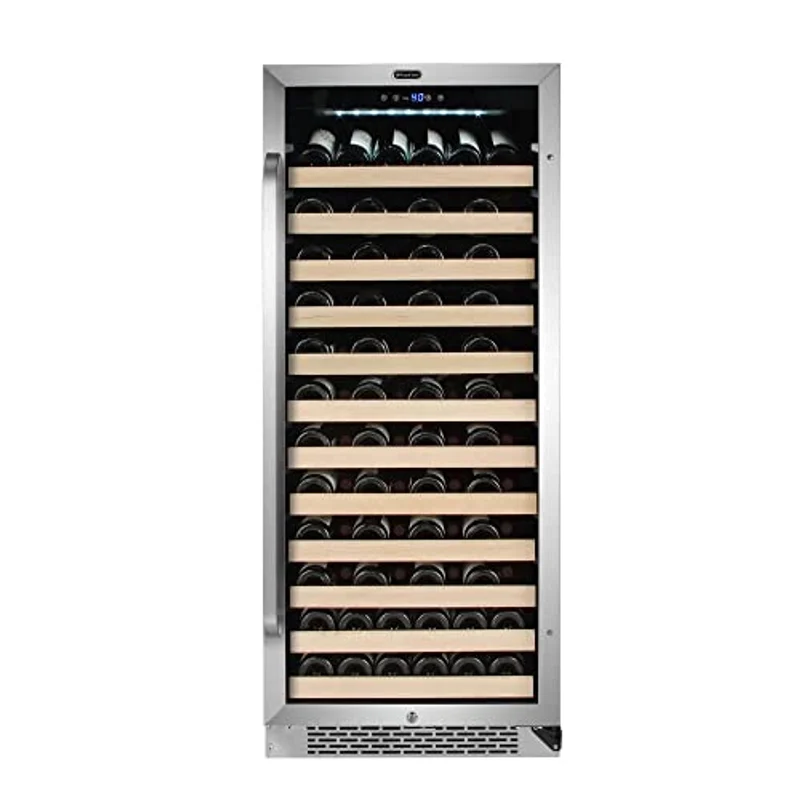
Look at the four cabinets in this guide side by side. The Whynter BWR-1002SD holds roughly 90 to 100 bottles for $709.99 — about $11 to $12 per bottle. The Allavino 50-bottle dual zone costs $1,254.20, or about $25 per bottle. The EdgeStar 36-bottle built-in costs $1,299.00, or roughly $36 per bottle. By pure dollars-per-bottle the Whynter wins by a wide margin — and yet all three are legitimately premium cabinets, because capacity was never the only thing being purchased.
What the Allavino and the EdgeStar are charging for instead is largely the built-in-capable construction discussed below, plus dual-zone control, plus the glass and finish upgrades above. The Whynter is a large single-zone storage cabinet with less of that overhead, so its price is dominated by raw cubic feet and shelving rather than installation-grade engineering. Neither approach is wrong; they solve different problems, and comparing only "price divided by bottles" across this bracket will consistently misread what is actually being bought — the full math, across every price tier, is in our cost-per-bottle breakdown.
The honest reframe: above $800, ask what the cabinet is for before asking how many bottles it holds. A cellar room wants raw capacity and one accurate temperature. A kitchen island wants built-in-rated construction and a matching finish. A household that drinks reds, whites, and beer wants a hybrid. Decide which of those you are, then let capacity be the second filter, not the first.
Built-in premium units vs large freestanding columns
At this price tier the installation question carries more weight than it does lower down the market, because premium cabinets are often bought specifically to finish a kitchen renovation or a custom bar — and getting the installation type wrong is an expensive mistake to discover after the cabinetry is built.
A true built-in unit vents through the front, usually behind or below the control panel, so the heat its compressor rejects can escape even when the cabinet is boxed in on three sides. The EdgeStar 24-inch, the Allavino 50-bottle, the Whynter BWR-1002SD, and the BODEGA wine-and-beverage unit are all rated for built-in or freestanding installation — the specification to check first if the unit is going into a cabinet run rather than standing alone.
A large freestanding column, by contrast, rejects heat from the back and sides and needs clear air space to breathe. Enclose one and the compressor runs continuously trying to reach a setpoint it can never hit, shortening its life dramatically — the single most common expensive mistake in this category. The upside of a genuine freestanding column is that it is often a few hundred dollars cheaper for the same capacity, since the manufacturer did not need to engineer front-venting, and it can be relocated later. If a cabinet here is going under a counter or between two base cabinets, confirm the built-in rating from the listing before ordering — and if a box has already arrived, our delivery and unboxing checklist covers what to verify in the first ten minutes, before the return window closes.
Premium freestanding columns also tend to be taller rather than wider, which raises temperature stratification: cold air sinks, so a tall single-zone cabinet without fan-forced circulation runs several degrees warmer at the top than the bottom. The Whynter BWR-1002SD addresses this directly, because at its height and bottle count stratification is the main engineering problem — more so than reaching a low enough number in the first place.
The wine-and-beverage hybrid at the top of the range
One category at this price tier deserves its own explanation, because it looks like a wine fridge with extra capacity and is really a different appliance with wine as half its job.
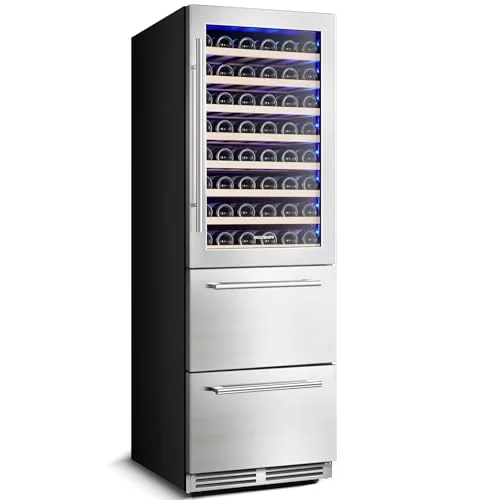
The BODEGA 24-inch 2-in-1 is the clearest example: one compressor-cooled cabinet split into a wine side holding 88 bottles and a beverage side holding roughly 149 cans, each independently controlled. That is a genuinely different proposition from a dual-zone wine fridge with a warm zone and a cold zone — one side here is racked for bottles, the other shelved for cans at drinking temperature, and the two halves solve unrelated storage problems rather than two versions of the same one.
Who this is actually for: a household where wine, beer, and soda are all competing for space in the kitchen refrigerator, and where consolidating that congestion into one premium appliance is worth paying for. It is not for a household trying to solve the reds-and-whites temperature question — a dual-zone wine-only cabinet like the Allavino does that job, and a hybrid does not, because its "second zone" is cans, not whites. Buy the BODEGA expecting a beer-and-soda solution with a genuinely large wine side attached, and it earns its price; expect a wine cellar with a bonus feature, and the can side is dead space you paid for. Naming on these units varies by brand — "wine and beverage center," "dual-zone cooler," "2-in-1 refrigerator" — and our guide to what those names actually mean is worth reading before assuming two similarly named listings are the same appliance.
Worth noticing: 88 bottles is still a substantial wine-only capacity for a 24-inch cabinet, which is why the BODEGA costs more than a wine-only unit of similar size — you are getting most of a full wine cabinet plus a second, independently cooled compartment, in the same footprint. For the right household, that premium is a reasonable one.
The picks
Four cabinets, four different reasons to cross $800. None of them compete directly with each other — each is the right answer to a different version of the premium question.
When a $400 cabinet does the same job for a fraction of the price
Not everyone who can afford a premium cabinet should buy one, and it is worth saying so plainly before closing this guide. The upgrades above — compressor duty cycle, insulation, glass, finish — are real, but they solve specific problems. If none apply to your situation, you are paying for engineering you will never notice.
- You're not building it into cabinetry. If the fridge stands freestanding in a corner, basement, or garage, the built-in-rated venting that accounts for a meaningful share of the premium price buys you nothing. A freestanding compressor cabinet in the $300–$500 range does the core cooling job identically well.
- Your collection is under fifty bottles and mostly one color. A single zone at 55°F stores red and white correctly at any price point — storage temperature does not differ by color, only serving temperature does. The 20-to-45-bottle class covers this size well without the installation-grade premium.
- You don't need the finish to match surrounding cabinetry. Fingerprint-resistant steel and a long-lived lock mechanism matter in a kitchen island on display. They matter much less in a closet or garage, where a basic finish does the same cooling job unnoticed.
- You don't need two zones or two functions. If you drink mostly one color and have no beer-and-soda overflow problem, the dual-zone and hybrid premiums in this guide are solving problems you don't have.
The flip side holds too: if a fridge is going under a counter between two base cabinets, built-in-rated construction is not optional — a freestanding unit forced into that space will overheat and fail early regardless of how good a deal it looked like. The ETL/UL certification guide is worth reading before any built-in installation, since certification and built-in rating are different claims often conflated in listings. And whichever bracket you land in, a compressor cabinet eventually needs a gasket, fan, or compressor serviced — our repair-or-replace guide covers telling a $15 fix from one not worth making on an older unit.
How we compared these — and what we cannot tell you
We compared published manufacturer specifications, current listed prices, and the installation ratings each brand publishes, then weighed what each cabinet's price was actually paying for rather than just its bottle count. Where a specification was not published — hinge reversibility, exact insulation thickness, glass layer count beyond what the listing states — we said so rather than filling the gap with a guess.
We do not run a testing lab. We do not own these units and we do not physically test them, so there is no invented score out of ten on this page, and no star ratings or review counts either — the retailer API does not return that data for this category, and we do not publish numbers we cannot source. What we can do honestly is read the specifications carefully, track the prices, and explain what each dollar above $800 is mechanically buying.
Prices quoted here were correct at the time of writing and change frequently. Confirm the current price before buying.
Frequently asked questions
Is a $1,300 wine fridge actually better than a $400 one, or just bigger?
Usually neither "better" nor "bigger" — often similar in bottle count, different in what the cabinet is built to do. The extra money typically buys stronger insulation and sealing, thicker or multi-pane glass, built-in-rated venting, and a finish meant to last in a kitchen on display. If none of that applies, the $400 cabinet stores wine just as correctly.
Do I need a built-in-rated cabinet if I'm not installing it in cabinetry yet?
No, but it is worth buying one anyway if there is a real chance the appliance moves into a cabinet run later, since a freestanding unit cannot be safely retrofitted into an enclosed space — it will overheat and fail early. If it stays permanently freestanding in an open room, the built-in rating is a feature you are paying for and not using.
Does a wine-and-beverage hybrid replace a dual-zone wine fridge?
No. A wine-and-beverage cabinet like the BODEGA splits its compartments between bottles and cans for different purposes, not between two wine temperatures. If the goal is serving reds and whites at their own temperatures, a dual-zone wine-only cabinet like the Allavino is the correct category; the hybrid solves wine and drinks competing for the same fridge space instead.
Why does the cheapest cabinet in this guide hold the most bottles?
Because capacity and price aren't buying the same thing at this tier. The Whynter puts most of its cost into raw cubic feet, shelving, and fan-forced circulation for a large single zone. The EdgeStar and Allavino put more cost into built-in-rated venting, dual-zone control, and finish, which raises the price per bottle without making the cabinet worse — it solves a different problem than maximum capacity.
Written by Ilane Tall. Research-based comparisons of published specifications and current prices — we do not physically test these units and we do not publish invented scores.