By Ilane Tall · Updated November 7, 2026 · Research-based.
Reader-supported: we may earn a commission when you buy through the links on this page, at no additional cost to you. It never changes which product we recommend. Prices quoted below were correct at the time of writing and move often.
The short version
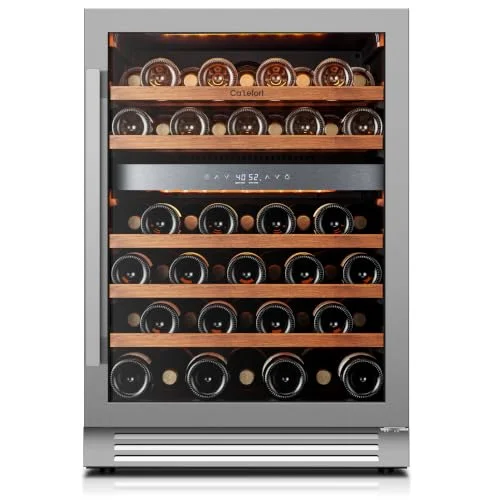
$600 to $800 is the band where a dual-zone claim starts being worth trusting and tempered glass stops being an afterthought — but it is also where wine-only cabinets and wine-and-beverage hybrids split hard on what they give you for the same dollar. The Ca’Lefort 24 Inch, 51-Bottle Built-In at $683.98 is the pick if bottle count is the whole point: a genuinely large wine-only cabinet for the money.
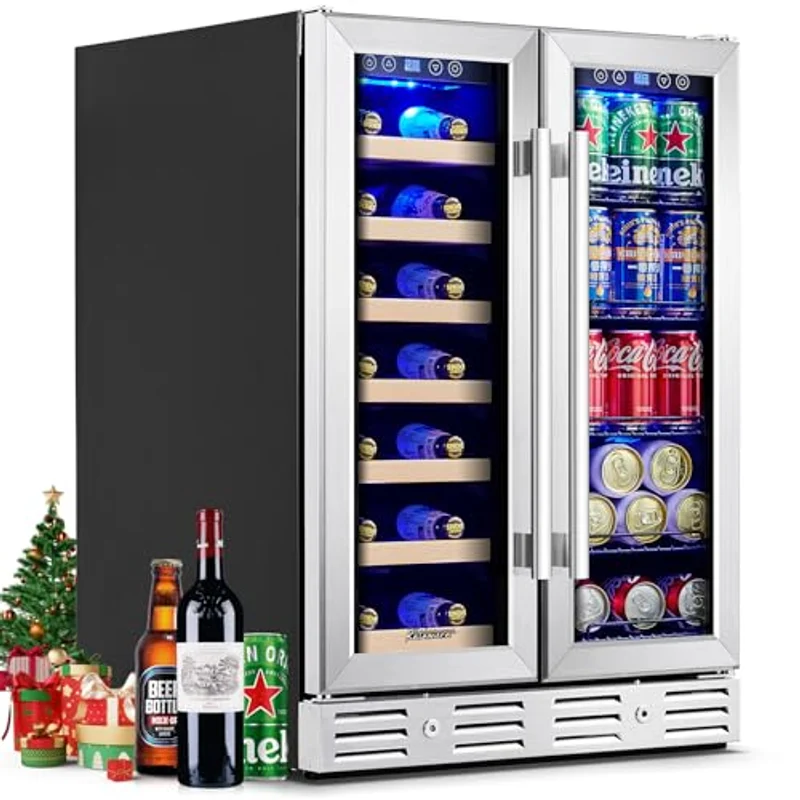
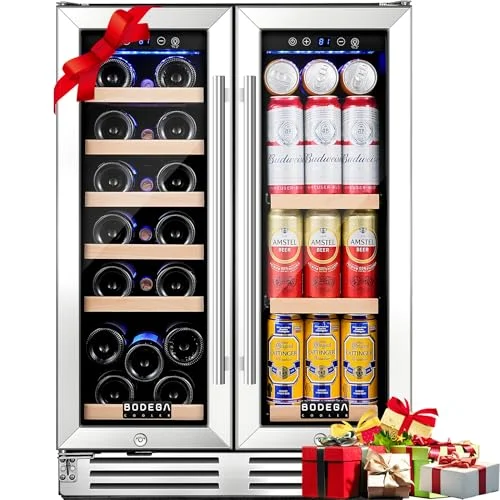
If cans are competing with bottles for space in your kitchen, the Kalamera 24″ Wine & Beverage ($699.99, 21 bottles + 75 cans) and the BODEGA 24″ ($626.99, 19 bottles + 57 cans) are the honest trade: fewer bottles, more total storage, one cabinet instead of two appliances.
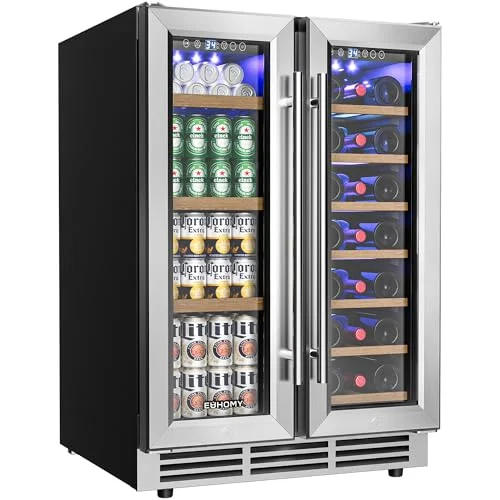
The EUHOMY 24″ Dual Zone at $577.99 sits right at the floor of this band and is worth a look only if you are comparison shopping and willing to confirm its unpublished capacity directly with the listing before buying. See when it's worth paying more than $800 instead, and when it plainly is not.
Why this band exists, and it is not just a marketing gap
It would be easy to assume that $600 to $800 is simply the space between two round numbers retailers use to slice up a category — a gap invented for ad targeting, not an engineering line. For wine fridges, that is mostly not true. Something real changes as price crosses roughly $600, and something real stops changing again once it crosses roughly $800.
Below $600, dual zone is common in name but inconsistent in substance. A cabinet can carry two displays and a physical divider while the compressor and refrigerant circuit underneath are still sized for a single zone, which means the warmer half can only drift a handful of degrees from the colder half no matter what the headline range promises. Glass is frequently a single pane with a basic tint. None of that makes a budget cabinet dishonest — it makes it a budget cabinet, built to a price, covered in our guide to the 20-to-45-bottle tier where most of that price pressure lives.
Above $800, the picture inverts. Our analysis of the premium tier over $800 found that price stops tracking bottle count the way it does lower down the market: a $1,200 cabinet and a $626.99 one can hold a broadly similar number of bottles, with the extra few hundred dollars going into compressor duty cycle, thicker insulation, multi-pane glass and a finish built to live in a kitchen on display rather than a basement. That is real money spent on real things — but it is not spent making the core cooling job more correct than a good $700 cabinet already does it.
$600 to $800 is the narrow band in between where those two curves cross: dual zone has enough budget behind it to be genuinely two zones rather than one zone with a divider for show, glass construction steps up from single pane to tempered or double pane, and the compressor is sized with enough margin to hold a real spread between its zones instead of straining to manage a few degrees. You are paying for the engineering to actually work as advertised, not yet paying extra for scale or showroom finish on top of it.
What $600 to $800 reliably buys
Four specific things separate this band from the one below it, and understanding them is the difference between paying for a real upgrade and paying extra for the same cabinet with a bigger price tag.
01
Real dual-zone precision
A physical divider backed by a compressor and refrigerant circuit actually sized to hold a wide spread between the two halves, not a display gimmick riding on a single-zone system.
02
Tempered, UV-resistant glass
Double- and triple-paned doors become the norm here rather than the exception, which matters for insulation as much as for blocking the light that degrades wine over time.
03
A proper compressor
Sized with enough headroom to hold its setpoint in a warm kitchen without running continuously — the quiet difference between a compressor that lasts years and one that burns out early.
04
Finish that holds up
Commercial-grade door hardware, a lock on some models, and a cabinet front built to sit in a kitchen or home bar rather than get hidden in a closet.
None of this is a guarantee that every number on every box is accurate — spec sheets in this category still disagree with themselves occasionally, as the picks below demonstrate. It is also worth being honest about what a "dual zone" number actually means before trusting it: our breakdown of why the thermostat display doesn't match the actual temperature explains the gap between a cabinet's quoted setpoint and what a thermometer on the middle shelf will actually read, which matters more on a dual-zone unit than a single-zone one because that gap exists twice.
Capacity at this price: 19 to 52 bottles, not a fixed number
Spend $626.99 to $683.98 on a wine fridge and you will not land on a consistent bottle count — you will land somewhere between 19 and 52 bottles, depending almost entirely on format rather than price. That spread is wider than the $120 price difference between the cheapest and most expensive cabinet in this guide would suggest, and the reason is simple: capacity in this band is a function of what fraction of the cabinet is racked for wine at all.
A wine-only cabinet in this price range puts its entire interior toward bottle storage, which is how the Ca’Lefort reaches 51 to 52 bottles (the brand's own listing states both figures in different places — more on that below) in a standard 24-inch footprint. A wine-and-beverage hybrid at the same width and the same price gives up roughly half its interior to a can-shelving section running at a colder, drinking temperature, which is why the Kalamera and the BODEGA land at 21 and 19 bottles respectively despite costing within $60 of the Ca’Lefort. The bottles did not get more expensive to store. Half the cabinet got reassigned to a different job.
Whatever number is on the box, discount it. Every advertised bottle count in this category, on every brand, is calculated using slim Bordeaux-style bottles racked perfectly nose to tail. Wider Burgundy and Pinot bottles, and heavier Champagne bottles with a punted base, eat more rack space than the marketing figure assumes. A reasonable planning number across all four cabinets here is 70–80% of the stated capacity — call the Ca’Lefort's 52 a realistic 37 to 42 once a mixed collection replaces a shelf of identical slim reds. The full math behind that discount, and how it plays out across every price tier rather than just this one, is in our cost-per-bottle breakdown.
Wine-only vs wine-and-beverage hybrids at the same price point
This is the decision that actually separates the four cabinets in this guide, far more than their prices do. Three of the four — BODEGA, Kalamera, and likely EUHOMY — are wine-and-beverage hybrids. One, the Ca’Lefort, is wine-only. At $699.99 to $683.98, you are choosing between two fundamentally different appliances that happen to occupy the same shelf in the same price range.
Wine-only (Ca’Lefort)
Every shelf is racked for bottles, split into two wine temperature zones. Buy this if wine is the only thing competing for space in the cabinet and you want the largest bottle count this budget can buy.
Wine & beverage hybrid (BODEGA, Kalamera)
One side racked for bottles at cellar temperature, the other shelved for cans running colder, near drinking temperature. Buy this if beer and soda are also fighting your kitchen fridge for room.
The naming on these listings does not make the distinction obvious. "Wine and beverage refrigerator," "dual zone wine cooler," and "bar fridge" all show up across brands describing functionally similar splits, and a shopper skimming titles can easily assume two listings are the same category when they are not. Our guide to what these names actually mean is worth reading before assuming the word "cooler" or "cellar" on a box tells you anything about what is inside it. The specification that actually matters — bottles versus cans, and the ratio between them — is buried in the bullet points, not the title.
The decision reduces to one honest question: is the cabinet solving a wine-storage problem, or a kitchen-congestion problem where wine, beer and soda are all competing for the same shelf? If it is purely wine, the Ca’Lefort's 51 to 52 bottles beats either hybrid by more than double. If cans genuinely need a home too, the BODEGA and Kalamera solve that in one footprint instead of two separate appliances — at the direct cost of bottle capacity you would otherwise have.
The picks
Four cabinets across the $600-to-$800 range, chosen to cover the real fork this band forces: wine-only capacity against wine-and-beverage flexibility, and how much a listing is actually willing to state in writing. If a box arrives with a cracked shelf or a scuffed door, our delivery and unboxing checklist covers what to verify in the first ten minutes, while the return window is still open.
When it's worth stretching to the over-$800 tier instead, and when it is not
Having spent this much of the guide explaining what $600 to $800 buys, it is worth being just as direct about when that budget is not the right place to stop.
Stretch past $800 if: you need the cabinet rated for true built-in installation in a finished kitchen run and none of the four here state that rating clearly enough to trust; your collection is approaching or past 80 bottles and a hybrid's smaller wine side will not hold it; or the cabinet is going somewhere on display and a premium finish — fingerprint-resistant steel, a lock that still turns smoothly in five years, LED lighting that will not yellow — genuinely matters to you. Our guide to the premium tier over $800 breaks down exactly which of those four things each extra dollar is buying, cabinet by cabinet.
Stay in this band if: 19 to 52 bottles already covers your actual collection or your actual can-and-bottle mix; the cabinet is not going into finished cabinetry where a built-in-rated front vent is non-negotiable; and you do not need a finish built to be stared at for a decade. For most households shopping a wine-and-beverage hybrid specifically, the jump past $800 tends to buy a wider cabinet with more total storage rather than a fundamentally different appliance — worth it if you genuinely need the scale, and a premium you are paying for nothing if you do not.
One practical note outranks both of those: a compressor cabinet, at any price, eventually needs a gasket, fan or compressor serviced. Before putting the extra few hundred dollars toward a bigger cabinet, it is worth reading our repair-or-replace decision guide — the honest math on when a failing unit in this price range is worth fixing versus when the repair cost argues for simply buying the next size up.
How we compared these — and what we can't tell you
We compared published manufacturer specifications and current listed prices for the four cabinets above, chosen from our product database for sitting at or near the $600-to-$800 price point and covering both the wine-only and wine-and-beverage formats that dominate this band. Where a listing stated a spec in more than one place — the Ca’Lefort's 51-versus-52-bottle discrepancy between its title and its size-variant field is the clearest example — we reported both figures rather than picking the one that looked tidier. Where a listing did not state a spec at all, as with EUHOMY's capacity and installation rating, we said so directly instead of estimating.
We do not run a testing lab. We do not own these units and we do not physically test them, so there is no invented score out of ten anywhere on this page, and no star rating or review count either — the retailer API does not supply either figure for this category, and we do not publish numbers we cannot source. What we can do honestly is read the specifications carefully, track the prices, and explain what this specific price band is actually buying versus the tiers above and below it.
Prices quoted here were correct at the time of writing and change frequently. Confirm the current price before buying.
Frequently asked questions
What does $600 to $800 actually buy that a $400 cabinet does not?
Mainly three things: dual-zone control backed by a compressor actually sized to hold a wide spread between the zones rather than a divider riding on single-zone cooling, tempered or multi-pane glass instead of a single thin pane, and finish details — commercial-grade door hardware, sometimes a lock — built to last in a kitchen rather than a closet. None of it makes the wine inside colder or safer than a well-built budget cabinet would; it makes the dual-zone claim and the glass more likely to be real rather than marketing.
Should I buy a wine-only cabinet or a wine-and-beverage hybrid in this price range?
It depends on what is actually competing for space in your kitchen. If the only problem is storing wine, a wine-only cabinet like the Ca’Lefort holds more than double the bottles of a hybrid at a similar price, because none of its interior is given up to cans. If beer and soda also need a cold home and you would rather not buy two appliances, a hybrid like the Kalamera or BODEGA solves both problems in one footprint — at the direct cost of fewer bottles.
Is it worth spending more than $800 instead of staying in this band?
Only for specific reasons: a true built-in installation rating none of these four state clearly, a collection approaching 80-plus bottles that a hybrid's wine side cannot hold, or a finish meant to be on display for years. If 19 to 52 bottles already covers your needs and the cabinet is not going into finished cabinetry, the extra money above $800 is mostly buying scale and showroom polish, not better core engineering.
Why do these four cabinets have such different bottle counts at almost the same price?
Because price in this band tracks engineering — real dual zone, tempered glass, compressor sizing — much more than it tracks bottle count on its own. A wine-only cabinet puts its whole interior toward bottles; a hybrid gives up roughly half of it to a can-shelving section running at a separate, colder temperature. The bottles are not more expensive at $683.98 than at $577.99 — the cabinets are simply doing different jobs with the same budget.
Written by Ilane Tall. Research-based comparisons of published specifications, current prices and public product data — we do not physically test these units and we do not publish invented scores.